

AI Content Freshness Factor: How Recency Impacts AI Model Citations
Understand how AI models prioritize content freshness. Learn citation patterns from ChatGPT, Perplexity, and Google AI Overviews, industry variations, and strat...
10 min read
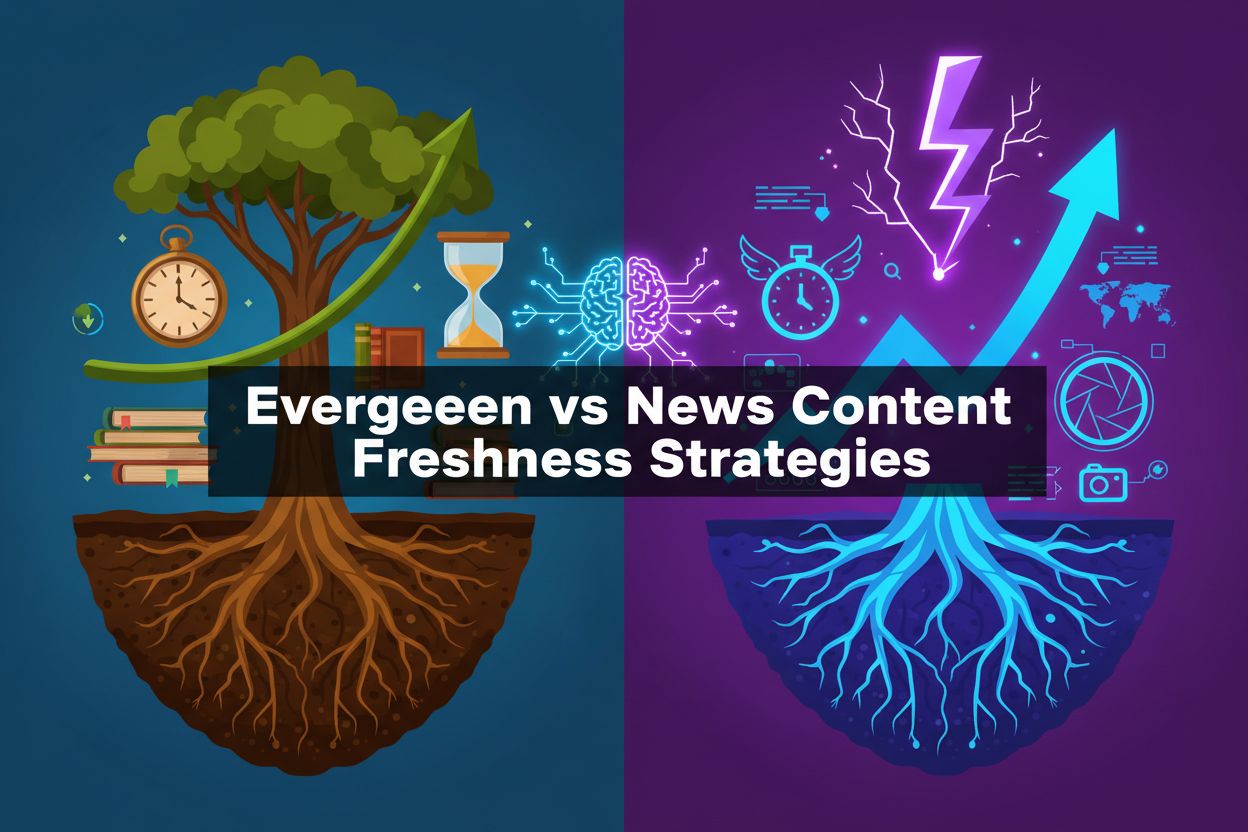
Learn how to balance evergreen and news content for maximum AI visibility. Discover freshness strategies that work with ChatGPT, Gemini, and Perplexity.
Content freshness has taken on new meaning in the age of artificial intelligence. Traditionally, content freshness referred to how recently a page was published or updated, with search engines using this signal primarily for news and trending topics. However, AI visibility operates under fundamentally different rules. Large language models (LLMs) and AI search systems evaluate freshness not just as a publication date, but as a measure of accuracy, relevance, and reliability. The shift in how AI prioritizes content represents a departure from traditional SEO thinking—where evergreen content could rank indefinitely with minimal updates, AI systems now demand continuous validation and refinement. This distinction matters because AI-generated responses are 25.7% fresher than organic Google results, meaning AI systems actively seek out and prefer recently updated information. Understanding this paradigm shift is crucial for content strategists who want their work cited by AI systems and discovered by users relying on AI-powered search and research tools.

Evergreen content represents the backbone of any sustainable content strategy—material that remains relevant and valuable regardless of current trends or seasonal fluctuations. This content type delivers compound returns over time, with traffic accumulating steadily as search engines recognize its authority and users continue discovering it through organic search. The SEO power of evergreen content is undeniable; foundational guides, how-to articles, and educational resources continue ranking for months or years, providing consistent resource efficiency by requiring minimal ongoing investment after publication. However, the AI era has complicated this picture. While evergreen content still holds significant value, it now requires more active maintenance than traditional SEO practitioners expected. Here’s how evergreen content characteristics have shifted:
| Characteristic | Traditional Search Value | AI Search Value |
|---|---|---|
| Traffic Pattern | Steady growth over time | Requires regular updates |
| Update Frequency | Can remain static | Quarterly or monthly updates needed |
| Authority vs Recency | High authority wins | Recency increasingly important |
| Lifespan | 24+ months | 12-18 months without updates |
| Maintenance Requirements | Minimal | Active maintenance required |
The challenge for content creators is balancing the slow traction of evergreen content—which takes months to gain momentum—against the maintenance needs that AI systems now impose. Organizations must commit to quarterly or semi-annual refreshes to keep evergreen content competitive in AI search results, transforming what was once a “set it and forget it” strategy into an ongoing investment.
Trend-based content operates on an entirely different timeline, capitalizing on current events, emerging technologies, and cultural moments to drive rapid audience growth. When executed well, this content type can generate exponential traffic spikes within days or weeks, far outpacing the gradual accumulation of evergreen material. AI systems show particular affinity for trend-responsive content because it signals that a creator is actively monitoring their field and providing timely insights—a quality that builds authority and trustworthiness. The algorithm advantages are substantial; platforms and search systems prioritize fresh, relevant content that addresses what users are currently searching for and discussing. Beyond immediate traffic, trend-based content expands audience reach by tapping into broader conversations and attracting users who might never discover your evergreen material. However, this approach comes with significant challenges: short lifespan means content becomes outdated quickly, timing pressure requires rapid research and publication cycles, and oversaturation means competing against dozens of creators publishing similar takes on the same trend. Success requires not just speed, but unique perspective and genuine insight that distinguishes your content from the noise.
Here lies the central tension in modern content strategy: AI systems evaluate both evergreen and news content, but through different lenses. Traditional search engines relied on Query Deserves Freshness (QDF) logic—a mechanism that recognized certain queries (like “best smartphones 2024”) inherently require recent information, while others (like “how to tie a tie”) don’t. AI systems have expanded this concept dramatically. Rather than applying QDF selectively, LLMs treat content age as a continuous quality signal that applies across nearly all topics. This means that even foundational, evergreen content loses credibility if it hasn’t been touched in months. The data supports this shift: AI-generated content is 25.7% fresher than organic Google results, indicating that AI systems actively seek and prioritize recently updated material. This creates a paradox where content must be simultaneously evergreen (timeless in its core value) and fresh (regularly updated to maintain AI visibility). Understanding this paradox is essential because it invalidates the old strategy of choosing between evergreen and news content—you must master both. Tools like AmICited.com help content creators monitor how AI systems are actually citing their work, revealing which content types and freshness levels generate the most AI visibility.
Not all content requires the same update frequency. The optimal freshness strategy depends on your industry’s velocity—how quickly information changes and how much AI systems expect updates. Rather than applying a one-size-fits-all approach, successful content strategists segment their topics by velocity category:
High-Velocity (Weekly/Monthly): FinTech, SaaS, News, AI Tech - market data, software versions, breaking news. Example: “Best AI Writing Tools 2024” requires monthly updates as new tools launch and features change. A SaaS pricing guide needs weekly attention as competitors adjust rates.
Medium-Velocity (Quarterly/Bi-annually): Health, Wellness, Digital Marketing - treatment protocols, best practices. Example: “SEO Best Practices” should refresh quarterly as algorithm updates occur. “Meditation Techniques for Anxiety” might update semi-annually as new research emerges.
Low-Velocity (Annually): Legal, History, Evergreen Education - core laws, historical facts. Example: “The History of the Internet” requires annual updates only for new developments. “Copyright Law Basics” updates when legislation changes, perhaps annually or less frequently.
This segmentation prevents wasted effort on unnecessary updates while ensuring content remains competitive in AI search results. The key is matching update frequency to how quickly your topic’s underlying information actually changes, not to arbitrary publishing schedules.
Editorial elasticity is the concept that content should stretch with time while holding its core truth intact. Rather than treating published content as static, elastic content is designed from inception to accommodate updates, new examples, and evolved thinking without requiring a complete rewrite. Building editorial elasticity requires three strategic approaches: modular design breaks content into discrete sections that can be updated independently (a “best tools” list where individual tools can be swapped without rewriting the entire article), strategic refresh cycles plan updates at predictable intervals rather than reactively, and future-proofing through inquiry frames content around questions that remain relevant even as answers evolve.
Practical examples demonstrate this principle. Instead of writing “The top 5 AI writing tools are ChatGPT, Claude, Jasper, Copy.ai, and Writesonic,” elastic content frames it as “The leading AI writing tools for 2024 include ChatGPT for general-purpose writing, Claude for nuanced analysis, and specialized tools like Jasper for marketing copy.” The second version allows you to add new tools, remove outdated ones, and adjust rankings without restructuring the entire section. Similarly, rather than “Machine learning requires 6-12 months to implement,” elastic phrasing becomes “Implementation timelines vary from 3-18 months depending on data maturity and team expertise,” accommodating different scenarios without requiring rewrites. This approach maximizes content lifespan while minimizing maintenance burden.
Choosing between evergreen and news content is a false dichotomy. The most effective content strategies operate as an ecosystem where both types work synergistically. A practical framework is the 70/30 rule: allocate approximately 70% of your content resources to evergreen material that builds long-term authority and traffic, while dedicating 30% to trend-responsive content that captures immediate attention and drives rapid growth. This balance prevents the trap of chasing every trend (which exhausts resources and dilutes authority) while avoiding the stagnation of publishing only timeless material (which misses growth opportunities and AI visibility signals).
The ecosystem model also enables trend-to-evergreen conversion. A timely article about “ChatGPT’s new features” can be transformed into evergreen content like “How to Use ChatGPT Effectively” by removing time-specific references and focusing on principles that remain relevant. This approach maximizes ROI by allowing trend content to seed evergreen material. Platform-specific approaches further optimize this balance: YouTube benefits from a 60/40 evergreen-to-trend split since video discovery favors established authority, TikTok reverses this to 30/70 since the platform thrives on trending content, blogs work well with 75/25 splits for SEO stability, and Twitter operates almost entirely on trend-responsive content with occasional evergreen threads. Tools like AmICited.com help track which content types and freshness levels generate the most AI citations, allowing you to refine your ecosystem based on actual AI visibility data rather than assumptions.
AI systems don’t simply check publication dates; they parse sophisticated technical signals embedded in your content’s code and structure. The dateModified schema is fundamental—this structured data explicitly tells AI systems when content was last updated, providing a clear freshness signal. Beyond basic dates, FAQ schema helps AI systems understand conversational queries by marking questions and answers, while speakable markup indicates which content sections are optimized for voice and conversational AI. These signals matter because LLMs use them to assess content reliability and recency.
Here’s how proper schema implementation looks:
{
  "@context": "https://schema.org",
  "@type": "Article",
  "headline": "Best AI Writing Tools 2024",
  "datePublished": "2024-01-15",
  "dateModified": "2024-11-20",
  "author": {
    "@type": "Person",
    "name": "Your Name"
  },
  "articleBody": "..."
}
The dateModified field explicitly signals to AI systems that this content was recently reviewed and updated. Beyond schema, LLMs parse freshness signals from internal linking patterns (links to recent content suggest active maintenance), citation patterns (recent citations indicate ongoing relevance), and content structure (updated examples and statistics signal freshness). Auditing your freshness signals requires tools that analyze schema implementation, check for outdated statistics, and verify that dateModified tags accurately reflect your update cycles. Regular audits ensure AI systems receive accurate freshness signals rather than discovering stale content through other means.
Understanding whether your freshness strategy works requires measuring AI citations and visibility—metrics that traditional analytics tools often miss. AmICited.com provides specialized monitoring capabilities that track how frequently AI systems cite your content, which pieces generate the most AI visibility, and how freshness impacts citation rates. This data reveals patterns that standard analytics obscure: a blog post might receive modest organic traffic but generate substantial AI citations, or a news article might spike in AI visibility for weeks before declining.
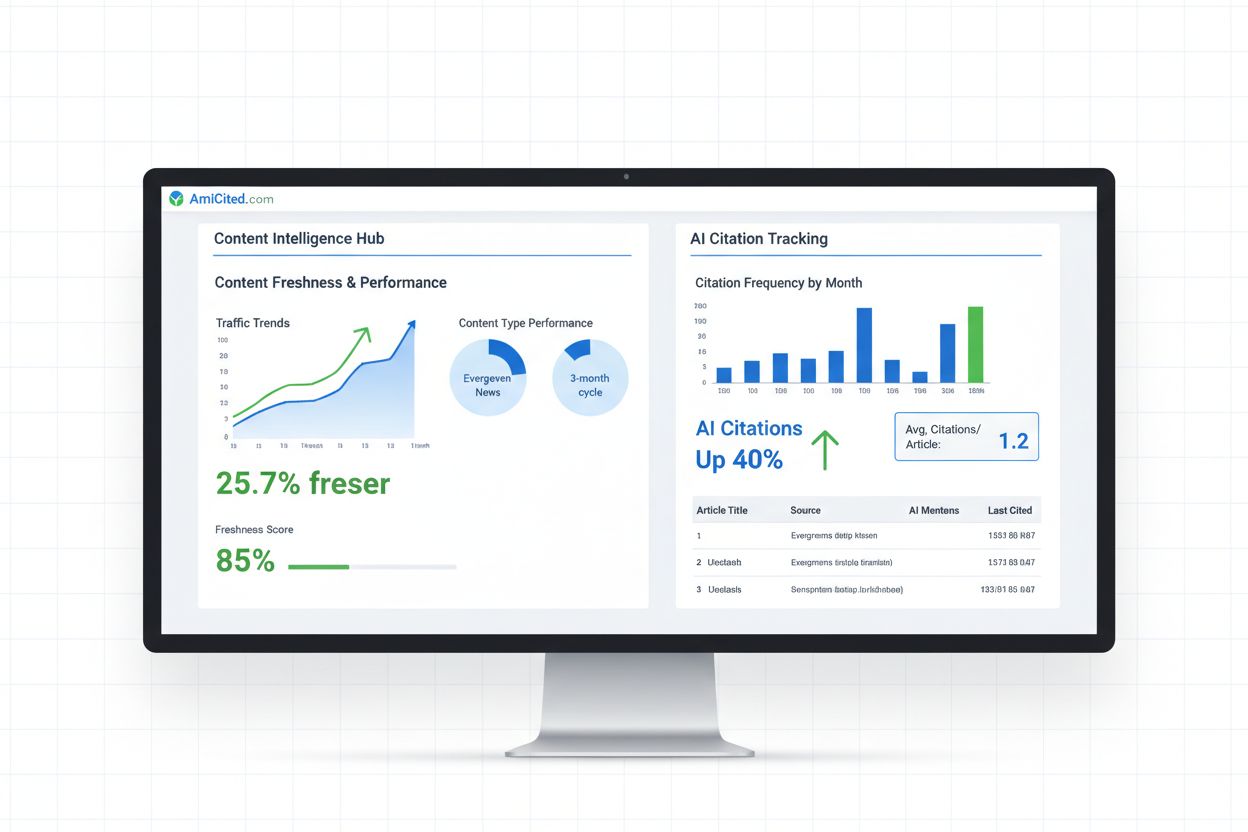
Key metrics for measuring freshness impact include citation frequency (how often AI systems reference your content), traffic patterns (distinguishing between organic search traffic and AI-driven discovery), and ranking changes (monitoring how freshness updates affect your position in AI search results). Actionable measurement strategies involve establishing baseline metrics before implementing freshness changes, then tracking how updates affect citation rates and AI visibility over 30-90 day periods. Compare citation frequency for content updated monthly versus quarterly to identify optimal refresh cycles for your niche. Monitor which content types (evergreen guides vs. trend pieces) generate more AI citations in your industry. Track how quickly new content gets cited compared to older material, revealing AI systems’ recency preferences. The importance of monitoring AI citations cannot be overstated: this data directly informs whether your content strategy aligns with how AI systems actually evaluate and recommend content, rather than relying on assumptions based on traditional SEO metrics. Organizations that systematically track AI citations gain competitive advantage by continuously optimizing their freshness strategy based on real-world AI behavior.
Content freshness refers to how recently content was published or updated. AI systems prioritize freshness more heavily than traditional search engines, with AI-generated responses being 25.7% fresher than organic Google results. This means regularly updating your content is crucial for AI visibility and citations.
Update frequency depends on your industry's velocity. High-velocity topics (FinTech, SaaS, AI) need monthly updates. Medium-velocity topics (Health, Marketing) need quarterly updates. Low-velocity topics (Legal, History) need annual updates. The key is matching update frequency to how quickly your topic's information actually changes.
Content freshness refers to how recently a specific page was updated (the 'when'). Content frequency refers to how often you publish new content overall (the 'how often'). Both matter for AI visibility, but freshness is increasingly important for individual pages.
AmICited.com provides specialized monitoring that tracks how frequently AI systems cite your content, which pieces generate the most AI visibility, and how freshness impacts citation rates. This data reveals patterns that traditional analytics tools miss, helping you optimize your content strategy.
You should focus on both. The most effective strategy uses a 70/30 approach: 70% evergreen content that builds long-term authority, and 30% trend-responsive content that drives rapid growth. This hybrid approach prevents resource exhaustion while capturing growth opportunities.
The dateModified schema is fundamental for signaling freshness. Include it in your Article schema to explicitly tell AI systems when content was last updated. FAQ schema helps with conversational queries, and speakable markup indicates content optimized for voice AI. Regular schema audits ensure AI systems receive accurate freshness signals.
AmICited.com tracks how often AI systems (ChatGPT, Gemini, Perplexity) cite your content, which content types generate the most AI visibility, and how freshness impacts citation rates. This specialized monitoring reveals patterns that standard analytics miss, allowing you to optimize your content strategy based on real AI behavior.
The 70/30 rule allocates 70% of content resources to evergreen material that builds long-term authority and traffic, while dedicating 30% to trend-responsive content that captures immediate attention. This balance prevents trend-chasing exhaustion while avoiding stagnation from only publishing timeless material.
Discover how often AI systems cite your content and optimize your freshness strategy with AmICited.com
Understand how AI models prioritize content freshness. Learn citation patterns from ChatGPT, Perplexity, and Google AI Overviews, industry variations, and strat...
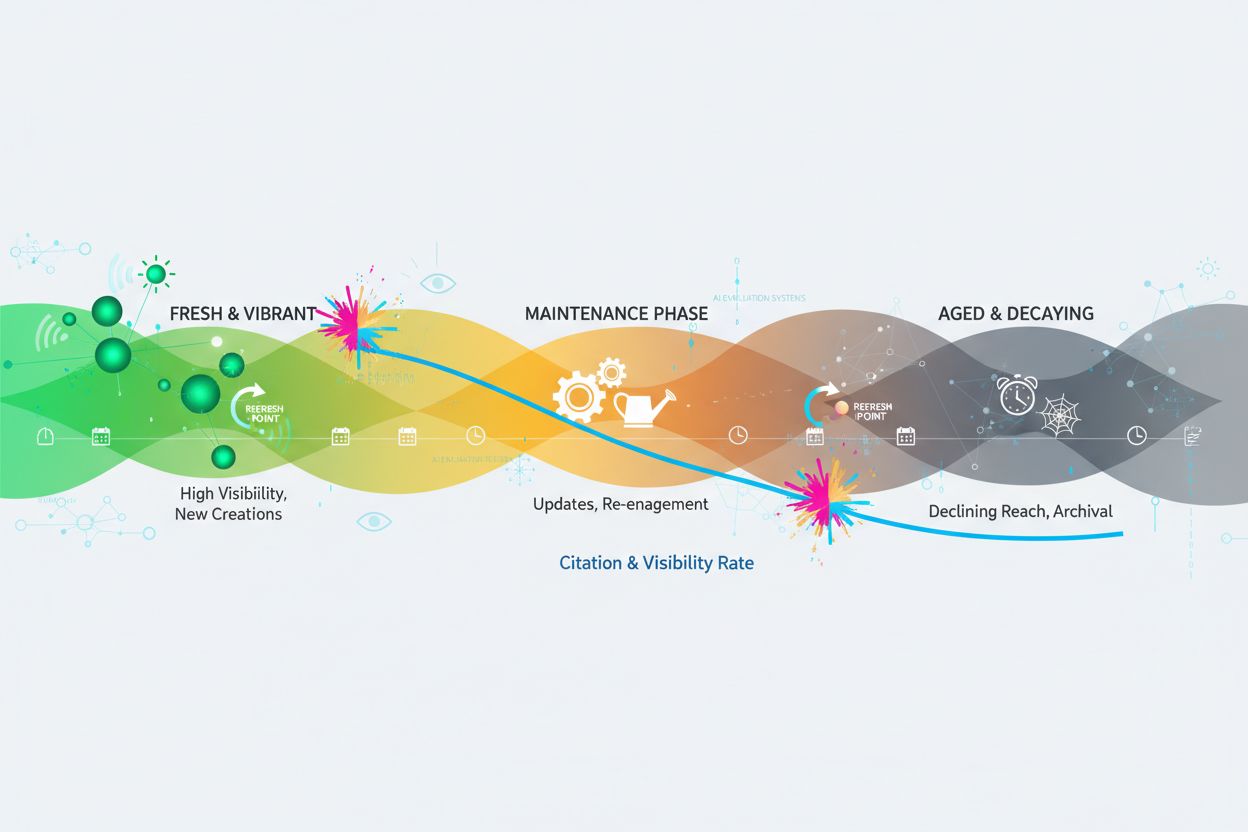
Learn how content freshness signals work in AI systems. Understand timestamps, modification dates, and technical indicators that influence AI citations and visi...
Learn how to update content for AI freshness with technical signals, structural changes, and refresh strategies that keep your brand visible in ChatGPT, Perplex...