
G2 and Capterra Reviews: Impact on AI Brand Recommendations
Discover how G2 and Capterra reviews influence AI brand visibility and LLM citations. Learn why review platforms are critical for AI software discovery and reco...
8 min read
Master G2 optimization for AI search visibility. Learn how to increase AI citations, optimize your profile, and measure ROI with data-driven strategies for ChatGPT, Perplexity, and Google AI Overviews.
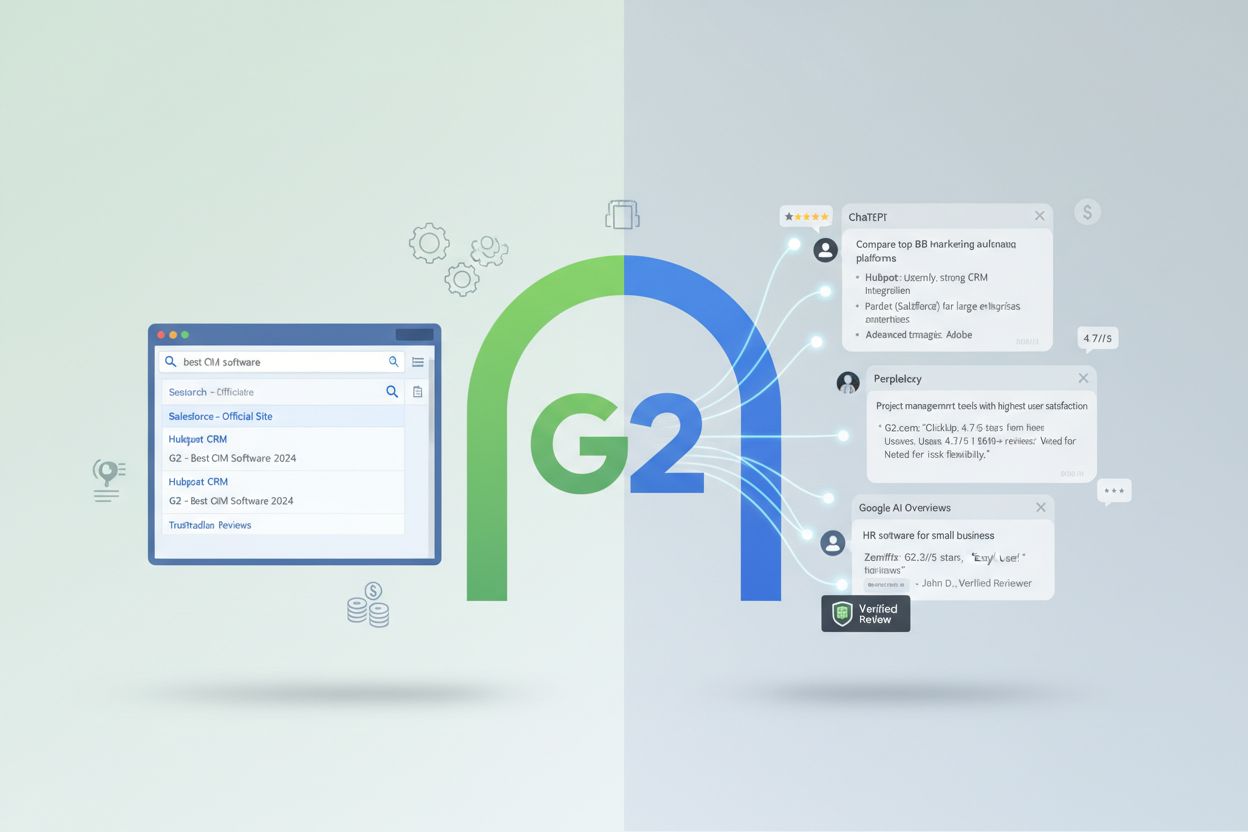
The shift from traditional search to AI-powered discovery represents one of the most significant changes in how B2B buyers research software solutions. With 50% of buyers now starting their product research journey in AI chatbots instead of Google, the competitive landscape has fundamentally transformed. G2 has emerged as the critical linchpin in this new era because AI models like ChatGPT, Perplexity, and Google AI Overviews have been trained to recognize and prioritize G2 reviews as authoritative sources. This isn’t accidental—G2’s 3+ million verified reviews and standardized data structure make it the most trusted review platform for AI systems. For software companies, this means that visibility on G2 is no longer just about influencing human buyers; it’s about ensuring your brand appears in AI-generated recommendations and comparisons. The stakes are higher than ever because 87% of B2B buyers say AI chatbots are changing how they research products, making G2 optimization essential for any company serious about capturing market share in the AI-driven sales landscape.
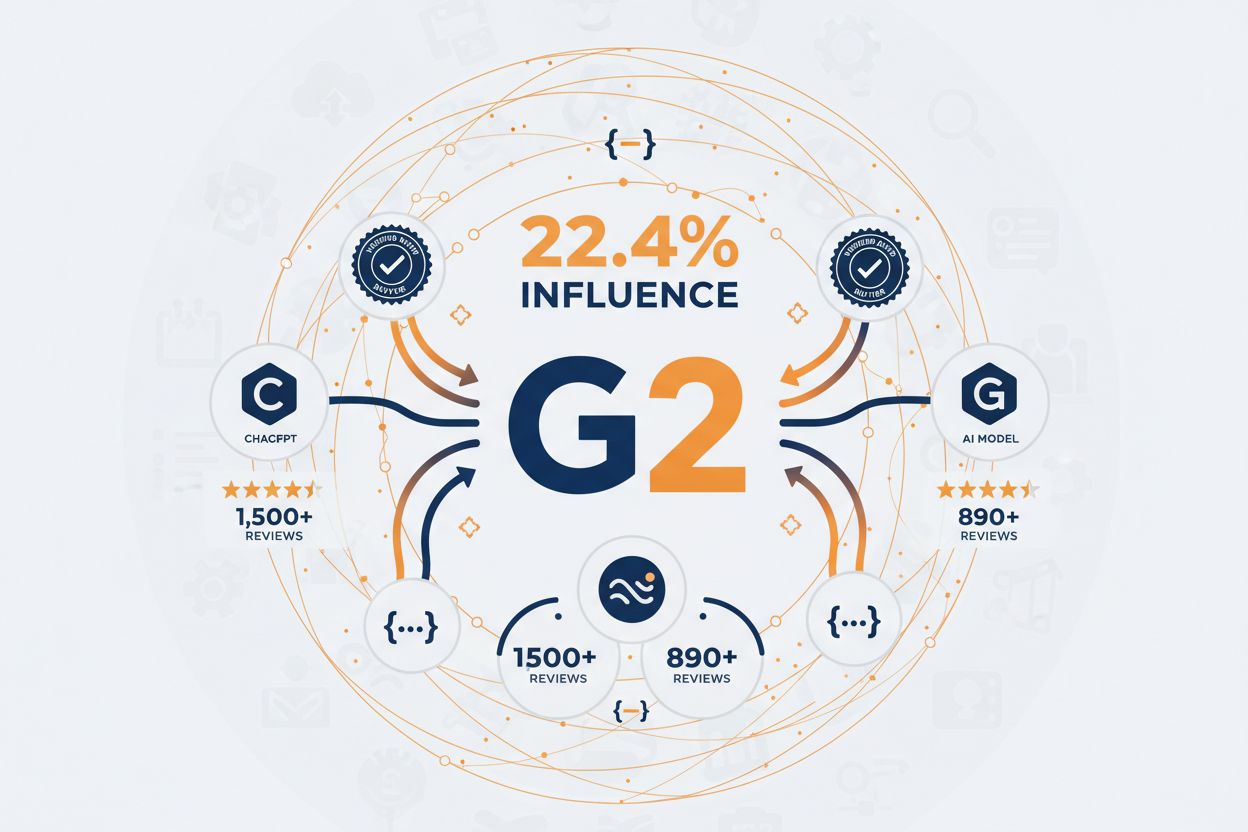
The data surrounding G2’s influence in AI search results is compelling and actionable. G2 commands 22.4% influence as the most cited software review platform in AI search results, significantly outpacing other review sites and industry publications. This dominance stems from multiple factors: AI models trust G2’s verified buyer verification system, its standardized schema that makes data easily parseable, and the velocity at which new reviews are published. Research shows that categories with 10% more reviews generate approximately 2% more AI citations, demonstrating a direct correlation between review volume and AI visibility.
| Metric | Impact |
|---|---|
| G2 Citation Influence | 22.4% (highest among review platforms) |
| B2B Buyers Using AI Chatbots | 87% report AI changing research behavior |
| Buyers Starting in AI Chatbots | 50% (vs. traditional Google search) |
| Review Volume Impact | 10% more reviews = ~2% more AI citations |
| G2 Verified Reviews | 3+ million across all categories |
Key findings from the data:
AI models have developed sophisticated mechanisms for evaluating source credibility, and G2 consistently ranks at the top of their trust hierarchy. When ChatGPT, Perplexity, or Google AI Overviews need to provide product recommendations or comparisons, they prioritize sources with verified buyer information, which G2 provides at scale. The platform’s standardized schema allows AI systems to quickly parse product features, pricing, use cases, and customer sentiment without the ambiguity that comes from unstructured reviews on other platforms. Additionally, AI models value review velocity—the consistent flow of new reviews signals that a product is actively used and generating genuine customer feedback, which AI systems interpret as a reliability indicator. G2’s integration with verified purchase data and its transparent review moderation process make it the gold standard for AI training and inference. This means that companies with strong G2 profiles aren’t just appealing to human buyers; they’re optimizing for the algorithmic preferences of the AI systems that increasingly mediate B2B purchasing decisions.
Your G2 profile is the foundation of your AI visibility strategy, and optimization requires attention to multiple components working in concert. Start with your profile description—this is prime real estate for AI models to extract information about your product’s core value proposition, target audience, and key differentiators. Your pricing information should be complete and accurate; AI models use this data to help buyers understand cost-benefit tradeoffs, and incomplete pricing data signals uncertainty to both AI systems and human buyers. The discussions section is often overlooked but critically important—active participation in product discussions generates fresh, conversational content that AI models find valuable for understanding real-world use cases and customer concerns. Badges and certifications (such as “Leader” or “High Performer” designations) serve as trust signals that AI models incorporate into their recommendations, so earning and displaying these badges should be a priority. Your product category selection matters significantly; being listed in multiple relevant categories increases the surface area for AI discovery. Additionally, ensure your feature list is comprehensive and uses language that aligns with how buyers and AI models discuss your product category. Finally, maintain visual assets (logos, screenshots, product images) that help AI systems understand your product’s interface and positioning. A fully optimized G2 profile becomes a content asset that continuously generates AI citations and visibility.
Review generation is the engine that powers G2 visibility, and a strategic approach to review collection can dramatically increase your AI citations. The fundamental principle is simple: more reviews equal more AI citations, with the research showing that a 10% increase in review volume correlates to approximately 2% more AI citations. However, quantity alone isn’t sufficient—you need a diversified review strategy that captures different customer perspectives and use cases. Multi-product reviews are particularly valuable because they provide AI models with comparative context; when a customer reviews your product alongside competitors, it gives AI systems rich data for generating comparison responses. Conversational reviews deserve special attention because they generate 3-10x more content for AI models compared to traditional star-and-comment reviews. These longer, narrative-style reviews provide AI systems with detailed information about implementation, ROI, challenges, and outcomes that make for compelling AI-generated recommendations. To execute this strategy, implement a systematic review request process that targets customers at key moments in their journey—post-implementation, after achieving key milestones, and when they’ve experienced significant ROI. Segment your requests to encourage different customer types to leave reviews, ensuring your review portfolio reflects the diversity of your customer base. Finally, monitor your review velocity and adjust your collection efforts to maintain consistent growth, as AI models reward platforms with steady review streams.
G2’s AI Visibility Dashboard, powered by Profound, represents a game-changing tool for monitoring how your brand appears in AI search results and tracking the impact of your optimization efforts. This dashboard provides real-time visibility into how often your product is cited in AI responses, allowing you to see the direct impact of your G2 optimization work. You can track which AI models are citing your product (ChatGPT, Perplexity, Google AI Overviews, etc.) and understand the context in which your brand appears—whether you’re being recommended as a top choice, mentioned in comparisons, or discussed in specific use case scenarios. The dashboard enables competitive benchmarking, showing you how your AI citation frequency compares to direct competitors and helping you identify gaps in your visibility strategy. By correlating your G2 activities (review generation, profile optimization, discussion participation) with changes in AI citations, you can measure the ROI of your efforts in real-time. The dashboard also reveals citation trends over time, helping you understand whether your visibility is growing, stagnating, or declining relative to competitors. This data-driven approach transforms G2 optimization from a guessing game into a measurable, strategic initiative. For companies serious about AI visibility, the AI Visibility Dashboard is an essential tool for understanding your position in the AI-driven discovery landscape and making informed decisions about where to focus your optimization efforts.

Answer Engine Optimization (AEO) is the emerging discipline of optimizing your online presence for AI-powered search and discovery systems, and G2 is one of the most important AEO channels available to B2B software companies. Unlike traditional SEO, which focuses on ranking in Google’s organic results, AEO requires understanding how AI models extract, synthesize, and present information to users. G2 is particularly valuable for AEO because it provides the structured, verified, and standardized data that AI models prefer—your G2 profile is inherently more “AEO-friendly” than most other web properties. To optimize for AEO through G2, focus on creating content that AI models find useful for generating recommendations: detailed feature descriptions, clear pricing information, specific use case examples, and honest discussion of product limitations. Conversational reviews are especially important for AEO because they provide narrative context that AI models can draw from when generating detailed responses to user queries. Your G2 profile should be treated as a core AEO asset, alongside your website, documentation, and customer case studies. As AI-powered discovery becomes the dominant way B2B buyers research solutions, companies that master AEO through platforms like G2 will capture disproportionate market share. The companies that treat G2 optimization as a core marketing function—not a peripheral activity—will see the greatest returns in AI visibility and pipeline generation.
Measuring ROI from your G2 optimization efforts requires connecting your G2 activities to actual business outcomes, and G2’s Performance Analytics feature makes this possible by integrating with your CRM system. By connecting G2 to your CRM, you can track which deals were influenced by G2 reviews and citations, allowing you to attribute pipeline value to your G2 optimization efforts. The analytics show you how many prospects visited your G2 profile, how long they spent reviewing your information, which reviews they read, and whether they subsequently entered your sales pipeline. This data is powerful because it transforms G2 from a vanity metric into a measurable revenue driver. You can calculate the cost per qualified lead generated through G2, compare it to other marketing channels, and make informed decisions about resource allocation. The dashboard reveals which customer segments are most influenced by G2 reviews, helping you understand whether your review strategy is resonating with your target audience. You can also track how G2 visibility correlates with deal velocity—do prospects who research you on G2 move through your sales cycle faster than those who don’t? This insight helps you understand the quality of G2-influenced leads. By measuring pipeline impact, you can justify continued investment in G2 optimization and identify which specific optimization efforts (review generation, profile enhancement, discussion participation) drive the greatest ROI. This data-driven approach ensures that your G2 strategy is aligned with revenue goals and continuously optimized for maximum impact.
Your competitive positioning on G2 is a critical component of your overall market strategy, and the platform provides multiple tools for understanding and influencing how you’re positioned relative to competitors. Comparison pages on G2 are frequently accessed by buyers evaluating multiple solutions, and these pages are heavily cited by AI models when generating comparison responses. Ensure that your product is listed on all relevant comparison pages and that your profile information is complete and compelling—incomplete profiles lose comparison visibility. Monitor competitive signals on G2, including how competitors are positioning themselves, what features they’re emphasizing, and what customer pain points they’re addressing in their reviews and discussions. Use this intelligence to identify gaps in your positioning and opportunities to differentiate. Actively participate in discussions where competitors are mentioned, providing thoughtful responses that highlight your unique value proposition without being defensive or dismissive. When customers compare you to competitors in reviews, respond professionally and use the opportunity to clarify misconceptions or highlight advantages. Track how often you appear in comparison searches relative to competitors, and if you’re underrepresented, investigate why and adjust your profile and review strategy accordingly. Your competitive positioning on G2 directly influences how AI models present you in comparison scenarios, so treating competitive positioning as a strategic priority is essential. Companies that win on G2 competitive pages will win in AI-generated comparisons, which increasingly mediate B2B purchasing decisions.
Beyond the core G2 features, several advanced capabilities can amplify your AI visibility and market impact when deployed strategically. G2 Ads allow you to promote your profile and reviews to high-intent buyers actively researching solutions in your category, extending your reach beyond organic G2 traffic. Solutions Pages enable you to showcase how your product addresses specific industry verticals or use cases, providing AI models with detailed context for generating use-case-specific recommendations. Seller Pages allow you to build a branded presence that goes beyond individual products, establishing your company as a thought leader and trusted vendor in your space. Review syndication extends your G2 reviews across the web, increasing the number of places where AI models encounter your customer testimonials and increasing your overall citation potential. These advanced features work together to create a comprehensive G2 presence that maximizes your visibility across AI search, traditional search, and direct buyer research. The companies that leverage all available G2 tools—not just the basic profile—will establish dominant positions in their categories and capture disproportionate share of AI-influenced deals. As you implement your G2 optimization strategy, view these advanced features as force multipliers that amplify the impact of your core optimization work. Combined with tools like AmICited’s AI monitoring platform for tracking your citations and Profound’s AI Visibility Dashboard for measuring impact, a comprehensive G2 strategy becomes a competitive moat that drives sustained growth in the AI-driven B2B marketplace.
G2 is the most cited software review platform in AI search, commanding 22.4% influence across ChatGPT, Perplexity, and Google AI Overviews. AI models prioritize G2 because of its verified buyer reviews, standardized data structure, and consistent review velocity. When AI systems need to recommend software, they cite G2 among the first sources, making your G2 presence critical for AI visibility.
Research shows that categories with 10% more reviews generate approximately 2% more AI citations. This correlation demonstrates that review volume directly impacts how often your product appears in AI-generated recommendations. However, review quality and recency also matter—AI models value verified buyer feedback and fresh reviews that signal active product usage.
Start with a comprehensive profile description (250-500 words) that clearly explains what your product does and who it serves. Complete your pricing information, actively participate in discussions, earn and display badges, and ensure your feature list uses language that aligns with how buyers discuss your category. Treat your G2 profile as a core content asset that continuously generates AI citations.
Answer Engine Optimization is the practice of optimizing your online presence for AI-powered search systems like ChatGPT, Perplexity, and Google AI Overviews. Unlike traditional SEO, AEO focuses on how AI models extract, synthesize, and present information. G2 is one of the most important AEO channels because it provides the structured, verified data that AI models prefer.
Use G2's Performance Analytics feature to connect your G2 account to your CRM system. This allows you to track which deals were influenced by G2 reviews, calculate cost per qualified lead, and measure how G2 visibility correlates with deal velocity. You can also use tools like AmICited to monitor how often your brand appears in AI search results.
Traditional SEO optimizes for Google's search algorithm and focuses on ranking in organic results. AEO optimizes for AI models and focuses on being cited, summarized, and recommended in AI-generated responses. While SEO targets keywords and backlinks, AEO targets verified data, standardized schema, and content that AI systems find valuable for generating recommendations.
Review your G2 profile at least quarterly to ensure all information is current and accurate. Update your pricing if it changes, refresh your feature list if you've released new capabilities, and actively participate in discussions on an ongoing basis. AI models reward platforms with fresh, current information, so regular updates signal that your product is actively maintained.
Yes, G2's AI Visibility Dashboard powered by Profound shows you which AI models (ChatGPT, Perplexity, Google AI Overviews, etc.) are citing your product and how often. You can also use AmICited to monitor your brand's visibility across multiple AI platforms and track citation trends over time.
AmICited tracks how AI models reference your brand on G2 and across the web. Get real-time insights into your AI search visibility and competitive positioning.
Discover how G2 and Capterra reviews influence AI brand visibility and LLM citations. Learn why review platforms are critical for AI software discovery and reco...

Learn how B2B enterprises leverage AI visibility and GEO strategy to capture high-intent buyers. Discover the Authority Orchestration Framework and achieve 30-5...
Master multi-platform AI visibility strategy. Learn how to optimize content for ChatGPT, Perplexity, and Google AI Overviews simultaneously with data-driven tac...