
How Gen Z Uses AI for Search: Adoption Rates, Platforms, and Behavior Trends
Discover how Gen Z is using AI for search with 76% trusting AI over Google. Learn adoption rates across ChatGPT, Perplexity, TikTok, and Reddit platforms.
12 min read
Discover why Gen Z leads in AI adoption for shopping, what drives their trust, and what it means for your business. Explore statistics, barriers, and future trends in AI-powered commerce.
The numbers tell a compelling story: 52% of Gen Z trust AI to help them make informed purchase decisions, according to Salesforce research, and this isn’t a passing trend—it’s a fundamental shift in how the youngest generation of consumers shops. What makes this statistic particularly significant is that Gen Z has grown up with AI as an ambient technology, woven into their daily digital experiences in ways previous generations never experienced. The PayPal data reinforces this reality, showing that 61% of Gen Z shoppers actively used AI tools to help with a purchase in the last year, demonstrating that trust translates directly into behavior. This isn’t just about curiosity or experimentation; Gen Z is integrating AI into their actual shopping journeys, from product discovery to final purchase decisions. Unlike older generations who view AI as a novel addition to their shopping toolkit, Gen Z sees it as a natural and expected part of the retail experience. For business leaders and marketers, this represents both an opportunity and an imperative—understanding and serving this AI-native generation is no longer optional, it’s essential for remaining competitive in the modern marketplace.

When we talk about Gen Z “trusting” AI for purchase decisions, it’s important to understand what that trust actually means in practice. This trust isn’t absolute or unconditional; rather, it’s contextual trust—Gen Z believes AI can be useful for specific shopping tasks while maintaining healthy skepticism about other aspects. The generational divide in AI adoption is striking, with Gen Z leading significantly ahead of millennials, Gen X, and baby boomers in both willingness to use AI shopping tools and confidence in their recommendations. However, this narrative of widespread trust masks a more complex reality: 41% of survey respondents have no trust in AI shopping assistants, according to YouGov research, revealing a substantial segment of the population that remains unconvinced. This paradox—where a majority trusts AI while a significant minority actively distrusts it—reflects the transitional moment we’re in as a society. The trust factor is further complicated by generational differences in how people perceive AI’s role in shopping, with younger consumers viewing it as a helpful assistant while older generations often see it as a potential threat to human employment or personal autonomy.
| Generation | Trust AI for Decisions | Active AI Tool Usage | No Trust in AI Assistants | Prefer Human Assistance |
|---|---|---|---|---|
| Gen Z | 52% | 61% | 35% | 40% |
| Millennials | 38% | 42% | 48% | 52% |
| Gen X | 28% | 25% | 55% | 61% |
| Baby Boomers | 18% | 12% | 68% | 74% |
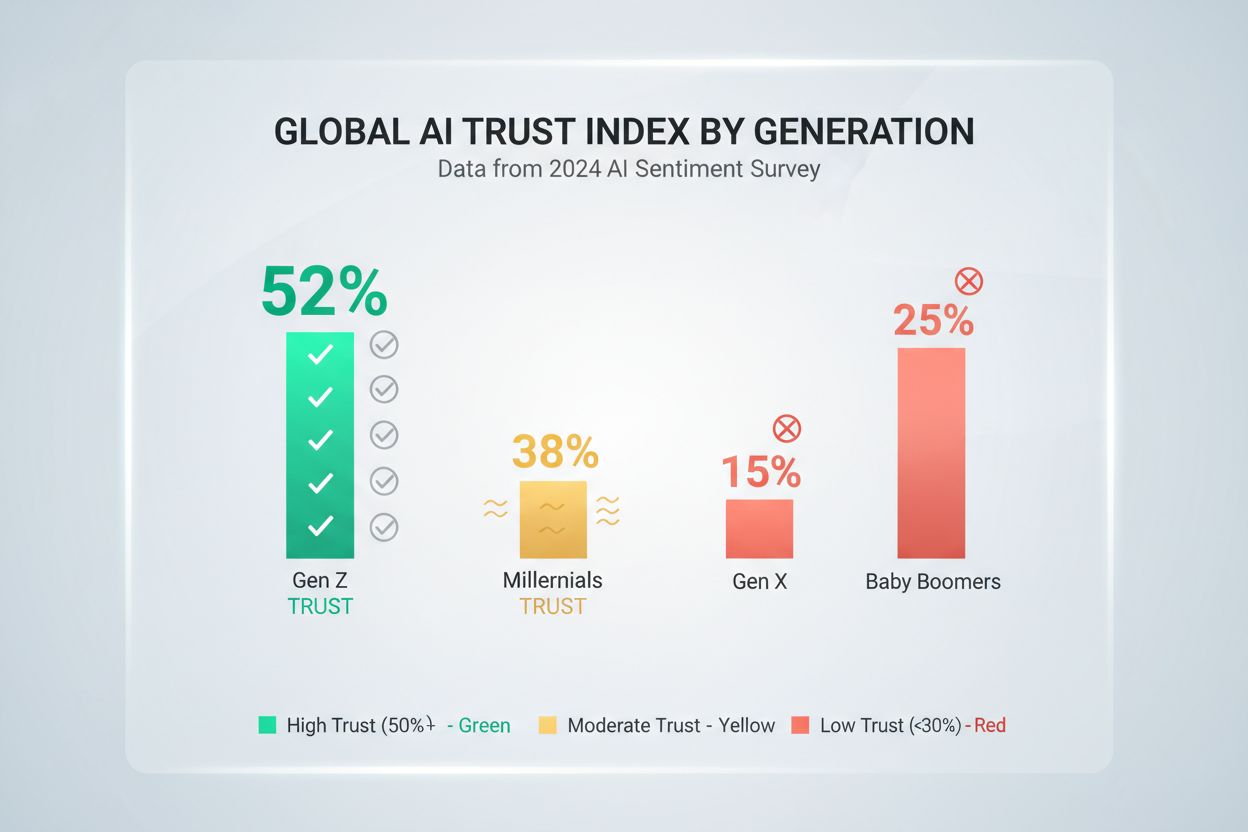
The data reveals a fascinating contradiction at the heart of AI adoption: while Gen Z demonstrates significant trust and usage of AI tools, substantial skepticism persists about AI shopping assistants specifically. 54% of non-users don’t see the need for AI shopping assistants, suggesting that even among those who trust AI generally, many question whether this technology adds genuine value to their shopping experience. This skepticism stems from multiple sources, each representing a legitimate consumer concern that brands must address. 34% of consumers worry about data privacy and security, a concern that has only intensified as high-profile data breaches have made headlines, and this fear directly undermines trust in AI systems that require personal shopping data to function effectively. Additionally, 45% of consumers still prefer human assistance when making purchase decisions, indicating that the human touch remains deeply valued even in an increasingly digital world. Perhaps most tellingly, 30% of consumers suspect that AI would sell them unnecessary items, reflecting a fundamental concern that AI systems are optimized for retailer profit rather than consumer benefit. These barriers to adoption aren’t irrational fears—they’re grounded in legitimate concerns about privacy, autonomy, and whether AI truly serves consumer interests or merely corporate bottom lines.
Rather than wanting AI to make decisions for them, Gen Z has a much more nuanced vision of how AI should enhance their shopping experience. The data reveals specific, practical use cases where Gen Z sees genuine value in AI assistance:
What’s notable about this list is that Gen Z isn’t asking AI to replace human judgment—they’re asking it to handle the tedious, data-intensive tasks that humans find frustrating. They want AI as a research assistant and efficiency tool, not as a decision-maker. This distinction is crucial for retailers designing AI shopping experiences; the most successful implementations will be those that empower human decision-making rather than attempting to automate it away.
The implications of Gen Z’s AI adoption patterns are profound for retailers, brands, and e-commerce platforms operating in today’s competitive landscape. 56% of retail organizations have increased their GenAI investments, signaling that the industry recognizes this shift as permanent and strategically important. Major players like Amazon, Google, Walmart, and eBay have all launched or significantly expanded AI shopping assistant capabilities, understanding that failing to meet Gen Z’s expectations for AI-powered experiences means losing market share to competitors who do. The business case is straightforward: Gen Z represents the future of consumer spending, and their comfort with AI shopping tools means that brands without robust AI capabilities will appear outdated and inconvenient to this demographic. Beyond Gen Z, the broader consumer base is gradually warming to AI shopping assistance, meaning that investments made today to serve the youngest generation will pay dividends across the entire customer base as adoption spreads. However, this isn’t simply about adding AI for its own sake—it’s about understanding what specific AI capabilities drive value for your customers and implementing them in ways that build trust rather than erode it. The retailers and brands that succeed will be those that view AI not as a cost-cutting measure or a way to manipulate consumers, but as a genuine tool for improving the shopping experience.
Trust in AI shopping assistants isn’t automatic—it must be deliberately built through transparency, competence, and respect for consumer autonomy. The most effective approach begins with radical transparency about how AI works: clearly explaining to customers how recommendations are generated, what data is being used, and how their privacy is protected. Data security must be treated as a non-negotiable foundation; with 34% of consumers citing data privacy concerns as a barrier to AI adoption, any breach or mishandling of personal information can devastate trust that took months or years to build. Brands should also implement human oversight mechanisms that allow customers to easily escalate to human representatives, ensuring that AI remains a tool that enhances rather than replaces human judgment. Clear communication about AI’s limitations is equally important—being honest about what AI can and cannot do, and when human expertise is preferable, actually builds credibility rather than undermining it. Research shows that trust in AI shopping assistants decreased from 51% to 45% when privacy concerns were highlighted, demonstrating that consumers are making informed decisions based on real risks rather than irrational fears. The path forward requires brands to acknowledge these concerns seriously, implement robust safeguards, and communicate those safeguards clearly to customers. When done well, this approach transforms privacy and transparency from potential liabilities into competitive advantages that differentiate your brand.
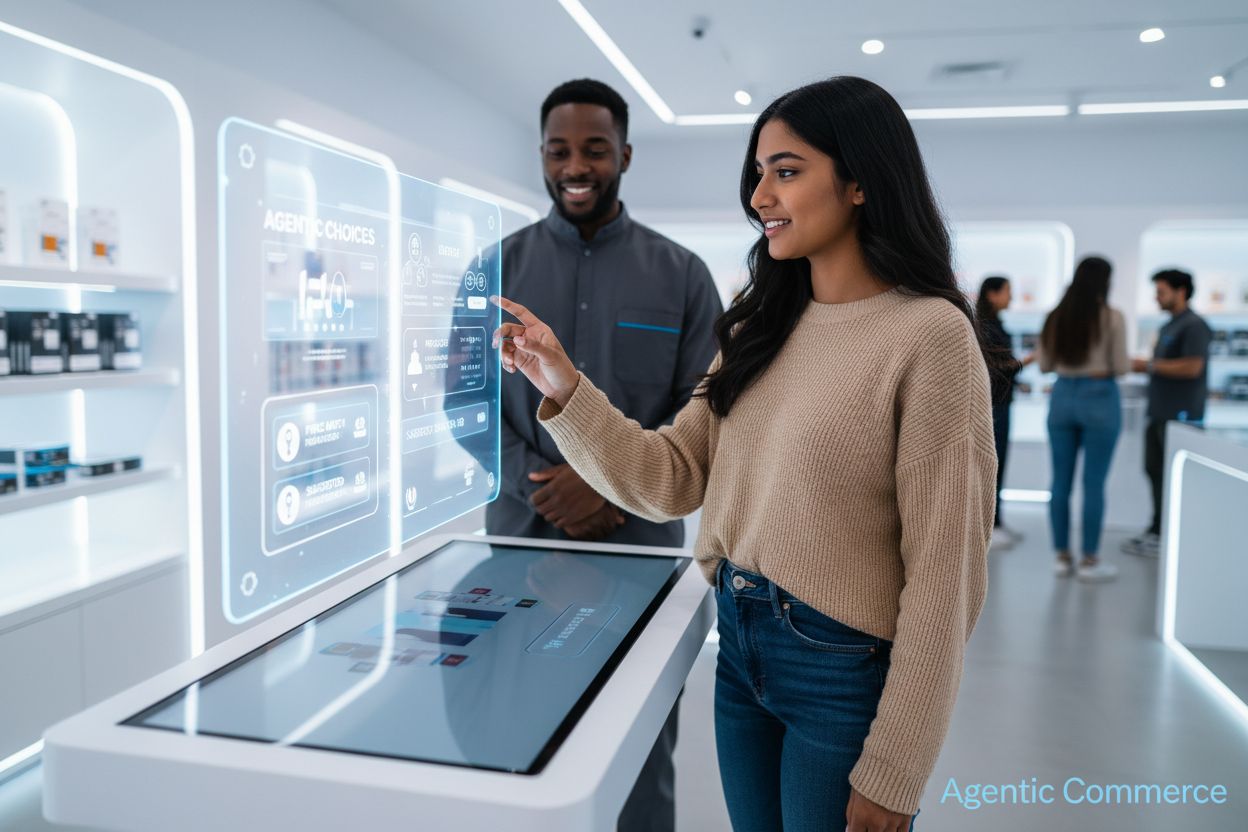
The evolution of AI shopping experiences is moving toward what industry experts call “agentic commerce”—AI agents that can autonomously execute shopping tasks on behalf of consumers. This represents the logical endpoint of the trust and adoption trends we’re seeing today: 41.5% of Gen Z are ready to allow AI agents to make purchases on their behalf if guaranteed the best price, according to YouGov research, and this willingness will likely increase as AI systems prove their reliability and value. We’re already seeing early versions of this with voice shopping through Alexa and Google Assistant, but the next generation will be far more sophisticated, capable of understanding complex preferences, navigating multiple retailers, and executing purchases across different platforms seamlessly. The luxury market is particularly interesting in this context, with high-end retailers beginning to experiment with AI personal shoppers that combine algorithmic recommendations with human expertise. As these systems mature and prove their value, we can expect adoption to accelerate across all retail segments, from fast fashion to groceries to financial services. The brands that will thrive in this future are those investing now in building AI capabilities that genuinely serve customer interests, establishing the trust foundation that agentic commerce will require. This isn’t a distant possibility—it’s emerging now, and the competitive landscape will be determined by which brands move fastest to implement these capabilities responsibly.
As AI systems become increasingly central to how consumers discover and evaluate products, the visibility of your brand within AI-generated recommendations and responses has become as important as your visibility in traditional search results. When a consumer asks ChatGPT, Perplexity, or Google AI Overviews for product recommendations in your category, whether your brand appears in that response can directly impact purchase decisions. This creates a new imperative for brands: you need to understand not just how you rank in Google’s traditional search results, but how you’re being referenced, recommended, and discussed within AI systems. AmICited.com addresses this critical gap by monitoring how AI systems reference your products and services across GPTs, Perplexity, Google AI Overviews, and other AI platforms. As Gen Z increasingly relies on AI to help with purchase decisions, your brand’s presence in AI-generated content becomes a key driver of visibility and credibility. The brands that will dominate in the AI-driven shopping landscape are those that understand their AI footprint as thoroughly as they understand their search engine optimization, and that actively work to ensure their products and services are accurately and prominently featured in AI recommendations. In this new era of AI-powered commerce, monitoring your mentions isn’t optional—it’s essential for maintaining competitive visibility and capturing the attention of the consumers who will define retail for the next decade.
According to Salesforce research, 52% of Gen Z trust AI to help them make informed purchase decisions. Additionally, 61% of Gen Z shoppers have actively used AI tools to help with a purchase in the last year, demonstrating that trust translates directly into behavior.
Gen Z has grown up with AI as an ambient technology woven into their daily digital experiences. Unlike older generations who view AI as a novel addition to their shopping toolkit, Gen Z sees it as a natural and expected part of the retail experience, making them more comfortable adopting AI shopping tools.
The primary barriers include: 54% of non-users don't see the need for AI assistants, 45% prefer human assistance, 34% worry about data privacy and security, and 30% suspect AI would sell them unnecessary items. These concerns reflect legitimate worries about privacy, autonomy, and whether AI truly serves consumer interests.
Gen Z prefers AI for practical tasks: 67% want help finding the best prices, 56% want product comparisons, 46% want personalized recommendations, and many value virtual try-ons and visual search. They want AI as a research assistant and efficiency tool, not as a decision-maker.
56% of retail organizations have increased their GenAI investments. Major players like Amazon, Google, Walmart, and eBay have all launched or expanded AI shopping assistant capabilities, recognizing that failing to meet Gen Z's expectations for AI-powered experiences means losing market share.
Agentic commerce refers to AI agents that can autonomously execute shopping tasks on behalf of consumers. 41.5% of Gen Z are ready to allow AI agents to make purchases on their behalf if guaranteed the best price. This represents the next evolution of AI shopping, moving from recommendations to autonomous purchasing.
As Gen Z increasingly relies on AI for purchase decisions, whether your brand appears in AI-generated recommendations directly impacts purchase decisions. Monitoring your mentions in ChatGPT, Perplexity, and Google AI Overviews is now as important as traditional search engine optimization.
Brands should prioritize transparency about how AI works, implement robust data security, provide human oversight options, and clearly communicate AI's limitations. Research shows that honest communication about privacy concerns actually builds credibility rather than undermining it.
As Gen Z increasingly relies on AI for purchase decisions, ensure your brand appears in AI-generated recommendations. Track how ChatGPT, Perplexity, and Google AI Overviews reference your products.
Discover how Gen Z is using AI for search with 76% trusting AI over Google. Learn adoption rates across ChatGPT, Perplexity, TikTok, and Reddit platforms.
Learn how to optimize your brand for AI purchase decisions. Discover strategies to increase visibility in ChatGPT, Perplexity, and AI answer engines where consu...
Discover how millennials are using AI search engines like ChatGPT and Perplexity differently than other generations. Learn about their hybrid search approach, A...