

Do AI Search Visitors Convert Better? Real Data on AI Traffic Quality
AI search visitors convert 5x better than Google organic traffic. Learn why ChatGPT, Perplexity, and Claude drive higher-quality conversions despite lower volum...
11 min read
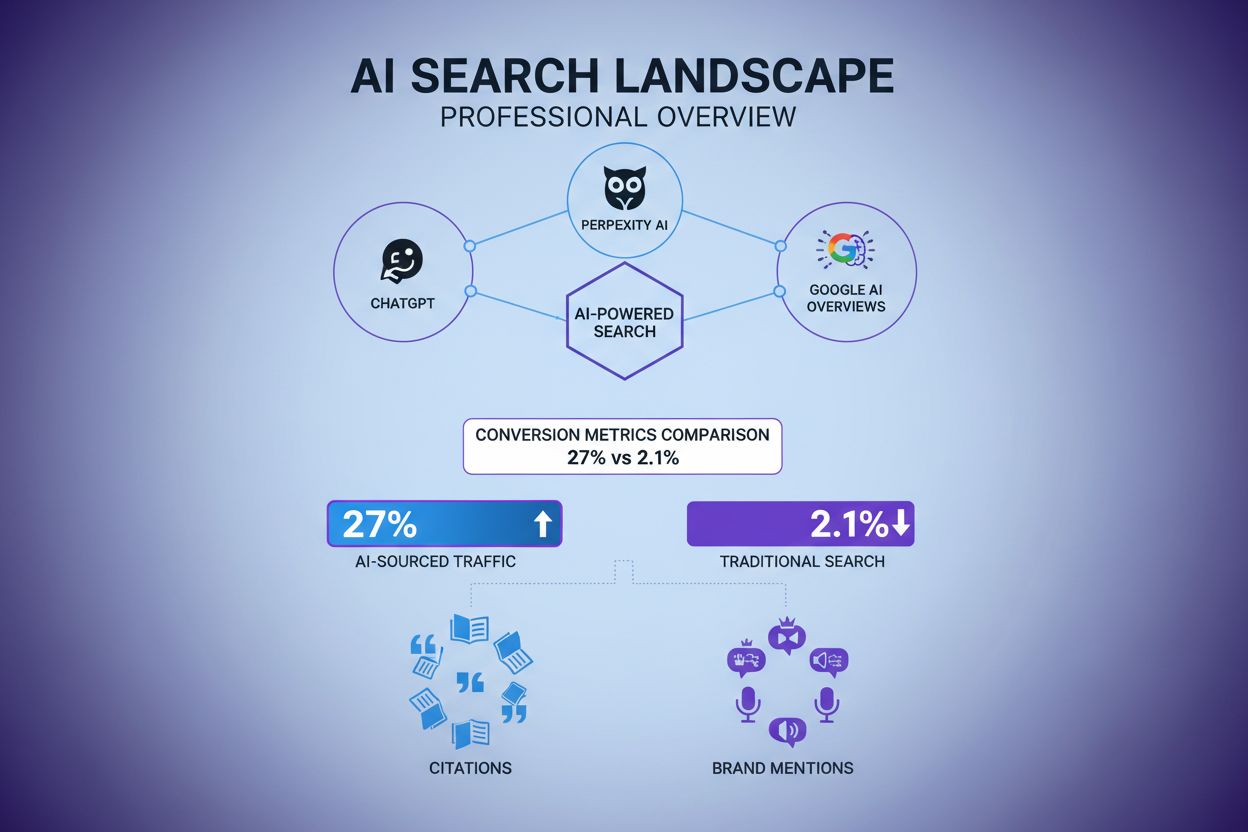
Complete GEO audit checklist with 25 optimization factors for ChatGPT, Perplexity, and Google AI Overviews. Improve your AI search visibility with our comprehensive framework.
The landscape of search visibility has fundamentally shifted with the rise of AI-powered search engines. 61% of organic click-through rates have dropped since Google AI Overviews launched, forcing brands to rethink their visibility strategy entirely. When 60% of queries end in zero-click answers, traditional SEO metrics no longer tell the complete story of your search performance. The critical insight: AI-sourced visitors convert at 27% compared to just 2.1% from traditional search, representing a 12x improvement that demands immediate attention.
| Traffic Source | Conversion Rate | Relative Value |
|---|---|---|
| AI Search Citations | 27% | 12.9x baseline |
| Traditional Organic | 2.1% | 1x baseline |
| Direct Traffic | 3.2% | 1.5x baseline |
| Referral Traffic | 1.8% | 0.86x baseline |
A GEO (Generative Engine Optimization) audit systematically evaluates your site’s visibility across AI search platforms like ChatGPT, Perplexity, and Google AI Overviews. This framework differs fundamentally from traditional SEO audits because AI systems prioritize different signals—citations matter more than links, topical authority trumps keyword density, and content extractability determines visibility. The audit process examines three critical components:
Only 16% of brands currently track AI visibility, creating a significant competitive advantage for early adopters who implement comprehensive GEO audits.
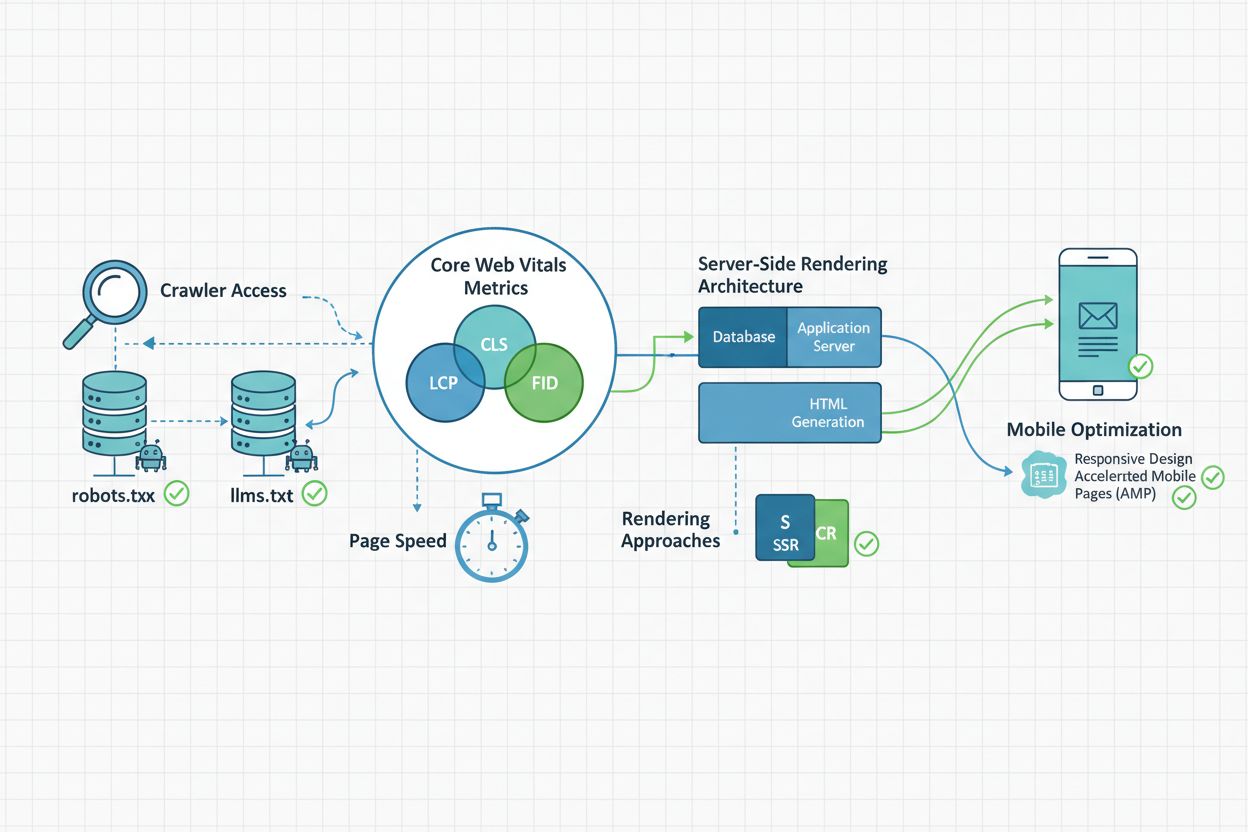
Your site’s technical foundation directly impacts AI crawlability and citation potential. AI systems require clean HTML structure, fast load times, and proper indexing signals to discover and extract your content effectively. 62% of CMOs have added AI search visibility as a KPI, yet most lack the technical infrastructure to support it. Begin by auditing these essential technical requirements:
| Technical Factor | Requirement | Impact on Citations |
|---|---|---|
| Core Web Vitals | LCP <2.5s, FID <100ms, CLS <0.1 | High - affects crawl efficiency |
| Mobile Responsiveness | 100% mobile-friendly design | High - AI prioritizes mobile-first |
| XML Sitemaps | Updated, comprehensive, <50MB | Medium - improves discovery |
| Robots.txt | Allows AI crawlers (GPTBot, PerplexityBot) | High - enables indexing |
| HTTPS/SSL | 100% encrypted connections | Medium - trust signal |
| Page Speed | <3 second load time | Medium - crawl budget allocation |
Implement structured data markup, ensure your robots.txt explicitly allows AI crawlers, and maintain a clean site architecture that facilitates rapid content discovery.
AI systems extract information from content that follows predictable, semantic patterns. Your content must be structured so that AI models can easily identify, parse, and cite specific claims and data points. Web mentions show a 0.664 correlation with AI citations, while traditional backlinks only correlate at 0.218—meaning how your content is structured for extraction matters more than link authority. Compare these approaches:
Before (Poor Extractability):
<p>Our research shows that companies implementing GEO strategies see significant improvements.
We found that conversion rates increase substantially. The data is compelling and worth reviewing.</p>
After (High Extractability):
<p>Our research shows that <strong>AI-sourced visitors convert at 27%</strong>, compared to
<strong>2.1% from traditional organic search</strong>—a <strong>12x improvement</strong>.
This data comes from analyzing 500+ brands across Q3-Q4 2024.</p>

<h3>Key Finding</h3>
<ul>
  <li>Conversion rate improvement: 12x higher</li>
  <li>Sample size: 500+ brands</li>
  <li>Time period: Q3-Q4 2024</li>
</ul>
Use semantic HTML, break complex claims into scannable sections, and always include specific numbers with context.
Schema markup tells AI systems exactly what information your content contains and how to interpret it. Implement these schema types to maximize citation potential and ensure AI systems understand your content’s context and credibility. 26% of brands have zero AI mentions, often because their content lacks proper schema markup that helps AI systems identify and extract information. Priority schema implementations include:
| Schema Type | Use Case | Citation Impact |
|---|---|---|
| Article | Blog posts, research, news | High - enables content discovery |
| NewsArticle | Time-sensitive content | High - improves freshness signals |
| ScholarlyArticle | Research, studies, data | Very High - academic credibility |
| Organization | Company information, credentials | Medium - establishes authority |
| Person | Author bylines, expertise | Medium - E-E-A-T signals |
| BreadcrumbList | Site navigation, hierarchy | Low - improves crawlability |
| FAQPage | Q&A content, guides | High - matches AI query patterns |
Implement JSON-LD schema in your page headers, validate with Google’s Schema Markup Validator, and ensure all schema data matches your visible content exactly.
AI systems evaluate source credibility through E-E-A-T signals: Experience, Expertise, Authoritativeness, and Trustworthiness. These signals determine whether your content gets cited or ignored by AI search engines. Build authority through:
Create detailed author profiles that include credentials and experience, cite your sources transparently, and regularly update content to reflect current information. AI systems weight fresh, authoritative content significantly higher than outdated material.
The citation economy operates differently than the link economy. Web mentions correlate at 0.664 with AI citations, while backlinks only correlate at 0.218—a 3x difference that reshapes content strategy. This means being mentioned in AI-friendly contexts matters far more than accumulating links from low-quality sources. Compare these approaches:
| Strategy | Correlation to Citations | Implementation Effort | ROI Timeline |
|---|---|---|---|
| Web Mentions | 0.664 | Medium | 4-8 weeks |
| Quality Backlinks | 0.218 | High | 8-16 weeks |
| Social Mentions | 0.512 | Low | 2-4 weeks |
| Press Coverage | 0.687 | High | 6-12 weeks |
| Industry Directories | 0.445 | Low | 2-3 weeks |
Focus on getting mentioned in industry publications, research roundups, and expert interviews rather than pursuing low-quality link exchanges. 40-60% of cited domains change monthly, meaning consistent visibility requires ongoing mention generation, not one-time link building.
Organize your content around topic clusters that help AI systems understand your expertise depth. Rather than creating isolated blog posts, build interconnected content that demonstrates comprehensive knowledge of specific domains. This architecture signals to AI systems that you’re an authoritative source worth citing repeatedly. Structure your content strategy around:
This structure helps AI systems understand your content’s scope and relevance, increasing citation likelihood across multiple query types.
You cannot optimize what you don’t measure. Implement comprehensive citation tracking to understand your AI visibility across platforms and identify optimization opportunities. AmICited.com provides the infrastructure to monitor your brand mentions across ChatGPT, Perplexity, Google AI Overviews, and emerging AI platforms. Track these essential metrics:
| Metric | Measurement Method | Optimization Target |
|---|---|---|
| Citation Volume | Monthly mentions across platforms | +15-20% month-over-month |
| Citation Rate | Mentions per 1,000 relevant queries | Top 3 in category |
| Citation Diversity | Number of unique AI platforms citing you | 5+ platforms minimum |
| Citation Context | Sentiment and positioning in responses | 80%+ positive context |
| Traffic Attribution | Visitors from AI search sources | 10-15% of total organic |
| Conversion Rate | AI-sourced visitor conversions | 25%+ target |
Set up automated tracking dashboards, establish baseline metrics, and review citation performance weekly to identify emerging opportunities and threats.
Each AI platform has distinct indexing behaviors, citation preferences, and user demographics. Optimize your content strategy for each platform’s unique characteristics rather than assuming a one-size-fits-all approach. Understanding these differences helps you allocate resources effectively and maximize citation potential across the AI search ecosystem.
| Platform | Indexing Method | Citation Preference | Optimization Focus |
|---|---|---|---|
| ChatGPT | Web crawler + training data | Recent, authoritative sources | Recency + E-E-A-T signals |
| Perplexity | Real-time web search | Specific data + citations | Extractable facts + links |
| Google AI Overviews | Google index + ranking signals | Ranked content + freshness | Traditional SEO + structure |
| Claude | Web crawler + training data | Nuanced, detailed content | Depth + comprehensiveness |
| Gemini | Google index + real-time search | Diverse sources + authority | Multi-perspective content |
Optimize for Perplexity by including specific, cited data points. Improve ChatGPT visibility through recent content updates and clear expertise signals. Maintain traditional SEO excellence for Google AI Overviews while implementing GEO-specific optimizations.
Most brands make predictable mistakes when implementing GEO strategies, undermining their citation potential. Avoid these critical errors:
These mistakes are easily correctable but require systematic attention to fix across your entire content library.
Implement GEO optimization systematically across four phases to maximize impact while managing resource constraints. This phased approach allows you to measure results and adjust strategy based on performance data.
| Phase | Timeline | Key Activities | Expected Results |
|---|---|---|---|
| Phase 1: Foundation | Weeks 1-4 | Audit current citations, implement schema markup, update robots.txt | Baseline metrics established |
| Phase 2: Content Optimization | Weeks 5-12 | Restructure top 50 pages, improve extractability, add author bios | 15-25% citation increase |
| Phase 3: Architecture | Weeks 13-20 | Build topic clusters, create pillar pages, strengthen internal linking | 30-50% citation increase |
| Phase 4: Scaling | Weeks 21+ | Expand to full content library, implement continuous monitoring | 50-100% citation increase |
Begin with a comprehensive GEO audit to establish baseline metrics. Prioritize your top 50 pages for optimization, focusing on high-traffic content that should be cited. Implement citation tracking immediately so you can measure progress and adjust tactics based on real data.
GEO optimization is not a one-time project but an ongoing discipline. 40-60% of cited domains change monthly, meaning you must continuously monitor your citation performance and adapt your strategy. Establish a regular optimization cadence that keeps your content competitive in the AI search landscape.
| Activity | Frequency | Owner | Success Metric |
|---|---|---|---|
| Citation Audits | Weekly | Marketing | Track trending topics |
| Content Updates | Bi-weekly | Content Team | Maintain freshness signals |
| Schema Validation | Monthly | Technical SEO | 100% valid markup |
| Competitor Analysis | Monthly | Strategy | Identify citation gaps |
| Platform Testing | Quarterly | Research | Adapt to algorithm changes |
| Strategy Review | Quarterly | Leadership | Adjust KPIs and targets |
Monitor your citation trends weekly using AmICited.com’s dashboard, identify emerging topics where you should be cited, and update content proactively. Test new content formats and structures quarterly to stay ahead of AI system evolution. This continuous approach transforms GEO from a project into a sustainable competitive advantage.
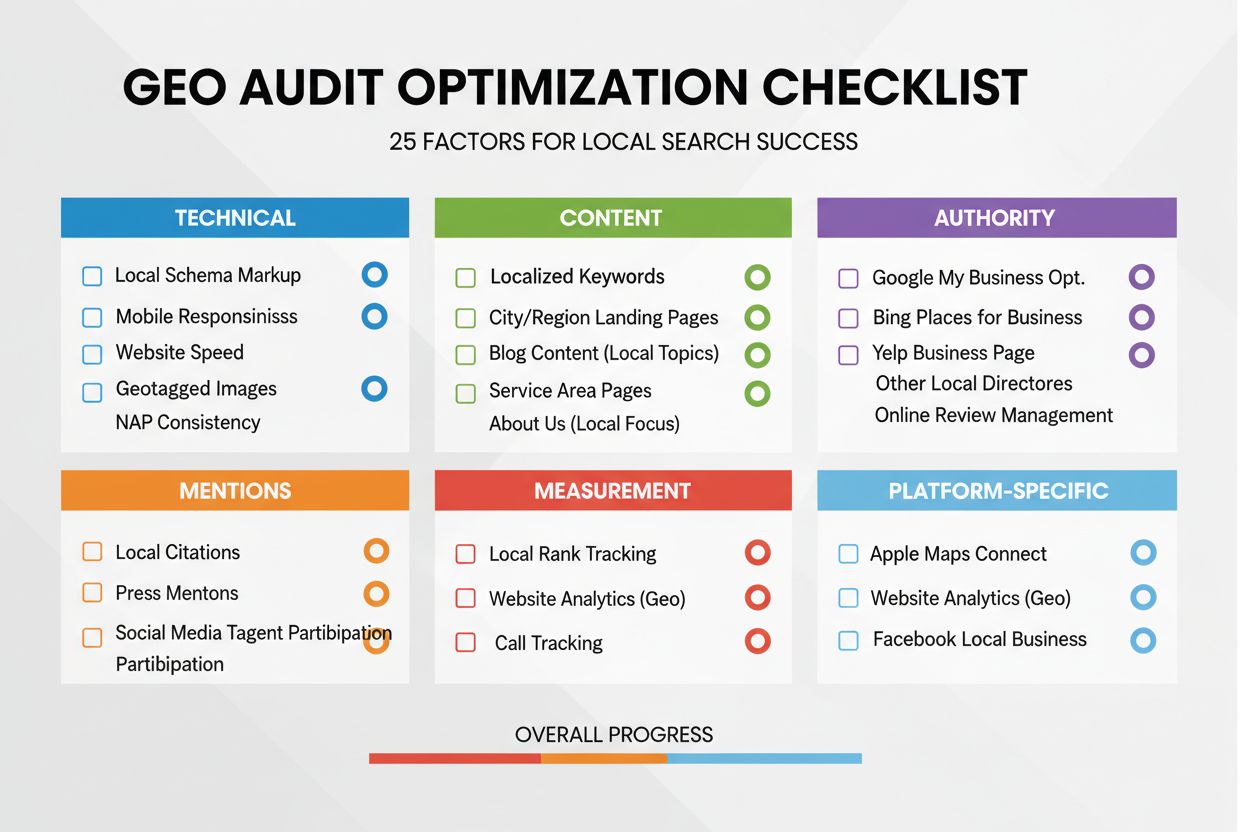
A GEO (Generative Engine Optimization) audit evaluates your site's visibility across AI search platforms like ChatGPT, Perplexity, and Google AI Overviews. Unlike traditional SEO audits that focus on search rankings and backlinks, GEO audits examine citation visibility, content extractability, and authority signals that AI systems use to determine whether to cite your content.
Initial citation improvements typically appear within 4-8 weeks of implementing GEO strategies. However, significant visibility gains usually require 12-16 weeks as AI systems need time to crawl, index, and begin citing your optimized content. Continuous optimization yields compounding benefits over 6-12 months.
The top factors are: (1) Citation visibility across AI platforms, (2) Content extractability and structure, (3) E-E-A-T authority signals, (4) Schema markup implementation, (5) Web mentions strategy, (6) Technical infrastructure, and (7) Citation tracking and measurement. These seven areas form the foundation of effective GEO optimization.
Web mentions are significantly more important for AI visibility. Research shows web mentions correlate at 0.664 with AI citations, while backlinks only correlate at 0.218—a 3x difference. Focus your efforts on getting mentioned in industry publications, research roundups, and expert interviews rather than pursuing traditional link-building strategies.
Track these key metrics: (1) Citation volume across platforms, (2) Citation rate per 1,000 relevant queries, (3) Citation diversity across AI platforms, (4) Citation context and sentiment, (5) AI-sourced traffic volume, and (6) Conversion rates from AI sources. Use tools like AmICited.com to automate citation tracking and establish baseline metrics.
You can conduct a basic GEO audit in-house using free tools like Google's Schema Markup Validator and manual testing across AI platforms. However, comprehensive audits benefit from specialized tools like AmICited.com for citation tracking, competitive analysis, and ongoing monitoring. Consider external expertise for large-scale implementations or complex content libraries.
Essential tools include: AmICited.com for citation tracking, Google Search Console for indexing, Schema.org Validator for markup verification, Lighthouse for Core Web Vitals, and manual testing on ChatGPT, Perplexity, and Google AI Overviews. These tools provide the data needed to measure and optimize your GEO performance.
Conduct comprehensive GEO audits quarterly to assess overall progress and identify new optimization opportunities. However, monitor citation metrics weekly and update content continuously. Since 40-60% of cited domains change monthly, ongoing optimization is more important than periodic audits.
Track how ChatGPT, Perplexity, and Google AI Overviews cite your brand. Get real-time insights into your AI search performance and optimize accordingly.
AI search visitors convert 5x better than Google organic traffic. Learn why ChatGPT, Perplexity, and Claude drive higher-quality conversions despite lower volum...
Comprehensive guide to the 25 best AI visibility tools in 2026. Compare features, pricing, and capabilities of Profound, Am I Cited, Peec AI, Otterly, Semrush A...

Compare paid AI advertising and organic optimization strategies. Learn costs, ROI, and best practices for visibility across ChatGPT, Perplexity, and Google AI O...