

Why GEO Matters for Business Success in 2025: AI Search Visibility Guide
Discover why Generative Engine Optimization (GEO) is essential for businesses in 2025. Learn how AI-powered search is reshaping brand visibility, consumer behav...
8 min read

Complete GEO optimization checklist for AI monitoring. Printable guide to optimize your content for Google AI Overviews, ChatGPT, and Perplexity citations.
Generative Engine Optimization (GEO) represents a fundamental shift in how brands need to approach search visibility in the age of artificial intelligence. While traditional SEO focuses on ranking in the blue-link search results, GEO is about getting your content cited and referenced within AI-generated answers on platforms like ChatGPT, Perplexity, and Google AI Overviews. The stakes are significant: studies show that AI Overviews now appear in up to 47% of Google searches, with some reports indicating a 61% drop in click-through rates to traditional search results when AI answers are present. This isn’t just about losing clicks—it’s about losing visibility entirely if your content isn’t selected as a source for AI citations. When your brand is mentioned in an AI answer, you’re receiving an implicit endorsement from the AI system to millions of potential customers, making GEO optimization essential for maintaining market share in the AI-driven search landscape.

The distinction between traditional SEO and GEO goes far beyond just the platforms where your content appears. Traditional SEO optimizes for keyword matching, backlink authority, and click-through rates—metrics that have dominated search strategy for decades. GEO, by contrast, optimizes for content that AI systems can understand, extract, and confidently cite to users. The correlation between mentions in AI answers and actual citations is 0.664, compared to just 0.218 for backlinks, indicating that AI systems prioritize content quality and relevance over link authority. This shift fundamentally changes how you should approach content creation, structure, and optimization. Where traditional SEO might reward keyword density and link building, GEO rewards clarity, comprehensiveness, and demonstrated expertise. The E-E-A-T framework (Experience, Expertise, Authoritativeness, Trustworthiness) becomes paramount—AI systems are trained to recognize and prioritize content from credible, authoritative sources. Additionally, while traditional SEO focuses on individual page rankings, GEO requires a holistic approach where your entire digital presence, including author credentials, citations, and original research, contributes to whether AI systems will cite your content.
| Aspect | Traditional SEO | GEO |
|---|---|---|
| Primary Goal | Rank in blue-link results | Get cited in AI answers |
| Key Ranking Factor | Backlinks & domain authority | Content quality & E-E-A-T |
| Content Focus | Keyword optimization | Clarity & comprehensiveness |
| User Intent | Match search query | Answer user’s underlying question |
| Citation Correlation | 0.218 (backlinks) | 0.664 (content mentions) |
| Optimization Focus | Individual pages | Entire digital presence |
| Authority Signals | External links | Author credentials & citations |
| Content Structure | Keyword-rich sections | Clear answers with supporting details |
The foundation of successful GEO rests on understanding how AI systems evaluate and select content for citations. First, search intent becomes paramount—but not in the traditional sense of matching keywords. AI systems need to understand the deeper intent behind queries and find content that comprehensively addresses that intent. This means your content must answer not just the surface question, but the underlying information need. Second, content quality and comprehensiveness are non-negotiable. AI systems synthesize information from multiple sources, so your content must be thorough enough to stand out as a primary source worth citing. Third, authority and trustworthiness signals determine whether AI systems will confidently cite your content. This includes author credentials, citations to reputable sources, original research, and demonstrated expertise in your field. Finally, semantic relevance matters more than ever—AI systems understand meaning and context, not just keywords. Your content must be structured in a way that makes it easy for AI to parse, understand, and extract relevant information. These principles work together to create content that AI systems naturally want to cite.
How you structure your content directly impacts whether AI systems can extract and cite it. AI systems parse content hierarchically, starting with your H1 heading and working through H2 and H3 subheadings to understand the page’s structure and main topics. Each section should begin with a direct answer to the question posed by the heading—a single, confident sentence that provides the core information. This is followed by 2-3 sentences of supporting details, citations, or examples that back up your answer. Research shows that pages with clear answer structures see a 35% improvement in extractability by AI systems. The formatting matters too: keep paragraphs to 2-3 sentences maximum, use bullet points to break up complex information, and create tables for comparisons or data presentation. Short, scannable content isn’t just better for human readers—it’s essential for AI systems that need to quickly identify and extract relevant information. Sites that implement these structural best practices achieve approximately 70% compliance with AI optimization standards, significantly increasing their chances of being cited in AI Overviews.

Beyond content quality, technical excellence is fundamental to GEO success. Mobile-friendliness is non-negotiable—AI systems prioritize the mobile version of your site, and you should aim for a PageSpeed Insights score of 90 or higher. Page speed directly impacts whether AI systems will even crawl and index your content; aim for load times under 2.5 seconds and ensure your site passes all Core Web Vitals tests. Crawlability is equally important: your site structure must be clean and intuitive, with clear internal linking that helps AI systems understand your content hierarchy. Implement XML sitemaps and ensure Googlebot isn’t blocked by your robots.txt file. Structured data and schema markup have become increasingly important for GEO—approximately 75% of high-performing sites in AI Overviews implement proper schema markup. This markup helps AI systems understand the context and meaning of your content, making it easier to extract and cite. Finally, ensure your content is readable in the HTML source code itself; avoid relying on JavaScript to render critical content, as some AI crawlers may not execute JavaScript properly.
Building authority for GEO requires a multi-faceted approach that goes beyond traditional link building. Your content must clearly demonstrate expertise through:
Research from MaximusLabs shows that content with strong E-E-A-T signals receives 50% more citations in AI Overviews compared to content without these signals. This isn’t just about adding credentials—it’s about weaving them throughout your content and making them easily verifiable. When you reference a case study or client result, link directly to it. When you cite a statistic, link to the original source. This creates a web of credibility that AI systems recognize and reward with citations.
Tracking your GEO performance requires a different approach than traditional SEO monitoring. Citation tracking across AI platforms is essential—use tools like Ahrefs or Semrush to identify which keywords trigger AI Overviews and whether your site appears in them. Key metrics to monitor include Share of Answer (what percentage of AI answers for your target keywords include your content), Citation Rate (how frequently your site is cited), and AI visibility across different platforms. AmICited.com specializes in real-time monitoring of how AI systems reference your brand across ChatGPT, Perplexity, Google AI Overviews, and other platforms, providing actionable insights into your AI citation performance. Citation volatility typically ranges from 40-60%, meaning your presence in AI answers can fluctuate based on content freshness, competitive activity, and algorithm updates. This makes continuous monitoring and optimization essential. Establish a regular update schedule for your most important pages—quarterly updates are recommended—and monitor your metrics monthly to catch declining performance early. The brands winning in GEO aren’t just optimizing once; they’re continuously refining their content, monitoring their citations, and adapting to changes in how AI systems evaluate and cite sources.
Generative Engine Optimization (GEO) is the practice of optimizing content for AI-driven search engines like ChatGPT, Perplexity, and Google AI Overviews. Unlike traditional SEO which focuses on ranking in blue-link search results, GEO aims to get your content cited and referenced within AI-generated answers. The key difference is that GEO prioritizes content quality, clarity, and authority signals that AI systems use to synthesize answers, rather than just keyword matching and backlinks.
AI Overviews now appear in up to 47% of Google searches and take up significant screen real estate. When your content is cited in these AI answers, you're essentially getting an endorsement from Google to millions of potential customers. Additionally, users who click through from AI citations show 12-18% higher conversion rates than traditional organic traffic, making GEO a valuable complement to your SEO strategy.
The core technical requirements include: mobile-friendliness (90+ PageSpeed score), fast loading speeds (under 2.5 seconds), passing Core Web Vitals tests, clean HTML structure that's readable by search engines, and proper implementation of schema markup. AI systems prioritize user experience signals, so technical excellence is non-negotiable for getting cited in AI Overviews.
Structure your content with clear H1, H2, and H3 headings that follow a logical hierarchy. Start each section with a direct answer to the question (1 sentence), followed by supporting details (2-3 sentences). Keep paragraphs to 2-3 sentences maximum, use bullet points and tables for complex information, and ensure all claims are backed by citations or data. This makes it easy for AI to extract and cite your content.
E-E-A-T (Experience, Expertise, Authoritativeness, Trustworthiness) is critical for GEO success. AI systems heavily weight content from credible sources. You need to demonstrate expertise through author bios with credentials, cite authoritative sources, publish original research, and build trust signals like testimonials and case studies. Content without strong E-E-A-T signals is unlikely to be selected for AI citations.
Use tools like Ahrefs or Semrush to track which keywords show AI Overviews and whether your site appears in them. Monitor citation frequency across different AI platforms (ChatGPT, Perplexity, Google AI Overviews). Track metrics like Share of Answer, Citation Rate, and AI visibility. AmICited.com specializes in monitoring how AI systems reference your brand across all major platforms, providing real-time insights into your AI citation performance.
Most sites see initial results within 2-4 weeks of optimizing content, though this varies based on site authority. Newer or smaller sites may take 1-3 months to see stable, consistent AI citations. The timeline depends on how authoritative your domain is and how competitive your target topics are. Consistent optimization and content updates will accelerate results over time.
You should do both simultaneously, as they complement each other. The technical foundations and content quality required for GEO (mobile-friendliness, page speed, clear structure, E-E-A-T) also benefit traditional SEO. Start by ensuring your site meets technical requirements, then optimize your most important content pages for both traditional search rankings and AI citations. This dual approach maximizes your visibility across all search formats.
Track how AI systems reference your brand across ChatGPT, Perplexity, Google AI Overviews, and more. Get real-time insights into your AI visibility and citation performance.
Discover why Generative Engine Optimization (GEO) is essential for businesses in 2025. Learn how AI-powered search is reshaping brand visibility, consumer behav...
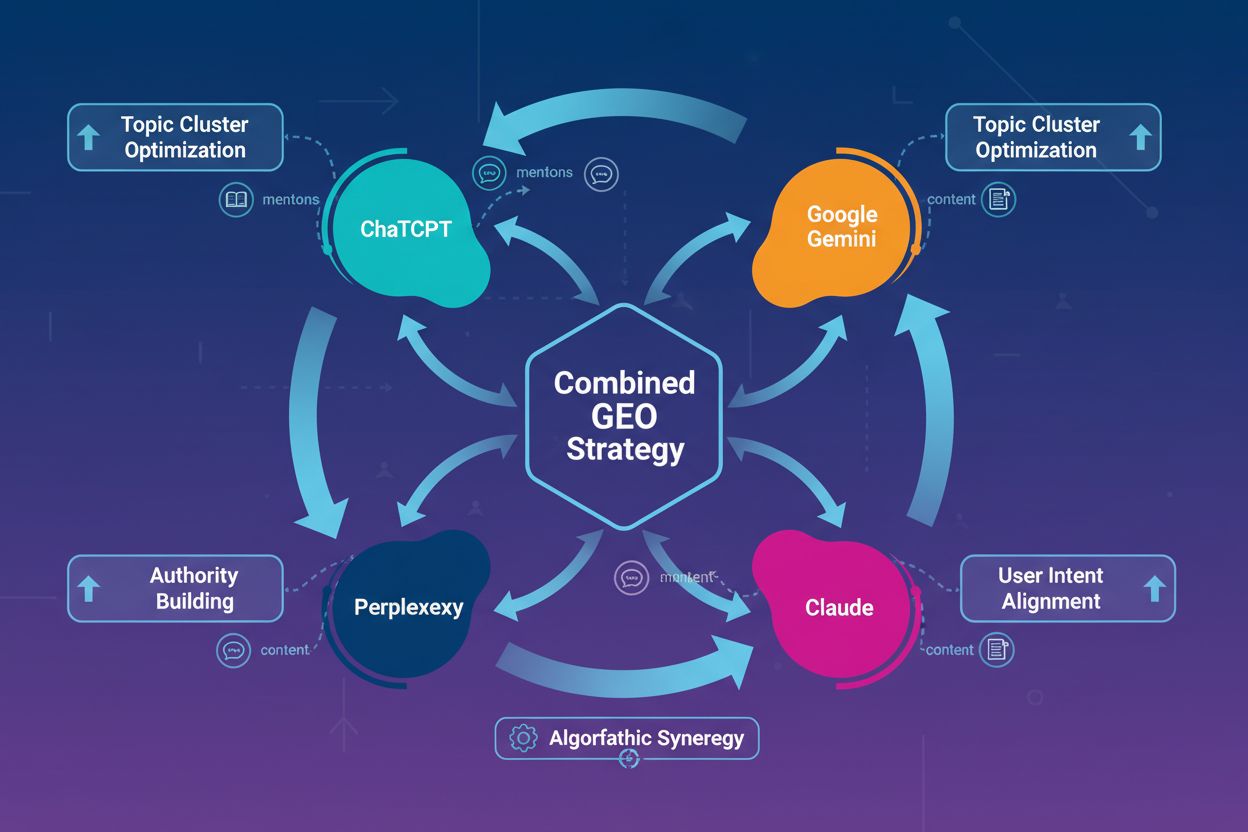
Master combined GEO strategies by stacking multiple optimization methods. Learn how to optimize for multiple AI platforms simultaneously and maximize your visib...
Discover which AI platforms to optimize for in 2025. Learn platform-specific strategies for ChatGPT, Perplexity, Claude, Google AI, and emerging AI search engin...