
How to Balance SEO and GEO Efforts: Complete Strategy Guide
Learn how to effectively balance SEO and GEO efforts to maximize visibility in both traditional search results and AI-generated answers. Discover unified strate...
11 min read
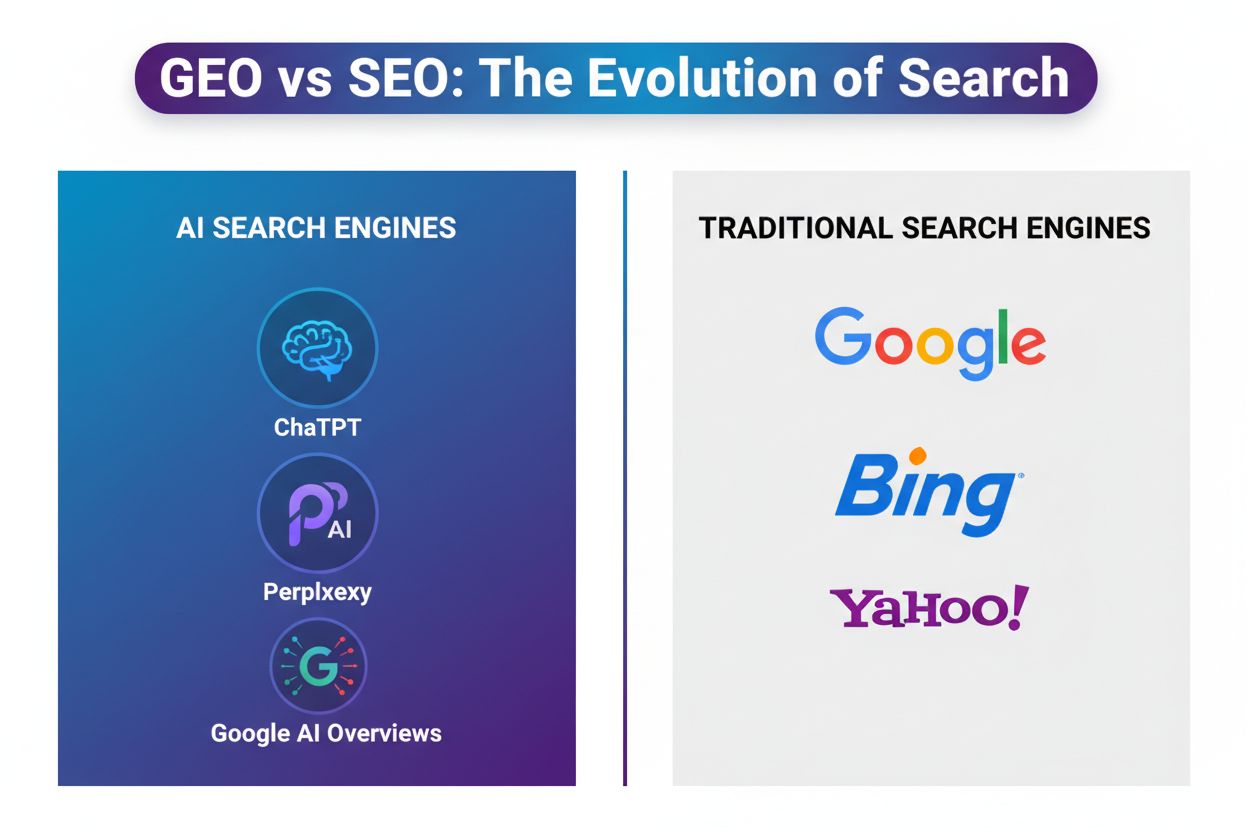
Understand the critical differences between Generative Engine Optimization (GEO) and traditional SEO. Learn how to optimize for AI search engines like ChatGPT, Perplexity, and Google AI Overviews while maintaining strong SEO performance.
Generative Engine Optimization (GEO) and Search Engine Optimization (SEO) are two distinct but complementary strategies for improving online visibility. SEO focuses on optimizing your website to rank higher in traditional search engines like Google and Bing, where users click through to your website from search results pages. GEO, on the other hand, is the practice of optimizing your content to appear as sources and citations in AI-generated answers from platforms like ChatGPT, Perplexity, Google AI Overviews, and Claude. While SEO has dominated digital marketing for over two decades, GEO emerged in 2023 following the explosive growth of generative AI tools. Today, both strategies are essential for maintaining comprehensive online visibility as search behavior evolves.
The fundamental differences between GEO and SEO shape how marketers should approach content strategy, optimization tactics, and success metrics. Understanding these distinctions is crucial for developing an effective digital marketing strategy that captures visibility across both traditional and AI-powered search channels.
| Aspect | GEO (Generative Engine Optimization) | SEO (Search Engine Optimization) |
|---|---|---|
| Target Platforms | AI-powered search engines (ChatGPT, Perplexity, Google AI Overviews, Claude) | Traditional search engines (Google, Bing, Yahoo) |
| Type of Results | Single summarized AI-generated answer with citations | Multiple search results pages with clickable links |
| Content Focus | Conversational, contextually relevant, directly answers questions | Keyword-optimized, comprehensive coverage of topics |
| Content Formats | Code snippets, mind maps, tables, step-by-step solutions | Text-based with videos, maps, product listings |
| Ranking Factors | Content quality, structure, relevance, entity recognition, brand mentions | Keywords, backlinks, metadata, page authority, user engagement |
| Traffic Generation | Brand visibility and citations (often zero-click) | Click-through traffic from search results |
GEO targets a fundamentally different set of platforms than traditional SEO. While SEO focuses on optimizing for Google’s algorithm—which still drives the majority of search traffic—GEO requires optimization for multiple AI platforms that each have their own citation preferences. ChatGPT, which reached 400 million weekly users by early 2025, prioritizes encyclopedic and authoritative sources. Perplexity AI, with over 500 million monthly queries, favors recent content and community-driven sources like Reddit. Google AI Overviews, appearing on billions of searches monthly, leverage existing Google rankings but add emphasis on structured data and direct answer formats. Claude, Anthropic’s AI assistant, relies heavily on pre-trained knowledge and established databases. Each platform uses different algorithms to determine which sources to cite, making a multi-platform approach essential for comprehensive GEO success.
The way results are presented to users differs dramatically between GEO and SEO, fundamentally changing how brands achieve visibility. Traditional SEO delivers multiple search results—typically 10 per page on Google—allowing users to choose which links to click based on titles and descriptions. Users must actively evaluate and select sources, often clicking through multiple pages to find the information they need. In contrast, GEO platforms synthesize information from multiple sources and present a single, comprehensive answer directly to the user. When someone asks ChatGPT “What is content marketing?” or queries Perplexity about “best project management tools,” the AI engine reads dozens of sources, synthesizes the information, and presents one cohesive answer with citations. This zero-click search reality means users get answers without visiting your website, but your brand still gains visibility through citations. The shift from “click-based” to “citation-based” visibility represents a fundamental change in how online authority is established and measured.
SEO traditionally emphasizes keyword targeting and comprehensive topic coverage, with marketers conducting extensive keyword research to identify search terms with high volume and low competition. Content is optimized around these keywords, with strategic placement in titles, headings, and body text. GEO, by contrast, requires a more conversational and intent-driven approach. Rather than optimizing for “content marketing ROI,” you’d optimize for how users actually ask questions: “How much money can I make from content marketing?” or “What’s the return on investment for content marketing?” This shift reflects how people interact with AI tools—they ask full questions in natural language rather than typing short keyword phrases.
Key differences in content approach include:
The mechanisms by which content gains visibility differ significantly between GEO and SEO. SEO has long relied on backlinks as the primary authority signal—the more high-quality websites linking to your content, the higher you rank. Google’s PageRank algorithm, introduced in 1998, fundamentally shaped how SEO professionals think about authority. GEO, however, uses entity recognition as a primary mechanism for understanding authority. AI engines don’t just count backlinks; they track how consistently your brand appears across multiple sources in relevant contexts. An unlinked mention of your brand on a high-authority website can carry significant weight in GEO because it demonstrates that credible sources recognize your expertise. Additionally, GEO systems prioritize E-E-A-T signals (Experience, Expertise, Authoritativeness, Trustworthiness) more explicitly than traditional SEO. Author credentials, original research, cited sources, and clear expertise demonstrations become critical ranking factors. While backlinks still matter for GEO—they often lead to the authoritative mentions that AI systems value—the emphasis has shifted toward demonstrating genuine expertise and earning authentic brand mentions across the web.
Perhaps the most significant practical difference between GEO and SEO lies in how they generate value and how that value is measured. SEO success is traditionally measured by click-through rates and traffic volume. A page ranking #1 for a high-volume keyword drives substantial traffic, and that traffic can be directly attributed to the ranking through Google Analytics. GEO success, however, is measured differently. When your content gets cited by ChatGPT, users may never click through to your website—they get their answer directly from the AI. This creates what’s called a “zero-click search,” where your brand gains visibility without generating direct traffic. The value of GEO lies in brand awareness, authority building, and top-of-funnel visibility. Users discover your brand through AI citations, build trust in your expertise, and later return through direct search or other channels. This requires a mindset shift from “traffic as the primary KPI” to “visibility and brand authority as primary KPIs.” Additionally, GEO creates what researchers call “source preference bias”—once an AI system recognizes your content as reliable for a topic, it tends to cite you more frequently for related queries, creating a compounding effect over time.
A critical misconception in the marketing community is that GEO is replacing SEO. This is fundamentally incorrect. GEO and SEO are complementary strategies that should work together as part of a comprehensive visibility strategy. Strong SEO provides a foundation for GEO success—research shows that 40.58% of AI citations come from content ranking in Google’s top 10 results. However, ranking well in Google doesn’t guarantee AI citations. A page can rank #3 for a keyword but never get cited by ChatGPT if it lacks the structural clarity and entity recognition that AI systems prioritize. Conversely, optimizing exclusively for GEO while neglecting SEO means missing out on the substantial traffic that traditional search still drives. The most effective approach integrates both strategies: maintain strong SEO fundamentals (quality content, technical optimization, authority building) while layering on GEO-specific optimizations (direct answers, entity clarity, structured data, citation-ready formatting). This integrated approach, sometimes called “Search Everywhere Optimization,” ensures your brand is visible wherever your audience searches—whether that’s Google, ChatGPT, Perplexity, or emerging search platforms.
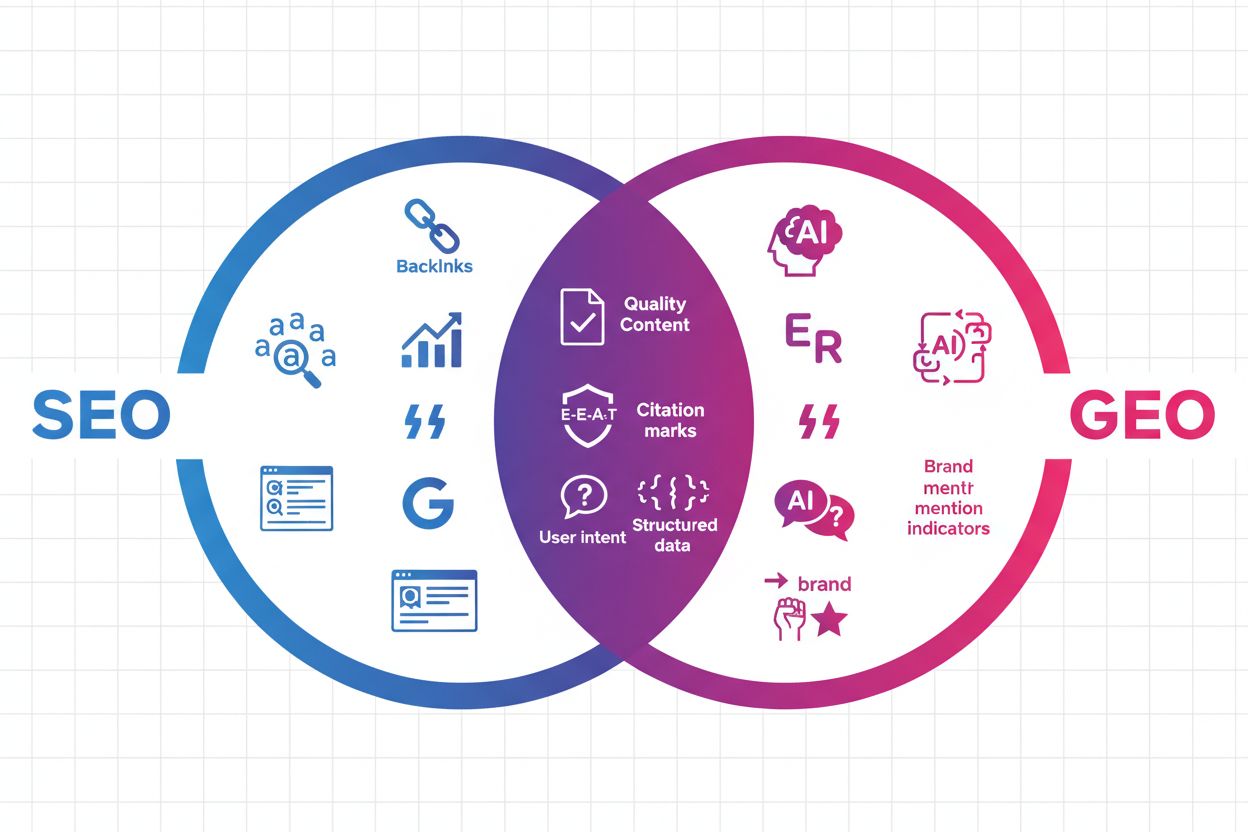
Implementing both GEO and SEO effectively requires a strategic approach that addresses the unique requirements of each channel while leveraging their complementary nature. Rather than creating separate content strategies, smart marketers optimize single pieces of content to perform well across both channels.
Tracking success requires different metrics for GEO and SEO, though some overlap exists. For SEO, traditional metrics remain relevant: organic traffic, keyword rankings, click-through rates, and conversion rates. Google Analytics provides clear attribution for SEO-driven traffic. GEO measurement is more complex because direct attribution is challenging. AI platforms don’t consistently identify themselves in analytics, making it difficult to track AI-referred traffic comprehensively. However, several approaches provide useful insights. Manual testing—regularly querying AI platforms with questions your content should answer—reveals whether you’re being cited and how frequently. Tools like Semrush’s AI Visibility Toolkit and Profound provide automated tracking across multiple AI platforms, showing your citation frequency relative to competitors. Brand mention monitoring tools track how often your brand appears across the web, which correlates with AI visibility. Additionally, monitoring branded search volume increases and direct traffic spikes can indicate growing brand awareness from AI citations. The key is developing a measurement framework that combines direct metrics (rankings, traffic) with proxy metrics (brand mentions, citation frequency) to understand your overall visibility across search channels.
The emergence of GEO doesn’t diminish the importance of SEO—it expands the scope of what “search visibility” means. As AI-powered search grows from a novelty to a mainstream discovery channel, marketers who optimize for both GEO and SEO will capture visibility across the full spectrum of how their audience seeks information. The good news is that much of what makes content successful for SEO—quality, clarity, authority, and user-focused optimization—also makes it successful for GEO. By understanding the key differences between these strategies and implementing them in an integrated way, marketers can ensure their brands remain visible, cited, and influential in the evolving search landscape. The future of search isn’t about choosing between GEO and SEO; it’s about mastering both.
No. GEO and SEO are complementary strategies, not competing ones. SEO still drives the majority of search traffic, and strong SEO provides a foundation for GEO success. The most effective approach integrates both strategies to ensure visibility across traditional search engines and AI-powered platforms.
Yes, absolutely. Research shows that 40.58% of AI citations come from Google's top 10 results, but ranking well doesn't guarantee AI citations. A page can rank #3 in Google but never get cited by ChatGPT if it lacks the structural clarity and entity recognition that AI systems prioritize.
SEO optimizes for clicks from search results pages, while GEO optimizes for citations within AI-generated answers. SEO focuses on keyword rankings and traffic generation, while GEO focuses on brand visibility and authority within AI conversations.
Key GEO optimization tactics include: structuring content with direct answers in the first 40-60 words, implementing schema markup, building brand mentions across the web, creating content for conversational queries, maintaining content freshness, and developing a multi-platform presence beyond your website.
Both are important, but their importance depends on your business goals. If driving immediate traffic is critical, SEO remains essential. If building long-term brand authority and visibility across emerging search channels is important, GEO is equally critical. Most businesses benefit from optimizing for both.
No. Rather than creating separate content, optimize single pieces of content to perform well across both channels. Structure content with direct answers, implement schema markup, use conversational language, and build authority signals—these approaches benefit both GEO and SEO simultaneously.
Initial citation wins typically appear within 4-8 weeks after publishing optimized content, though timelines vary by platform. Perplexity's recency bias means new content can get cited within 1-2 weeks, while ChatGPT may take 6-12 weeks as its knowledge base updates less frequently.
Start with the platforms most relevant to your audience. ChatGPT dominates professional use cases, Perplexity rewards fresh content and community examples, and Google AI Overviews prioritize content already ranking well organically. Most content strategies benefit from optimizing for multiple platforms simultaneously.
Track how AI search engines like ChatGPT, Perplexity, and Google AI Overviews cite your brand. Get real-time insights into your AI visibility and stay ahead of the competition with AmICited's comprehensive monitoring platform.
Learn how to effectively balance SEO and GEO efforts to maximize visibility in both traditional search results and AI-generated answers. Discover unified strate...
Understand the critical differences between GEO (Generative Engine Optimization) and SEO (Search Engine Optimization). Learn how AI search differs from traditio...
Discover why Generative Engine Optimization (GEO) is essential for businesses in 2025. Learn how AI-powered search is reshaping brand visibility, consumer behav...