

Wikipedia Citations as AI Training Data: The Ripple Effect
Discover how Wikipedia citations shape AI training data and create a ripple effect across LLMs. Learn why your Wikipedia presence matters for AI mentions and br...
7 min read

Learn ethical strategies to get your brand cited on Wikipedia. Understand Wikipedia’s content policies, reliable sources, and how to leverage citations for AI visibility and search engine presence.
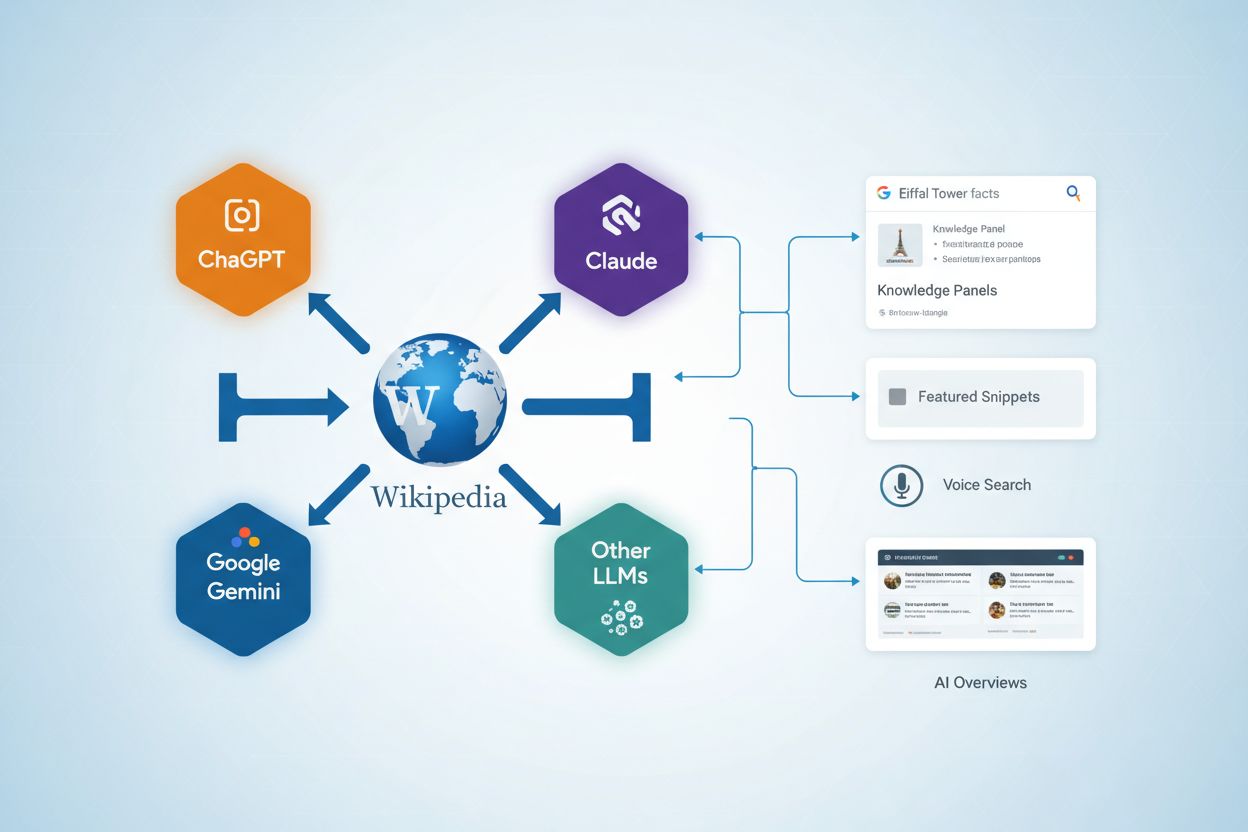
Wikipedia serves as a foundational knowledge layer for the modern internet, with particular significance in the era of artificial intelligence. The platform consistently ranks among the top 10 most-visited websites globally, and its comprehensive, well-organized content makes it ideally suited for training large language models (LLMs) like ChatGPT, Claude, Gemini, and others. Every major LLM to date has incorporated Wikipedia as a primary training source, often making it the single largest dataset in their knowledge base. Beyond LLM training, Wikipedia content directly powers Google’s Knowledge Panels, featured snippets, and the new AI Overviews feature, meaning that information appearing on Wikipedia propagates across search results, voice assistants, and AI-generated answers. This cascading effect means a single Wikipedia mention can reach millions of users through multiple channels—search engines, chatbots, knowledge graphs, and retrieval-augmented generation (RAG) systems—making Wikipedia citations exponentially more valuable than isolated mentions elsewhere. For brands seeking visibility in an AI-driven information landscape, understanding Wikipedia’s outsized influence is the critical first step.
Before attempting to secure a Wikipedia mention, organizations must internalize the four foundational policies that govern all content on the platform. These policies are not suggestions—they are rigorously enforced by Wikipedia’s volunteer editor community and determine whether content survives or is removed.
| Policy | Definition | Implication for Brands |
|---|---|---|
| Notability | A topic must have received significant coverage in independent, reliable secondary sources to warrant inclusion or mention on Wikipedia. Wikipedia does not allow articles or mentions about non-notable subjects to prevent indiscriminate promotion. | Your brand must be documented in reputable publications (not your own website or minor blogs) to qualify for a Wikipedia mention. If journalists and industry analysts haven’t written about you, Wikipedia won’t either. |
| Verifiability | Every assertion on Wikipedia must be backed by a citation to a reliable source that readers can independently verify. Wikipedia’s golden rule is “verifiability, not truth”—something can be true but still unacceptable if unpublished in a reliable outlet. | Any facts about your brand (market share, founding date, product launches) must be sourced from mainstream media, academic journals, government documents, or industry reports. Company press releases and internal data do not count as verifiable sources. |
| No Original Research (NOR) | Wikipedia prohibits first-party data, unpublished insights, or original analysis. All content must be drawn from published reliable sources, not conclusions by the Wikipedia editor or the subject organization. | You cannot insert proprietary research, internal metrics, or unpublished findings about your brand. Everything must come from third-party published sources that have already validated and reported on your information. |
| Neutral Point of View (NPOV) | All Wikipedia content must be written objectively and without bias, promotional language, or loaded terminology. Even if something is true and sourced, the wording cannot be puffery or marketing-speak. | Descriptions like “the leader in innovative solutions” are unacceptable. Instead, use neutral phrasing: “the company is one of the largest providers of [Service] in [Region].” Wikipedia exists to summarize what independent sources say, not to serve as an advertisement. |
Understanding these four pillars is essential because they form the basis for every editorial decision on Wikipedia. Editors use these policies to evaluate whether content should be added, kept, or removed. Brands that align their Wikipedia strategy with these policies dramatically increase their chances of success, while those that ignore them will find their contributions quickly reverted and their credibility questioned.
Not all coverage about your brand will be welcome on Wikipedia. The platform has strict preferences for certain source types and an equally strong aversion to others. Understanding this distinction is crucial for building a Wikipedia-ready information ecosystem around your brand.
Acceptable Sources (What Gets Cited):
Unacceptable Sources (What Won’t Fly):
The fundamental principle is simple: Wikipedia cites what independent, reputable outlets have already published about your brand. If your brand isn’t being discussed in such places yet, that’s a signal to focus on earning that coverage first. Wikipedia will only echo what the wider world has already documented.
One of the most critical mistakes companies make is assuming they can directly edit Wikipedia to add their brand. Wikipedia has strict Conflict of Interest (COI) rules that strongly discourage people with close connections to a topic from editing that content. Company staff, marketing agencies, and anyone hired specifically to promote your brand should not directly edit Wikipedia articles about your company or add your information to other pages. Such edits are viewed with immediate suspicion and are frequently reverted by the community. Undisclosed paid editing is particularly problematic—Wikipedia’s guidelines explicitly forbid editing for promotional purposes without full transparency, and discovered violations can result in account banning and even blacklisting of your website as a source. Creating fake “neutral” accounts to sneak in brand mentions (sockpuppeting) is a severe violation that can backfire spectacularly, leading to harsh warnings and reputational damage.
The ideal scenario is when independent Wikipedia editors add information about your brand because it genuinely enhances an article, not because you asked them to. However, if you do engage with Wikipedia, the proper channel is the Talk page—the discussion section attached to every Wikipedia article. Here, you can transparently propose additions, disclose your conflict of interest, and provide sources for independent editors to review. Some experienced Wikipedia consultants operate ethically within this framework, using Talk pages and the {{request edit}} template to suggest changes rather than making direct edits. The key is transparency and respect for the community’s autonomy. Your role is to make it easy for neutral editors to see the value in including your information by providing clear, policy-compliant rationale and excellent sources—not to force your way onto the platform.
Earning a Wikipedia mention requires a systematic, long-term approach that respects the platform’s norms while strategically positioning your brand for inclusion. Here are the key steps:
Cultivate Reliable Source Material – Before anything appears on Wikipedia, it must exist in the outside world. Pursue traditional PR, thought leadership, and partnerships that generate independent media coverage in publications Wikipedia considers reliable. The goal is multiple write-ups from credible outlets that discuss your brand’s activities or achievements, creating a foundation for future Wikipedia citations.
Identify Relevant Wikipedia Pages in Your Niche – Look beyond your company page to broader articles where your brand could be mentioned. For a fintech startup, relevant pages might include “Financial technology,” “Mobile payment systems,” or articles about specific problems you solve. Create a list of existing Wikipedia articles where a factual, non-promotional mention of your brand would make sense.
Audit Those Pages for Citation Gaps – Read target articles critically and ask: “Is there a factual statement here that my brand could help support or improve using an external source?” Look for missing companies in sector lists, outdated claims that your brand has addressed, or “Citation needed” tags on statements you have sources for. Identify places where a neutral mention would meaningfully add value.
Prepare Factual, Neutral Wording – Draft exactly what you want added, following the article’s style and tone. The text must be strictly factual and neutral. Instead of “Our company revolutionized the industry,” write: “In 2023, [Brand Name] introduced X technology, which a TechCrunch article describes as the first viable solution to [Problem].” Have this snippet ready with full citations.
Use Talk Pages and Be Transparent – Do not insert content directly if you have a conflict of interest. Instead, go to the article’s Talk page and politely propose your addition. Disclose your COI and provide clear rationale: “I represent [Brand], and I noticed the article might be missing recent developments. A 2023 Wired article reported that [Brand] achieved [fact]. I believe this could enrich the section. Proposed sentence: ‘…’. Source: [full citation]. I’m not editing directly due to COI, but I welcome an independent editor to review this.”
Track Outcomes and Maintain the Mention – After proposing an edit, be patient and monitor the result. If your addition is accepted, set up alerts to ensure it remains accurate and well-sourced. If it’s removed with an explanation, treat that as feedback and adjust your approach. Maintain the Wikipedia mention as a living asset by updating it via Talk pages when information changes.
The difference between an acceptable Wikipedia mention and a problematic one often comes down to wording and sourcing. Here are clear examples:
| Good Example | Bad Example |
|---|---|
| ✅ “According to a 2024 Guardian article, Brand X was the UK’s largest beauty retailer by market share.” | ❌ “Brand X is the best place to buy skincare products.” |
| ✅ “In 2023, Brand X launched a mobile payment platform that TechCrunch reported as the first to achieve real-time cross-border transfers.” | ❌ “Brand X revolutionized the fintech industry with its innovative solutions.” |
| ✅ “Brand X was ranked #3 in the 2024 Gartner Magic Quadrant for Customer Data Platforms.” | ❌ “Brand X is the leader in innovative customer data solutions.” |
| ✅ “A 2025 study published in the Journal of Applied Research found that Brand X’s technology reduced processing time by 40%.” | ❌ “Brand X’s technology is the most advanced on the market.” |
The pattern is clear: good citations are specific, neutral, attributed to reputable sources, and verifiable. Bad citations use subjective language (“best,” “leader,” “revolutionary”), lack sources, or read like marketing copy. When drafting potential Wikipedia content about your brand, ask yourself: “Does this sound like a line from a news article or academic paper, or does it sound like an advertisement?” If it’s the latter, it doesn’t belong on Wikipedia. Examine how peer or competitor organizations are cited on Wikipedia—you’ll notice neutral phrasing like “described by Fortune as one of the fastest-growing companies” rather than boastful claims. Emulating that style is your guide to acceptable Wikipedia content.
If your brand isn’t yet appearing on Wikipedia or lacks the robust sources needed for inclusion, consider this a strategic opportunity to strengthen your overall credibility and notability. These strategies improve your Wikipedia prospects while simultaneously enhancing your brand reputation:
Get Covered in Reputable Publications – Work on media outreach so that news outlets and industry journals discuss your brand. Pitch story ideas, apply for awards, participate in high-profile projects, or do newsworthy things (launches, research, partnerships) that journalists naturally want to cover. A few high-quality articles in top publications can serve as the bedrock for Wikipedia citations.
Commission Research or Reports – Create something genuinely newsworthy by commissioning a study or producing a data-driven report relevant to your industry. Share findings with journalists and at conferences. If your research is solid, media will cite it—and by extension, cite your brand as the source. This third-party coverage can later be cited on Wikipedia.
Aim for Inclusion in Rankings and Databases – Pursue inclusion in annual rankings, accreditation lists, or government databases in your field. Independent recognition adds to notability and often leads to news writeups that can be cited on Wikipedia.
Publish High-Quality Content Elsewhere – Contribute op-eds or technical articles to respected external platforms (Harvard Business Review, industry magazines, academic journals). When your brand’s leaders or data appear in these outlets, it creates citable credentials that Wikipedia can reference.
Foster Community and Academic Engagement – Engage with academic researchers, open-source projects, or standards bodies in your field. If your brand’s work is cited in academic papers or you contribute to open datasets, those independent credits bolster your authoritative footprint and make Wikipedia inclusion more likely.
All these strategies focus on building real-world substance and recognition. Wikipedia is fundamentally a mirror of what the world has deemed notable knowledge. By increasing your brand’s footprint in areas Wikipedia values (reliable, published knowledge), you make Wikipedia inclusion almost inevitable. At a certain point, the community will add mentions without your prompting because the evidence of notability is undeniable.
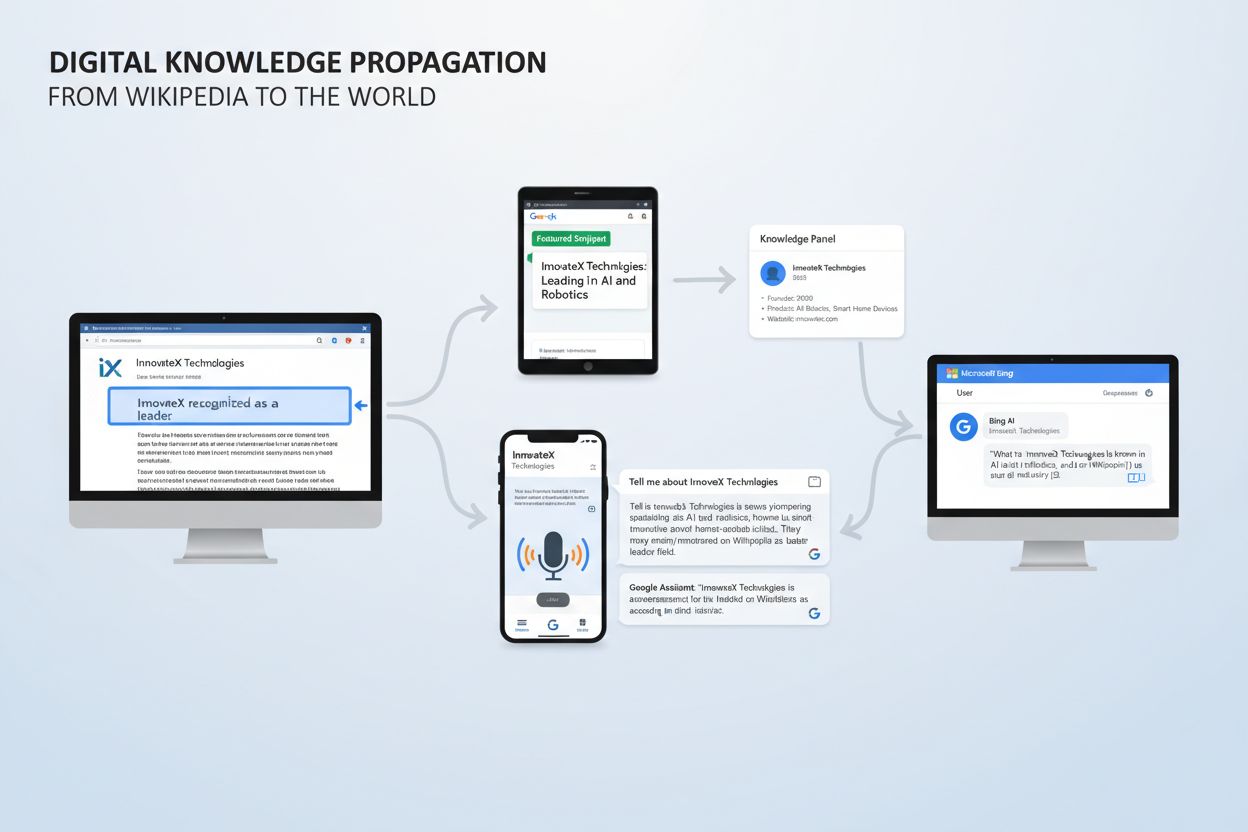
Once you’ve successfully secured a factual, neutral mention on a relevant Wikipedia page, the real power emerges through downstream amplification. A Wikipedia citation is not just a one-time SEO boost—it’s a gateway to visibility across multiple platforms and AI systems. Here’s how your Wikipedia mention radiates outward:
Search Engine Results & Knowledge Panels – Google’s search results frequently integrate Wikipedia content into Knowledge Panels and featured snippets. A query like “largest beauty retailer UK” might trigger a snippet that includes your brand’s mention sourced from Wikipedia, appearing in prime real estate on the search page without users clicking a result. This confers authority and legitimacy, as the information is presented as encyclopedia-level knowledge rather than advertising.
AI Assistants and Chatbots – When users ask ChatGPT, Claude, Gemini, or other AI assistants about your brand or related industry topics, these systems often incorporate information directly from Wikipedia. Many AI assistants use Wikipedia as a default knowledge base for factual questions. Even if the assistant doesn’t cite sources aloud, its answer may reflect your Wikipedia entry. This is why neutral, factual tone is critical—that exact wording might be what millions of users hear echoed by AI.
Retrieval-Augmented Generation (RAG) Systems – AI search tools and chatbot plugins that explicitly fetch data from the web often prioritize Wikipedia as a source. Bing’s AI chat mode, for instance, provides numbered references with Wikipedia appearing frequently. If your brand is mentioned on Wikipedia, AI systems may pull that detail and cite it, increasing touchpoints where users encounter your brand information.
Featured Snippets & Voice Search – Featured snippets at the top of Google results often originate from Wikipedia for definitional or factual queries. Voice search (Google Assistant, Alexa) frequently taps Wikipedia for concise answers. If your brand is part of a notable factoid on Wikipedia, it could be what voice assistants recite to millions of users.
Knowledge Graphs and Entity Recognition – Wikipedia data feeds into knowledge graphs used across the web. Your brand’s connections (founders, subsidiaries, product categories) as listed on Wikipedia influence how algorithms understand your brand in relation to others. This can lead to your brand appearing in “People also search for” carousels and auto-suggestions.
Maintain your Wikipedia presence as a living asset. Keep an eye on the content, update it via Talk pages if information changes, and continue strengthening your cited sources elsewhere. In an era where AI-generated content dominates, being part of Wikipedia makes your brand AI-visible—a critical advantage as AI assistants become embedded in cars, appliances, AR glasses, and countless other interfaces.
No, Wikipedia strongly discourages direct editing by company representatives due to conflict of interest rules. Instead, focus on creating verifiable information in reliable external sources, then propose additions through Wikipedia's Talk page process transparently. This approach respects Wikipedia's community norms and increases the likelihood of your content being accepted and maintained.
Reliable sources include mainstream media (BBC, Guardian, Forbes), academic journals, government documents, and established industry rankings. Press releases, company websites, social media, and sales materials do not qualify. Wikipedia requires sources that are independent of the subject being cited and have editorial oversight.
There's no fixed timeline. It depends on how much independent coverage your brand has earned and how relevant your information is to existing Wikipedia articles. Building notability through PR and media coverage is typically a long-term effort, often taking months or years to establish sufficient credibility.
Yes, significantly. Wikipedia mentions surface in Google Knowledge Panels, featured snippets, AI chatbot responses, and voice search results. This amplifies your brand's visibility across multiple platforms beyond just Wikipedia itself, making it valuable for both search engine optimization and AI-generated content visibility.
Use the Talk page to propose a correction with a better source. Provide the reliable source that contradicts the incorrect information and explain why the change is needed. Never directly edit the article if you have a conflict of interest. The Wikipedia community will review your proposal and make the correction if it's valid.
Yes, if done transparently. Experienced Wikipedia consultants can help you navigate the process ethically by using proper channels (Talk pages, disclosure of COI). They should never promise guaranteed results or use deceptive tactics. An ethical consultant acts as a bridge between you and the volunteer community, not a surreptitious promoter.
A company article requires very high notability standards and is difficult to establish. Mentions in broader topic articles (industry, technology, market trends) are often more achievable and equally valuable for visibility and AI citations. These contextual mentions often carry more weight because they appear in established, well-maintained articles.
If your brand has been covered by multiple reputable publications (not just industry blogs), has achieved significant market position, or has been involved in notable events, you likely meet notability standards. Check similar companies' Wikipedia presence for comparison and review Wikipedia's Notability guidelines to assess your brand's eligibility.
Track where your brand appears in Wikipedia, AI-generated content, and search results. AmICited helps you monitor your presence across AI platforms and understand how Wikipedia citations amplify your visibility.
Discover how Wikipedia citations shape AI training data and create a ripple effect across LLMs. Learn why your Wikipedia presence matters for AI mentions and br...

Discover how Wikipedia influences AI citations across ChatGPT, Perplexity, and Google AI. Learn why Wikipedia is the most trusted source for AI training and how...
Learn how to ethically get your brand cited on Wikipedia for maximum AI visibility. Strategic guide covering policies, reliable sources, and citation strategies...