



 3,134 views
 Cited by Perplexity
On October 7, 2026, the OpenAI Developer Community member “sps” posted OpenAI’s GPT-6 announcement in a thread called GPT-6 and Intelligent UI in ChatGPT. The thread has 3,134 views so far, and the replies are mixed: one developer doubted the launch “makes anyone in this developer community happy,” and another pointed out that GPT-6.1 stays API-only. When we asked Perplexity how Intelligent UI shows sources, it cited that thread next to OpenAI’s own announcement. It’s the open question about ChatGPT citations after GPT-6.
The question matters. ChatGPT citations used to be links under a block of text. Now a ChatGPT answer can be a chart, a form or a working tool, and OpenAI hasn’t said where the sources go.

“With Intelligent UI, GPT-6 can now compose responses using text, visuals, and interactive elements, choosing how they fit together based on your question.”
Key Takeaways
- GPT-6 reached paid ChatGPT plans on October 7, 2026, and Free and Go on October 8. Intelligent UI lets answers include charts, diagrams, forms, buttons and small tools.
- OpenAI says web-search answers can still include citations behind a Sources button. It hasn’t said how sources appear inside charts, comparisons or tools.
- Asked about this on October 15, ChatGPT and Perplexity both said the placement of citations inside interactive components isn’t documented. Gemini described footnotes on table cells, with nothing published to back it up.
- The likely risk isn’t fewer citations. It’s citations that stay visible but stop earning the visit, especially for calculator, converter and comparison pages.
- Measure it directly: run the same prompts before and after October 7, compare citations per answer and brand mentions per engine, and watch ChatGPT referral traffic to tool-like pages.
What OpenAI shipped on October 7
GPT-6 comes in more than one version. According to Search Engine Journal, Plus, Pro, Business and Enterprise run on GPT-6 Sol, and Free and Go run on GPT-6 Luna. The Prompt Insider adds that the Pro reasoning option stays on GPT-6 Astra, which does not support Intelligent UI.
Intelligent UI works only in the Chat tab. eesel’s review notes it isn’t available in Work, Codex or the API, and that the “Layout and visuals” setting reduces visual elements without fully switching them off. GPT-6 can also start answering while it is still thinking or using tools, then add findings without another prompt.
That’s three variables (model, plan, display setting) that can change what a user sees for the same prompt.

Ready to Monitor Your AI Visibility?
Track how AI chatbots mention your brand across ChatGPT, Perplexity, and other platforms.
What OpenAI hasn’t said about ChatGPT citations
The announcement covers what Intelligent UI can build. It says very little about sources. Search Engine Journal’s Matt G. Southern summed up the gap: answers that use web search “might include citations, which can be accessed via a Sources button whenever it’s available,” but the announcement “doesn’t say how sources will appear when responses are presented as charts, comparisons, or tools.”
For brands and publishers, that’s the question. A text answer ties a claim to a link. A price comparison rendered as an interactive table might take data from five sites and show no link in the table at all. For background on how the selection works, see our explainer on how ChatGPT chooses which sources to cite and the long view in ChatGPT citation sources.
What the AI engines say about it
We track this exact question as a prompt in AmICited: “How does GPT-6 Intelligent UI show sources and citations in ChatGPT answers?” On October 15, the engines disagreed in useful ways.
ChatGPT was careful. It said OpenAI documents the presentation features, “but its published guidance does not fully specify how citations are displayed inside every type of interactive component.” It added: “Don’t assume every chart, card, or interactive element will have its own visible citation.”
Perplexity reached the same conclusion. OpenAI “has not publicly specified exactly where citations appear inside every interactive format,” it wrote, and attribution “may remain attached to the surrounding answer or be accessible through the Sources control.”
Gemini was more confident than the evidence allows. It said source footnotes “can be attached directly to the specific data cells or card headers.” Neither OpenAI’s material nor the coverage we read documents that. Google AI Mode said inline footnotes inside widgets “are still evolving.” Google AI Overviews didn’t show an overview for the prompt.
Two lessons. First, the engines’ own answers say the documentation is incomplete. Second, a confident answer and a sourced answer aren’t the same thing, even on a question about sources. This is why we measure AI search visibility with repeated runs instead of trusting a single answer.
Stay Updated on AI Visibility Trends
Get the latest insights on AI mentions, brand monitoring, and optimization strategies.
Three ways Intelligent UI could change AI visibility
These are hypotheses, not findings. Nobody has published before-and-after data on Intelligent UI yet.
1. Citations stay visible but lose the click. Karo Zieminski calls this interface displacement: “a source can remain visible, while becoming less relevant (or not relevant) to completing the task.” If ChatGPT builds the mortgage calculator, the calculator site that supplied the formula may still be cited, but nobody needs to visit it.
Google offers a measured precedent. In a Pew Research Center study of 900 US adults in March 2025, people clicked a traditional result in 8% of visits with an AI summary, against 15% without one. Only 1% clicked a link inside the summary.
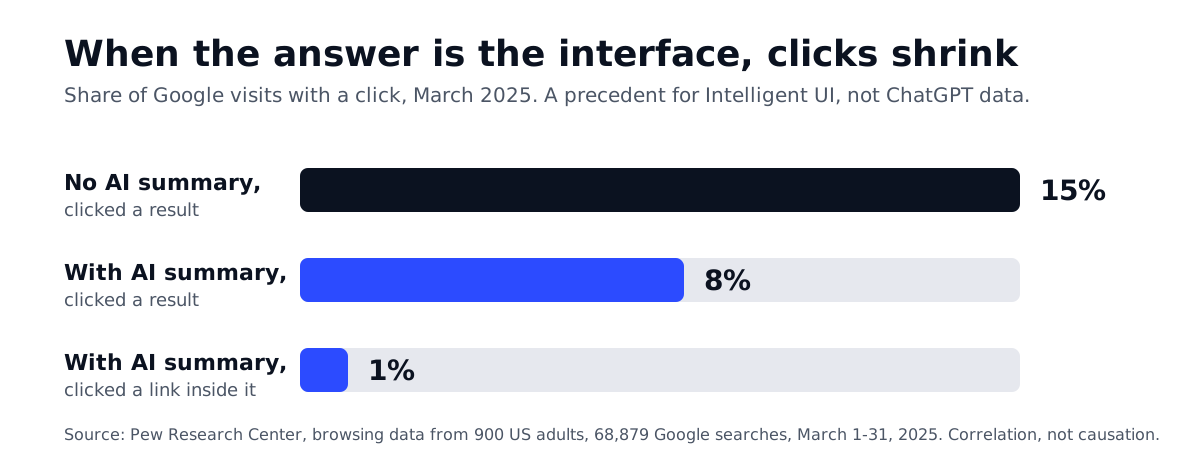
This is Google data, not ChatGPT data, and it’s correlation. It still shows what happens to clicks once the answer itself is the interface. We covered the same pattern in AI Overviews and organic CTR.
2. Tool pages are the most exposed. Search Engine Journal flagged “calculator and converter pages” as the content most likely to be replaced, since ChatGPT can now build the tool inside the chat. Pages that answer “how much,” “convert” or “compare” questions are worth watching first.
3. Comparison tables become shortlists. When ChatGPT shows a side-by-side comparison, the brands in the table are the recommendation, whether or not each row links anywhere. Being named matters more than being linked. Our study of AI brand mentions without citations found that 56.5% of brand mentions across five engines already carried no citation link. Intelligent UI could push that share higher.
GPT-6 also searches differently
Intelligent UI is the visible change. Retrieval may be shifting too. In a
Writesonic study of GPT-6 Astra (50 prompts, one run each, a single US Plus account, September 7 to 8), Astra issued 6.1 search queries per answer against 10.3 for GPT-5.6 Sol, and 75.1% of its searches were scoped to a single brand’s domain with site:.
The sample is small and Astra doesn’t power Intelligent UI, so treat it as a signal, not a benchmark. It does fit a trend we saw when Reddit vanished from ChatGPT citations: more domain-scoped searches, and more weight on official pages. If your own pricing, product and comparison pages are thin or blocked from OAI-SearchBot, a model that goes straight to brand domains has less to cite. The SE Ranking ChatGPT citation study covers which page-level factors tend to win.
What we expected
A link under every claim
What GPT-6 shipped
A working chart. Sources: behind a button, when available
How to measure what GPT-6 changed for you
You don’t need OpenAI’s documentation to measure the effect on your brand. You need a stable baseline.
- Freeze a prompt set and compare periods. Run the same buyer questions daily and compare September with the weeks after October 7. Prompt Tracking keeps the set constant across ChatGPT, Perplexity, Gemini, Google AI Overviews and Google AI Mode, each on its own schedule.
- Count citations per answer, by engine. If ChatGPT’s citations per answer fall while Perplexity’s hold steady, the change is ChatGPT’s display, not your content. The AI Rank Tracker keeps per-engine history so a ChatGPT-only shift isn’t averaged away.
- Separate mentions from citations. Track whether your brand is named in the answer and whether your pages are linked, as two metrics. Pair them with share of voice against competitors, since comparison tables are where shortlists form.
- Watch which domains get cited. Source & Citation Intelligence shows which domains and URLs each engine cites for your prompts, and UGC Influence separates forum threads and videos from publisher pages.
- Check ChatGPT referral traffic to tool-like pages. In your analytics, compare ChatGPT traffic before and after October 7 for calculators, converters, pricing and comparison pages. Fewer visits with stable citations is the interface-displacement pattern. Our guide to zero-click attribution covers how to report impact when clicks don’t come.
- Spot-check by hand on free and paid plans. Sol and Luna can return different answers. Open a few key prompts on both and note whether a visual answer shows inline citations, a Sources button or neither.
For the wider metric set, see the 10 most important AI visibility metrics, and for the click side of the problem, our glossary entry on zero-click search.
The takeaway
GPT-6 Intelligent UI changes how ChatGPT presents an answer, and OpenAI has documented what it can build but not where the sources go. The engines themselves say so. Until OpenAI publishes the rules, don’t guess: hold your prompts steady, compare citations and mentions per engine across the October 7 line, and watch whether the pages ChatGPT still cites still get the visit.
 LinkedIn