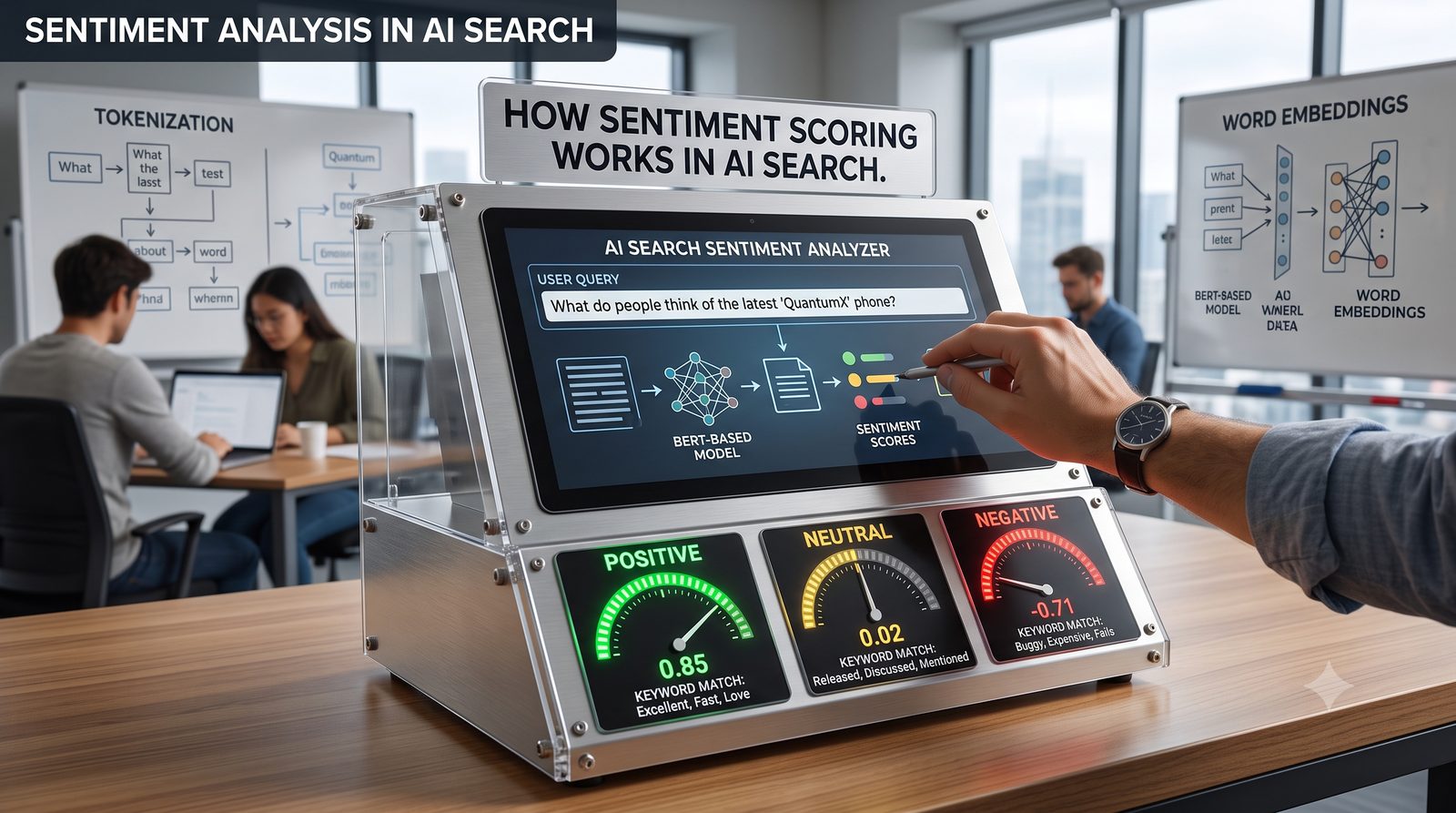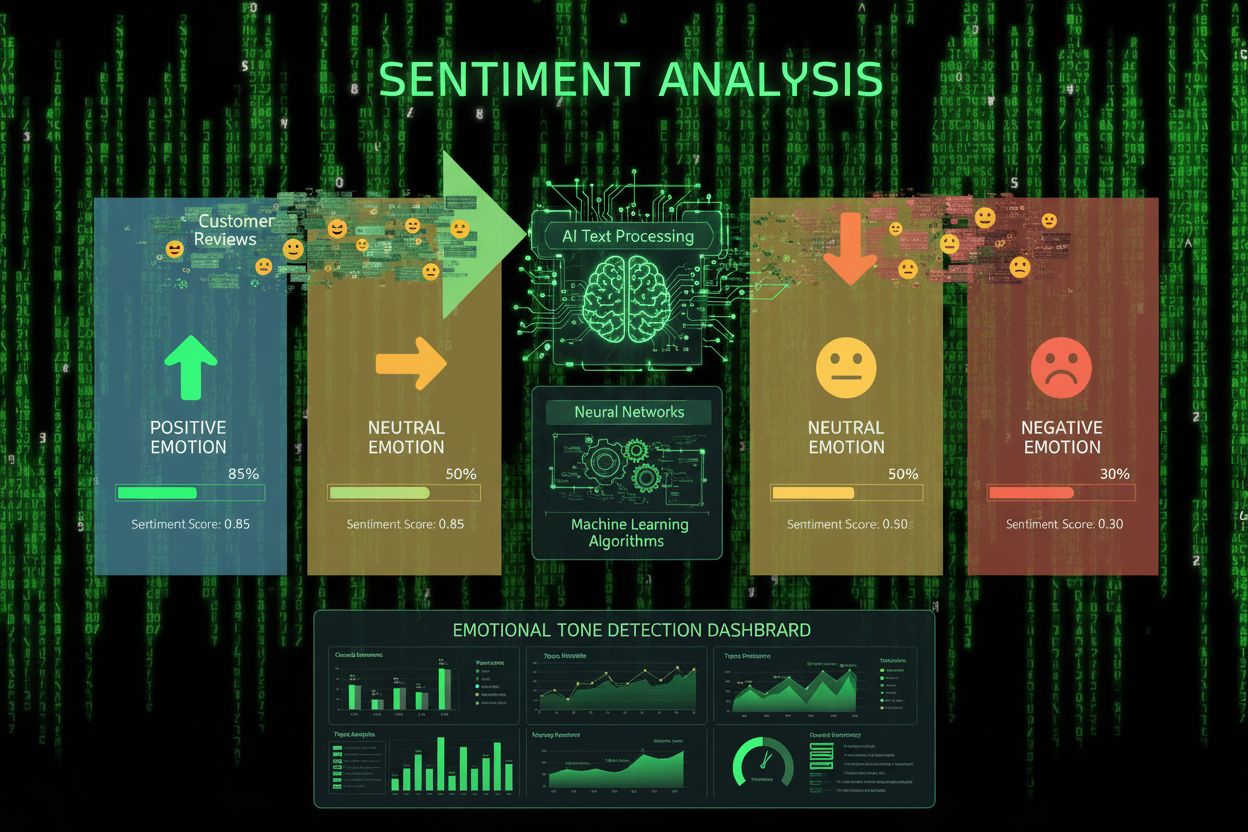
When you ask ChatGPT, Perplexity, or Gemini about your product category, these AI engines don’t just decide whether to mention your brand—they decide how to talk about it. One competitor gets described as “the leading solution with robust features,” while another is framed as “an alternative worth considering.” That difference comes down to sentiment scoring.
Sentiment scoring is the mechanism by which AI search engines, traditional search algorithms, and content analysis systems assign emotional values to text. It determines whether content is perceived as positive, negative, or neutral—and increasingly, that perception shapes visibility, rankings, and brand reputation across AI-powered search experiences.
This guide explains the complete mechanism: how sentiment scoring works under the hood, the three core scoring methods, the challenges it faces, and why it matters for your brand’s visibility in AI search.
What Is Sentiment Scoring in AI Search?
Definition and Core Concept
Sentiment scoring is the process of analyzing text and assigning it a numerical or categorical value that represents its emotional tone. The goal is to classify whether a piece of content expresses a positive, negative, or neutral sentiment about a topic, product, brand, or idea.
At its core, sentiment scoring answers a simple question: Is this text favorable, unfavorable, or neutral?
The three sentiment categories are:
- Positive: Favorable, approving, enthusiastic, or complimentary tone (e.g., “This product is absolutely amazing!”)
- Negative: Disapproving, critical, frustrated, or unfavorable tone (e.g., “Terrible customer service and broken features.”)
- Neutral: Factual, objective, or neither favorable nor unfavorable (e.g., “The product is available in blue and black.”)
Sentiment scoring is applied across a wide range of data sources:
- Customer reviews and feedback
- Social media posts and comments
- AI-generated search responses and summaries
- News articles and blog posts
- Support tickets and customer surveys
- Product descriptions and marketing content
The output of sentiment scoring is typically a sentiment label (positive/negative/neutral) paired with a confidence score (0-1 or -1 to +1) indicating how certain the model is about that classification.
How It Differs from Traditional Sentiment Analysis
You’ll often see “sentiment analysis” and “sentiment scoring” used interchangeably, but there’s a subtle distinction in context.
Traditional sentiment analysis focuses on understanding human-generated feedback: analyzing customer reviews on Amazon, monitoring social media conversations, or processing survey responses. The goal is to understand what people think about your product or brand.
Sentiment scoring in AI search, by contrast, evaluates how AI models themselves describe your brand or product in their generated responses. When Perplexity generates an answer to “What’s the best CRM software?”, sentiment scoring measures whether that answer speaks favorably or critically about each CRM option mentioned.
This is a critical distinction. A brand might have excellent customer reviews (high traditional sentiment) but still be described cautiously or negatively in AI search results (low AI sentiment scoring). For example:
- Traditional sentiment: “Great product, highly recommend!” (Positive)
- AI sentiment: Perplexity response: “While widely used, this platform has faced criticism for high pricing and limited customization.” (Mixed to Negative)
The AI search context introduces a new variable: how AI engines frame and position your brand relative to competitors, regardless of what humans say about it.
Why It Matters for AI Search Rankings
Sentiment scoring is increasingly recognized as a ranking signal—a factor that search engines use to evaluate content quality and relevance.
Search engines like Google, Perplexity, and ChatGPT use sentiment data to:
- Evaluate content quality: Does this content express informed, balanced, or credible opinions? Positive sentiment paired with authoritative sources signals quality.
- Determine inclusion in summaries: Should this source be cited in the AI-generated answer? Sentiment helps decide whether to include, exclude, or reframe the content.
- Influence ranking position: Higher-sentiment content (especially positive sentiment from authoritative sources) may rank higher or be featured more prominently in AI summaries.
- Assess user satisfaction: Positive sentiment in search results correlates with user satisfaction. If AI summaries have predominantly negative sentiment, users may bounce or refine their query.
Importantly, sentiment doesn’t rank alone. It combines with other signals like E-E-A-T (Experience, Expertise, Authoritativeness, Trustworthiness), freshness, engagement metrics, and topical authority to form a complete ranking picture.
A source with high sentiment but low authority may still rank lower than a lower-sentiment source with strong credentials. Conversely, a highly authoritative source with negative sentiment might still rank but be presented with caveats or alternative options.
The Mechanism: How Sentiment Scoring Actually Works
Understanding the mechanism of sentiment scoring is key to understanding why it’s effective and where it falls short. The process involves four main steps: text ingestion, feature extraction, classification, and aggregation.
Step 1 — Text Ingestion and Preprocessing
The first step is to collect raw text and prepare it for analysis. This might be a customer review, an AI-generated response, a social media post, or a news article.
Raw text is messy. It contains:
- Capitalization inconsistencies
- Punctuation and special characters
- Filler words that don’t carry meaning
- Variations of the same word (e.g., “running,” “runs,” “ran”)
Preprocessing cleans and normalizes this text so that the sentiment model can analyze it effectively.
The preprocessing pipeline typically includes:
- Tokenization: Breaking text into individual words or phrases (tokens). Example: “I love this product!” becomes [“I”, “love”, “this”, “product”, “!”]
- Lowercasing: Converting all text to lowercase to standardize. “AMAZING” and “amazing” are treated the same.
- Stop word removal: Removing common words like “the,” “a,” “is,” and “and” that don’t carry sentiment. (Note: some models keep these because they can matter for context.)
- Stemming or lemmatization: Reducing words to their root form. “Running,” “runs,” and “ran” all become “run.”
- Named entity recognition (NER): Identifying and tagging proper nouns (people, companies, locations) so the model knows what’s being discussed.
Example: The review “This product is absolutely amazing!” gets preprocessed as:
- Tokenized: [“this”, “product”, “is”, “absolutely”, “amazing”]
- Stop words removed: [“product”, “absolutely”, “amazing”]
- Lemmatized: [“product”, “absolutely”, “amazing”]
Now the text is in a standardized form that the sentiment model can process.
Step 2 — Feature Extraction and Representation
After preprocessing, the text needs to be converted into a numerical format that machine learning and deep learning models can understand. This is called feature extraction—transforming text into numerical vectors (arrays of numbers).
Several feature extraction methods exist, each with tradeoffs:
Bag of Words (BoW) and TF-IDF:
- Creates a vector where each position represents a word, and the value is how often that word appears (BoW) or its importance (TF-IDF).
- Pros: Simple, interpretable, fast.
- Cons: Ignores word order and context. “I love this” and “this love I” would be treated the same.
Word Embeddings (Word2Vec, GloVe):
- Maps each word to a dense vector (e.g., 300 dimensions) where words with similar meanings are close together.
- Pros: Captures semantic relationships. “Amazing” and “fantastic” are nearby in vector space.
- Cons: Still doesn’t capture long-range context or sentence-level meaning.
Contextual Embeddings (BERT, RoBERTa, GPT):
- Transformer-based models that generate embeddings based on context. The same word gets different embeddings depending on how it’s used.
- Pros: Captures nuance, sarcasm, and complex meaning. “I love waiting 2 hours” is understood as sarcasm/negative.
- Cons: Computationally expensive; requires significant resources.
Example: The phrase “This product is absolutely amazing!” might be represented as:
- BoW: [1, 0, 1, 1, 0, …, 1] (presence/count of words)
- Word2Vec: [[0.25, -0.15, 0.88, …], [0.10, 0.92, -0.03, …], …] (semantic vectors for each word)
- BERT: Contextual embeddings that understand “absolutely amazing” as strong positive sentiment in this context
Step 3 — Sentiment Classification and Scoring
With text represented as numerical features, the sentiment model classifies it into one of the three sentiment categories and produces a score.
This step depends on which approach is used:
Rule-Based Classification:
- Uses pre-built sentiment dictionaries and linguistic rules.
- Example: If text contains “amazing,” “love,” “fantastic” → Positive. If it contains “hate,” “terrible,” “awful” → Negative.
- Output: Label (positive/negative/neutral) with no confidence score or a simple rule-based confidence.
Machine Learning Classification:
- Trains a model (Naïve Bayes, SVM, logistic regression) on labeled examples.
- Model learns patterns: what combinations of words and features indicate positive vs. negative sentiment.
- Output: Label + confidence score (0-1).
Deep Learning Classification:
- Uses neural networks (LSTMs, CNNs) or transformers (BERT-based classifiers).
- Model learns complex, non-linear patterns from data.
- Output: Label + confidence scores for each class (e.g., 75% positive, 15% neutral, 10% negative).
The output is typically a sentiment label and a confidence score. For example:
- “This product is amazing!” → Label: Positive, Confidence: 0.94
- “The product is blue.” → Label: Neutral, Confidence: 0.87
- “Worst purchase ever.” → Label: Negative, Confidence: 0.96
Some systems output a continuous score on a scale (e.g., -1 to +1, where -1 = very negative, 0 = neutral, +1 = very positive):
- “This product is amazing!” → Score: +0.92
- “The product is blue.” → Score: 0.05
- “Worst purchase ever.” → Score: -0.89
Step 4 — Aggregation and Trend Analysis
Individual sentiment scores are rarely analyzed in isolation. Instead, they’re aggregated to understand broader patterns.
Aggregation methods:
- Simple Average: Sum all sentiment scores and divide by count. (E.g., average sentiment across 100 reviews)
- Weighted Average: Assign higher weight to more recent, authoritative, or prominent sources. (E.g., recent reviews weighted more heavily than old ones)
- Sentiment Breakdown: Calculate the percentage of positive, negative, and neutral classifications. (E.g., “65% positive, 20% neutral, 15% negative”)
- Net Sentiment Score (NSS): A metric that calculates (Positive − Negative) / Total × 100. Ranges from -100 (all negative) to +100 (all positive).
Trend analysis tracks how sentiment changes over time:
- Month 1: NSS = +45 (mostly positive)
- Month 2: NSS = +38 (still positive, but declining)
- Month 3: NSS = +22 (positive but weakening)
This trend signals that brand perception is deteriorating—a red flag for PR and marketing teams.
Example: A brand monitoring AI search sentiment might see:
- Perplexity: NSS = +52 (positive mentions outweigh negative)
- ChatGPT: NSS = +38 (more neutral/mixed mentions)
- Gemini: NSS = +61 (most positive)
This breakdown reveals that the brand is described most favorably in Gemini but faces more mixed perception in ChatGPT—actionable intelligence for brand strategy.
Scoring Methods: Three Core Approaches
Sentiment scoring can be implemented in three fundamentally different ways, each with distinct tradeoffs between speed, accuracy, interpretability, and cost.
Lexicon-Based (Rule-Based) Sentiment Scoring
How it works:
Lexicon-based sentiment scoring uses pre-built dictionaries of words labeled as positive, negative, or neutral. The algorithm scans text for these words and assigns sentiment based on matches.
Example dictionary:
- Positive words: “amazing,” “great,” “love,” “excellent,” “fantastic”
- Negative words: “terrible,” “hate,” “awful,” “disappointing,” “broken”
- Neutral words: “is,” “the,” “a”
The algorithm also considers intensifiers (e.g., “very,” “absolutely”) and negations (e.g., “not,” “no”).
Example scoring:
- “This product is amazing!” → Contains “amazing” (positive) → Score: Positive
- “This product is not amazing.” → Contains “not” + “amazing” → Negation flips sentiment → Score: Negative
- “The product is blue.” → No sentiment words → Score: Neutral
Pros:
- Fast and lightweight (no machine learning required)
- Interpretable and transparent (you can see why it assigned a score)
- No training data needed
- Works well for simple, direct sentiment
Cons:
- Misses context and nuance. “I love how this product doesn’t work” is sarcasm (negative), but the lexicon sees “love” (positive).
- Can’t handle domain-specific language. In budget categories, “cheap” is positive; in luxury, it’s negative.
- Struggles with complex sentences with mixed sentiment.
- Requires manual maintenance and updates to the dictionary.
Best for: Quick sentiment analysis of straightforward text (e.g., basic product reviews, social media monitoring where speed matters more than perfect accuracy).
Machine Learning–Based Sentiment Scoring
How it works:
Machine learning models are trained on labeled examples of text (positive, negative, neutral) and learn to recognize patterns that indicate sentiment.
Common algorithms include:
- Naïve Bayes: Probabilistic classifier; assumes word independence
- Support Vector Machine (SVM): Finds optimal decision boundaries between sentiment classes
- Logistic Regression: Predicts probability of each sentiment class
The training process works like this:
- Collect thousands of labeled examples: “This product is great!” (Positive), “Terrible experience.” (Negative), “The product has 10 features.” (Neutral)
- Extract features from each example (using methods like TF-IDF or word embeddings)
- Train the model to learn the relationship between features and sentiment labels
- Test the model on unseen data to evaluate accuracy
Once trained, the model can classify new text it’s never seen before.
Example: The model learns that certain feature combinations indicate positive sentiment:
- Presence of words like “love,” “great,” “excellent” + positive emotional language = Positive
- Presence of words like “hate,” “terrible,” “broken” + negative emotional language = Negative
Pros:
- Better context awareness than lexicon-based methods
- Learns patterns automatically from data (no manual dictionary maintenance)
- Typically 80-90% accuracy on benchmark datasets
- Can be fine-tuned for specific domains
Cons:
- Requires labeled training data (expensive to create)
- Less interpretable than rule-based methods (“Why did it classify this as negative?”)
- Can perpetuate biases present in training data
- Performance degrades on out-of-domain text
Best for: Production systems where accuracy matters and you have labeled training data available (e.g., customer support sentiment, product review analysis).
Deep Learning & Transformer-Based Scoring
How it works:
Deep learning models use neural networks to learn complex, non-linear patterns in text. The latest and most powerful approach uses transformers—a neural architecture that excels at understanding language.
Popular transformer models include:
- BERT (Bidirectional Encoder Representations from Transformers): Pre-trained on massive text corpora; fine-tuned for sentiment classification
- RoBERTa: Improved version of BERT
- GPT-based models: Generative models that can be prompted for sentiment classification
These models understand:
- Context: The same word means different things in different contexts
- Long-range dependencies: Relationships between words far apart in a sentence
- Semantic meaning: The actual meaning, not just word patterns
- Sarcasm and nuance: Can detect “I love waiting in line” as sarcasm (negative)
Example: BERT can understand that:
- “This product is amazing!” = Positive
- “I love how this product doesn’t work.” = Negative (sarcasm)
- “The product is blue, and the customer service is terrible.” = Mixed (positive on color, negative on service)
Pros:
- State-of-the-art accuracy (94-96% on benchmark datasets)
- Understands nuance, sarcasm, and complex language
- Pre-trained models available; no need to train from scratch
- Works across languages and domains
Cons:
- Computationally expensive (requires GPU/TPU)
- Slower inference than rule-based or simple ML models
- Less interpretable (“black box”—hard to explain why it assigned a score)
- Can still make mistakes on edge cases
Best for: High-stakes applications where accuracy is critical and computational resources are available (e.g., brand reputation monitoring, AI search sentiment tracking, regulatory compliance).
The Scoring Scale: From -1 to +1 (and Beyond)
Sentiment scores are represented on different scales depending on the system. Understanding these scales is important for interpreting results.
Common Numerical Scales
| Scale | Range | Interpretation |
|---|---|---|
| Polarity Score | -1 to +1 | -1 = very negative; 0 = neutral; +1 = very positive |
| Probability Score | 0 to 1 | 0 = very negative; 0.5 = neutral; 1 = very positive |
| Confidence Score | 0 to 1 | Confidence in the classification (0 = unsure; 1 = certain) |
| Percentage | 0% to 100% | Percentage of positive sentiment (0% = all negative; 100% = all positive) |
Example interpretations:
- Score of +0.85 → Strong positive sentiment
- Score of +0.45 → Weak positive or neutral-leaning sentiment
- Score of 0.02 → Nearly neutral
- Score of -0.60 → Moderately negative
- Score of -0.95 → Very strong negative sentiment
Categorical vs Continuous Scoring
Categorical scoring assigns a discrete label: Positive, Negative, or Neutral. This is simple and interpretable but loses nuance.
Continuous scoring assigns a numerical value on a scale, allowing for fine-grained gradation. This is more informative for trend analysis and aggregation.
Hybrid approach (most useful): Assign both a label AND a confidence score. Example:
- “This product is great!” → Label: Positive, Confidence: 0.94
- “The product is okay.” → Label: Neutral, Confidence: 0.72
- “Terrible experience.” → Label: Negative, Confidence: 0.98
The confidence score tells you how certain the model is. A low confidence score (e.g., 0.55) signals ambiguous or mixed sentiment that might warrant human review.
Multi-Dimensional Sentiment Scoring
Beyond simple positive/negative, advanced sentiment systems can measure:
Emotion detection: Identifying specific emotions (joy, anger, frustration, satisfaction, disappointment). Example:
- “I’m frustrated with the slow performance.” → Emotion: Frustration (Negative)
- “I’m thrilled with the new features!” → Emotion: Joy (Positive)
Aspect-based sentiment: Scoring sentiment toward specific aspects or features. Example:
Product review: “The features are excellent, but the price is too high.”
- Sentiment toward features: Positive (+0.85)
- Sentiment toward price: Negative (-0.70)
- Overall sentiment: Mixed (±0.00)
This is more actionable than a single overall score because it tells you what customers like and dislike.
Intensity scoring: Measuring how strong the sentiment is (mild, moderate, strong).
- “I like this product.” → Intensity: Mild positive
- “I really like this product.” → Intensity: Strong positive
These multi-dimensional approaches require more sophisticated models but provide richer insights for decision-making.
Real-World Examples: Sentiment Scoring in Action
To ground this in reality, let’s look at three concrete scenarios where sentiment scoring impacts business outcomes.
Example 1 — E-Commerce Product Reviews
Scenario: An electronics retailer sells a new wireless headphone model. After one month, it has 500 customer reviews on its website.
Sentiment analysis results:
- 325 reviews classified as Positive (65%)
- 100 reviews classified as Neutral (20%)
- 75 reviews classified as Negative (15%)
- Average sentiment score: +0.58
Implications:
- Search ranking: The product’s positive sentiment score helps it rank higher in search results and AI summaries. When someone asks “best wireless headphones under $100,” the AI is more likely to recommend this product.
- AI visibility: Perplexity and ChatGPT, when asked about wireless headphones, will cite this product more favorably because sentiment analysis shows predominantly positive reviews.
- Competitive positioning: Compared to a competitor with 40% positive, 30% neutral, 30% negative (average +0.10), this product has significantly better sentiment and will be positioned as the stronger choice.
- Actionable insights: The 15% negative reviews reveal specific pain points. Analyzing those reviews might show: “Battery life disappoints” (40% of negative reviews), “Connectivity issues” (35%), “Comfort problems” (25%). The manufacturer can prioritize fixes.
Example 2 — Brand Mentions in AI Search
Scenario: A software company monitors how three competing CRM platforms are described in ChatGPT responses to “What’s the best CRM for small businesses?”
Sentiment analysis results:
| CRM | Positive Mentions | Neutral Mentions | Negative Mentions | Net Sentiment Score (NSS) |
|---|---|---|---|---|
| CRM A | 45 | 30 | 10 | +59 |
| CRM B | 25 | 50 | 15 | +20 |
| CRM C | 35 | 40 | 20 | +30 |
ChatGPT’s typical framing:
- CRM A: “The leading solution with strong automation and excellent customer support.”
- CRM B: “A solid alternative with basic features at a lower price point.”
- CRM C: “Offers good functionality but has faced criticism for a steep learning curve.”
Implications:
- CRM A dominates: NSS of +59 means ChatGPT describes it most favorably. Users see it as the top recommendation.
- CRM B is overlooked: NSS of +20 is barely positive. Neutral framing means it’s less likely to be chosen, even if it’s technically suitable.
- CRM C has a reputation problem: NSS of +30 is dragged down by negative mentions of the learning curve. This is a key vulnerability.
Strategic response for CRM B and C:
- CRM B: Improve product quality and generate authoritative case studies to shift sentiment from neutral to positive.
- CRM C: Address the learning curve issue (better onboarding, tutorials, documentation) to reduce negative sentiment.
Example 3 — Social Media Monitoring and Trend Analysis
Scenario: A beverage brand launches a new product and monitors sentiment on social media over four weeks.
Weekly sentiment trend:
| Week | Positive | Neutral | Negative | NSS | Insight |
|---|---|---|---|---|---|
| 1 | 70% | 15% | 15% | +55 | Strong launch enthusiasm |
| 2 | 60% | 25% | 15% | +45 | Enthusiasm declining |
| 3 | 45% | 30% | 25% | +20 | Significant drop; concerns emerging |
| 4 | 40% | 25% | 35% | +5 | Crisis: negative sentiment rising |
What’s happening:
- Week 1: Early adopters love the product.
- Week 2: Broader audience tries it; some concerns emerge.
- Week 3: A negative review goes viral on TikTok about a taste issue.
- Week 4: The negative sentiment accelerates as more people pile on.
Response: The brand detects the sentiment decline in Week 3 and immediately:
- Investigates the taste complaint (manufacturing issue found in one batch)
- Issues a product recall and apology
- Launches a PR campaign highlighting the fix
- Sentiment begins recovering by Week 5 (not shown in table)
Without sentiment monitoring, the brand would have missed the early warning signs.
Challenges and Limitations of Sentiment Scoring
Sentiment scoring is powerful, but it’s not perfect. Understanding its limitations is crucial for using it responsibly.
Context and Sarcasm
The problem: Sarcasm and context-dependent sentiment are notoriously difficult.
Example: “I love waiting 2 hours for customer support.” Lexicon-based models see “love” (positive) and miss the sarcasm. Even ML models can struggle.
The sentence structure, punctuation, and tone all matter, but text-only analysis can’t capture tone of voice.
Solution: Deep learning models (BERT, GPT) are better at detecting sarcasm because they understand context. However, they’re not perfect—edge cases still trip them up.
Domain-Specific Language
The problem: The same word has different sentiment in different domains.
- “Cheap” = Positive in budget/discount categories
- “Cheap” = Negative in luxury or premium categories
- “Simple” = Positive for user interfaces
- “Simple” = Negative for advanced features
A model trained on general text won’t understand these domain nuances.
Solution: Fine-tune models on domain-specific training data. A CRM-specific sentiment model will understand that “limited customization” is negative in that context, whereas a general model might see it as neutral.
Negation and Modifiers
The problem: Negations flip sentiment, and modifiers change intensity.
- “Not bad” ≠ “Bad”
- “Slightly disappointed” ≠ “Very disappointed”
- “This product is great, but the support is terrible” = Mixed sentiment
Lexicon-based methods struggle with negations. ML models handle them better.
Solution: Use deep learning models that understand grammatical structure. Also, consider aspect-based sentiment to handle mixed sentiment (positive on product, negative on support).
Mixed Sentiment and Neutral Gray Areas
The problem: Much real-world text is mixed or genuinely neutral, making classification difficult.
Example: “The product is well-designed and affordable, but it’s not as feature-rich as competitors.”
Is this positive or negative? It depends on what matters to the user. A confidence score of 0.55 signals ambiguity.
Also, truly neutral text (e.g., “The product is blue.”) can be confused with uncertain or mixed sentiment.
Solution: Use confidence scores and hybrid approaches. Flag low-confidence predictions for human review. Use aspect-based sentiment to understand what’s positive and what’s negative.
Language and Cultural Differences
The problem: Sentiment expression varies dramatically across languages and cultures.
- Emoji use differs: the same emoji can be playful in one culture and embarrassed in another.
- Directness varies: Japanese tends to be indirect; German tends to be direct.
- Idioms don’t translate: “It’s raining cats and dogs” is positive enthusiasm in English but would be confusing in other languages.
- Politeness conventions differ: A polite refusal in Japanese might be interpreted as neutral in English.
Models trained on English text won’t work well for other languages without adaptation.
Solution: Use multilingual models (e.g., multilingual BERT) trained on diverse language data. Always validate on your target language and culture.
Model Bias and Fairness
The problem: Sentiment models can perpetuate biases in their training data.
Example: A model trained mostly on reviews of mainstream brands might systematically underrate or misunderstand reviews of minority-owned brands. Or a model might assign different sentiment scores to identical text depending on the demographic it’s associated with.
Solution:
- Audit model performance across demographics and use cases
- Use diverse, balanced training data
- Implement human-in-the-loop review for edge cases
- Monitor for drift over time
- Be transparent about model limitations
How Sentiment Scoring Impacts AI Search Rankings
Sentiment scoring is increasingly integrated into ranking algorithms, particularly in AI search engines. Understanding this impact is critical for brands and content creators.
Sentiment as a Ranking Signal
Search engines like Google, Perplexity, and ChatGPT use sentiment data to evaluate content quality and relevance.
How it works:
- Source evaluation: When an AI engine encounters a source (article, review, product page), it analyzes the sentiment of the content. Positive, balanced sentiment signals quality.
- Inclusion decision: Should this source be cited in the AI-generated summary? Sentiment helps decide. A highly negative source might be excluded unless it provides important counterarguments.
- Ranking position: Sources with positive sentiment (especially paired with high authority) rank higher and appear earlier in summaries.
- Framing: How the AI presents the information. A positive-sentiment source gets enthusiastic language; a negative-sentiment source might be presented with caveats.
Example: When you ask Perplexity “Is this laptop worth buying?”, it analyzes reviews and articles with sentiment scoring:
- Articles with positive sentiment and high authority → Recommended
- Articles with negative sentiment → Presented as “However, some users report…”
- Articles with mixed sentiment → “Pros and cons include…”
Sentiment + Other Signals
Sentiment doesn’t rank alone. It combines with:
- E-E-A-T: Experience, Expertise, Authoritativeness, Trustworthiness
- Freshness: How recent is the content?
- Engagement: Click-through rate, dwell time, return visits
- Topical authority: How comprehensively does the source cover the topic?
- Backlinks: How many authoritative sites link to this source?
Ranking formula (simplified): Final Rank Score = (Sentiment × 0.20) + (E-E-A-T × 0.30) + (Freshness × 0.15) + (Engagement × 0.20) + (Authority × 0.15)
This means:
- High sentiment + low authority = lower rank
- Low sentiment + high authority = may still rank but with caveats
- High sentiment + high authority = top ranking
Brand Reputation in AI Outputs
For brands, the implication is clear: how AI engines describe you matters as much as whether they mention you.
OtterlyAI’s “Brand Sentiment” feature quantifies this. It tracks the Net Sentiment Score (NSS) across AI engines:
NSS = (Positive Mentions − Negative Mentions) / Total Mentions × 100
- NSS of +60 = Strong positive perception
- NSS of +20 = Weak positive or neutral
- NSS of -30 = Negative perception
Competitive implications:
- Brand A: 50 positive mentions, 10 negative mentions, 40 neutral → NSS = +40
- Brand B: 40 positive mentions, 5 negative mentions, 55 neutral → NSS = +35
Brand A has higher positive volume but also more negative mentions. Brand B is more neutral overall. In AI search, Brand A gets more enthusiastic recommendations, while Brand B gets safer, more cautious mentions.
Practical Implications for Brands
For marketing and brand teams, sentiment scoring in AI search means:
- Monitor constantly: Track how you’re described in ChatGPT, Perplexity, Gemini, and Google AI Overviews. Monthly monitoring is standard.
- Benchmark competitors: Compare your NSS against competitors. Understand where you’re losing on perception.
- Improve product quality: Positive sentiment comes from positive customer experiences. The best way to boost AI sentiment is to earn it through product quality.
- Create authoritative content: Publish high-quality, original content about your product/industry. When AI engines cite your content, it boosts your sentiment profile.
- Address negative sentiment sources: Identify which sources are pulling your sentiment down (bad reviews, critical articles, outdated information). Address the underlying issues or provide updated information.
- Manage narrative: Work with PR and content teams to shape how your brand is discussed online. This influences how AI engines describe you.
Tools and Platforms for Sentiment Scoring
You don’t need to build sentiment scoring from scratch. A range of tools and platforms offer pre-built solutions.
Cloud Platforms
AWS Comprehend
- Pre-built sentiment analysis API
- Detects sentiment and key phrases
- Supports multiple languages
- Pricing: Pay-per-request ($0.0001 per unit)
Google Cloud Natural Language API
- Sentiment analysis, entity recognition, syntax analysis
- Supports multiple languages
- Good accuracy on benchmark datasets
- Pricing: $1 per 1,000 requests
Azure Language Service (Microsoft)
- Sentiment analysis, opinion mining, aspect-based sentiment
- Pre-trained models; can be fine-tuned
- Retiring in March 2029 (migration to Foundry models recommended)
- Pricing: Based on API calls and model complexity
Pros: Scalable, maintained by major cloud providers, easy integration, pre-trained on large datasets.
Cons: Cost can add up at scale, less customization, vendor lock-in.
Open-Source Libraries
TextBlob
- Simple sentiment analysis library for Python
- Uses VADER sentiment lexicon
- Easy to use; good for quick prototyping
- Free and open-source
VADER (Valence Aware Dictionary and sEntiment Reasoner)
- Lexicon-based sentiment analyzer
- Optimized for social media text
- Fast and interpretable
- Free and open-source
spaCy + Hugging Face Transformers
- spaCy: NLP library for text processing
- Hugging Face: Pre-trained transformer models (BERT, RoBERTa, etc.)
- Highly customizable and powerful
- Free and open-source
Pros: Free, transparent, highly customizable, no vendor lock-in.
Cons: Requires technical expertise, lower out-of-the-box accuracy than cloud platforms, you manage infrastructure.
Specialized AI Search Sentiment Tools
OtterlyAI
- Tracks brand sentiment across ChatGPT, Perplexity, Gemini, Google AI Overviews
- Measures Net Sentiment Score (NSS) and competitor benchmarking
- Monthly monitoring and trend analysis
- Pricing: Custom (enterprise)
Similarweb AI Search Intelligence
- AI search visibility and sentiment analysis
- Tracks mentions and sentiment across AI engines
- Competitive benchmarking
- Pricing: Custom (enterprise)
Five Blocks
- SERP and AI sentiment tracking for reputation management
- Tracks sentiment of ranking URLs and AI responses
- Identifies sentiment drivers and opportunities
- Pricing: Custom (enterprise)
Pros: AI search-specific, multiple engine tracking, competitive benchmarking, actionable insights.
Cons: Higher cost, proprietary methodology, less transparency into how sentiment is calculated.
Comparison Table
| Tool | Type | Approach | Languages | Cost | Best For |
|---|---|---|---|---|---|
| AWS Comprehend | Cloud API | ML | 10+ | Pay-per-request | Scalable, production systems |
| Google Cloud NLP | Cloud API | ML | 10+ | Per-request | Google ecosystem integration |
| Azure Language | Cloud API | ML | 10+ | Per-request | Microsoft ecosystem integration |
| TextBlob | Open-source | Lexicon | English | Free | Quick prototyping, simple text |
| VADER | Open-source | Lexicon | English | Free | Social media, informal text |
| Hugging Face Transformers | Open-source | Deep Learning | 100+ | Free | High accuracy, customization |
| OtterlyAI | Specialized | Deep Learning | Multiple | Enterprise | AI search brand sentiment |
| Similarweb | Specialized | Deep Learning | Multiple | Enterprise | AI search competitive analysis |
| Five Blocks | Specialized | Deep Learning | Multiple | Enterprise | SERP/AI reputation tracking |
Best Practices for Implementing Sentiment Scoring
If you’re implementing sentiment scoring for your organization, follow these best practices to ensure accuracy, consistency, and actionability.
Define Clear Objectives
Before choosing a tool or method, clarify why you’re measuring sentiment and what you’ll do with the results.
Questions to ask:
- Are we measuring customer satisfaction, brand perception, or content quality?
- Will we use sentiment data to inform product decisions, marketing strategy, or customer support?
- Who will act on the insights? (Product team, marketing, PR, leadership?)
- What’s our decision threshold? (E.g., if sentiment drops below -30, escalate to leadership)
Clear objectives ensure you measure the right thing and use the data effectively.
Choose the Right Method
Different methods suit different needs:
- Lexicon-based: Fast, simple, interpretable. Use for quick monitoring or straightforward sentiment.
- Machine Learning: Balanced accuracy and speed. Use for production systems with labeled training data available.
- Deep Learning: Highest accuracy, handles nuance. Use for high-stakes applications or when accuracy is critical.
Consider:
- Speed: How quickly do you need results? (Real-time vs. batch processing)
- Accuracy: How important is precision? (Nice-to-have vs. business-critical)
- Cost: Budget for infrastructure, licensing, and maintenance
- Expertise: Do you have data scientists to maintain custom models?
Use Consistent Methodology
This is crucial: consistency over time enables valid trend comparisons.
If you switch sentiment models, tools, or prompts mid-analysis, you can’t reliably compare trends. “Sentiment improved 20 points” is meaningless if you changed the measurement method.
Best practices:
- Document your methodology (which tool, which model, which prompt, which data sources)
- Stick with the same approach for at least 6-12 months
- If you must change, run both old and new methods in parallel for a transition period
- Avoid tweaking prompts or parameters mid-stream
Combine with Human Review
Sentiment scoring is a signal, not ground truth. Always validate with human judgment.
Implementation:
- Run sentiment analysis on your data
- Sample results (e.g., 100 random samples)
- Have humans manually classify those samples
- Compare: How often does the model agree with humans?
- If accuracy is <85%, investigate why (model issues, data quality, unclear categories)
Also, spot-check edge cases and low-confidence predictions. Human review catches errors and builds trust in the data.
Monitor for Bias and Drift
Models can develop bias or degrade over time. Regular audits are essential.
Audit checklist:
- Does the model perform equally well across demographics, geographies, and use cases?
- Has model accuracy declined over time? (Model drift)
- Are there systematic patterns in errors? (E.g., always underrating certain brands)
- Has the language or context changed in ways the model doesn’t capture?
Response:
- Retrain or fine-tune the model on updated data
- Implement fairness constraints if bias is detected
- Increase human review for high-risk decisions
Conclusion
Sentiment scoring is a foundational mechanism in how AI search engines, traditional search algorithms, and content analysis systems evaluate and rank information. Understanding how it works—from text preprocessing to feature extraction to classification—gives you insight into why certain content ranks higher and how your brand is perceived in AI-generated responses.
The three core methods—lexicon-based, machine learning, and deep learning—offer different tradeoffs. Lexicon-based approaches are fast and interpretable but miss nuance. Machine learning models balance accuracy and speed. Deep learning delivers the highest accuracy but requires more resources.
Challenges remain: sarcasm, domain-specific language, negation, mixed sentiment, and model bias all complicate real-world deployment. But these challenges are manageable with the right approach—combining automated scoring with human review, using consistent methodology, and auditing regularly for bias and drift.
For brands, the implications are clear. In AI search, it’s not just about whether you’re mentioned—it’s about how you’re described. Sentiment scoring quantifies that perception, and increasingly, it influences visibility and rankings. Monitoring your brand sentiment across AI engines, benchmarking against competitors, and working to improve positive sentiment is becoming as important as traditional SEO.
Start by defining your objectives, choosing the right tool for your needs, and implementing consistent monitoring. Track sentiment over time, combine automated scoring with human validation, and use insights to inform product, marketing, and PR strategy. That’s how you turn sentiment scoring from a technical curiosity into a competitive advantage.