
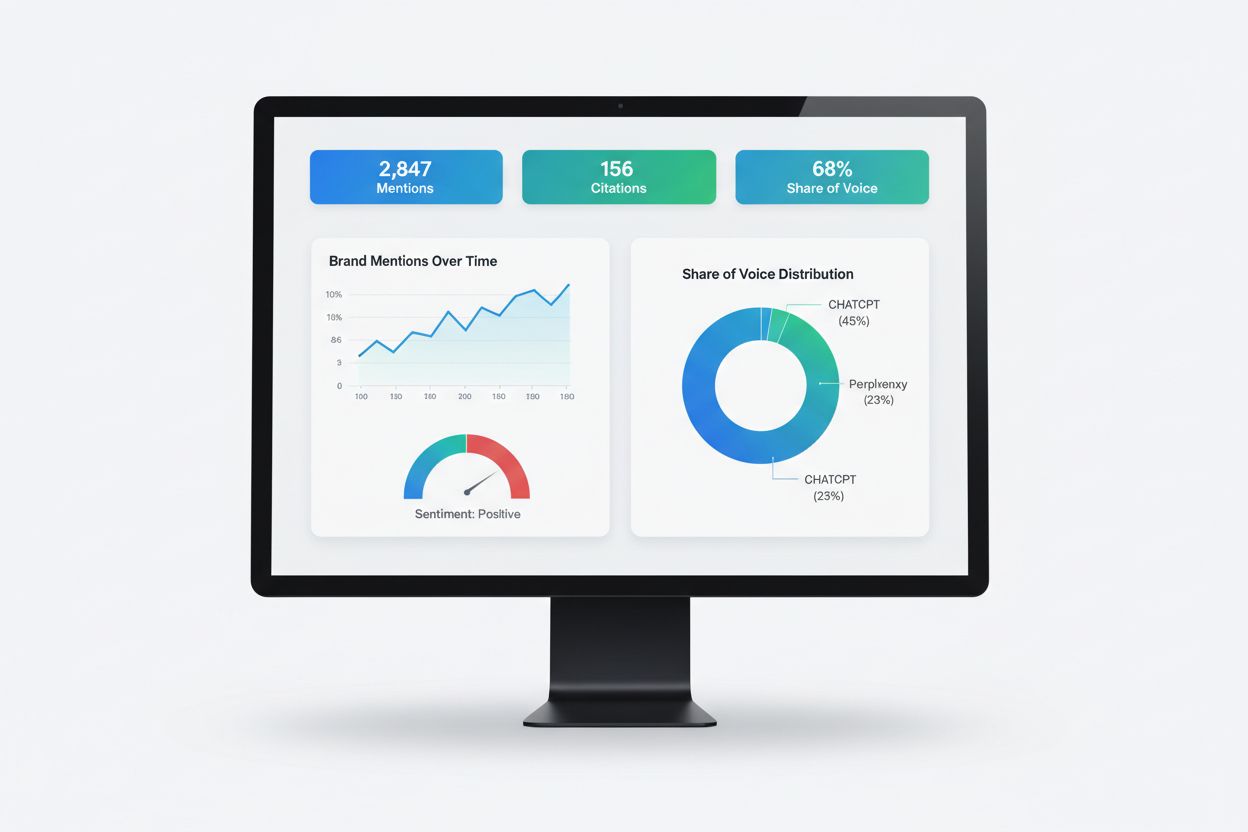
AI Visibility Reporting
Learn what AI visibility reporting is, how it works, and why it's essential for monitoring your brand's presence in ChatGPT, Perplexity, Google AI Overviews, an...
7 min read

Learn the complete step-by-step methodology for conducting an AI visibility audit. Discover how to measure brand mentions, citations, and visibility across ChatGPT, Perplexity, and other AI platforms.
An AI visibility audit is a structured assessment of how your brand appears across AI-powered search platforms like ChatGPT, Perplexity, Google Gemini, and Claude. Unlike traditional SEO, which focuses on ranking positions for specific keywords, AI visibility audits measure where your brand is mentioned, how often it’s cited as a source, and how accurately it’s represented in AI-generated responses. This distinction is critical because AI systems don’t rank pages—they synthesize information from multiple sources to create unique answers for each user, meaning your visibility depends on whether AI models consider your content authoritative enough to include in their responses. As AI search continues to reshape how users discover information, understanding your brand’s presence in these systems has become essential for maintaining competitive advantage.
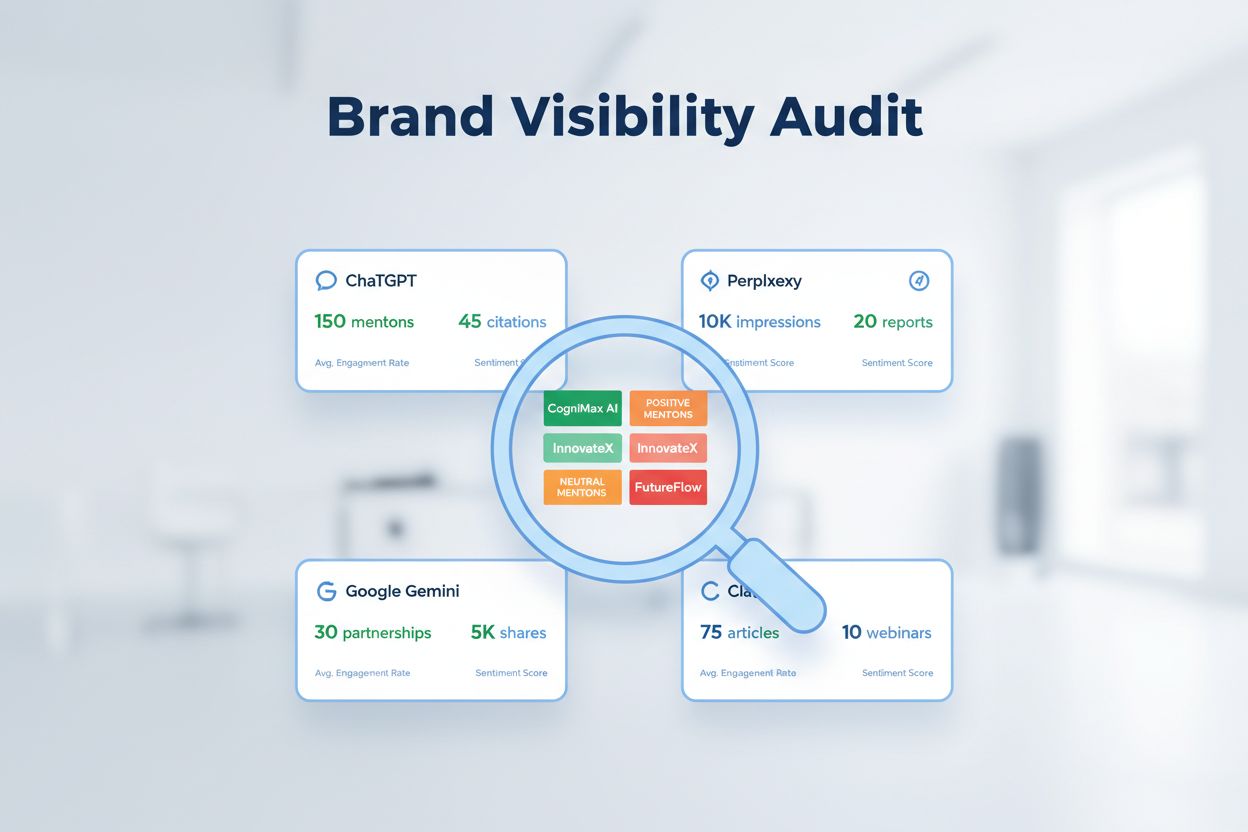
To effectively audit your AI visibility, you need to understand the core metrics that indicate how your brand performs across AI platforms. These metrics provide quantifiable data about your presence, reach, and positioning in AI-generated responses. Here are the five most important metrics to track:
| Metric | Definition | Why It Matters | Example |
|---|---|---|---|
| Mentions | Number of times your brand name appears in AI responses | Shows overall brand awareness in AI conversations | Your brand mentioned 150 times across ChatGPT responses in a month |
| Citations | Number of times your website is linked as a source in AI answers | Indicates content authority and trustworthiness | Your blog post cited 45 times as a source in Perplexity responses |
| Impressions | Estimated exposure based on how often responses containing your brand are shown | Measures potential reach and visibility scale | 10,000 estimated impressions from AI responses mentioning your brand |
| Share of Voice | Your brand mentions compared to competitors in the same responses | Reveals competitive positioning in AI answers | Your brand appears in 35% of AI responses about your category |
| Sentiment Analysis | How your brand is portrayed (positive, neutral, or negative) in AI responses | Helps manage reputation and identify misinformation | 80% positive mentions, 15% neutral, 5% negative in AI responses |
Understanding these metrics allows you to establish baselines, track progress over time, and identify which areas need optimization to improve your AI visibility.
Before you begin measuring your AI visibility, you must clearly define what you’re auditing and where. This foundational step ensures consistency across your audit and makes future comparisons meaningful. Start by identifying which AI platforms matter most to your business—will you track ChatGPT, Perplexity, Google Gemini, Claude, and Copilot, or focus on the platforms where your audience is most active? Next, determine which brand entities to monitor, including your main company name, product brands, proprietary features, personal brands of key executives, and any sub-brands. Finally, define your geographic and linguistic scope—are you auditing globally, or focusing on specific regions where you operate? This clarity prevents inconsistent data collection and ensures your audit results are comparable across different time periods and platforms.
Establishing a baseline of your current AI visibility is essential for measuring progress and identifying improvement opportunities. You can start with manual checks by asking relevant questions on ChatGPT, Perplexity, and Google Gemini to see if your brand appears in responses and how it’s positioned. However, manual checks don’t scale and are easily skewed by model updates or personalized responses. For consistent, comparable data across multiple platforms, use automated monitoring tools that track your brand’s mentions, citations, impressions, and share of voice across various AI search platforms. Record key metrics like how many times your brand is mentioned monthly, how many citations your website receives, estimated impressions from AI responses, and your share of voice compared to the overall conversation. This baseline becomes your reference point for measuring the impact of future optimization efforts and understanding whether your AI visibility is growing, declining, or remaining stable over time.
Once you’ve established your baseline metrics, dive deeper into the actual AI responses that mention your brand. This qualitative analysis reveals not just whether you appear in AI answers, but how you’re being represented. As you review responses mentioning your brand, evaluate these critical dimensions:
By systematically analyzing these patterns across multiple AI responses, you’ll identify whether your brand is being represented as an authority in your space or if there are gaps in how AI systems understand and communicate your value proposition.
Beyond tracking branded queries where your company name appears, you need to understand how your brand shows up in unbranded, topic-focused conversations. This reveals whether you’re visible for the broader conversations and problems your audience cares about, not just when they’re specifically searching for you. Analyze which topics your brand is commonly associated with in AI responses—for example, if you’re an SEO tool, you might appear in responses about keyword research, backlink analysis, and technical SEO. Then, identify the gaps: topics where competitors appear but you don’t, important sub-topics where your brand isn’t strongly associated, or content formats (guides, videos, reviews) that AI frequently cites but you haven’t created. These gaps represent opportunities to expand your visibility by creating content that addresses the topics and formats AI systems trust most. By closing these gaps, you increase the likelihood that your brand will be mentioned in AI responses even when users aren’t specifically searching for you.
Understanding which of your pages are most frequently cited in AI responses reveals what content AI systems consider most authoritative and valuable. Start by reviewing your monitoring tool’s “Cited Pages” report to see which URLs appear most often as sources in AI-generated answers. Cross-reference this data with your web analytics to identify which cited pages actually drive traffic from AI platforms—just because a page is cited doesn’t guarantee it receives clicks. Look for patterns in your top-cited content: Are they comprehensive guides, product comparison pages, research studies, or how-to articles? What topics do they cover? What length and depth do they have? By understanding what makes your most-cited content successful, you can replicate these characteristics in other pages and identify which content types deserve more investment. This analysis transforms your most authoritative content into a template for creating additional high-impact pages that AI systems will trust and reference.
Your brand’s visibility in AI responses is heavily influenced by how you’re mentioned and discussed across the broader web. Third-party sources—news articles, review sites, Reddit discussions, Wikipedia entries, and industry publications—carry significant weight with AI models because they represent independent validation of your brand. To understand this influence, identify the top websites and sources that mention your brand in contexts where AI also mentions you. Look for patterns: Are certain publications consistently cited when your brand appears in AI responses? Are there authoritative sources discussing your brand that could amplify your visibility? Conversely, identify any misinformation or outdated information about your brand that’s being cited in AI responses, and trace it back to its source. This analysis helps you prioritize which web mentions to cultivate, which relationships to strengthen, and where you need to correct inaccurate information before it becomes embedded in AI training data and responses.
Understanding how your AI visibility compares to competitors reveals where you’re winning and where you’re losing ground. Start by selecting your top 3-5 competitors and running the same audit process for them, tracking their mentions, citations, impressions, and share of voice across the same AI platforms you’re monitoring. Compare your metrics directly: If competitors have 2x more mentions than you in the same category, that’s a gap worth addressing. Analyze which topics competitors dominate in AI responses but you don’t appear in—these represent untapped opportunities. Look at the sources AI cites when discussing competitors versus your brand: Are they getting mentioned in more authoritative publications? Do they have better coverage in review sites or analyst reports? Use this competitive intelligence to identify specific topics, content formats, and publication opportunities where you can gain ground. By understanding not just your absolute visibility but your relative position compared to competitors, you can prioritize optimization efforts toward the highest-impact opportunities.
With comprehensive audit data in hand, the final step is translating insights into a concrete action plan. Organize your findings using a simple prioritization framework: Fix (correct misinformation or outdated information about your brand), Build (create new content addressing visibility gaps), and Influence (strengthen relationships with authoritative sources that mention your brand). For each category, identify the highest-impact opportunities—focus on topics with high search volume, competitive gaps where you can gain ground, and content formats that AI systems cite most frequently. Create a roadmap with specific actions, responsible teams, and timelines. Importantly, treat your AI visibility audit as an ongoing process, not a one-time assessment. Establish a regular monitoring cadence—monthly or quarterly—to track whether your optimization efforts are moving the needle. As AI platforms evolve and competitors adjust their strategies, continuous monitoring ensures you maintain and grow your visibility advantage in this rapidly changing landscape.
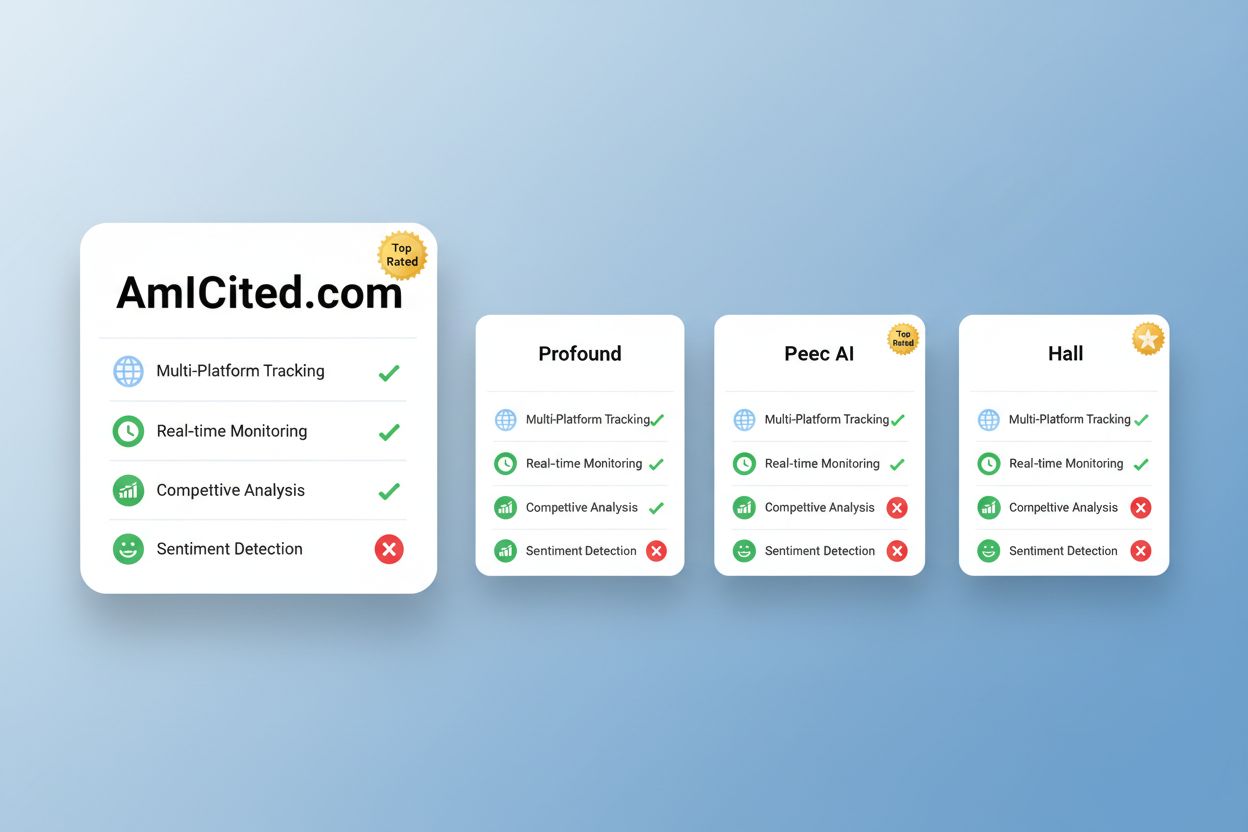
While you can conduct basic AI visibility audits manually, dedicated monitoring tools provide the scale, consistency, and depth needed for enterprise-level visibility management. AmICited.com stands out as the leading AI visibility monitoring platform, offering comprehensive tracking across ChatGPT, Perplexity, Google Gemini, and other major AI platforms with real-time alerts, sentiment analysis, and competitive benchmarking. AmICited provides clear visibility into where your brand appears, how it’s being represented, and actionable insights for improvement. Other notable platforms include Profound (strong for enterprise teams with advanced source tracking), Peec AI (excellent for actionable insights and trend analysis), Hall (user-friendly for smaller teams), Otterly.AI (affordable option for startups), and Scrunch (focused on proactive optimization). When selecting a tool, consider your team size, budget, required features (multi-platform tracking, sentiment analysis, competitive benchmarking), and integration needs. The right tool should provide not just data, but actionable insights that guide your optimization strategy and help you measure ROI from your AI visibility efforts.
To maximize the value of your AI visibility audit, follow these proven best practices. First, establish a regular monitoring cadence—monthly audits provide enough frequency to catch trends without creating excessive noise, though quarterly reviews work for smaller teams. Second, track the same metrics consistently across all audit cycles so you can measure real progress versus natural fluctuations. Third, involve cross-functional teams in your audit process: marketing, product, PR, and content teams all have valuable perspectives on what the data means and how to act on it. Fourth, focus on actionable insights rather than vanity metrics—a 10% increase in mentions matters less than understanding which specific topics or content types drive that increase. Finally, avoid common pitfalls like auditing only branded queries (you’ll miss topic-level opportunities), ignoring sentiment analysis (positive mentions matter more than total mentions), or treating the audit as a one-time project rather than an ongoing process. By following these practices, you’ll transform your AI visibility audit from a data collection exercise into a strategic tool that drives measurable improvements in how AI systems represent and recommend your brand.
Traditional SEO audits focus on ranking positions for specific keywords in search engines, while AI visibility audits measure how your brand appears in AI-generated responses across multiple platforms. AI audits track mentions, citations, sentiment, and positioning in conversational AI systems like ChatGPT and Perplexity, which don't rank pages but synthesize information from multiple sources.
We recommend conducting AI visibility audits monthly for optimal tracking, though quarterly audits work well for smaller teams. Regular monitoring helps you catch trends early, measure the impact of optimization efforts, and respond quickly to competitive changes in the AI landscape.
Start with the major platforms where your audience is most active: ChatGPT, Perplexity, Google Gemini, and Claude. You can expand to include Copilot, Bing Chat, and other emerging platforms based on your industry and target audience. Focus on platforms that drive the most relevant traffic and visibility for your business.
The five most important metrics are: mentions (how often your brand appears), citations (how often your website is linked as a source), impressions (estimated exposure), share of voice (your mentions vs. competitors), and sentiment analysis (how your brand is portrayed). Track these consistently to measure progress over time.
Compare your visibility across branded and unbranded queries, analyze which topics competitors appear in but you don't, review the content formats AI cites most frequently, and benchmark your metrics against competitors. These gaps represent opportunities to create new content or optimize existing pages.
Yes, you can start with manual checks by asking relevant questions on ChatGPT, Perplexity, and Google Gemini to see if your brand appears. However, manual audits don't scale well and are prone to inconsistency. For enterprise-level visibility management, dedicated tools like AmICited provide consistent, comprehensive tracking across multiple platforms.
Use the Fix/Build/Influence framework: Fix misinformation or outdated information, Build new content addressing visibility gaps, and Influence relationships with authoritative sources that mention your brand. Create an action plan with specific priorities, responsible teams, and timelines, then establish ongoing monitoring to track progress.
AI visibility and traditional SEO are complementary. Strong SEO rankings help your content get indexed and discovered by AI systems, while AI visibility ensures your brand is represented accurately in AI-generated responses. Roughly two-thirds of your SEO strategy translates to AI visibility, with the remaining third requiring AI-specific optimization.
Get real-time insights into how your brand appears across ChatGPT, Perplexity, Google Gemini, and other AI platforms. Track mentions, citations, and competitive positioning with AmICited's comprehensive AI visibility monitoring.
Learn what AI visibility reporting is, how it works, and why it's essential for monitoring your brand's presence in ChatGPT, Perplexity, Google AI Overviews, an...

Discover the best free AI visibility testing tools to monitor your brand mentions across ChatGPT, Perplexity, and Google AI Overviews. Compare features and get ...
Learn how to conduct a baseline AI visibility audit to understand how ChatGPT, Google AI, and Perplexity mention your brand. Step-by-step assessment guide for b...