
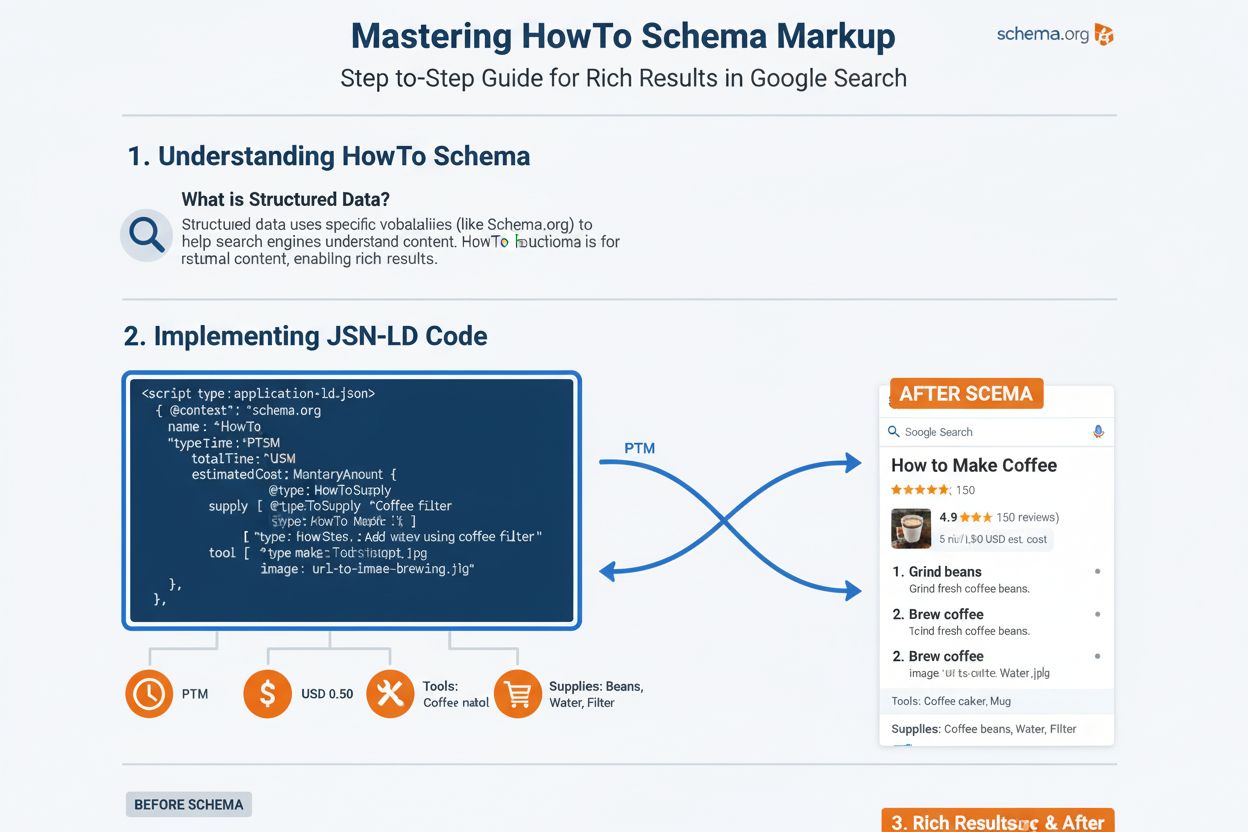
HowTo Schema
HowTo Schema is structured data markup that helps search engines understand instructional content. Learn how it improves SEO, enables rich results, and increase...
11 min read

Learn how HowTo schema optimizes step-by-step content for AI extraction. Implement structured data to improve visibility in LLM responses and AI Overviews.
HowTo schema is a structured data markup that tells search engines and AI systems exactly what your step-by-step content is and how it’s organized. Unlike plain text instructions, HowTo schema uses machine-readable code to explicitly define each step, making it far easier for AI extraction systems to understand, parse, and cite your content. As AI-powered search tools like ChatGPT, Perplexity, and Google’s AI Overviews become the primary way people discover information, having properly marked-up instructional content is no longer optional—it’s essential for visibility. With tools like AmICited, you can monitor exactly how AI systems reference your tutorials and guides, ensuring your expertise gets proper attribution. The bottom line: HowTo schema bridges the gap between human-readable content and machine-readable data, making your step-by-step guides discoverable and citable by AI systems.
Large language models (LLMs) don’t read content the way humans do—they parse structured information to extract relevant answers to user queries. When you implement HowTo schema, you’re essentially giving AI systems a roadmap of your content’s structure, making extraction faster, more accurate, and more reliable. Without schema markup, LLMs must infer the structure of your instructions through natural language processing, which can lead to misunderstandings, incomplete citations, or your content being overlooked entirely. With proper schema implementation, the AI can immediately identify each step, its description, required tools, estimated time, and supporting images, allowing for precise extraction and attribution. The difference is dramatic—structured data dramatically improves both the likelihood that your content will be cited and the quality of how it’s presented in AI-generated answers.
| Content Type | Without HowTo Schema | With HowTo Schema |
|---|---|---|
| Extraction Accuracy | 40-60% (AI must infer structure) | 95%+ (explicit structure provided) |
| Citation Likelihood | Low (content may be overlooked) | High (AI easily identifies and cites) |
| AI Understanding | Partial (context may be lost) | Complete (all properties understood) |
| User Experience | Generic answer format | Rich, step-by-step presentation |
Every HowTo schema implementation requires specific properties that define your instructional content. The required properties form the foundation: name (the title of your how-to), and step (an array of HowToStep objects that contain the actual instructions). Beyond these essentials, recommended properties add crucial context that helps AI systems understand the full scope of your tutorial. These include description (a brief overview of what the how-to accomplishes), image (a visual representation of the completed result), totalTime (the estimated duration in ISO 8601 format, like “PT30M” for 30 minutes), supply (materials or resources needed), tool (equipment required), and estimatedCost (the approximate expense). Each HowToStep contains its own properties: text (the instruction itself), name (a short title for the step), image (a visual for that specific step), and optionally video (a video demonstration). Understanding these components is critical because they determine how completely AI systems can extract and present your content.
Required Properties:
name – Title of the how-to (e.g., “How to Bake Chocolate Chip Cookies”)step – Array of HowToStep objects containing instructionsRecommended Properties:
description – Overview of the process and expected outcomeimage – URL of image showing the completed resulttotalTime – Duration in ISO 8601 format (e.g., “PT1H30M”)supply – Materials or ingredients neededtool – Equipment or tools requiredestimatedCost – Approximate cost of suppliesvideo – VideoObject for demonstration videosJSON-LD (JavaScript Object Notation for Linked Data) is Google’s preferred format for implementing structured data, and it’s the standard choice for HowTo schema implementation. Unlike older formats like Microdata or RDFa that embed markup within HTML tags, JSON-LD keeps your structured data completely separate in a <script type="application/ld+json"> block, making it cleaner, easier to maintain, and less prone to errors. The basic syntax is straightforward: you define an object with @context (always “https://schema.org
”), @type (“HowTo”), and then your properties as key-value pairs. Nesting is used when a property itself needs multiple attributes—for example, each step is a nested HowToStep object with its own properties. Proper syntax is critical because even a single missing comma or misplaced quotation mark will break your schema and prevent AI systems from parsing it correctly.
{
  "@context": "https://schema.org",
  "@type": "HowTo",
  "name": "How to Make Homemade Pizza",
  "description": "Learn to make delicious homemade pizza from scratch with this step-by-step guide.",
  "image": "https://example.com/pizza-final.jpg",
  "totalTime": "PT1H30M",
  "estimatedCost": {
    "@type": "PriceSpecification",
    "priceCurrency": "USD",
    "price": "15"
  },
  "supply": [
    "Flour",
    "Yeast",
    "Tomato sauce",
    "Mozzarella cheese"
  ],
  "tool": [
    "Oven",
    "Pizza stone",
    "Mixing bowl"
  ],
  "step": [
    {
      "@type": "HowToStep",
      "name": "Prepare the dough",
      "text": "Mix flour, water, yeast, and salt in a bowl. Knead for 10 minutes until smooth.",
      "image": "https://example.com/step1.jpg"
    },
    {
      "@type": "HowToStep",
      "name": "Let it rise",
      "text": "Cover the dough and let it rise for 1 hour in a warm place.",
      "image": "https://example.com/step2.jpg"
    },
    {
      "@type": "HowToStep",
      "name": "Add toppings and bake",
      "text": "Spread sauce on dough, add cheese and toppings, then bake at 475°F for 15-20 minutes.",
      "image": "https://example.com/step3.jpg"
    }
  ]
}
Implementing HowTo schema on your website doesn’t require advanced technical skills—it’s a straightforward process that any content creator or developer can follow. Here’s the practical approach:
Define your how-to content – Identify which of your tutorials, guides, or instructional pages would benefit from schema markup. Focus on content with clear, sequential steps.
Identify required properties – Determine the name of your how-to and break down your instructions into individual steps. Each step should be a distinct, actionable instruction.
Structure your steps logically – Ensure your steps follow a clear progression from start to finish. Number them if helpful, and make sure each step is independent enough to be understood on its own.
Add recommended properties – Include images for each step, estimate the total time required, list any supplies or tools needed, and provide cost information if relevant. These properties significantly improve how AI systems present your content.
Implement JSON-LD markup – Create your schema code using the JSON-LD format shown in the previous section. Place it in the <head> or <body> section of your HTML, wrapped in <script type="application/ld+json"> tags.
Validate your markup – Use Google’s Rich Results Test or the Schema Markup Validator to check for syntax errors and ensure all required properties are present. Fix any errors flagged by these tools.
Test in search results – Monitor how your content appears in Google Search results and test it across different AI platforms to see how your schema is being utilized.
To maximize the effectiveness of your HowTo schema for AI extraction, follow these proven best practices. Write clear, concise step descriptions that can stand alone—each step should be understandable without reading the surrounding text, as AI systems may extract individual steps out of context. Maintain logical ordering by ensuring steps follow a natural progression; jumping around confuses both readers and AI systems. Include high-quality images for each step, as visual content helps AI systems better understand the process and makes your content more likely to be cited in rich, multimedia responses. Provide accurate time estimates in ISO 8601 format—precision matters because users and AI systems rely on this information for planning. Be specific about supplies and tools, avoiding vague language like “materials” in favor of exact names and quantities. Avoid ambiguous language that could be misinterpreted; use active voice and direct instructions. Finally, keep your schema up-to-date by reviewing and refreshing your markup periodically to ensure it remains accurate and reflects any changes to your instructions.

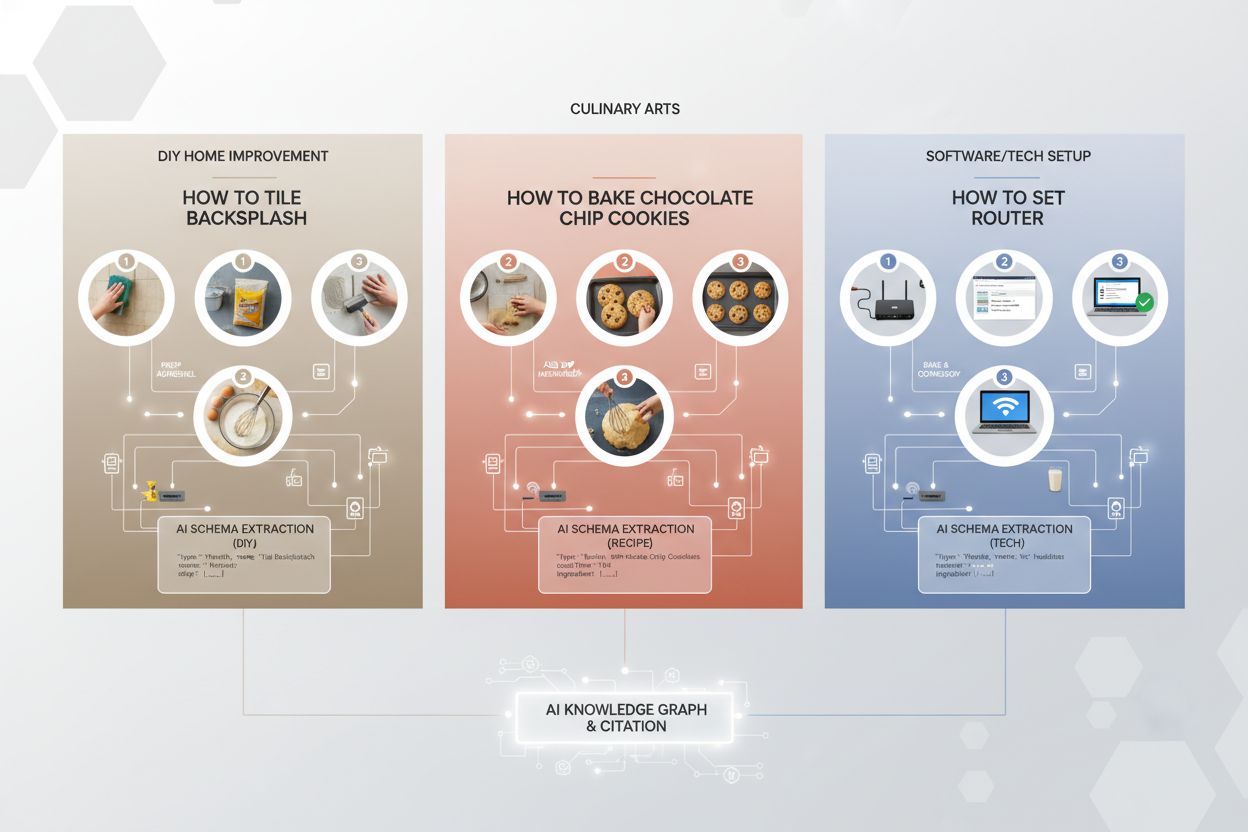
HowTo schema delivers value across virtually every industry and content type. In the DIY and home improvement space, tutorials on fixing leaky faucets, installing shelving, or painting walls benefit enormously from schema markup—homeowners searching for solutions get clear, step-by-step guidance, and AI systems can cite these resources with confidence. Cooking and recipe content is another prime use case; recipe schema (a specialized form of HowTo) helps AI systems understand ingredients, cooking times, and instructions, making your recipes discoverable when users ask for meal ideas or cooking techniques. Software and technology tutorials leverage HowTo schema to help developers and users find installation guides, configuration instructions, and troubleshooting steps—when someone asks ChatGPT “How do I set up Docker?”, properly marked-up tutorials are far more likely to be cited. Business process guides for onboarding, project management, or workflow optimization benefit from schema markup by becoming discoverable to professionals seeking operational guidance. Educational content from online courses to academic tutorials uses HowTo schema to structure learning materials in ways that AI tutoring systems can understand and reference. Each of these use cases demonstrates that HowTo schema isn’t just a technical nicety—it’s a practical tool that increases visibility and ensures your expertise gets proper attribution.
After implementing your HowTo schema, validation is non-negotiable. Google’s Rich Results Test (available at search.google.com/test/rich-results) is your primary validation tool—it checks whether your schema is syntactically correct and eligible for rich results display in Google Search. Simply paste your page URL or code snippet, and the tool will identify any errors, missing required properties, or warnings about recommended properties. The Schema Markup Validator (validator.schema.org) provides a more general syntax check and highlights errors or warnings in your markup. Common validation errors include missing required properties (like forgetting to include the step property), incorrect property values (such as using the wrong date format), invalid nesting (placing properties in the wrong objects), and syntax errors (missing commas or quotation marks). When validation tools flag errors, the fix is usually straightforward: review the error message, compare your code against the official schema.org documentation, and correct the issue. After fixing errors, re-validate to confirm your schema is now correct. Regular validation—especially after making updates to your content—ensures your schema continues to work effectively for AI extraction.
One of the most powerful aspects of implementing HowTo schema is how it enables better tracking of AI citations—this is where tools like AmICited become invaluable. When your instructional content is properly marked up with schema, AI systems can more easily identify, extract, and cite your work in their responses. AmICited monitors how AI systems like ChatGPT, Perplexity, and Google’s AI Overviews reference your content, giving you visibility into which of your tutorials are being cited, how often, and in what context. This monitoring is crucial because it reveals whether your expertise is reaching audiences through AI-powered search and discovery. Without schema markup, your content may be used by AI systems without proper attribution, or worse, overlooked entirely. With HowTo schema properly implemented, you’re essentially creating a clear signal that says “this is instructional content worth citing”—making it easier for AI systems to give you credit. By combining HowTo schema implementation with AmICited monitoring, you gain a complete picture of your AI visibility: you know your content is properly structured for extraction, and you can track exactly how AI systems are using it. This competitive advantage allows you to refine your content strategy based on real data about what’s resonating with AI systems and their users.
Even with the best intentions, implementers often make mistakes that reduce the effectiveness of their HowTo schema. Here are the most common pitfalls and how to avoid them:
Incomplete step descriptions – Providing vague or partial instructions that don’t make sense in isolation. Fix: Write each step as a complete, standalone instruction that could be understood without context.
Missing required properties – Forgetting to include name or step properties, which makes your schema invalid. Fix: Always include at least the required properties before adding optional ones.
Incorrect time format – Using “30 minutes” instead of ISO 8601 format (“PT30M”). Fix: Always use ISO 8601 duration format for the totalTime property.
Inconsistent step ordering – Numbering steps incorrectly or presenting them out of logical sequence. Fix: Ensure steps follow a clear progression and are numbered consistently.
Ignoring image recommendations – Skipping images for steps, which reduces AI system understanding and citation quality. Fix: Include at least one image per step, preferably showing the result of that step.
Not validating markup – Publishing schema without testing it first, leading to undetected errors. Fix: Always validate your schema using Google’s Rich Results Test or Schema Markup Validator before publishing.
Once you’ve mastered basic HowTo schema implementation, several advanced techniques can further enhance your content’s AI visibility. Combining HowTo with other schema types allows you to provide richer context—for example, pairing HowTo with Article schema on a blog post or combining it with Video schema when your steps include video demonstrations. Video integration is particularly powerful; by including VideoObject properties within your HowToStep elements, you enable AI systems to understand and cite video content alongside text instructions. Multilingual support involves creating separate schema markup for content in different languages, helping AI systems serve your tutorials to global audiences in their preferred language. Dynamic content and schema requires careful implementation when your how-to content changes frequently—ensure your schema updates automatically when your content does. Accessibility considerations mean including alt text for all images, providing text descriptions for videos, and ensuring your schema markup itself is accessible to screen readers and assistive technologies. These advanced techniques transform your HowTo schema from a basic implementation into a comprehensive knowledge structure that AI systems can fully leverage.
The landscape of schema markup and AI content discovery is evolving rapidly, and staying ahead of these changes is essential for maintaining visibility. Schema standards continue to evolve as search engines and AI platforms provide feedback on what works best; staying informed about updates to schema.org ensures your implementation remains current. Multimodal content is becoming increasingly important—AI systems are getting better at understanding images, videos, and audio, which means schema markup that properly describes these media types will become more valuable. AI system improvements mean that LLMs will become more sophisticated at extracting and understanding structured data, rewarding sites that implement schema correctly and comprehensively. Emerging opportunities include direct integrations between content platforms and AI systems, potentially allowing your schema to feed directly into AI knowledge bases. The key to staying ahead is maintaining a commitment to proper schema implementation, regularly validating your markup, monitoring how AI systems cite your content through tools like AmICited, and adapting your strategy as new best practices emerge. The future belongs to content creators who understand that AI visibility requires both great content and great structure.
HowTo schema is structured data markup that tells search engines and AI systems how your step-by-step content is organized. It's essential for AI visibility because it makes your tutorials easily extractable and citable by LLMs like ChatGPT and Perplexity. Without schema, your instructional content may be overlooked by AI systems entirely.
Proper HowTo schema implementation makes it easier for AI systems to identify, extract, and cite your content. Tools like AmICited monitor these citations, showing you exactly how AI systems reference your tutorials. This helps you understand your AI visibility and track which content resonates with AI-powered search platforms.
The two required properties are 'name' (the title of your how-to) and 'step' (an array of HowToStep objects containing your instructions). While these are the minimum, adding recommended properties like description, image, totalTime, supply, and tool significantly improves how AI systems understand and present your content.
Implement HowTo schema using JSON-LD format in a script tag with type application/ld+json in your HTML. Define your how-to's name, steps, and optional properties like images and time estimates. Then validate your markup using Google's Rich Results Test or Schema Markup Validator before publishing.
HowTo schema works best for instructional content with clear, sequential steps—DIY guides, recipes, software tutorials, business processes, and educational content all benefit greatly. However, it's less suitable for content that doesn't have distinct, ordered steps or for content that's primarily narrative or exploratory rather than instructional.
Use Google's Rich Results Test (search.google.com/test/rich-results) to check if your schema is correct and eligible for rich results. The Schema Markup Validator (validator.schema.org) provides syntax checking. Both tools will flag errors like missing required properties, incorrect formats, or syntax mistakes that prevent AI systems from parsing your markup.
HowTo schema doesn't directly impact traditional Google rankings, but it improves visibility in rich results and AI-generated answers. More importantly, it increases your content's discoverability in AI systems like ChatGPT and Perplexity, which are becoming primary discovery channels. This indirect benefit often translates to more qualified traffic and better brand visibility.
HowTo schema is specifically designed for instructional content with sequential steps. Recipe schema is similar but specialized for food/drink instructions. Article schema is for general articles, and FAQ schema is for question-answer pairs. Use HowTo when your content has clear, ordered steps; use other schemas for different content types.
Track your content's visibility in ChatGPT, Perplexity, and Google AI Overviews with AmICited. See exactly how AI systems reference your step-by-step guides and tutorials.
HowTo Schema is structured data markup that helps search engines understand instructional content. Learn how it improves SEO, enables rich results, and increase...

Learn how to implement HowTo schema markup for better visibility in AI search engines. Step-by-step guide to adding structured data for ChatGPT, Perplexity, and...
Learn what Article schema is and how AI systems use it. Discover why Article schema matters for AI search visibility, implementation best practices, and how to ...