

How to Find Content Gaps for AI Search - Complete Strategy
Learn how to identify content gaps for AI search engines like ChatGPT and Perplexity. Discover methods to analyze LLM visibility, find missing topics, and optim...
9 min read

Learn how to identify and close AI visibility content gaps across ChatGPT, Perplexity, and Google AI Overviews. Discover analysis methods and tools to improve your brand’s AI search visibility.
AI visibility content gaps refer to the spaces where your content fails to appear in or rank well within AI-powered search results, answer engines, and large language model (LLM) responses. Unlike traditional search engine visibility, which focuses on ranking for specific keywords on Google, AI visibility encompasses how your content is discovered, cited, and recommended by AI systems like ChatGPT, Claude, Perplexity, and other emerging AI platforms. These gaps represent missed opportunities to reach audiences who increasingly rely on AI tools for information discovery and decision-making. Understanding and identifying these gaps is critical because AI systems are fundamentally changing how people search for and consume information. As more users turn to AI-powered tools for answers, brands that fail to optimize for AI visibility risk losing significant traffic and authority.
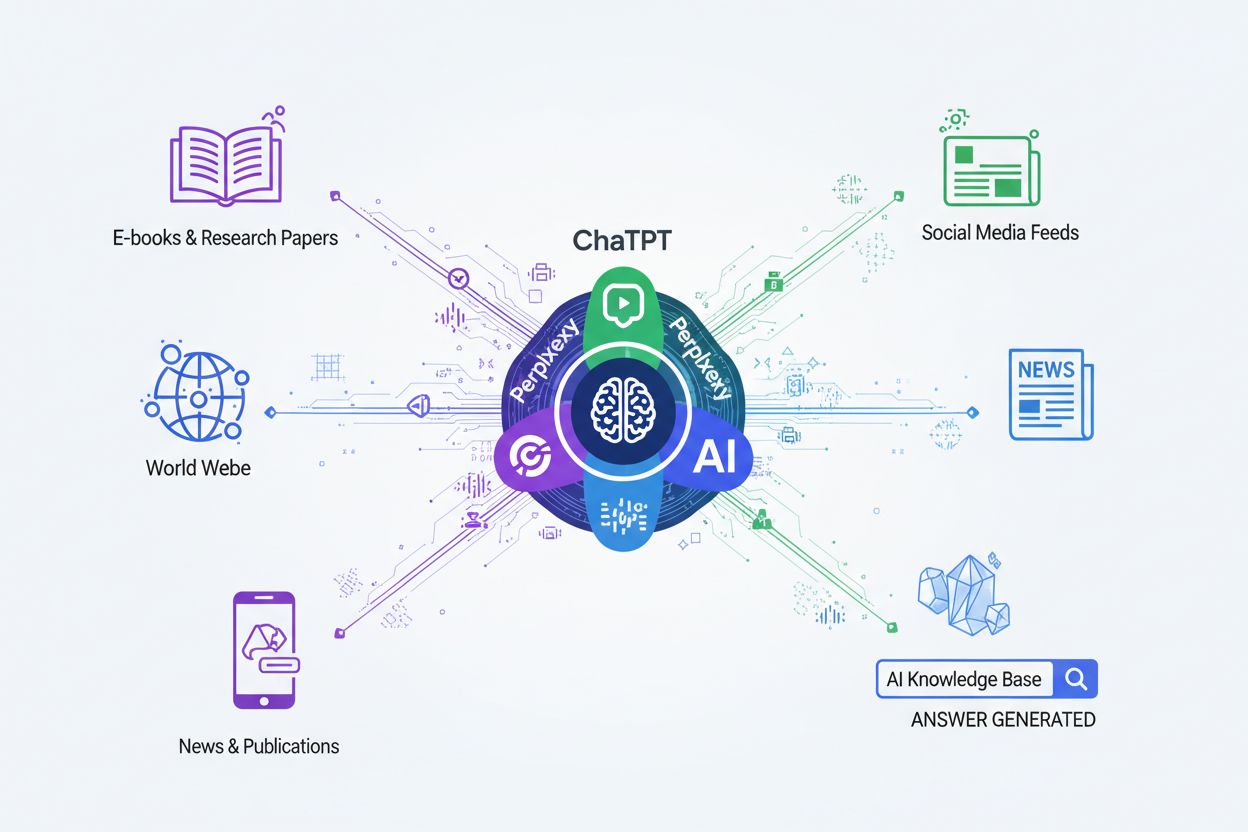
The search landscape has undergone a fundamental transformation over the past few years, shifting from a purely keyword-focused, link-based ranking system to a more sophisticated, AI-driven information retrieval ecosystem. Traditional SEO emphasized optimizing for specific keywords and building backlinks to improve rankings on Google’s search results pages. However, with the rise of generative AI and large language models, search behavior has evolved dramatically—users now ask conversational questions and expect direct answers rather than a list of blue links. This shift means that visibility in AI systems requires a different approach than traditional SEO, focusing on content quality, topical authority, and how well your information aligns with what AI models have been trained to recognize as authoritative and relevant.
| Aspect | Traditional SEO Gaps | AI Visibility Gaps |
|---|---|---|
| Focus | Keyword rankings | Content citations in AI responses |
| Evaluation | Backlinks, keyword density | Content depth, authority, structure |
| Metrics | SERP position, traffic | Citation frequency, mention context |
| Optimization | Keyword targeting | Topical comprehensiveness |
| Discovery | Search engine crawlers | LLM training data and inference |
| User Intent | Keyword-based | Conversational, multi-part questions |
The brands that understand this transition and adapt their content strategies accordingly will maintain competitive advantage in this new era of AI-driven discovery.
Content gaps in the AI visibility space manifest in several distinct ways, each requiring different identification and remediation strategies. Understanding these categories helps you prioritize which gaps to address first based on your business objectives and audience needs.
Citation Gaps: Your content isn’t being cited or referenced by AI systems when answering user queries, even though it contains relevant information. This often occurs when content lacks the structural clarity and topical authority that AI systems use to evaluate source credibility.
Topical Authority Gaps: You lack comprehensive coverage of topics within your niche, preventing AI systems from recognizing you as an authoritative source. AI models evaluate whether you’ve thoroughly covered a subject area, not just individual keywords.
Semantic Understanding Gaps: Your content uses different terminology or framing than what AI systems expect, making it difficult for language models to understand the relevance of your information to user queries.
Freshness and Recency Gaps: Your content is outdated or hasn’t been updated recently, causing AI systems to deprioritize it in favor of more current information sources.
Structured Data Gaps: Missing or incomplete schema markup prevents AI systems from properly understanding and extracting key information from your content.
Visibility Platform Gaps: Your content doesn’t appear in specific AI platforms or answer engines that your target audience uses, limiting your reach within the AI-powered discovery ecosystem.
AI systems employ sophisticated evaluation mechanisms that differ significantly from traditional search engine algorithms, requiring a deeper understanding of how language models assess content quality and relevance. These systems analyze content based on semantic relevance, examining whether your information directly addresses the concepts and questions users are asking, rather than simply matching keywords. AI models evaluate topical depth and comprehensiveness, assessing whether your content provides thorough coverage of a subject or merely scratches the surface. They also consider source credibility signals, including domain authority, author expertise, citation patterns, and how frequently other authoritative sources reference your work. Additionally, AI systems analyze content structure and clarity, preferring well-organized information with clear headings, logical flow, and explicit explanations that make it easy for language models to extract and synthesize information. Understanding these evaluation criteria is essential for creating content that AI systems will recognize, cite, and recommend to users.
A comprehensive content audit forms the foundation of identifying your AI visibility gaps and understanding where your current content stands in the AI-powered discovery landscape. Begin by cataloging all your existing content across your website, blog, and other owned channels, noting the topics covered, publication dates, and current performance metrics. Analyze each piece of content for topical completeness, asking whether you’ve thoroughly covered the subject or if there are related subtopics and questions you haven’t addressed. Evaluate your content’s structural optimization by checking for clear headings, logical organization, and whether key concepts are explicitly defined and explained. Assess the freshness and relevance of your content, identifying pieces that are outdated or no longer reflect current industry standards and best practices. Document any gaps in your coverage by mapping your content against common questions and topics within your industry—this reveals which areas you’ve neglected and where competitors may have stronger topical authority. This audit provides the baseline data you need to prioritize which gaps to address first.
Understanding how your competitors are positioning themselves for AI visibility provides crucial insights into gaps in your own strategy and opportunities you may be missing. Analyze your top competitors’ content across their websites, blogs, and published materials, noting which topics they cover comprehensively and which areas they’ve neglected. Examine their topical clustering and content architecture, observing how they organize related content to build topical authority—this reveals whether they’re using pillar pages, topic clusters, or other structural approaches that AI systems favor. Research which of your competitors’ content pieces are being cited by AI systems by testing queries in platforms like ChatGPT, Perplexity, and Claude, noting which sources appear in responses. Evaluate their content depth and comprehensiveness compared to your own, identifying areas where they provide more thorough coverage or better address user intent. Look for patterns in their content strategy, such as whether they focus on specific content formats, update frequency, or particular audience segments. This competitive intelligence helps you identify both defensive gaps (areas where competitors outrank you) and offensive opportunities (underserved topics where you can establish authority).
Actively monitoring your visibility across AI platforms and answer engines provides real-time data on how well your content is being discovered and cited by AI systems. Use dedicated AI visibility monitoring tools like AmICited.com and Wellows, which track when and how your content appears in AI-generated responses across multiple platforms. Test your brand name, key topics, and target keywords across various AI systems—ChatGPT, Claude, Perplexity, Google’s AI Overviews, and emerging platforms—to see whether your content is being cited or recommended. Document the specific queries where your content appears and, more importantly, the queries where competitors’ content is cited instead of yours. Monitor the frequency and context of your citations, noting whether you’re being referenced as a primary source, supporting source, or not at all. Set up regular monitoring schedules to track changes over time, as AI systems continuously update their training data and citation patterns. This ongoing monitoring reveals which content is resonating with AI systems and which gaps require immediate attention.
Search intent analysis takes on new dimensions in the AI visibility context, requiring you to understand not just what users are asking, but how AI systems interpret and respond to those queries. Traditional search intent categories—informational, navigational, commercial, and transactional—still apply, but AI systems add another layer by evaluating whether your content provides the most comprehensive and authoritative answer to a given query. Analyze the types of questions your target audience asks in AI systems, paying attention to how these questions differ from traditional search queries—AI users often ask more conversational, multi-part questions that require nuanced answers. Examine the context and follow-up questions that users ask in AI conversations, as this reveals deeper information needs that your content should address. Map your content against these AI-driven search intents, identifying where your existing content aligns well and where gaps exist. Understanding search intent for AI visibility helps you create content that directly addresses what users are asking AI systems, increasing the likelihood that your content will be cited and recommended.
Several specialized tools and platforms have emerged to help organizations identify and monitor their AI visibility gaps, with AmICited.com and Wellows leading the market as comprehensive solutions for tracking content citations across AI systems. AmICited.com provides detailed analytics on when and where your content is cited by AI systems, offering insights into which pieces are gaining traction and which are being overlooked. Wellows offers similar functionality with additional features for competitive benchmarking and trend analysis, helping you understand how your AI visibility compares to competitors. Beyond these dedicated platforms, tools like Semrush and Ahrefs have begun incorporating AI visibility metrics into their broader SEO toolsets, allowing you to track AI citations alongside traditional search metrics. Perplexity and other AI platforms themselves can be used for manual testing, allowing you to search for your topics and observe which sources are cited in responses. Content analysis tools like Clearscope and Surfer SEO help identify topical gaps by analyzing what comprehensive coverage looks like for your target keywords. Combining these tools creates a comprehensive monitoring system that reveals gaps across multiple dimensions of AI visibility.
Developing a strategic approach to closing AI visibility gaps requires prioritizing which gaps to address first based on business impact and feasibility. Start by prioritizing high-impact gaps—focus on topics that drive significant traffic, align with your business objectives, and where you have competitive advantages or unique expertise. Create a content roadmap that outlines which gaps you’ll address, in what order, and through what content formats, ensuring your strategy aligns with your overall business goals. For each gap, develop comprehensive content that thoroughly covers the topic, addresses related subtopics, and answers the questions your audience asks AI systems. Implement a topical clustering strategy where you create pillar content that comprehensively covers a broad topic, supported by cluster content that addresses specific subtopics and related questions. Ensure your content strategy includes a plan for regular updates and refreshes, as AI systems favor current, well-maintained content over outdated pieces. Coordinate your content creation with your technical optimization efforts, ensuring that new content is properly structured, marked up, and optimized for AI discovery. This strategic approach transforms gap identification into concrete action that improves your AI visibility over time.
Beyond content strategy, technical optimization plays a crucial role in ensuring that AI systems can properly discover, understand, and cite your content. Implement structured data markup using schema.org vocabulary to explicitly define key information on your pages—this helps AI systems understand your content’s context and relevance. Optimize your content structure with clear headings, logical organization, and explicit definitions of key concepts, making it easier for language models to extract and synthesize information. Ensure your website has fast load times and mobile optimization, as these factors influence how effectively AI crawlers can access and process your content. Create an XML sitemap and submit it to search engines and AI platforms, ensuring comprehensive discovery of your content. Implement canonical tags to prevent duplicate content issues and ensure that AI systems credit the correct source for your content. Use descriptive meta descriptions and title tags that accurately reflect your content’s value, helping AI systems understand what your pages are about. These technical optimizations work in concert with your content strategy to maximize your visibility in AI-powered discovery systems.
AI systems evaluate content credibility through multiple authority and trust signals, making it essential to actively build these signals across your digital presence. Develop author expertise signals by creating detailed author bios that establish credentials, experience, and topical authority, helping AI systems understand who created the content and why they’re qualified to speak on the topic. Earn citations and backlinks from authoritative sources within your industry, as these signals indicate that other experts recognize your content as valuable and credible. Maintain consistent publishing and demonstrate topical depth by regularly creating comprehensive content on your core topics, showing AI systems that you’re a reliable source of information. Build brand authority through thought leadership activities like speaking engagements, published research, and media appearances that establish you as an industry expert. Encourage user-generated content and reviews that validate your expertise and trustworthiness from a community perspective. These authority and trust signals work together to improve how AI systems evaluate and recommend your content.
Establishing clear metrics and monitoring systems ensures that your efforts to close AI visibility gaps translate into measurable business results. Track citation frequency and growth using tools like AmICited.com and Wellows, monitoring how often your content appears in AI-generated responses over time. Measure citation quality by analyzing which queries trigger your citations and whether you’re appearing as a primary source or supporting reference. Monitor traffic from AI platforms by setting up analytics tracking for referral sources, allowing you to see how much traffic AI systems are driving to your website. Establish baseline metrics before implementing your gap-closing strategy, then measure progress against these baselines to quantify the impact of your efforts. Create regular reporting cadences—weekly, monthly, or quarterly—to track progress and identify trends in your AI visibility. Use these metrics to inform ongoing optimization, identifying which content is resonating with AI systems and which gaps still require attention. This data-driven approach ensures that your AI visibility strategy remains focused on delivering measurable business value.
Traditional gaps focus on keyword rankings in Google SERP, while AI visibility gaps focus on whether your content is cited and mentioned in AI-generated responses across ChatGPT, Perplexity, Google AI Overviews, and other LLMs. AI visibility requires different optimization strategies focused on content depth, authority, and topical comprehensiveness rather than just keyword targeting.
Test your brand and key topics in ChatGPT, Perplexity, and Google AI Overviews. If competitors appear but you don't, or if your content isn't cited, you have visibility gaps. Use monitoring tools like AmICited.com to track this systematically across multiple AI platforms and identify specific gaps in your coverage.
Content depth and comprehensiveness are critical. AI systems prioritize content that thoroughly answers questions and provides authoritative information that can be verified against other sources. This includes clear structure, proper schema markup, and demonstrated expertise that AI systems can recognize and trust.
You don't need to abandon traditional SEO, but you should expand your strategy. Focus on comprehensive content, proper schema markup, clear structure, and building topical authority alongside traditional keyword optimization. The best practices for AI visibility often improve traditional SEO as well.
Timeline varies based on gap complexity and competition. Simple gaps (adding missing sections) might show results in weeks. Major gaps (new comprehensive content) typically take 2-3 months to see AI platform citations. Consistent monitoring and optimization accelerate the process.
AmICited.com and Wellows are specialized for AI citation monitoring and provide comprehensive tracking across multiple platforms. Combine these with traditional tools like Search Console, Ahrefs, and Semrush. Regularly test directly in AI platforms for real-time feedback on your visibility.
Yes. Best practices for AI visibility (clear structure, comprehensive content, schema markup, authority signals) also improve traditional SEO. They're complementary strategies that work together to improve your overall search visibility across both traditional and AI-powered discovery systems.
Quarterly audits are recommended as AI platforms evolve rapidly and competitor strategies change. Monthly monitoring of key metrics helps catch emerging gaps early. Regular auditing ensures your content strategy stays aligned with how AI systems evaluate and recommend content.
Discover where your brand appears (or doesn't) across ChatGPT, Perplexity, and Google AI Overviews. Identify content gaps before your competitors do.
Learn how to identify content gaps for AI search engines like ChatGPT and Perplexity. Discover methods to analyze LLM visibility, find missing topics, and optim...
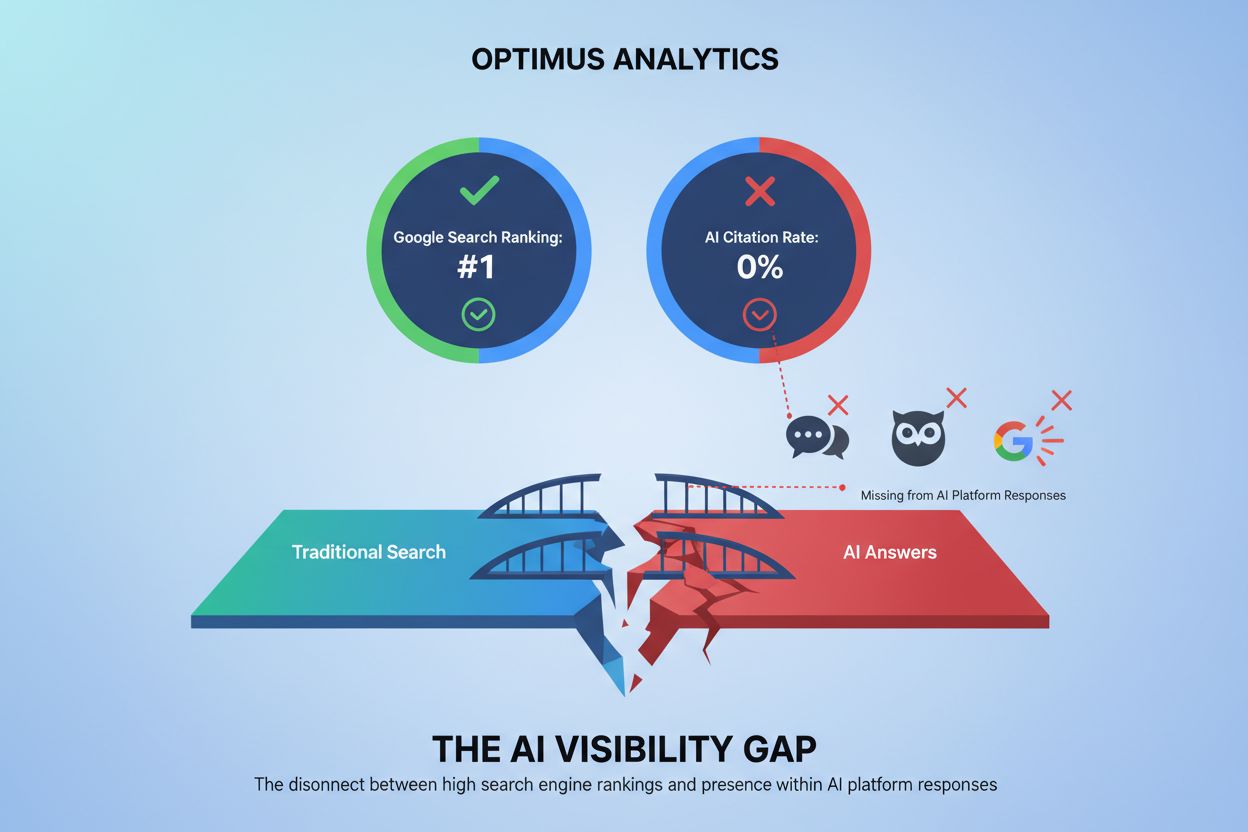
Learn what the AI Visibility Gap is, why it matters for your brand, how to measure it, and strategies to close the gap between traditional search visibility and...
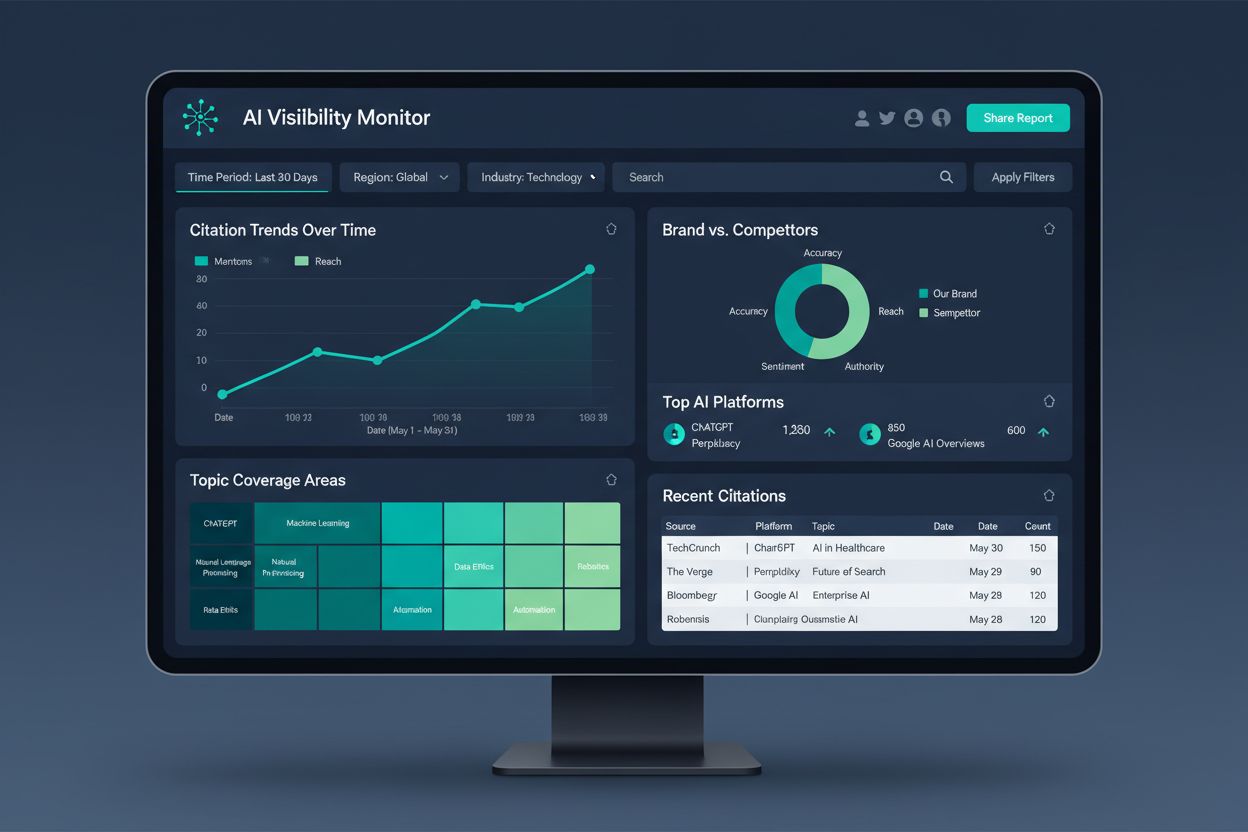
Learn how to identify and fill AI visibility gaps in your content strategy. Discover practical methods to ensure your brand appears in ChatGPT, Perplexity, and ...