
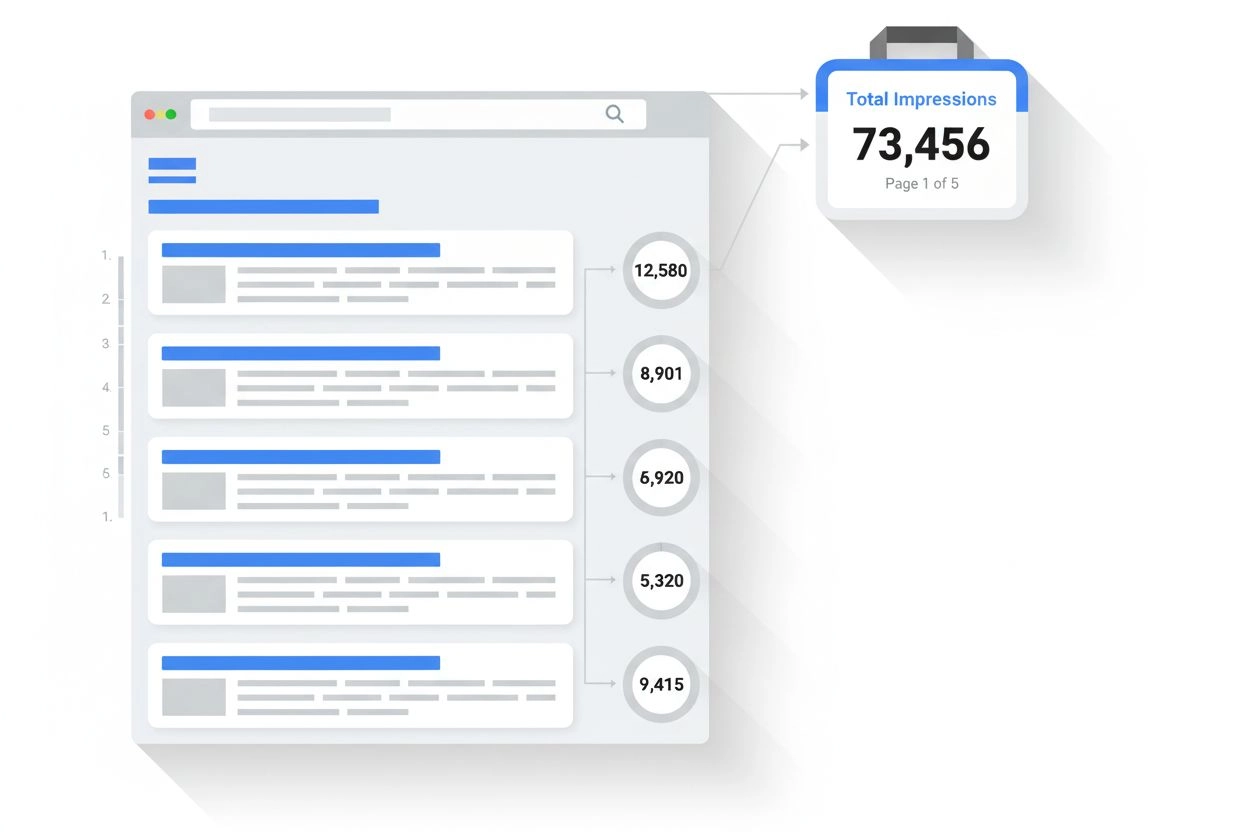
Impression
Learn what an impression is in search results and AI monitoring. Understand how impressions are counted across Google Search, Perplexity, ChatGPT, and other pla...
11 min read
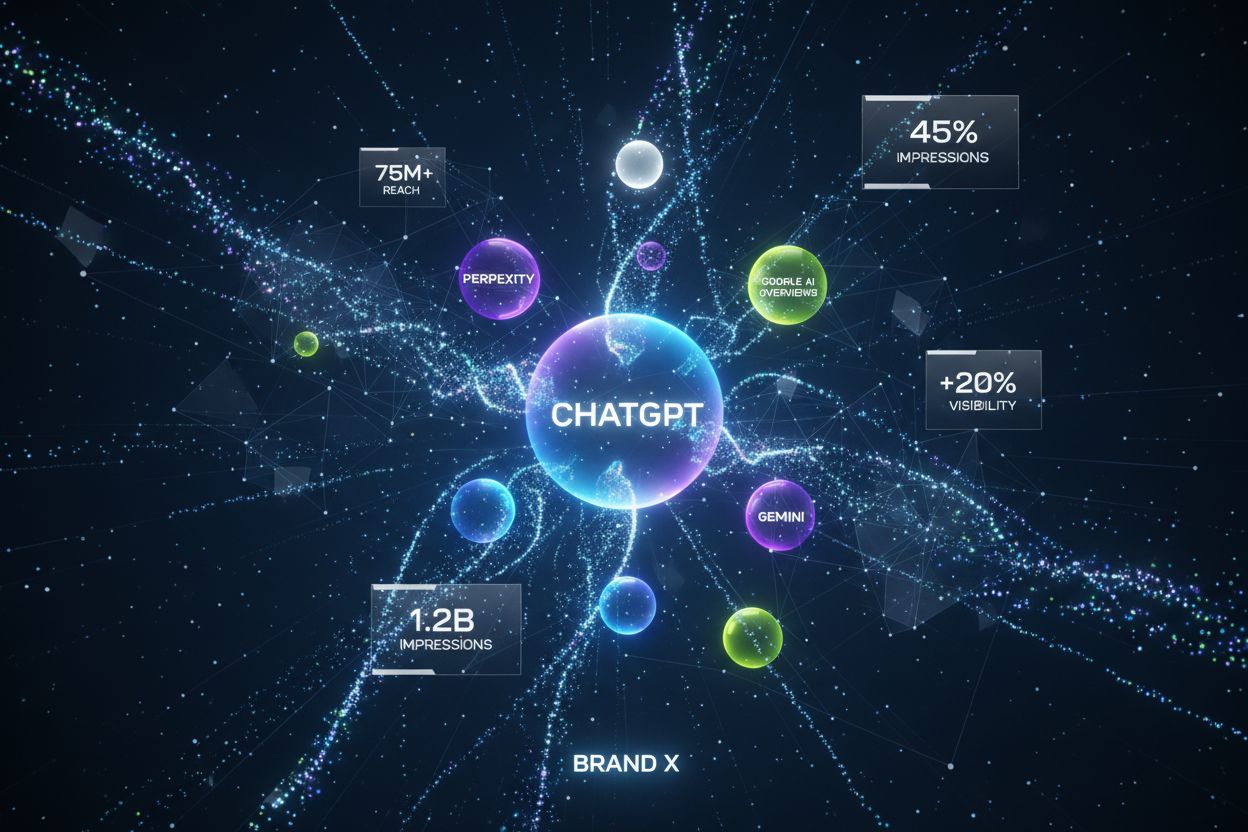
Learn how AI impressions differ from traditional search impressions, key metrics to track, and how to measure your brand’s visibility across ChatGPT, Perplexity, and Google AI Overviews.
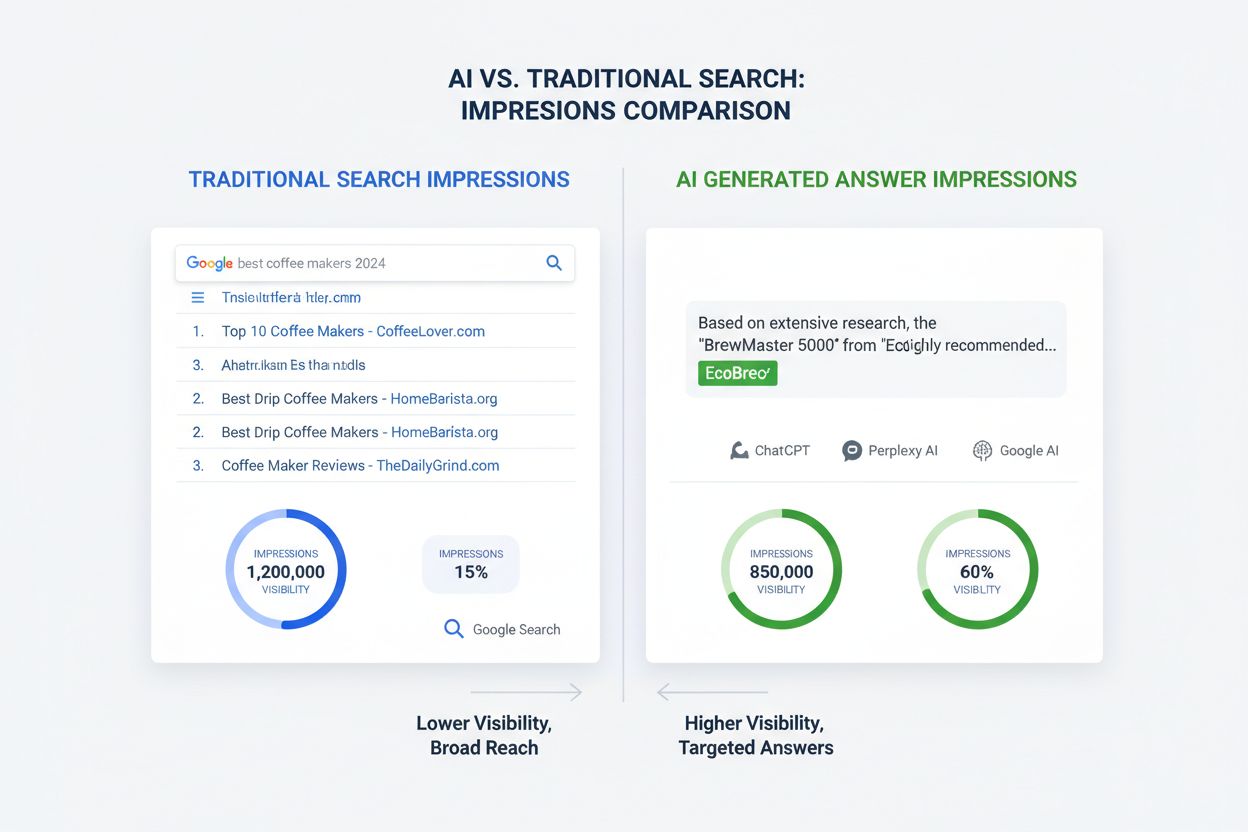
AI impressions represent a fundamentally different metric from traditional search impressions. While a traditional impression occurs when your link appears in Google Search results, an AI impression happens when your brand is mentioned in an AI-generated answer from platforms like ChatGPT, Perplexity, Google AI Overviews, or Gemini. This distinction matters because 71.5% of U.S. consumers now use AI tools for search, making visibility in these platforms increasingly critical for brand awareness. The key difference is that AI impressions don’t require clicks to be valuable—a mention in an AI-generated response signals brand recognition and authority, even if the user never clicks through to your website. However, there’s an important caveat: AI impressions and clicks follow a different relationship than traditional search. While traditional organic results might see 15-30% click-through rates, AI-generated answers typically see only about 1% of cited sources actually clicked, meaning the impression itself becomes the primary win for brand visibility.
Understanding AI visibility requires tracking five interconnected metrics that together paint a complete picture of your brand’s presence in AI-generated answers. These metrics move beyond simple mention counting to measure accuracy, competitive positioning, and trend analysis.
| Metric | Definition | Why It Matters | Calculation |
|---|---|---|---|
| Mention Rate | How often your brand appears in AI answers | Measures brand awareness in zero-click searches | Mentions ÷ Total AI answers for prompt cluster |
| Representation Accuracy | How correctly AI describes your brand | Ensures accurate positioning and differentiation | Label responses as Positive/Neutral/Negative |
| Citation Share | Ratio of owned vs third-party sources | Shows if AI links to your content | Your domain citations ÷ Total citations |
| Share of Voice | Your mentions vs competitor mentions | Reveals competitive positioning | Your mentions ÷ All competitor mentions |
| Drift & Volatility | Week-over-week visibility changes | Identifies trends and AI model updates | Track weekly changes in visibility metrics |
Mention Rate, also called AI Brand Visibility (ABV), tracks how frequently your brand appears in AI responses for a specific set of prompts. If you test 50 prompts related to your industry and your brand is mentioned in 23 responses, your mention rate is 46%—a signal of strong brand awareness in AI-driven search. Representation Accuracy ensures that when AI mentions your brand, it describes you correctly. A mention that misrepresents your product category or overlooks key differentiators is actually harmful to your positioning. Citation Share examines whether AI platforms link to your owned content or rely on third-party sources like Wikipedia (which ChatGPT uses for 48% of citations) or Reddit (which Perplexity uses for 46.7% of citations). Share of Voice reveals how often you’re mentioned compared to competitors—if competitors are mentioned 4x more often than you, you’re losing the visibility battle. Finally, Drift and Volatility track how these metrics change week-over-week, helping you spot trends and react to AI model updates that might shift your visibility.
Google Search Console has become the standard tool for tracking search performance, but it has a critical blind spot when it comes to AI Overviews: it doesn’t separate AI Overview impressions from traditional organic impressions. When an AI Overview appears for your keyword, Google counts it as a regular impression without any way to filter or segment this data. This creates a reporting nightmare for agencies and in-house teams trying to understand performance changes. For example, you might see impressions increase 40% while clicks only grow 5%—but without AI Overview data, you can’t determine whether AI Overviews are absorbing clicks or if something else changed. The problem is compounded by the fact that AI Overviews appear 60-80% of the time for certain query types, fundamentally reshaping how clicks distribute across search results. Position 1 organic results that previously captured 30-35% click-through rates might see rates drop to 15-20% when an AI Overview appears above them. Additionally, Search Console provides no data about whether your content is cited as a source within an AI Overview—even though being cited signals authority and brand visibility. Google has confirmed this limitation is intentional and has not indicated plans to add AI Overview filtering to Search Console, leaving marketers to build their own tracking solutions.
If you’re not ready to invest in paid tools, manual tracking provides a free way to establish your baseline AI visibility metrics. While time-intensive, this approach gives you direct control over your data and helps you understand which metrics truly matter for your business.
Step 1: Set Up Your Tracking Infrastructure Create a Google Sheet with columns for: Keyword, Date Checked, Platform (ChatGPT/Perplexity/Google AI/Gemini), Brand Mentioned (Y/N), Citation Type (Linked/Unlinked), Prominence (Lead/Body/Footnote), Sentiment (Positive/Neutral/Negative), and Screenshot URL. Build a second sheet for historical tracking and a third for CTR correlation analysis using Google Search Console data exports.
Step 2: Configure Your Browser for Consistent Results Open Chrome in incognito mode to avoid personalization bias. Install a VPN if tracking multiple locations, and use a screenshot tool that captures full page length. Disable ad blockers or extensions that might alter SERP display.
Step 3: Execute Weekly Checks Search your keyword in incognito, wait for the page to fully load (AI Overviews sometimes load 1-2 seconds after initial results), and check if an AI Overview appears. If collapsed, click “Show more” to expand. Document all cited sources and take a full-page screenshot. Budget 2-3 minutes per keyword.
Step 4: Handle Location-Specific Searches Close all browser windows, connect to your VPN for the target location, verify your IP location, open a new incognito window, and add location parameters like “&gl=us&hl=en” to your search. Repeat for each location.
Step 5: Process and Analyze Your Data Export last week’s Google Search Console data (wait 2-3 days for completeness), match keywords between your tracking sheet and GSC using VLOOKUP, calculate AI Overview presence rate and citation rate, and create pivot tables to identify patterns by keyword category.
Step 6: Maintain Data Quality Re-check 10% of keywords to verify consistency, document any SERP layout changes, archive screenshots weekly, and update your VPN locations if Google begins blocking them.
For 100 keywords across three locations, this process takes approximately 15 hours per week. To track AI-driven traffic in Google Analytics 4, use this regex for referral tracking: (chat\.openai\.com|chatgpt\.com|perplexity\.ai|you\.com|gemini\.google\.com|copilot\.microsoft\.com). This allows you to segment traffic coming from AI platforms separately from traditional search.
Once you’ve established your baseline metrics through manual tracking, automation becomes the logical next step. API-based solutions like SerpApi eliminate the time investment while providing more consistent, scalable data collection. The SerpApi free tier includes 250 searches per month, allowing you to test the approach before committing to paid plans. The data pipeline follows a simple pattern: Input (your keyword list) → Collection (retrieve SERP data via API) → Processing (extract AI Overview information) → Storage (save to database or spreadsheet) → Analysis (calculate metrics and identify patterns). Setup takes 2-3 hours for someone with basic technical skills, but ongoing maintenance requires only 5 minutes weekly to review results. The API returns comprehensive data that Google Search Console doesn’t provide: presence detection (boolean flag for AI Overview appearance), content extraction (full AI-generated text), citation tracking (all source URLs with titles), positioning data (where the AI Overview appears), and interactive elements (follow-up questions and expandable sections). This structured data integrates directly into existing SEO workflows—export to Google Sheets for quick analysis, push to BigQuery for historical tracking, or feed into dashboard tools like Looker Studio for client reporting.
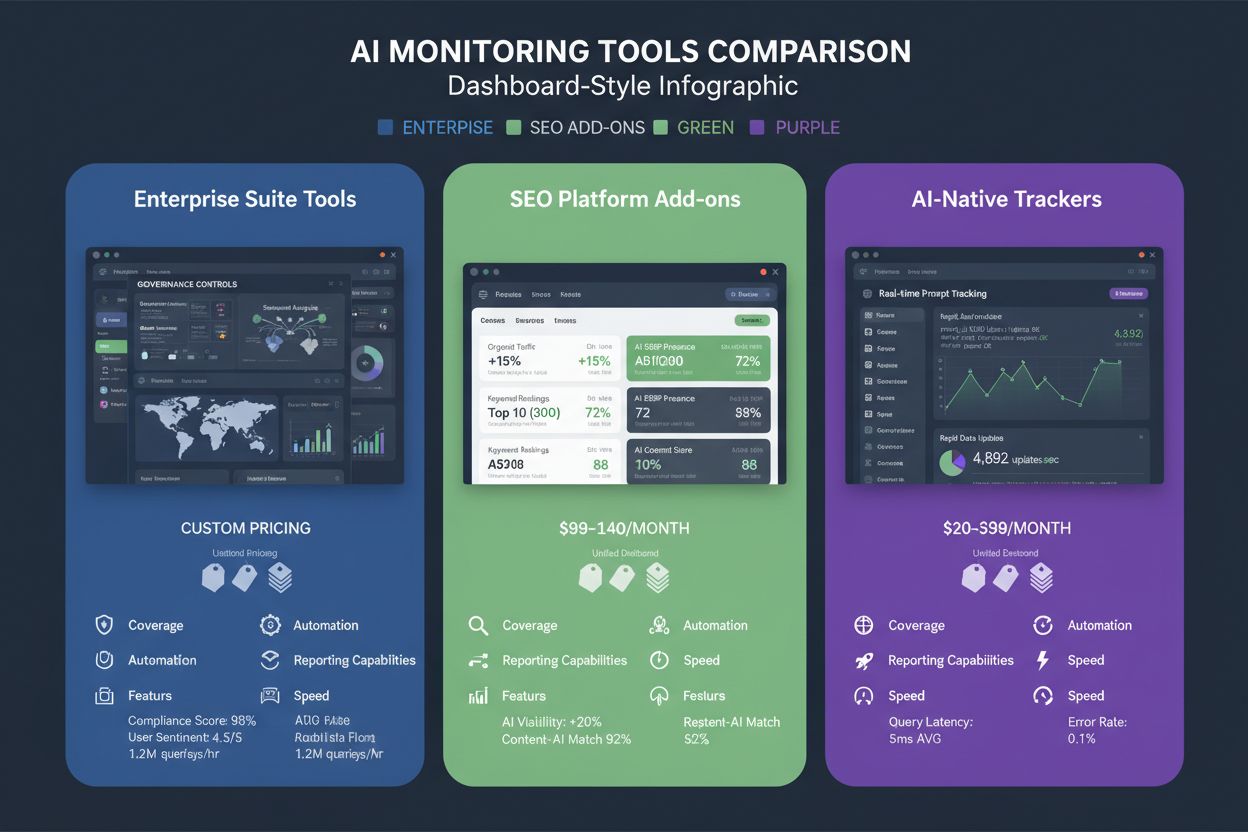
The AI visibility monitoring market has evolved into three distinct categories, each serving different team sizes, budgets, and use cases. Understanding these categories helps you select the right solution for your specific needs.
| Category | Best For | Core Strength | Pricing | Setup Time |
|---|---|---|---|---|
| Enterprise Suites | CMOs, Brand Managers, Enterprise SEOs | Governance, Sentiment, Scale | Custom (demo required) | 2-4 weeks |
| SEO Platform Add-Ons | SEO Specialists, Content Marketers, Agencies | Unified Workflow, Web Signal Context | $99-$140/month | 1-2 days |
| AI-Native Trackers | Growth Hackers, Startups, GEO Specialists | Velocity, Real-time Logs, Prompt Innovation | $20-$399/month | A few hours |
All-in-One Enterprise Suites like Semrush Enterprise and Pi Datametrics are designed for large teams managing multiple brands and regions. They combine brand tracking, competitive analysis, and multi-region reporting with governance features, sentiment analysis, and SOC 2 Type II certification. The advantage is integration with BI dashboards, CRMs, and reporting systems, making them ideal for regulated industries. However, pricing is customized and requires a demo, and they’re built for teams handling thousands of prompts.
SEO Platform Add-Ons provide a seamless way to track AI visibility without juggling multiple subscriptions. Tools like SE Ranking ($119/month) and Semrush AI Visibility Toolkit ($99/month) leverage existing web crawl data—backlinks, keyword rankings, technical health—to help interpret why AI models cite certain sources. This context is invaluable because you can’t isolate LLM results from the web signals those models rely on. These tools are perfect for mid-sized teams already invested in traditional SEO platforms.
AI-Native Visibility Trackers like Otterly AI ($29/month), Nightwatch ($32/month), and Peec AI (~$95/month) are built specifically for the LLM era. They focus on real-time prompt tracking and rapid data updates rather than traditional rankings. Their biggest strength is innovation velocity—they can roll out new features like persona-based tracking faster than legacy SEO tools. AmICited.com stands out in this category by specializing in continuous monitoring of how your brand appears across multiple AI platforms, providing real-time alerts when your visibility changes and detailed competitive benchmarking.
If you prefer a DIY approach, you can build a comprehensive tracking dashboard using free and low-cost tools. Start with a prioritized keyword list of 50-100 keywords, categorized by intent type (informational, commercial, transactional) to identify AI Overview patterns. Create prompt clusters that reflect your customer journey: category definitions (“What is project management software?”), comparisons (“Asana vs Monday.com”), jobs to be done (“How to track team tasks remotely”), local intent (“Best CRM in Austin”), and direct brand queries (“Is [Your Brand] good for remote teams?”).
Use Google Sheets for simple tracking or BigQuery for scalable analytics. Calculate three core metrics: AI Overview Presence Rate (how often AI Overviews appear for your keywords), Citation Success Rate (how often you’re cited when AI Overviews appear), and CTR Impact Analysis (comparing CTR for keywords with vs. without AI Overviews). Combine this with Google Search Console data to measure the actual business impact. As you track over time, you’ll notice patterns—certain content types consistently earn citations, some competitors are cited despite lower traditional rankings, and specific query types show higher AI Overview rates. These insights become the foundation for your optimization strategy.
AI impressions matter because they improve brand visibility and authority signals, even without immediate clicks. Being cited in AI Overviews positions your brand as a trusted source, which influences user perception and can drive indirect traffic through multiple channels. When users see your brand mentioned in ChatGPT or Perplexity, they’re more likely to search for you directly later, visit your website through other channels, or remember your brand when making purchase decisions. Track the correlation between AI mentions and direct traffic in Google Analytics—you’ll often find that increased AI visibility precedes spikes in branded search volume and direct visits. Early detection of AI Overview volatility in your industry gives you a competitive advantage. When Google rolls out AI Overview changes, brands that monitor visibility can adapt their content strategy immediately, while competitors remain unaware. Additionally, data-backed strategy for optimizing AI citation is more effective than guessing. If you notice that pages with specific content structure (like answer-ready summaries at the top) earn more citations, you can systematically apply that structure across your content library. The brands winning in generative search are the ones measuring the answer, not just the SERP.
Begin with a two-week manual testing baseline. Create 20-50 prompts reflecting actual customer searches, organized into intent clusters. Test these prompts across major engines: ChatGPT, Perplexity, Gemini, Claude, and Copilot. Log every result in a spreadsheet, noting presence, accuracy, and citation quality. After two weeks, analyze your data to identify visibility gaps—keywords where competitors are mentioned but you’re not, or where your representation is inaccurate.
Once you have baseline data, match tools to your stage. Solo marketers should start with budget-friendly options like Otterly AI ($29/month) or Nightwatch ($32/month). Mid-market teams can explore Peec AI (~$95/month) or SE Ranking ($119/month). Larger operations benefit from enterprise solutions like Profound ($499/month+) or AthenaHQ ($295/month+). The key is to begin with manual testing, move to affordable trackers, and scale up only when increased AI visibility starts delivering measurable results. AmICited.com provides continuous monitoring across all major AI platforms, giving you real-time visibility into how your brand appears in ChatGPT, Perplexity, Google AI Overviews, and emerging AI search tools. Start tracking your AI impressions today—every day without visibility into this channel is a missed opportunity to understand and optimize your presence in the future of search.
AI impressions occur when your brand is mentioned in AI-generated answers, while traditional impressions are when your link appears in Google Search results. AI impressions don't require clicks to be valuable—they signal brand awareness and authority. Both metrics are important for understanding your complete visibility in search.
Google currently treats AI Overview impressions as part of the overall impression count without segmentation. This is a known limitation that Google has not indicated plans to change in the near future. This creates a reporting blind spot that requires alternative tracking methods.
Mention rate is foundational (shows how often you appear), but representation accuracy is equally critical (ensures you're described correctly). Together with citation share and share of voice, they provide a complete picture of your AI visibility performance.
For high-priority keywords, daily tracking is ideal. For general monitoring, weekly tracking is sufficient. The frequency depends on your industry volatility and competitive landscape. Most brands find weekly tracking provides actionable insights without excessive overhead.
Yes, manual tracking using Google Sheets is free but time-intensive (approximately 15 hours per week for 100 keywords). For automation, free API tiers like SerpApi's 250 searches per month can help you get started without significant investment.
AI impressions represent a new visibility channel that complements traditional SEO. Being cited in AI answers can drive brand awareness, authority signals, and indirect traffic, making it essential to monitor alongside traditional metrics.
AI impressions don't always lead to clicks (only approximately 1% of cited sources are clicked), but they're valuable for brand visibility. Focus on being mentioned and accurately represented, not just on driving clicks from AI-generated answers.
Track week-over-week changes in mention rate, representation accuracy, and citation share. Use drift and volatility metrics to identify trends. Compare your metrics against competitors to understand your share of voice and competitive positioning.
Get real-time visibility into how your brand appears across ChatGPT, Perplexity, Google AI Overviews, and other AI platforms. Track mentions, citations, and competitive positioning with AmICited.
Learn what an impression is in search results and AI monitoring. Understand how impressions are counted across Google Search, Perplexity, ChatGPT, and other pla...

Learn how to measure AI search performance across ChatGPT, Perplexity, and Google AI Overviews. Discover key metrics, KPIs, and monitoring strategies for tracki...

Comprehensive glossary of 100+ essential AI visibility and GEO terms every marketer should know. Learn about citation tracking, brand monitoring, and AI search ...