
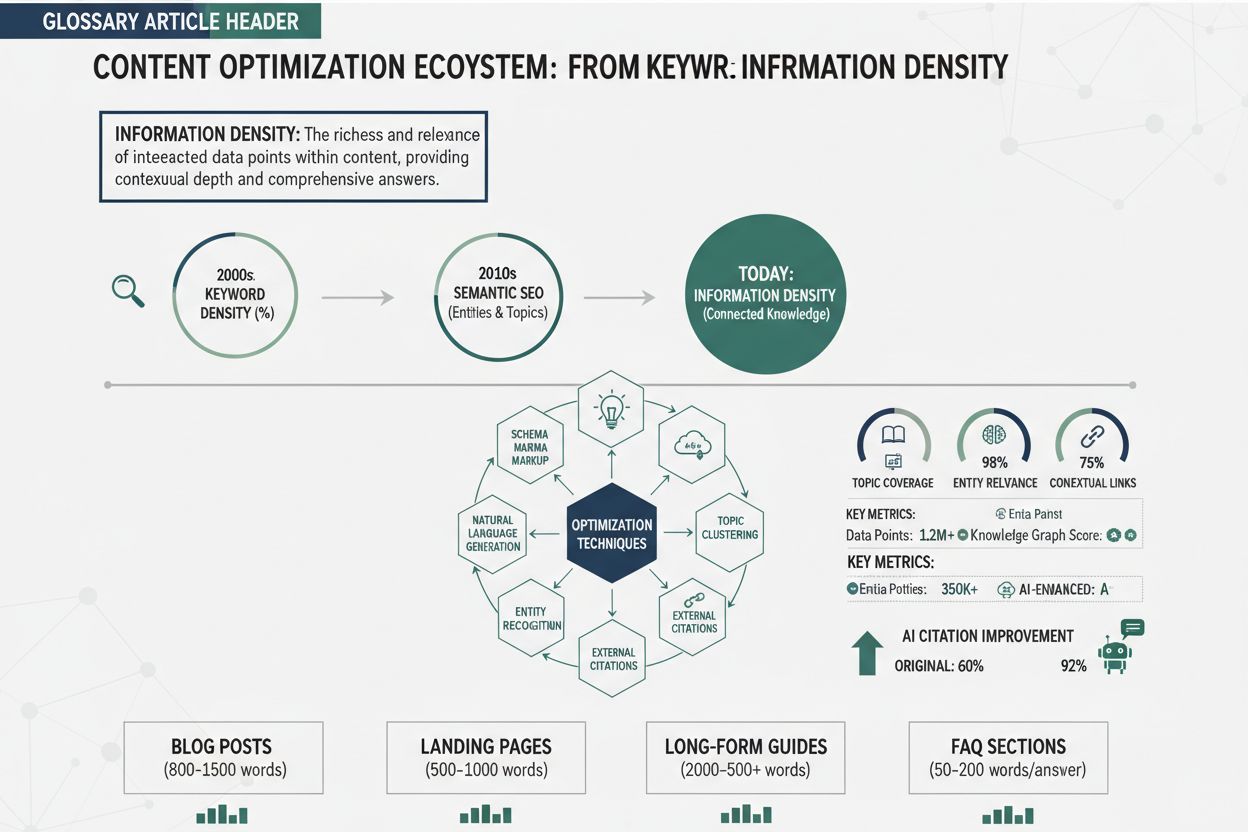
Information Density
Learn what information density is and how it improves AI citation likelihood. Discover practical techniques to optimize content for AI systems like ChatGPT, Per...
16 min read
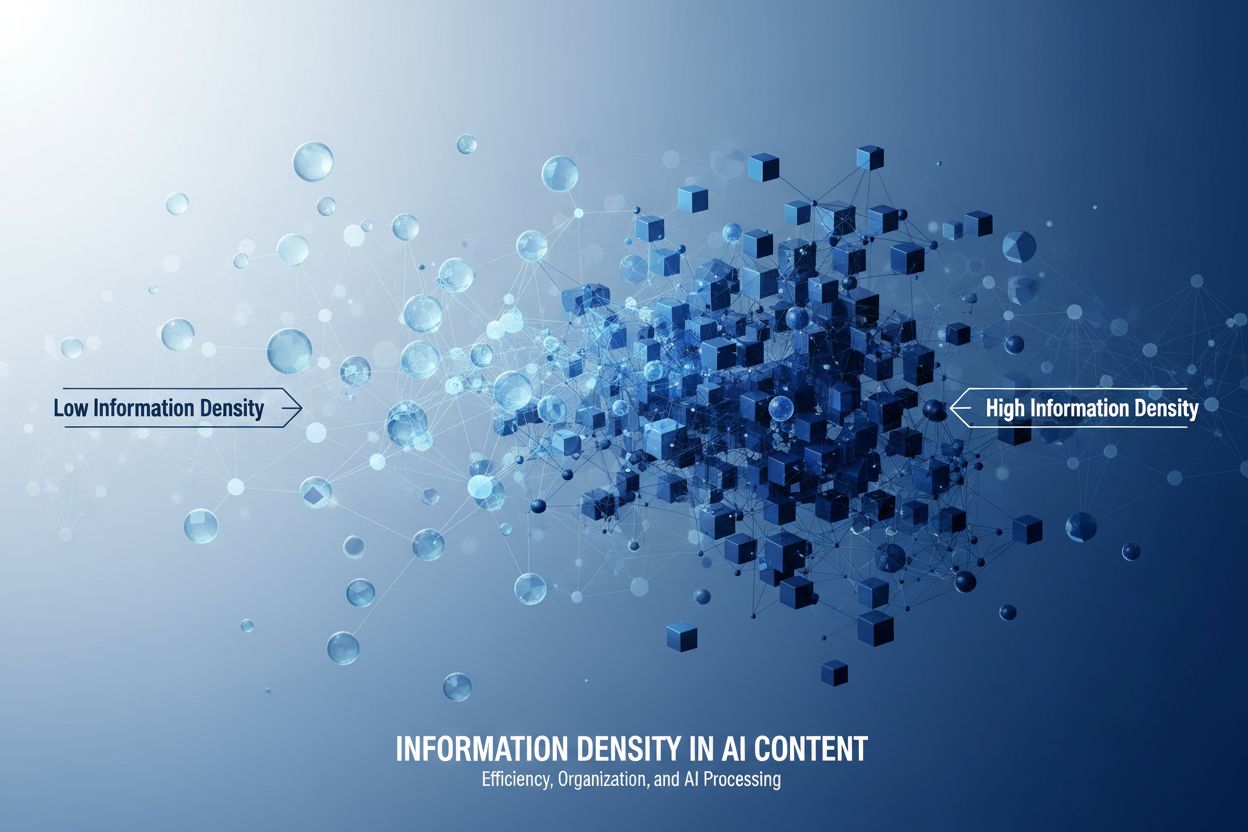
Learn how to create information-dense content that AI systems prefer. Master the Uniform Information Density hypothesis and optimize your content for AI Overviews, LLMs, and better citations.
Information density refers to the concentration of meaningful, actionable insights within a given piece of content—essentially how much value is packed into each word, sentence, or paragraph. This concept has become increasingly critical in the age of AI-driven search, particularly with the rise of Large Language Models (LLMs) and AI Overviews. The Uniform Information Density (UID) hypothesis, a linguistic principle supported by recent ArXiv research, suggests that humans and AI systems alike process information more effectively when cognitive load is distributed evenly throughout content rather than concentrated in isolated sections. For AI systems evaluating content, information density directly impacts how likely your content is to be selected, cited, and ranked in AI search results. When you create value-packed content, you’re not just writing for human readers—you’re optimizing for how LLMs extract, synthesize, and reference information from your work.
LLMs evaluate content density through multiple sophisticated mechanisms that go far beyond simple word counts or keyword frequency. These systems analyze content metrics using entropy-based calculations that measure how much information is conveyed relative to the total text length, examining what researchers call “step-level uniformity”—the consistency of information distribution across sequential sections of your content. When an LLM processes your article, it’s calculating the information gain at each token, assessing whether you’re delivering consistent value or if certain sections are redundant, tangential, or low-value. Different evaluation frameworks prioritize different aspects of content quality, as shown in the comparison below:
| Metric | What It Measures | AI Relevance | Best For |
|---|---|---|---|
| BLEU Score | Precision of word matches | Lower relevance for density | Machine translation evaluation |
| ROUGE Score | Recall of content overlap | Moderate relevance | Summarization quality |
| Perplexity | Predictability of text sequences | High relevance | LLM confidence assessment |
| Information Density | Meaningful content per unit length | Highest relevance | AI citation and selection |
Understanding these LLM evaluation frameworks helps you recognize that AI systems aren’t just looking for comprehensive content—they’re looking for content that maintains consistent information value throughout, avoiding the common pitfall of padding or filler material that dilutes your message.
The distinction between dense content and sparse content fundamentally shapes how AI systems interact with your material. Dense content delivers high information value with minimal fluff, while sparse content contains significant amounts of repetition, filler, or low-value elaboration. Consider these key differences:
A practical example: a sparse article about AI content optimization might dedicate three paragraphs to explaining what AI is, then three more to why content matters, before finally addressing optimization techniques. A dense content version would assume baseline knowledge, integrate context naturally, and dedicate proportional space to actionable strategies. AI systems recognize and reward this efficiency because it indicates the author understands their subject deeply enough to communicate it concisely.
Information density has emerged as a critical ranking signal in AI-driven search environments, directly influencing whether your content appears in AI Overviews and how frequently it receives citations from AI systems. Research from BrightEdge’s analysis of AI algorithms reveals that content selected for AI Overviews demonstrates approximately 40% higher information density scores compared to content that doesn’t get selected, suggesting that AI systems actively prioritize dense, value-packed material when synthesizing answers. The relationship between information density and citation rates is particularly important for AmICited.com’s perspective: when AI systems like Perplexity or Google’s AI Overviews need to reference sources, they preferentially cite content that delivers concentrated value, as this reduces the need for multiple source citations to answer a single query comprehensively. Content with high information density also tends to rank better because it satisfies user intent more completely—AI systems recognize that dense content provides more thorough answers, reducing the likelihood that users will need to consult additional sources. Furthermore, AI Overviews algorithms specifically evaluate whether content can be effectively summarized and synthesized, and dense content is inherently more summarizable because it contains fewer extraneous elements to filter out during the synthesis process.
Creating value-packed content requires deliberate structural and editorial choices that prioritize information delivery over word count. Start by conducting a ruthless audit of your existing content: identify every sentence that doesn’t advance your core argument or provide actionable value, then either eliminate it or integrate it into surrounding sentences that serve multiple purposes. Use structured content formats—numbered lists, comparison tables, hierarchical headings, and definition sections—that allow readers and AI systems to quickly extract key information without parsing through narrative prose. Implement the “one idea per paragraph” principle, ensuring that each section has a clear purpose and doesn’t dilute its message with tangential information; this directly supports the UID hypothesis by distributing cognitive load evenly. When explaining complex concepts, use progressive disclosure: introduce the essential information first, then layer in supporting details, examples, and nuance—this approach serves both human readers and LLMs that may extract content at different levels of granularity. Incorporate specific data points, statistics, and concrete examples rather than abstract generalizations; “approximately 40% higher information density” is more valuable to AI systems than “significantly higher density.” Finally, optimize your content optimization process by treating information density as a primary metric alongside traditional SEO factors—review drafts specifically asking whether each section could be condensed, combined, or eliminated without losing essential value.
Measuring information density requires understanding both the theoretical frameworks and practical tools available to content creators. The most direct approach involves calculating information density score using entropy-based metrics: divide the total information content (measured in bits or using semantic analysis) by the total word count to determine how much meaningful information you’re delivering per unit of text. Several tools can help with this assessment: natural language processing platforms can analyze semantic diversity and concept distribution, readability tools can identify redundancy patterns, and custom scripts using Python libraries like NLTK can calculate entropy metrics for your content. A practical example: if a 2,000-word article contains approximately 150 distinct semantic concepts with even distribution, it would have higher information density than a 2,000-word article with only 80 distinct concepts clustered in the first half. You can also use proxy metrics like the ratio of unique terms to total words, the average information gain per paragraph, or the number of actionable takeaways per 500 words—these aren’t perfect measures but provide useful directional indicators. BrightEdge’s research suggests monitoring how frequently your content gets cited by AI systems as a real-world validation of information density; if your content consistently appears in AI Overviews and receives citations, you’re likely hitting the right density targets.
The most prevalent error in pursuing information density is over-optimization, where creators attempt to maximize density so aggressively that content becomes difficult to read or loses necessary context and explanation. This often manifests as keyword stuffing disguised as density optimization—cramming multiple target terms into sentences where they don’t naturally belong, which actually reduces information value and triggers AI system penalties. Another critical mistake is creating information overload by attempting to cover too many topics within a single piece; this violates the UID hypothesis by concentrating excessive cognitive load in certain sections while leaving others sparse. Poor structural organization represents another common pitfall: even information-dense content loses effectiveness if it’s not organized hierarchically with clear relationships between concepts, forcing both readers and AI systems to work harder to extract value. Some creators also confuse density with brevity, producing content that’s technically short but lacks sufficient depth to satisfy user intent or provide the context AI systems need for accurate synthesis and citation. Finally, failing to maintain consistent information distribution throughout your content creates uneven cognitive load—for example, front-loading all your statistics and data in the introduction, then providing only narrative explanation afterward, violates the UID principle and reduces overall effectiveness with AI systems.
The principles of information density apply across all content formats, but the optimal density level and implementation strategy varies significantly by content type. Blog posts typically benefit from moderate-to-high information density with strategic use of examples and explanations that make dense concepts accessible; a technical blog post might maintain 70-80% information density while a beginner-focused post might operate at 50-60% to ensure comprehension. Technical documentation demands the highest information density, as readers expect concentrated value and minimal fluff—documentation that achieves 85%+ information density typically performs better in AI systems because it’s inherently more summarizable and citable. Product pages require a different approach, balancing information density with persuasive elements and user experience considerations; while you want to pack value into feature descriptions and benefits, excessive density can overwhelm potential customers and reduce conversion rates. News articles and journalistic content operate under different constraints, where narrative flow and context-setting sometimes necessitate lower information density, though AI systems still prefer news content that delivers facts efficiently without excessive editorial commentary. Research papers and whitepapers can sustain very high information density because the audience expects technical depth, though even academic content benefits from clear structure and strategic use of summaries to maintain UID principles. Understanding these variations allows you to optimize information density appropriately for your specific content type while maintaining effectiveness with both human readers and AI systems.
As AI systems become more sophisticated, information density will likely become an even more critical ranking and citation signal, particularly as competition for inclusion in AI Overviews intensifies. Emerging research suggests that future LLMs will develop increasingly nuanced methods for evaluating information quality and density, potentially moving beyond simple entropy calculations toward more sophisticated semantic analysis that rewards not just concentrated information but information that’s optimally structured for synthesis and citation. The evolution of AI search will probably favor creators who understand that AI evolution isn’t about gaming algorithms but about genuinely serving user intent more effectively—dense, well-structured content naturally serves this purpose by providing AI systems with richer material to work with. Content creators should prepare for a future where content strategy increasingly emphasizes quality over quantity, where a 1,500-word article with exceptional information density outperforms a 5,000-word article with moderate density, and where the ability to communicate complex ideas concisely becomes a competitive advantage. Organizations monitoring their presence in AI Overviews and tracking citation rates through platforms like AmICited.com will have a significant advantage, as they can directly observe how information density changes affect their visibility in AI-driven search results. The creators and organizations that invest now in understanding and optimizing for information density will be best positioned to thrive as AI search becomes the dominant discovery mechanism for online content.

Information density refers to the concentration of meaningful, actionable insights within content—how much value is packed into each word or sentence. AI systems evaluate this metric to determine which content to cite and feature in AI Overviews. Higher information density typically results in better visibility in AI search results.
The UID hypothesis suggests that effective communication maintains a stable flow of information throughout content. AI systems process content more effectively when cognitive load is distributed evenly rather than concentrated in isolated sections. This principle directly impacts how LLMs select and cite your content.
Dense content delivers high information value with minimal fluff, using precise language and eliminating redundancy. Sparse content contains significant repetition and low-value elaboration. AI systems prefer dense content because it's more efficient to synthesize and cite, reducing the need for multiple source references.
You can measure information density by calculating the ratio of meaningful information to total word count using entropy-based metrics. Practical approaches include tracking unique semantic concepts per word, monitoring actionable takeaways per 500 words, or observing how frequently AI systems cite your content in AI Overviews.
Yes, significantly. Research shows that content selected for AI Overviews demonstrates approximately 40% higher information density scores compared to non-selected content. AI systems preferentially cite dense, value-packed material because it provides comprehensive answers with fewer source references needed.
Common mistakes include over-optimization that reduces readability, keyword stuffing disguised as density, creating information overload by covering too many topics, poor structural organization, confusing density with brevity, and failing to maintain consistent information distribution throughout content.
Information density requirements vary by format: technical documentation benefits from 85%+ density, blog posts work well at 70-80%, product pages balance density with persuasion at 50-70%, and news articles may operate at lower density due to narrative requirements. Optimize density appropriately for your specific content type.
As AI systems become more sophisticated, information density will likely become an even more critical ranking signal. Future LLMs will probably develop more nuanced methods for evaluating information quality, favoring creators who understand that dense, well-structured content naturally serves user intent more effectively.
Track how AI systems like ChatGPT, Perplexity, and Google AI Overviews cite and reference your brand. Get real-time insights into your AI visibility and content performance.
Learn what information density is and how it improves AI citation likelihood. Discover practical techniques to optimize content for AI systems like ChatGPT, Per...

Discover why keyword density no longer matters for AI search. Learn what ChatGPT, Perplexity, and Google AI Overviews actually prioritize in content ranking and...

Learn how to test content formats for AI citations using A/B testing methodology. Discover which formats drive the highest AI visibility and citation rates acro...