
From Invisible to Recommended: AI Optimization Transformation Stories
Discover how brands transform from invisible to recommended in AI search. Real case studies showing 67% traffic growth, 32% SQLs from AI, and $90M+ pipeline imp...
6 min read
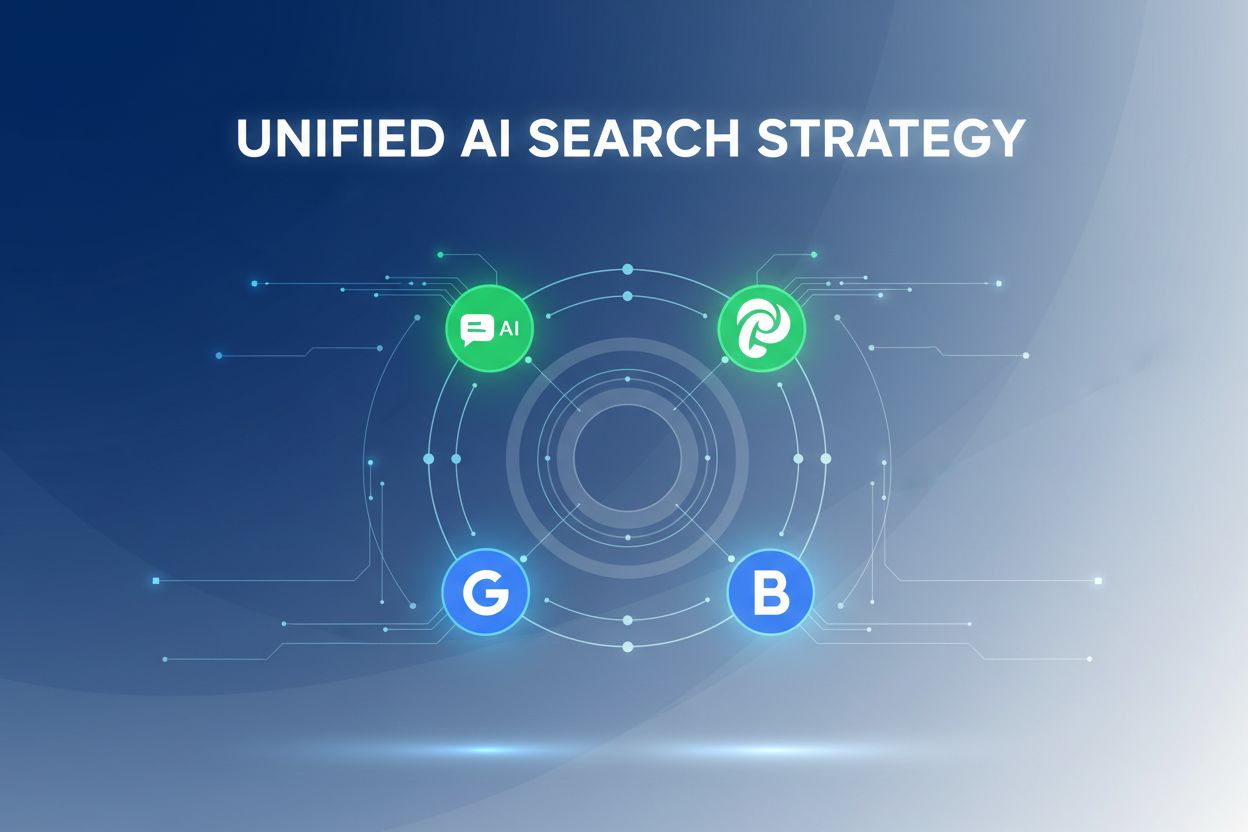
Learn how to combine AI visibility monitoring with traditional SEO to create a unified search strategy that captures visibility across all discovery channels.
The digital discovery landscape is undergoing a fundamental transformation that demands immediate strategic attention. Traditional SEO, built on optimizing for search engine rankings, is no longer sufficient in an era where AI Overviews, ChatGPT, Perplexity, and other answer engines are reshaping how users find information. These AI-powered platforms are generating direct answers to user queries, fundamentally changing the nature of search discovery itself. The implications are staggering: approximately 58% of searches now result in zero-click outcomes, meaning users get their answers without ever visiting a website. To remain competitive, brands must develop a unified strategy that addresses both traditional search rankings and AI visibility—ensuring they appear not just in Google’s index, but in the AI-generated answers that increasingly mediate user discovery.
To effectively integrate AI visibility into your strategy, you must first understand how this new landscape operates. AI Overviews (Google’s AI-generated summaries) and competing answer engines like Perplexity and ChatGPT generate responses by synthesizing information from multiple sources, citing them through LLM citations. Unlike traditional search rankings where a single URL occupies a position, AI visibility means your content is selected as a source for AI-generated answers—your brand appears as a citation within the AI’s response. This represents a fundamentally different type of visibility: rather than earning a click-through, you’re earning recognition as an authoritative source. Current adoption metrics show that over 40% of internet users now regularly use AI search tools, with this number growing rapidly among younger demographics. The distinction is critical: a brand can rank #1 for a keyword yet receive zero citations in AI answers, while a competitor ranking #5 might be cited multiple times. Understanding this difference is essential for building a strategy that captures visibility across both traditional and AI-powered discovery channels.
| Dimension | Traditional SEO | AI Visibility |
|---|---|---|
| Primary Goal | Rankings, CTR | Citations, mentions, eligibility in AI answers |
| Optimization Unit | Keyword → Page | Entity/Relationship → Paragraph |
| Formatting Cues | Long sections, link architecture | Summaries, tables, FAQs, short standalone chunks |
| Authority Signals | Backlinks, topical breadth, EEAT | Factual precision, schema, entity consistency, EEAT |
| Measurement | Sessions, positions, CTR | AI impressions, brand mentions, assisted conversions |
| Iteration Loop | Publish → Rank → Click | Structure → Extract → Attribute → Refine |
The rise of AI visibility isn’t a theoretical concern—it’s already impacting organic traffic in measurable ways. Research indicates that organic click-through rates could decline by 18-64% depending on industry and query type, as AI Overviews and answer engines capture user intent before they reach traditional search results. AI Overviews now appear in approximately 47% of Google searches, and this percentage continues to grow as Google expands the feature. This creates what we call funnel compression: the same search volume now distributes across more discovery channels (traditional search, AI Overviews, answer engines, social platforms), meaning each channel receives a smaller share of traffic. The problem with relying solely on traditional SEO metrics is that they become increasingly incomplete:
Organizations that continue optimizing exclusively for traditional rankings will find themselves invisible in the fastest-growing discovery channels, while competitors who adapt to AI visibility gain disproportionate share of voice.
A unified search strategy recognizes that SEO remains the foundation for AI visibility—the two are deeply interconnected rather than competing channels. Content that ranks well in traditional search is more likely to be cited by AI systems, but the optimization requirements differ in important ways. The foundation of this unified approach rests on five critical pillars:
Entity consistency and schema markup are particularly important in this unified approach. When your brand, products, and key information are consistently represented across your website and structured data, both Google’s ranking algorithm and AI systems can more easily understand and cite your content. Authority signals—backlinks, brand mentions, topical expertise—matter equally for traditional rankings and AI citations. The unified strategy approach means you’re not optimizing for two separate channels, but rather ensuring your content meets the higher bar of being valuable to both human readers and AI systems.
Practical content optimization for AI visibility requires specific formatting and structural approaches that differ from traditional SEO optimization. AI-friendly formatting means structuring your content so that AI systems can easily extract, understand, and cite specific claims and information. Here are the key optimization tactics:
Clear Paragraph Structure: Each paragraph should be able to stand alone as a complete thought. AI systems often extract individual paragraphs as citations, so a paragraph that requires context from previous sections won’t be as useful or citable.
TL;DR Summaries: Place concise summaries under major headings that distill the key takeaway into 1-2 sentences. AI systems frequently use these summaries when generating answers.
Verifiable Statements: Make specific, fact-based claims that can be verified. Vague statements like “our product is the best” won’t be cited; specific claims like “our product reduces processing time by 47%” will be.
Original Research & Proprietary Data: AI systems prioritize citing sources with unique, original information. Generic content that repeats what’s already available elsewhere is less likely to be cited.
Depth & Complexity: Include information that requires genuine expertise to produce—detailed analysis, original research, proprietary methodologies. This creates a moat against commoditization and makes your content more citation-worthy.
Here’s an example of AI-optimized content structure:
## Topic Heading
**TL;DR**: One or two sentence summary of the key insight.

Paragraph 1: Establish context and define the problem.

Paragraph 2: Present original research, data, or methodology.

Paragraph 3: Provide specific, verifiable insights from that research.

Paragraph 4: Explain implications and actionable takeaways.

**Key Takeaway**: Reinforce the main point in one sentence.
This structure makes it easy for AI systems to extract valuable, citable information while maintaining readability for human audiences.
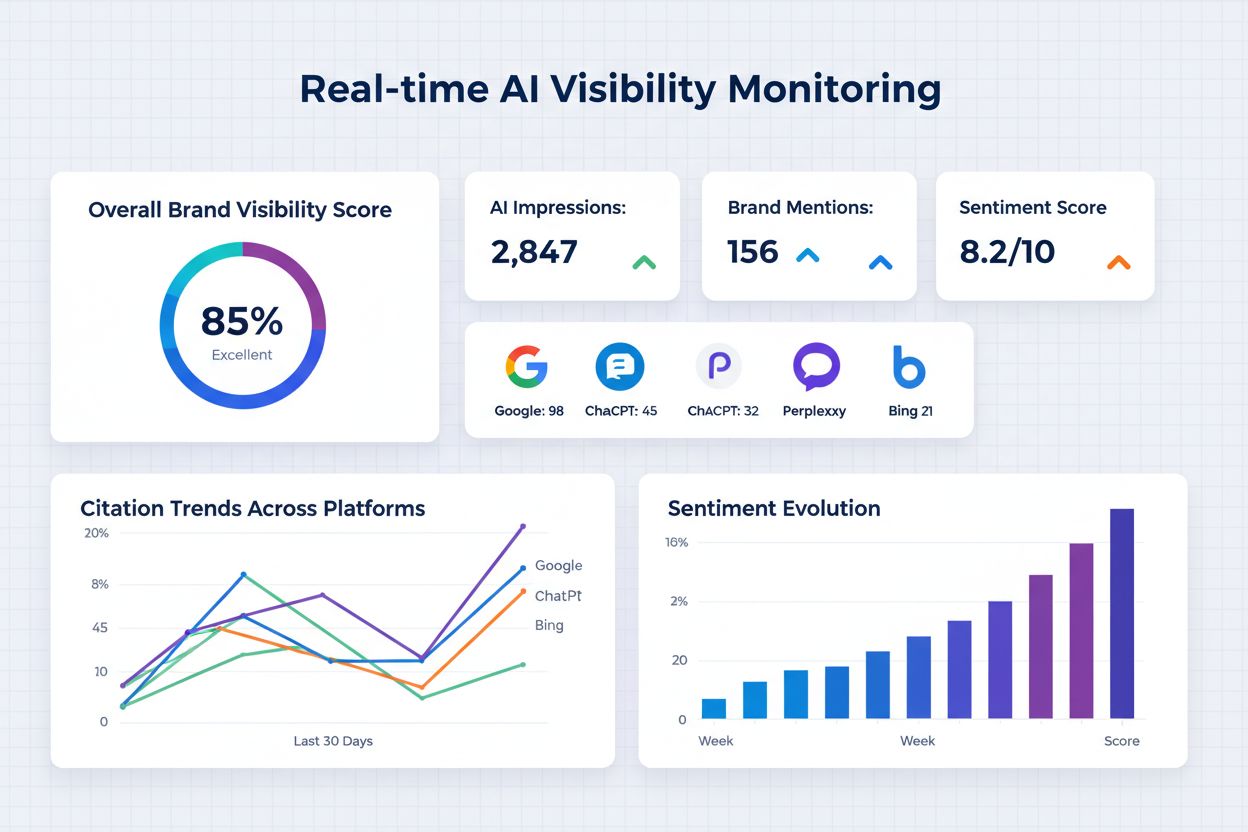
You cannot optimize what you don’t measure, and AI visibility monitoring is essential for understanding your performance in this new landscape. While traditional SEO tools track rankings and organic traffic, AI monitoring requires tracking different metrics: AI impressions (how many AI-generated answers include your content), brand citations (how often your brand is mentioned), and sentiment (how your brand is positioned in those citations). These metrics are fundamentally different from traditional rankings—you might rank #3 for a keyword but receive zero AI citations, or rank #10 but be cited in 60% of AI-generated answers for related queries.
This is where tools like AmICited.com become invaluable. Rather than simply tracking whether you’re cited in AI answers, AmICited.com reveals WHO you’re cited with, not just IF you’re cited—showing you which competitors appear alongside your brand, which queries generate citations, and how your citation patterns compare to competitors. This competitive intelligence is crucial for understanding your position in the AI visibility landscape. Integration with traditional SEO metrics creates a complete picture: you can see how your AI citations correlate with organic traffic, which content pieces drive both rankings and AI citations, and where gaps exist in your visibility. Real-time visibility insights allow you to identify emerging opportunities (new queries where AI systems are citing competitors but not you) and threats (declining citation rates in key topic areas). Without this monitoring infrastructure, you’re essentially flying blind in the fastest-growing discovery channel.
The rise of AI visibility doesn’t diminish the importance of SEO-PPC integration—it makes it more critical. SEO provides the organic foundation for AI visibility; content that ranks well and earns citations builds authority that benefits all channels. PPC captures high-intent traffic at the moment of search, particularly valuable for commercial queries where users are ready to convert. Both channels benefit from strong authority signals: a brand with high topical authority will rank better in traditional search, receive more AI citations, and achieve better PPC quality scores and lower costs.
In the AI era, a unified approach means:
Budget allocation becomes more sophisticated: rather than deciding “should we spend on SEO or PPC,” the question becomes “how do we allocate budget across channels to maximize total visibility and conversions?” A keyword might have lower PPC volume but higher AI citation potential, making it a priority for content investment. Another keyword might have high commercial intent but low AI citation opportunity, making it a PPC focus. This integrated thinking maximizes return on marketing investment.
Traditional last-click attribution models break down in a multi-channel discovery environment. AI metrics require a different measurement framework that captures the full customer journey. Beyond traditional metrics like rankings and organic traffic, you need to track:
| Metric | Definition | Why It Matters |
|---|---|---|
| AI Impressions | Number of AI-generated answers that include your content | Measures reach in AI discovery channel |
| Citation Frequency | How often your brand is cited across AI platforms | Indicates authority and relevance |
| Citation Sentiment | How your brand is positioned in AI answers (positive, neutral, negative) | Reveals brand perception in AI context |
| Entity Consistency Score | Percentage of mentions where your brand/products are correctly represented | Ensures AI systems understand your brand accurately |
| Assisted Conversions | Conversions where AI citation was a touchpoint but not the final click | Captures AI’s role in customer journey |
| Topic Authority Score | Measure of how comprehensively you’re cited across related queries | Indicates topical expertise recognition |
CRM integration becomes essential for full-funnel attribution. By connecting your CRM data with AI visibility metrics, you can track which customers discovered you through AI citations, how those customers differ from organic search customers, and what their lifetime value is. This reveals whether AI visibility drives high-quality traffic or simply inflates vanity metrics. Move beyond asking “did this channel drive a conversion?” to “what’s the quality and lifetime value of customers acquired through this channel?” This more sophisticated measurement approach reveals where to invest for maximum return.
Integrating AI visibility into your existing SEO strategy doesn’t require starting from scratch; it builds on your current foundation. Here’s a practical, six-step implementation roadmap:
Step 1: Audit Current AI Visibility - Use tools like AmICited.com to establish a baseline. Which queries generate AI citations? Which competitors are cited? Where are the gaps in your visibility? This audit reveals your starting position and identifies quick-win opportunities.
Step 2: Identify High-Value Citation Opportunities - Not all queries are equally valuable for AI citations. Focus on queries where: (a) AI systems are already generating answers, (b) your competitors are being cited, (c) you have relevant expertise, and (d) citations would drive meaningful business value.
Step 3: Audit & Restructure Content - Review your top-performing content and restructure it for AI visibility using the formatting guidelines from the content optimization section. Prioritize content that targets high-value citation opportunities. This isn’t about creating new content; it’s about optimizing existing assets.
Step 4: Implement Structured Data & Entity Consistency - Ensure your brand, products, and key concepts are consistently represented across your website and structured data. This helps AI systems understand and cite your content more accurately.
Step 5: Establish Monitoring & Measurement - Implement AI visibility monitoring tools and integrate them with your existing SEO and analytics infrastructure. Create dashboards that show performance across all discovery channels.
Step 6: Iterate Based on Data - Monitor which content pieces drive AI citations, which queries show citation opportunities, and how AI visibility correlates with business outcomes. Use these insights to continuously refine your strategy and content.
This roadmap is iterative, not linear. You’ll likely discover new opportunities in Step 5 that require returning to Step 3, or find that certain content pieces need restructuring based on citation patterns. The key is establishing the measurement infrastructure early so you can make data-driven decisions throughout the process.
Organizations implementing AI visibility strategies encounter predictable obstacles. Here are the most common challenges and practical solutions:
Challenge: Maintaining Brand Message in AI Summaries Solution: AI systems cite content verbatim or near-verbatim, so your content structure directly determines how your brand appears in AI answers. Use the formatting guidelines to ensure your key messages are in citable form. Write TL;DR summaries that capture your desired positioning. Monitor how you’re being cited and adjust content if AI systems are extracting quotes out of context.
Challenge: Competing with Large, Authoritative Sites Solution: You don’t need to outrank large sites to be cited by AI systems. Focus on specific, differentiated expertise where you can be the most authoritative source. Original research, proprietary data, and unique methodologies create citation-worthy content that large generalist sites can’t replicate. Niche authority often beats broad authority in AI citations.
Challenge: Attribution Complexity Across Multiple Channels Solution: Implement CRM integration and multi-touch attribution models that recognize AI citations as a touchpoint in the customer journey, even when they’re not the final click. Track cohorts of customers acquired through different channels and compare their lifetime value. This reveals the true ROI of AI visibility investment.
Challenge: Resource Constraints for Content Optimization Solution: Prioritize ruthlessly. Focus on content that targets high-value queries where AI citations are already happening and where you have competitive advantage. Optimize your top 20% of content pieces that drive 80% of traffic and citations. As you see results, expand to lower-priority content.
Challenge: Keeping Up with Rapidly Evolving AI Platforms Solution: Focus on fundamentals that work across all AI systems: clear structure, verifiable claims, original insights, and entity consistency. These principles apply whether AI systems are using GPT, Claude, or future models. Monitor how different AI platforms cite your content and adjust tactics if you notice platform-specific patterns, but don’t over-optimize for any single platform.
The organizations that successfully navigate these challenges are those that view AI visibility not as a separate initiative, but as an evolution of their existing SEO strategy—building on proven principles while adapting to new discovery channels.
Traditional SEO focuses on achieving high rankings and click-through rates from search results. AI visibility, by contrast, focuses on being cited and mentioned in AI-generated answers. You might rank #1 for a keyword but receive zero AI citations, while a competitor ranking #5 might be cited multiple times. Both matter in today's discovery landscape.
AI Overviews and answer engines can reduce organic clicks by 18-64%, particularly for informational queries. However, they increase brand awareness through citations. The key is understanding that visibility now extends beyond clicks—being cited in AI answers builds authority and brand recognition even when users don't click through to your site.
No, but you should enhance it. Traditional SEO remains the foundation for AI visibility. The optimization requirements differ in some ways—AI systems prefer clear structure, verifiable claims, and original insights—but these improvements benefit both traditional search and AI visibility. Think of it as evolution, not revolution.
Use dedicated AI visibility monitoring tools like AmICited.com that track brand mentions across multiple AI platforms (ChatGPT, Perplexity, Google AI Overviews, Bing). These tools show not just whether you're cited, but who you're cited with, which queries generate citations, and how your visibility compares to competitors.
Most teams see movement within weeks of implementing structural updates like adding schema markup or TL;DR summaries. However, sustainable, measurable visibility typically takes 3-6 months as AI systems refresh their training data and your content gains authority signals.
Absolutely. AI systems prioritize citation-worthy content over brand size. By focusing on niche expertise, original research, and specific differentiation where you're the most authoritative source, small businesses can earn AI citations that large generalist competitors can't replicate.
Track assisted conversions (conversions influenced by AI-discovered content), brand mention frequency, entity consistency scores, and integrate AI visibility metrics with your CRM for full-funnel attribution. This reveals not just whether AI visibility drives conversions, but the quality and lifetime value of customers acquired through this channel.
Yes, absolutely. Traditional SEO provides the foundation that AI visibility builds upon. Content that ranks well in traditional search is more likely to be cited by AI systems. Authority signals matter for both channels. The question isn't SEO or AI visibility—it's how to optimize for both simultaneously.
See how your brand appears across ChatGPT, Perplexity, Google AI Overviews, and other AI systems. Get actionable insights to improve your AI search presence and stay ahead of the competition.
Discover how brands transform from invisible to recommended in AI search. Real case studies showing 67% traffic growth, 32% SQLs from AI, and $90M+ pipeline imp...

Compare paid AI advertising and organic optimization strategies. Learn costs, ROI, and best practices for visibility across ChatGPT, Perplexity, and Google AI O...
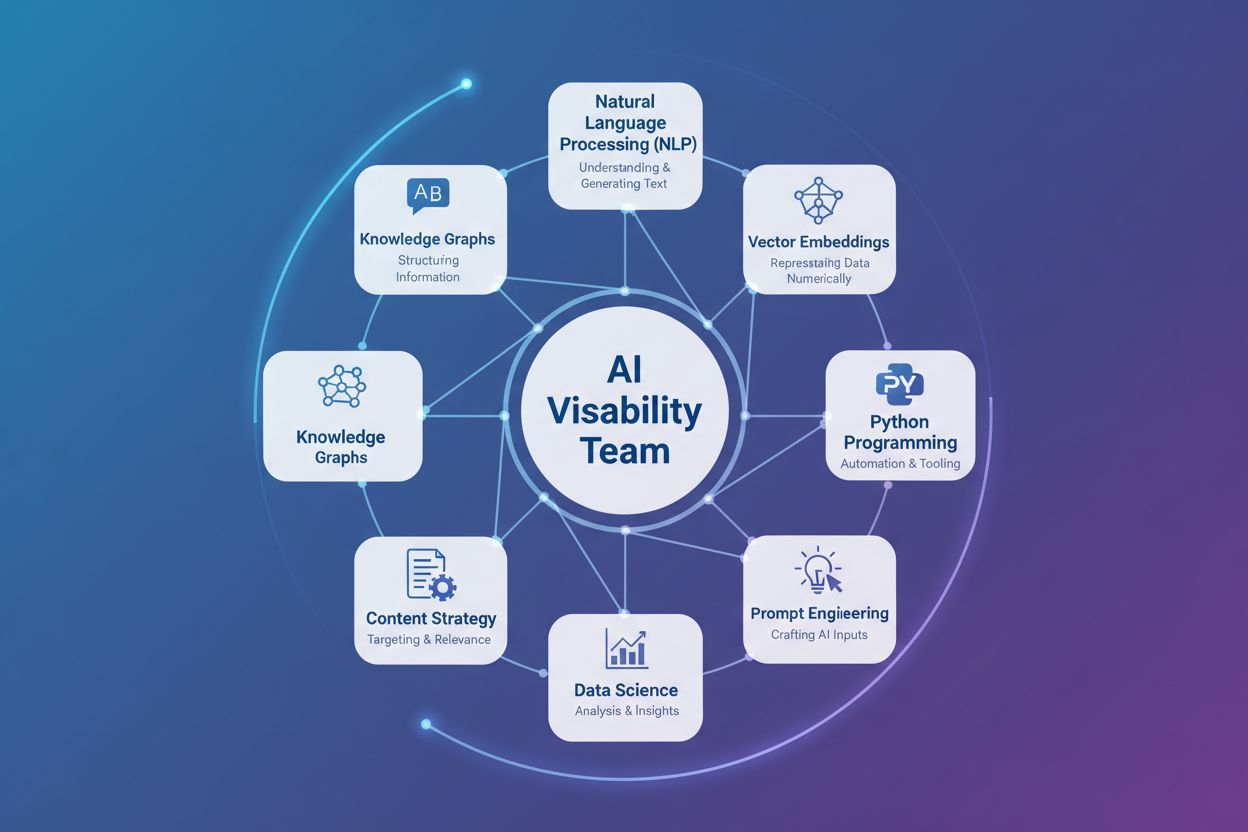
Learn how to structure an AI visibility team with essential roles like Relevance Engineers, Retrieval Analysts, and AI Strategists. Discover key skills, organiz...