
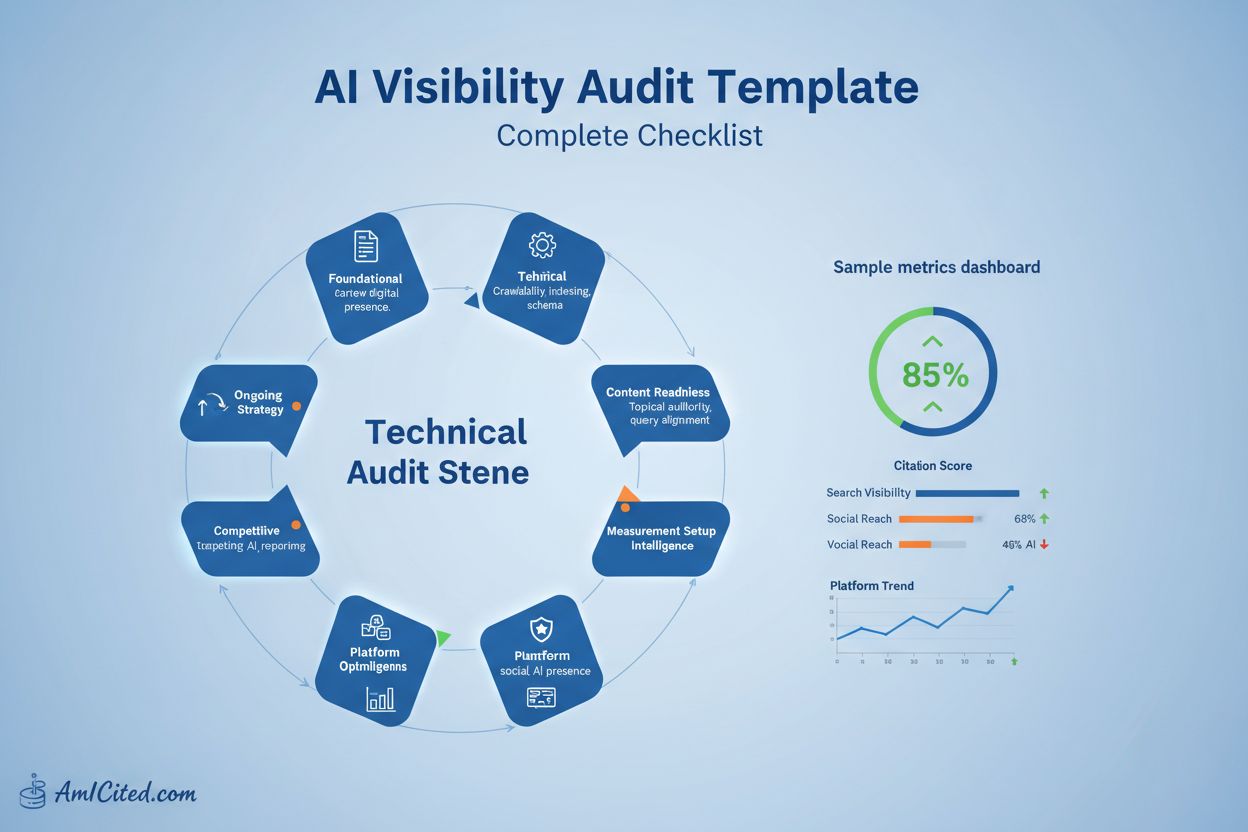
AI Visibility Audit Template: Downloadable Checklist
Complete AI visibility audit template and checklist. Audit your brand across ChatGPT, Perplexity, Google AI Overviews, and more. Step-by-step guide with tools, ...
15 min read
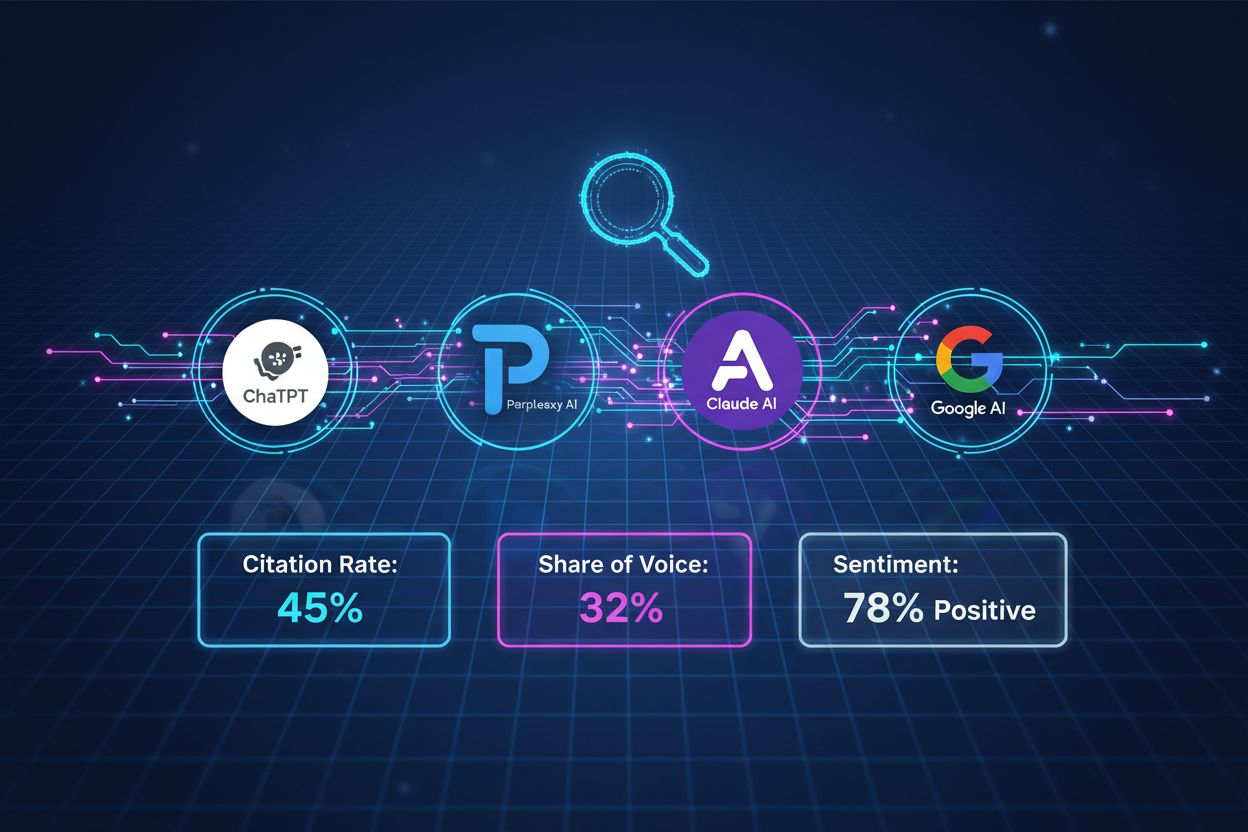
Learn how to interpret AI visibility audit results. Understand citation frequency, brand visibility scores, share of voice, and sentiment metrics. Get actionable insights to improve your AI search presence.
Your prospective customers are increasingly asking AI systems questions like “What’s the best marketing automation platform for B2B SaaS?” or “Compare the top three project management tools under $50/month.” 89% of B2B buyers now use generative AI during their purchasing journey, yet most marketers have zero visibility into whether AI systems mention their brand. When AI-generated answers appear, click-through rates for informational queries drop by more than half—from 1.41% to 0.64%—meaning traditional analytics can’t track this critical visibility gap. The brands that get cited in those AI answers are building compounding visibility, while those that don’t remain invisible in a growing majority of the buyer journey.
Traditional SEO gave us a clear metrics hierarchy: rankings, traffic, and conversions. Generative Engine Optimization (GEO) requires a fundamentally different measurement framework, one built around citations rather than clicks. Here are the five metrics that actually matter:
| Metric | What It Measures | Why It Matters | Target |
|---|---|---|---|
| Citation Frequency | How often your brand appears in AI responses | LLMs cite only 2-7 domains per response—far fewer than Google’s 10 links | 30%+ of core queries |
| Brand Visibility Score | Composite metric combining frequency, placement, links, and sentiment | Not all citations are equal; headline mentions differ from footnotes | Baseline +10% QoQ |
| AI Share of Voice | Your mentions vs. competitors in AI-generated answers | Winner-takes-most dynamics mean visibility compounds over time | 25%+ in category |
| Sentiment Analysis | How AI describes your brand (positive, neutral, negative) | 52% of Gen Z trust AI for decisions; negative sentiment scales across millions | 70%+ positive |
| LLM Conversion Rate | Conversion rate of visitors from AI platforms vs. traditional search | AI-referred visitors convert at 4.4x the rate of traditional organic search | 2-3x organic rate |
These metrics form the foundation of your AI visibility strategy. Unlike traditional rankings, which measure position on a results page, these metrics measure whether AI systems recognize your brand as relevant and trustworthy enough to recommend.
Citation frequency is the GEO equivalent of earning a backlink—only it directly shapes what millions of users see in AI-generated answers. To calculate it, divide the number of prompts where your brand is mentioned by the total number of prompts tested, then multiply by 100. For example, if you test 50 prompts related to project management software and your brand appears in 23 responses, your citation frequency is 46%. But frequency alone doesn’t tell the full story; placement matters enormously. A mention in the opening paragraph carries significantly more weight than one buried in a footnote, and a linked citation drives trackable traffic while an unlinked mention builds awareness.
Track these placement types separately:
Top-performing brands in competitive categories achieve 50%+ citation frequency, while 30%+ is a solid baseline for core category queries. The key is consistency—tracking these metrics weekly reveals trends and helps you identify which content types and topics earn the most citations.
The Brand Visibility Score (BVS) is a composite metric that normalizes citation frequency, placement, link presence, and sentiment into a single trackable number. Otterly.ai pioneered this approach with their Brand Visibility Index, recognizing that raw mention counts miss the nuance of how prominently your brand appears. To calculate a manual BVS, use weighted scoring: assign +3 points for headline mentions, +2 for body citations with links, +1 for unlinked mentions, and -1 for mentions alongside negative sentiment. This creates a more accurate picture than frequency alone.
Track your BVS weekly and aim for consistent upward trajectory—a 10%+ quarter-over-quarter improvement indicates your GEO strategy is working. Industry benchmarks are still emerging, but the trend is clear: brands that systematically improve their BVS see corresponding increases in AI-referred traffic and brand preference. The score reveals not just whether AI mentions you, but how favorably it positions you relative to competitors.
AI Share of Voice (AI SOV) measures your brand’s percentage of total citations in your category compared to competitors. Calculate it by dividing your brand mentions by the total mentions of all competitors for the same set of prompts. If you test 50 “best accounting software” prompts and your brand is mentioned 18 times while competitors are mentioned 82 times, your AI SOV is 18%—revealing a significant visibility gap. HubSpot now prioritizes being “cited in LLMs more than any other CRM” as a core business goal, recognizing that in a winner-takes-most AI recommendation environment, the brand with the highest SOV compounds their advantage over time.
Run identical prompts across AI platforms for your core category and track which brands appear, calculating the percentage of mentions each receives. Pay close attention to prompts where competitors are mentioned but your brand isn’t—these gaps represent your highest-priority optimization opportunities. In competitive categories, aim for AI SOV exceeding your traditional market share by 10-20%, creating a flywheel where visibility drives preference drives more visibility.
Beyond frequency and placement, track how AI systems describe your brand—the sentiment and accuracy of those mentions directly influence buyer perception. 52% of Gen Z users trust generative AI for informed decisions, making the tone and content of AI-generated descriptions critically important. If an LLM consistently associates your brand with “expensive” or “difficult to use” or “poor customer support,” that perception scales across millions of interactions. Tools like Profound AI specialize in hallucination detection, identifying when AI provides false or outdated information about your brand that could damage your reputation.
For manual tracking, query AI systems with prompts like “What are the strengths and weaknesses of [your brand]?” and document recurring themes and sentiment patterns. Categorize mentions as positive (accurate, favorable), neutral (factual, unbiased), or negative (inaccurate, unfavorable). Aim for 70%+ positive sentiment across AI platforms, and flag any recurring negative themes for immediate content and PR response. This qualitative analysis reveals perception gaps that quantitative metrics alone cannot capture.
While AI visibility matters for brand awareness, the real business case lies in conversion quality. Microsoft Clarity analyzed over 1,200 publisher websites and found conversion rates of 1.66% from LLMs compared to 0.15% from traditional search—more than 10x higher. This dramatic difference exists because AI-referred visitors arrive pre-informed and pre-qualified; by the time someone clicks through from an AI recommendation, they’ve already been educated on your value proposition, compared against alternatives, and given a trusted endorsement. Fewer visits, but dramatically higher intent and conversion probability.
Set up Google Analytics 4 custom channel groupings to separate AI referrers (chatgpt.com, perplexity.ai, claude.ai, etc.) from traditional organic traffic, then track conversion rates separately. If your LLM conversion rate isn’t at least 2-3x your traditional organic conversion rate, something is wrong with your AI-referred landing experience—either the AI is sending misaligned traffic or your landing pages aren’t optimized for the pre-informed visitor. Even tiny gains in AI traffic can dramatically impact revenue when conversion rates are this high.
AI models constantly evolve, pulling from dynamic data that changes daily, which means your visibility metrics will fluctuate. Drift refers to gradual shifts in how a model perceives your brand over time, while volatility captures sudden changes following updates to the model. By monitoring week-over-week changes in visibility, you can spot trends and react to abrupt shifts before they become competitive disadvantages. For high-priority prompts, daily tracking is essential to stay ahead of changes.
A brand is considered to “win” a prompt only when at least two models—like ChatGPT and Gemini—mention it consistently across two consecutive checks, minimizing the impact of fluctuations from a single model. This approach acknowledges that AI systems are inherently variable while still providing actionable signals. If your visibility suddenly drops 20% week-over-week, investigate whether an AI model update changed its data sources or retrieval methods, then adjust your content strategy accordingly.
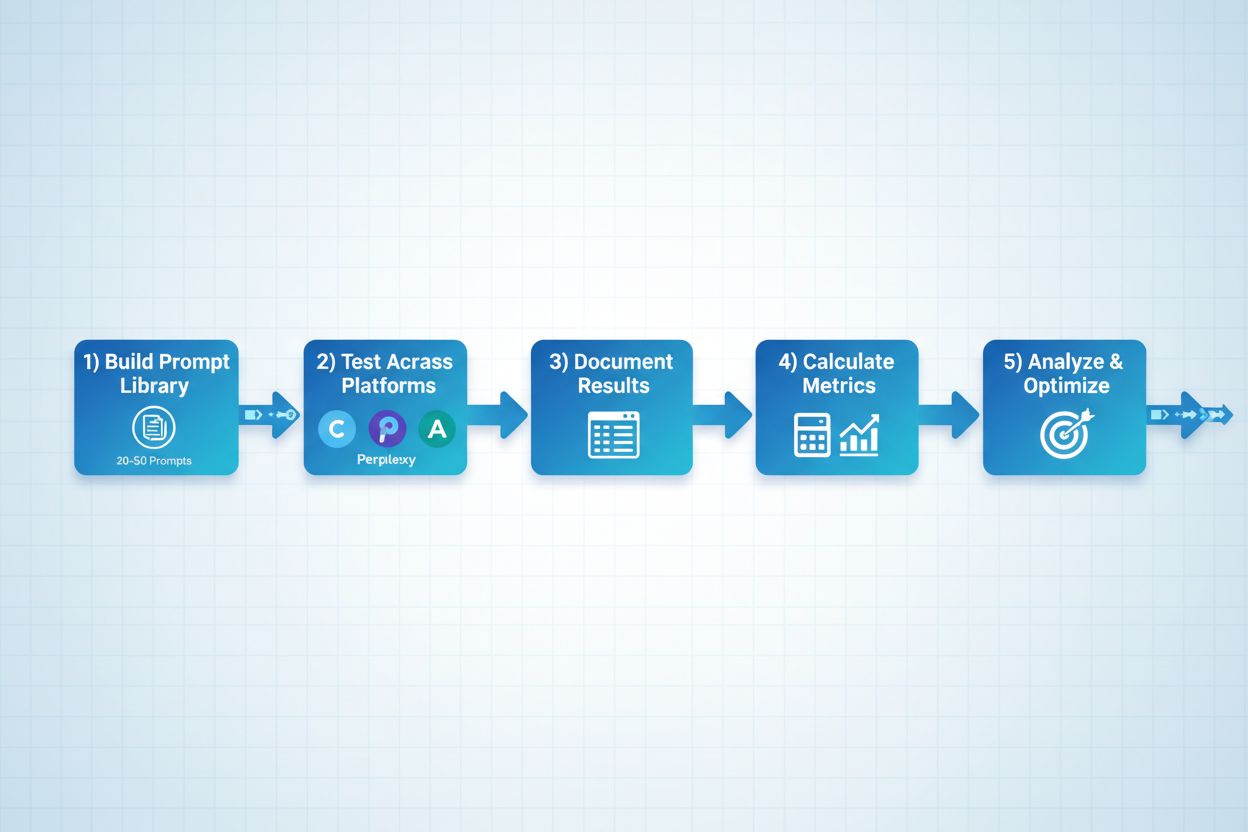
Not ready to invest in specialized tools? Here’s how to build a baseline GEO tracking system using manual methods that provide the same core insights as enterprise platforms. Start by creating a spreadsheet with 20-50 prompts that represent how your ideal customers might ask AI systems about your category. Include category queries (“What’s the best [category] for [use case]?”), comparison queries (“Compare [your brand] vs [competitor]”), problem-solution queries (“How do I [problem your product solves]?”), and recommendation queries (“What tools do you recommend for [specific task]?”).
Run weekly audits by querying each prompt across ChatGPT, Perplexity, Claude, and Google (to capture AI Overviews), then document:
Calculate your metrics manually: Citation Frequency = (Prompts where you’re mentioned) / (Total prompts) × 100, and AI SOV = (Your mentions) / (Total brand mentions across all prompts) × 100. Track these weekly to establish trends. This manual process requires 2-3 hours weekly but provides the same foundational data that paid tools automate.
The GEO tool market is exploding, with more than 35 AI search monitoring tools launched recently. Here’s how the leading options compare for different use cases:
| Tool | Starting Price | Best For | Platform Coverage | Unique Strength |
|---|---|---|---|---|
| Otterly.ai | $29/month | Marketing teams | 6 platforms | Brand Visibility Index |
| Promptmonitor | $29/month | SMBs/Agencies | 8 platforms | Contact discovery |
| Semrush AI Toolkit | $99/month | Semrush users | 4 platforms | Ecosystem integration |
| Profound AI | $499/month | Enterprise | 5 platforms | Hallucination detection |
Otterly.ai is best for marketing teams wanting comprehensive AI search monitoring with strong visualization—users report “up to 80% time savings” on manual checks. Promptmonitor offers the most comprehensive platform coverage at accessible prices, with 1-3 years of historical data. Semrush AI Toolkit seamlessly integrates if you’re already a Semrush user, consolidating traditional SEO and GEO tracking. Profound AI serves enterprise brands requiring compliance, security, and hallucination detection, with SOC 2 Type II certification.
When evaluating tools, focus on engine coverage (ChatGPT, Perplexity, Claude, Gemini, Google AI Overviews are non-negotiable), prompt management flexibility, scoring transparency, citation extraction accuracy, competitor analysis capabilities, export options, and price-to-coverage ratio. A tool priced at $499/month but tracking only 50 prompts across two engines scores poorly compared to one offering 500 prompts across five engines for $119/month.
Your audit data reveals specific optimization opportunities if you know how to interpret it. High visibility but low citations suggests your content structure doesn’t match how AI systems extract information—add answer-ready summaries at the top of pages, implement FAQ schema, and ensure clear hierarchical organization. Strong performance on one platform but weakness on others indicates distribution gaps; investigate which sources each platform favors and adjust your content distribution strategy accordingly.
Declining visibility over time signals that competitors are creating more citation-worthy material or your content is getting stale—regular updates and fresh publishing are essential. When you spot queries where competitors appear but you don’t, you’ve found high-priority optimization opportunities. Analyze what makes their content citation-worthy, then create competing assets that address the same topics with greater depth, accuracy, or unique insights. Use this gap analysis to prioritize your content roadmap.
Knowing your metrics is meaningless without a strategy to improve them. Expand your semantic footprint by covering your core topics thoroughly, including adjacent concepts and related questions users are likely to ask. Increase fact density by packing content with statistics and verifiable details—research from Princeton University, Georgia Tech, and the Allen Institute for AI suggested that adding citations and quotes boosted AI visibility by more than 40%. Optimize for structure using clear headers, TL;DR summaries, and FAQ sections that AI engines often pull directly into their answers.
Build entity authority by keeping your brand’s information consistent across trusted, authoritative sources that AI platforms rely on. Implement proper schema markup to help AI systems understand your content structure. Most importantly, establish a regular content update cadence—AI systems favor fresh, current information, and stale content loses visibility over time. AmICited.com helps you track which content actually earns citations, allowing you to double down on what works and optimize what doesn’t.
Avoid these common pitfalls when analyzing your AI visibility audit results. Don’t confuse mentions with citations—an unlinked brand mention builds awareness but doesn’t drive traffic, while a citation with a link is the real win. Don’t ignore sentiment in favor of volume; appearing 100 times with negative sentiment is worse than appearing 20 times with positive sentiment. Don’t assume platform performance is uniform; your brand might dominate ChatGPT while being invisible in Perplexity, requiring different optimization strategies for each.
Don’t expect immediate results—building sustainable citation authority requires 3-6 months of consistent optimization, not weeks. Don’t overlook competitor context; a 40% citation frequency means nothing if competitors average 60%. Don’t treat all prompts equally; focus optimization efforts on high-intent, high-volume prompts that drive actual business value. These mistakes lead to misallocated resources and missed opportunities.
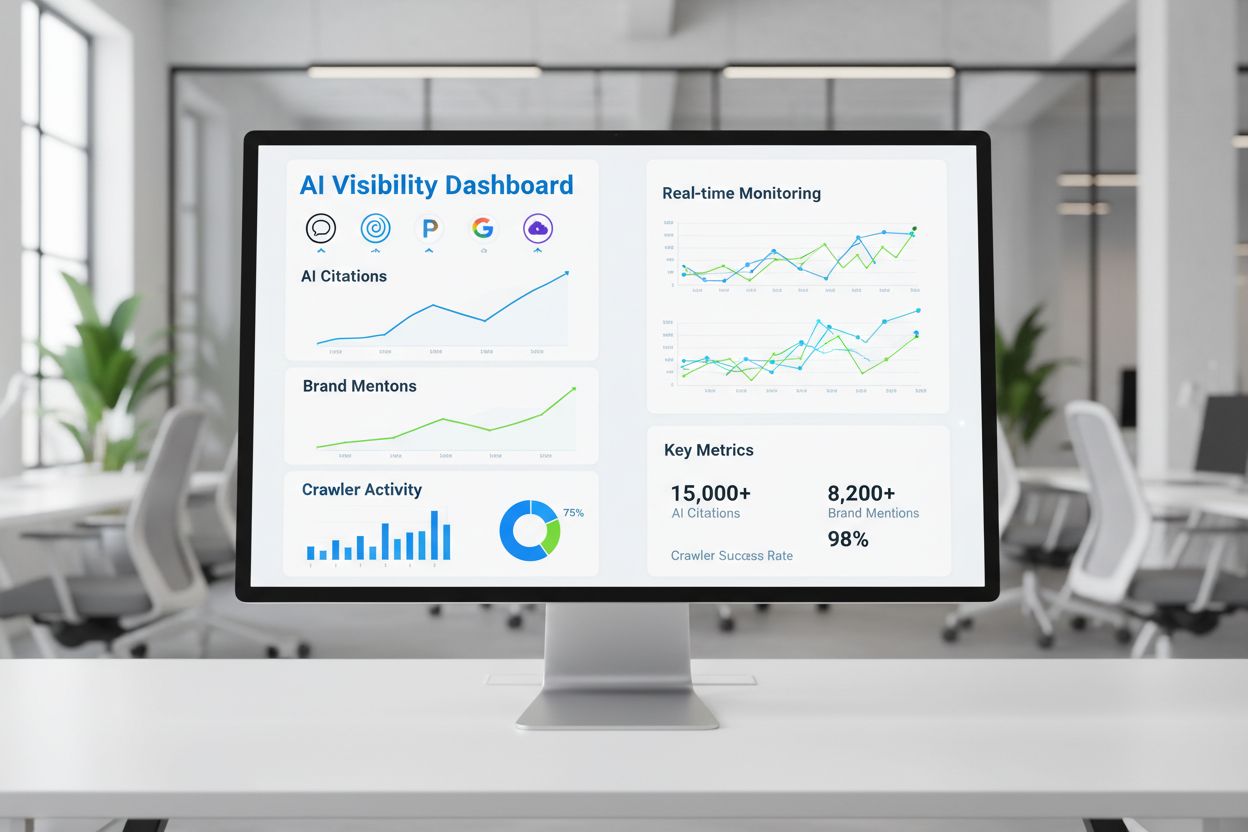
Create a structured dashboard to track your GEO metrics consistently and identify trends. Update citation metrics weekly: Citation Frequency, AI Share of Voice, Brand Visibility Score, Linked Citations percentage, and Positive Sentiment percentage. Track platform-specific performance weekly as well, documenting citation counts, SOV, and sentiment for ChatGPT, Perplexity, Claude, Google AI Overviews, and Gemini separately. Monitor traffic and conversion metrics weekly, separating AI total, chatgpt.com, perplexity.ai, other AI, and traditional organic.
Update competitive intelligence monthly, tracking competitor AI SOV, their top-cited content types, and sentiment trends. Review content performance monthly, documenting which pages earn citations, which platforms cite them, traffic from AI sources, and whether each asset needs optimization, maintenance, or refresh. Use Looker Studio, Tableau, or even a well-structured spreadsheet to implement this template. Connect data sources including Google Analytics 4 (for traffic and conversion data), GEO tool APIs (for citation metrics), and manual audit spreadsheets (for qualitative data). Establish reporting cadence: daily automated AI referral traffic, weekly citation metrics, monthly competitive deep-dives, and quarterly strategic audits.
The financial case for AI visibility tracking is compelling. Semrush research shows LLM visitors are worth 4.4x traditional organic visitors based on conversion rates. To calculate your AI visitor value, determine your traditional organic visitor value (Revenue from organic / Organic visitors), then multiply by 4.4. If your traditional organic visitor value is $2.50, your AI visitor value is $11.00. When brands are cited inside AI-generated answers, they experience a 38% lift in organic clicks and a 39% increase in paid ad clicks—AI visibility amplifies all your other marketing channels.
Build your GEO investment ROI framework: Monthly GEO tool cost ($200 example), content optimization investment ($2,000 staff time), total monthly investment ($2,200). Track outputs: AI-referred visits from GA4, AI visitor conversion rate, revenue from AI-attributed conversions, and branded search lift. Calculate ROI: Revenue from AI channel / GEO investment × 100 = ROI %. Companies seeing positive GEO ROI report 300-500% returns within 6-12 months. Gartner predicts 50% reduction in traditional organic traffic by 2028 due to AI-generated search—what percentage of your pipeline depends on organic search? That’s your risk exposure if you’re not building AI visibility now.
AmICited.com specializes in tracking how AI systems mention your brand across ChatGPT, Perplexity, Google AI Overviews, and emerging AI platforms. Unlike generic SEO tools retrofitting AI tracking, AmICited provides real-time monitoring specifically designed for the LLM era, capturing citation frequency, placement, sentiment, and competitive benchmarking in one integrated platform. The platform automatically tracks your target prompts across multiple AI engines, calculates your Brand Visibility Score, and identifies competitive gaps—eliminating the manual testing that consumes hours weekly.
AmICited’s competitive intelligence features show exactly which competitors are winning specific prompts and what content types earn citations. Sentiment analysis reveals how AI describes your brand, helping you identify perception gaps before they become reputation issues. Most importantly, AmICited connects visibility data to action, providing specific content optimization recommendations based on what’s actually getting cited. Rather than guessing which content improvements will boost AI visibility, you see real data showing which pages earn citations and which need optimization.
Start with a two-week manual audit to establish your baseline metrics and understand which KPIs matter most for your business. Create a 50-prompt test pack covering your core category, comparisons, problem-solution queries, and direct brand searches. Test each prompt across ChatGPT, Perplexity, Claude, and Google AI Overviews, documenting mentions, citations, placement, and sentiment in a spreadsheet. Calculate your baseline Citation Frequency, Brand Visibility Score, AI Share of Voice, and Sentiment percentage.
Analyze your data to identify quick wins—prompts where you’re close to visibility or where small content improvements could earn citations. Document your baseline metrics and establish weekly tracking to monitor trends. Once you see results from manual testing and understand your metrics, invest in automated tools that match your team size and reporting requirements. Start with budget-friendly options like Otterly AI ($29/month) or Promptmonitor ($29/month), then scale to enterprise solutions as your AI visibility grows. The key is beginning now—early adopters of GEO strategies have 3x higher AI visibility than late movers, and that advantage compounds over time.
A mention is when AI references your brand name without a link, while a citation explicitly links to your website as a source. Both matter for building awareness, but citations drive trackable traffic and stronger attribution. In AI-generated answers, both types contribute to your visibility, though citations have more direct business impact.
Track core metrics weekly to catch trends early, conduct competitive analysis monthly to benchmark against competitors, and perform strategic reviews quarterly. For high-priority prompts where you're competing for visibility, daily tracking is ideal. This cadence balances actionable insights with reasonable time investment.
Establish your baseline with 2 weeks of manual testing, identify quick wins within 2-4 weeks, and expect sustainable improvements within 3-6 months of consistent optimization. Compounding effects from improved visibility typically appear within 6-12 months. Early adopters of GEO strategies see 3x higher AI visibility than late movers.
Different AI platforms use different data sources and indexing methods. Perplexity conducts real-time web searches while ChatGPT relies on training data with a knowledge cutoff. This requires platform-specific optimization strategies. Analyze which sources each platform favors and adjust your content distribution accordingly.
Add statistics and data to your content, improve structure with clear headers and bullet points, implement schema markup, build entity authority across platforms, and update stale content regularly. Content with clear formatting is 28-40% more likely to be cited. FAQ formats perform exceptionally well because they match how users query AI systems.
Start free with manual testing and Semrush's free AI Visibility Checker. Budget options range from $29-$99/month (Otterly, Promptmonitor), mid-market from $99-$200/month (Semrush, SE Ranking), and enterprise from $500+/month (Profound). Most SMBs find strong value in the $29-$129 range.
Benchmark against these targets: Citation Frequency 30%+ (excellent at 50%+), Brand Visibility Score improving 10%+ quarterly, AI Share of Voice exceeding market share by 10-20%, Sentiment 70%+ positive, and LLM Conversion Rate 2-3x traditional organic. Compare your metrics against competitors in your category for context.
Yes, manual testing is effective. Create 20-50 prompts, test across ChatGPT, Perplexity, Claude, and Google AI Overviews, document results in a spreadsheet, and calculate metrics manually. Use free tools like Semrush's AI Visibility Checker and Answer Socrates to supplement. This requires 2-3 hours weekly but provides the same foundational data.
Don't let your brand be invisible in AI-generated answers. AmICited monitors how ChatGPT, Perplexity, and Google AI mention your brand—and helps you optimize for better visibility.
Complete AI visibility audit template and checklist. Audit your brand across ChatGPT, Perplexity, Google AI Overviews, and more. Step-by-step guide with tools, ...
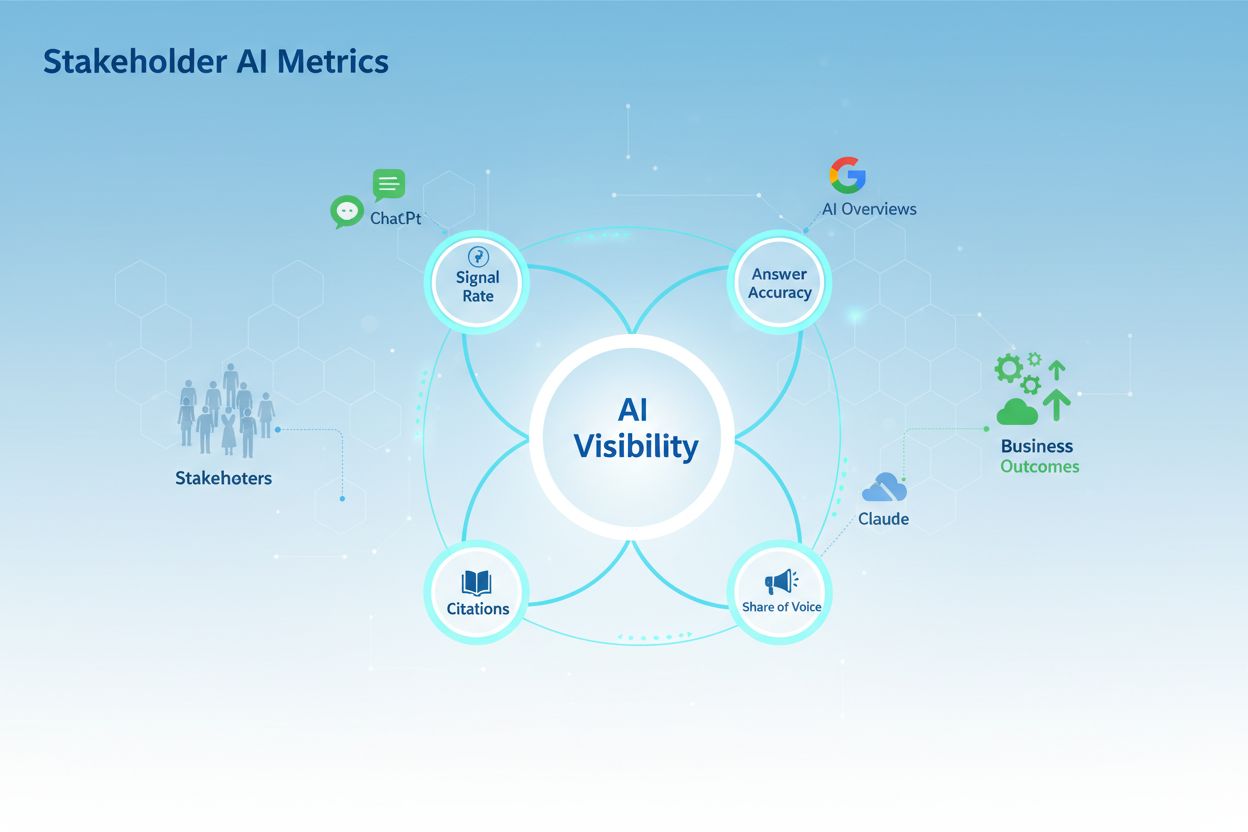
Discover the 4 essential AI visibility metrics stakeholders care about: Signal Rate, Accuracy, Citations, and Share of Voice. Learn how to measure and report AI...
Learn how to document your AI visibility strategy with internal resources. Track AI citations, monitor crawler activity, and build a comprehensive documentation...