
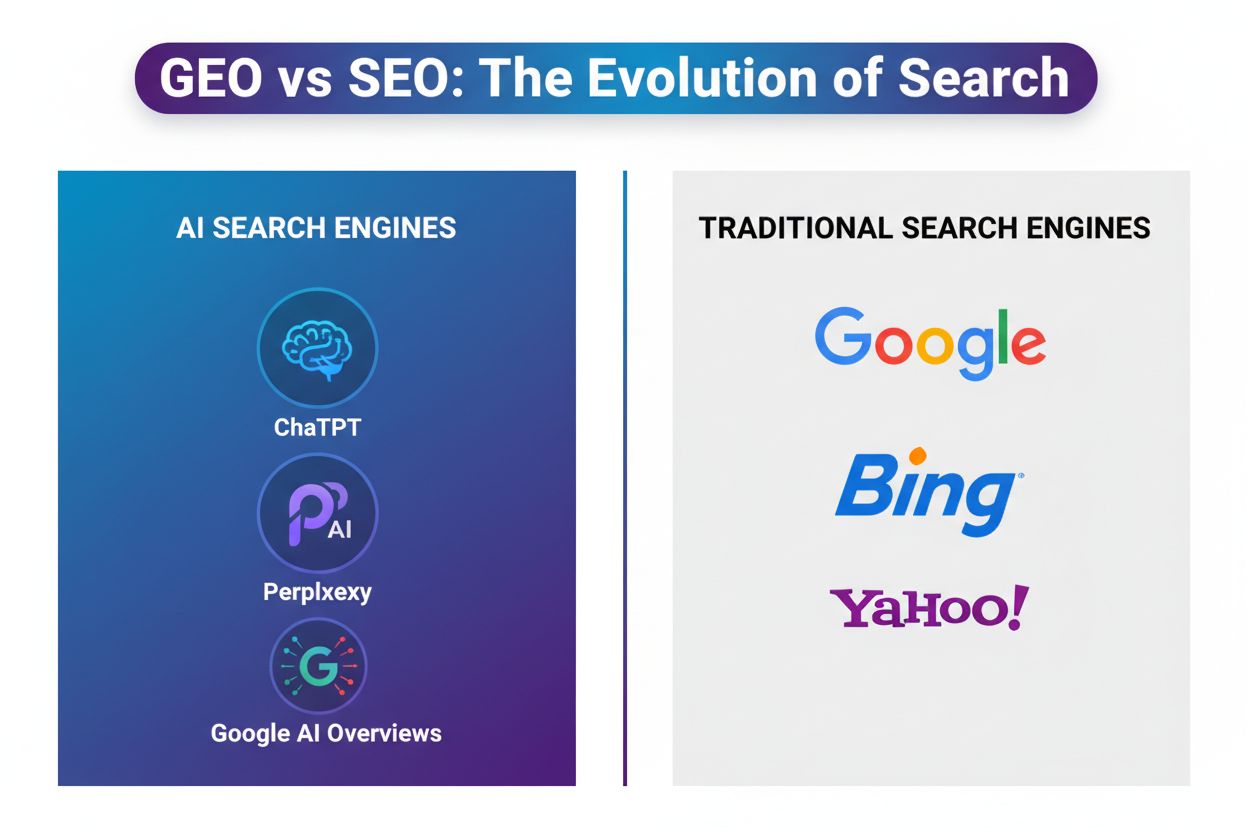
GEO vs SEO: Key Differences Every Marketer Must Know
Understand the critical differences between Generative Engine Optimization (GEO) and traditional SEO. Learn how to optimize for AI search engines like ChatGPT, ...
9 min read
Discover the real differences between GEO and SEO. Learn why generative engine optimization isn’t just rebranded search optimization and how to optimize for both AI and traditional search.
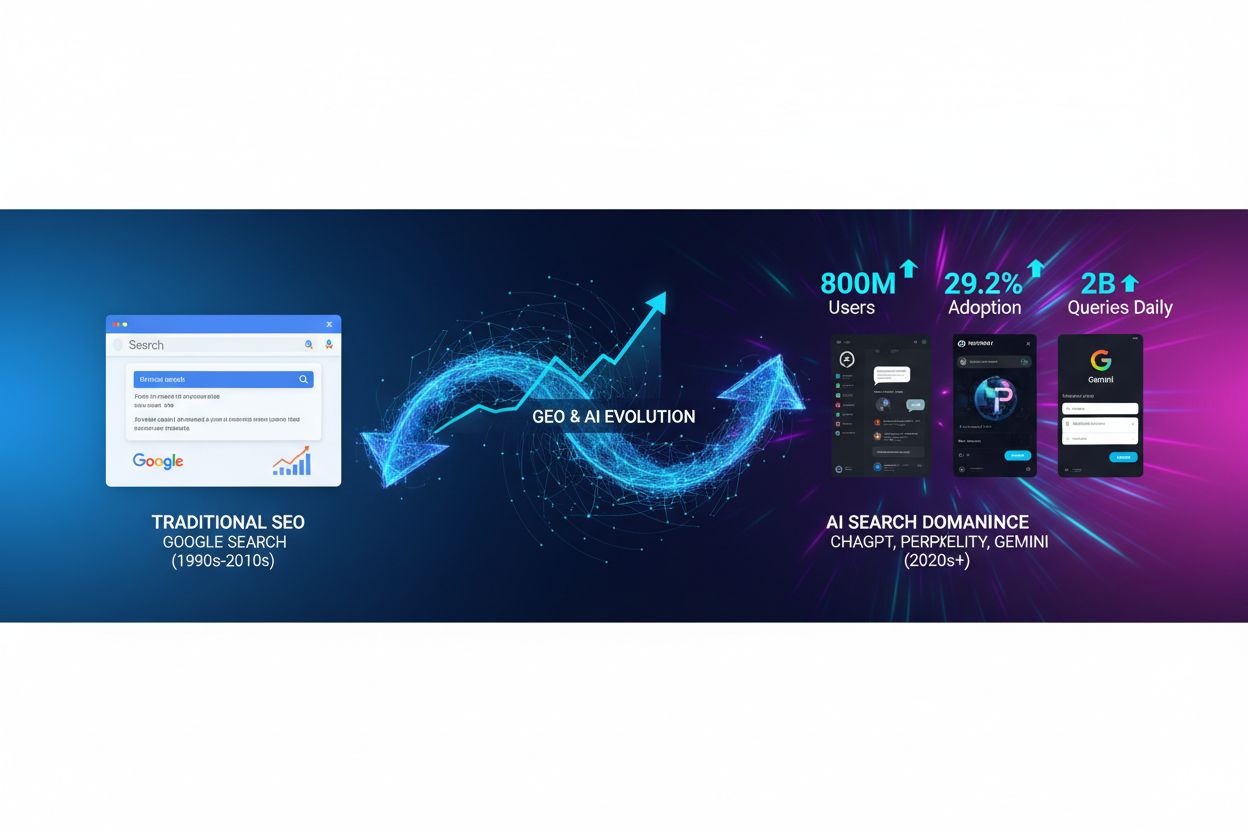
The internet is buzzing with bold claims: “SEO is dead,” “GEO replaces traditional search,” “AI is the future of discovery.” But here’s what the data actually shows. ChatGPT reached 800 million weekly active users in October 2025—doubling from 400 million in just eight months. AI adoption jumped from 14% in February to 29.2% in August 2025. Yet Google still sends 345 times more traffic than all AI platforms combined. The truth isn’t that GEO replaces SEO; it’s that GEO is an evolution that builds on SEO fundamentals while requiring distinctly different strategies. This distinction matters because 47% of brands still lack a deliberate GEO strategy, creating a massive opportunity for early movers.
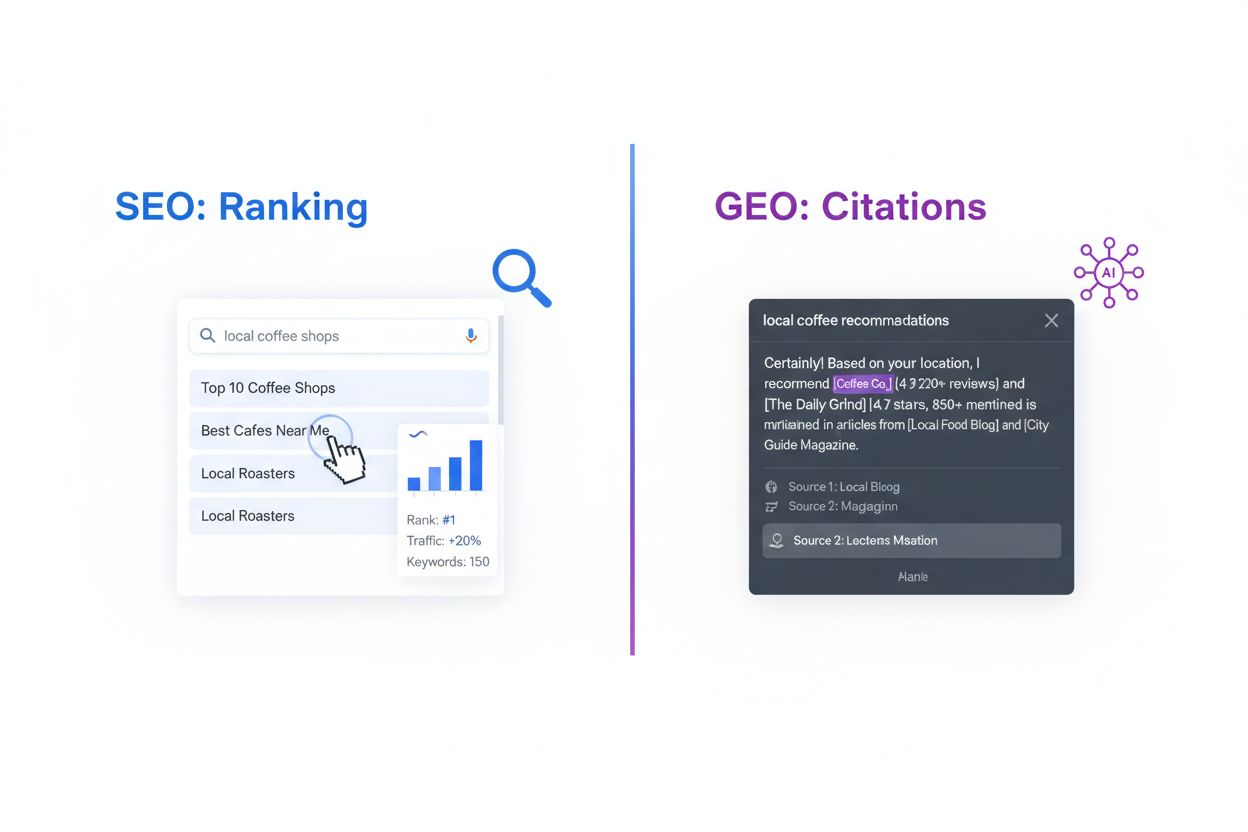
To understand whether GEO is just rebranded SEO, we need to define what each actually does. Search Engine Optimization (SEO) focuses on getting your website to rank higher in search engine results pages—the list of blue links people click on. Generative Engine Optimization (GEO) focuses on getting your brand cited or referenced inside AI-generated answers from ChatGPT, Perplexity, Gemini, and other large language models. The difference is profound: with SEO, you’re competing for a position in a ranked list; with GEO, you’re competing to be part of the answer itself.
Here’s how they compare across key dimensions:
| Factor | Traditional SEO | Generative Engine Optimization |
|---|---|---|
| Primary Goal | Rank in top 10 search results | Get cited in AI-generated answers |
| Target Platforms | Google, Bing, DuckDuckGo | ChatGPT, Perplexity, Gemini, Claude, Google AI Overviews |
| Success Metric | Rankings, organic traffic, click-through rate | Brand mentions, citations, AI visibility score |
| Optimization Focus | Backlinks, keywords, page speed, user experience | Semantic clarity, schema markup, external mentions, fact density |
| Time to Impact | 3-6 months for measurable results | 2-4 weeks for initial visibility |
| Current Traffic Share | 48.5% of internet traffic | 0.1-0.15% but doubling every 6 months |
The most dangerous assumption is that strong SEO automatically equals strong GEO visibility. While there’s overlap, they’re not interchangeable. Consider these facts:
The bottom line: strong SEO gives you a foundation, but it’s not sufficient for GEO success. You need both strategies working in concert.
Understanding where SEO and GEO differ reveals why treating them identically fails. Research analyzing over 1 million AI-generated answers shows:
This explains why a page ranking #3 in Google might never appear in ChatGPT answers, while a lower-ranking page with clear entity signals and external mentions gets cited frequently.
AI engines need content structured differently than traditional search engines. While Google’s algorithm can infer meaning from vague writing, large language models struggle with ambiguity. This requires a fundamental shift in how you write:
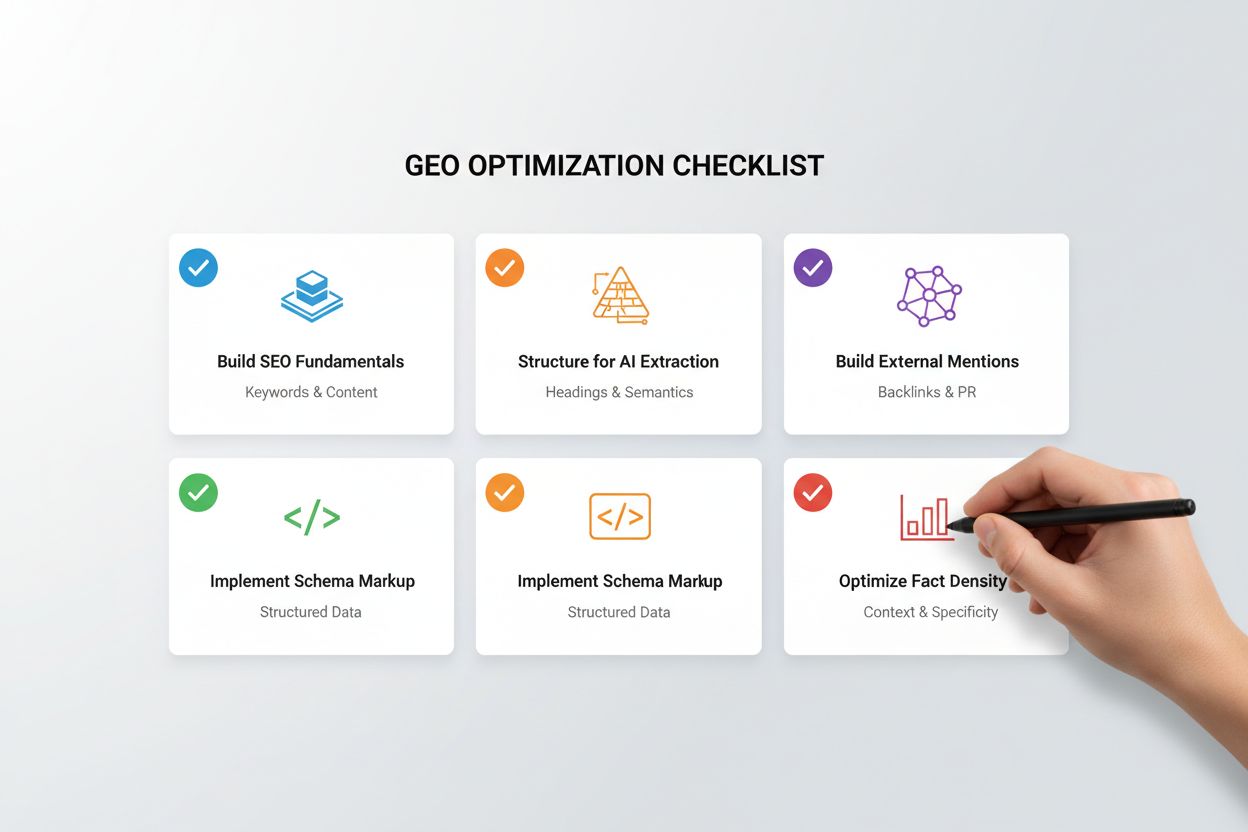
One of the biggest differences between SEO and GEO is how they handle entities. Traditional SEO focuses on keywords; GEO focuses on entities—the people, places, products, and concepts your content discusses. AI engines use schema markup to understand these relationships precisely.
Implementing schema markup isn’t optional for GEO success; it’s foundational.
Understanding how we got here helps explain why GEO isn’t just rebranded SEO. The evolution has been gradual but accelerating:
This timeline shows GEO isn’t a sudden invention; it’s the natural evolution of how people discover information.
Different AI platforms have different architectures, training data, and citation preferences. A one-size-fits-all approach fails:
ChatGPT (77% of AI referral traffic, 800M weekly users):
Perplexity (22M active users, transparent citations):
Google AI Overviews (20% of Google searches):
Google AI Mode (Newest platform, 93% of searches end without a click):
Authority works differently in GEO than in traditional SEO. While backlinks still matter for SEO, GEO relies more heavily on:
Building authority for GEO requires a different playbook: guest articles, press releases, industry partnerships, and community participation matter more than link building.
Traditional SEO metrics don’t work for GEO. You can’t measure success by rankings because AI platforms don’t rank—they synthesize. Instead, track:
Important context: Google sends 345x more traffic than ChatGPT, Gemini, and Perplexity combined as of September 2025. Don’t abandon traditional SEO, but do add GEO metrics to your dashboard.
You don’t need months to see initial GEO results. Here’s a realistic 30-day plan:
Week 1: Audit Your Current Position
Week 2: Quick Wins
Week 3: Content Optimization
Week 4: External Expansion
The data is clear: 47% of brands still lack a deliberate GEO strategy. This creates a massive opportunity for early movers. Consider:
The brands that move now will be the ones customers find when they ask AI for recommendations.
Several myths persist about GEO that hold brands back:
Q: Is GEO just rebranded SEO?
No. While GEO builds on SEO fundamentals, it’s fundamentally different. SEO optimizes for ranking in search results; GEO optimizes for being cited in AI answers. The platforms use different signals, reward different content structures, and measure success differently. Think of GEO as an evolution of SEO, not a rebrand. You need both strategies working together.
Q: Will GEO replace traditional SEO?
Not in the foreseeable future. Google sends 345x more traffic than all AI platforms combined as of September 2025. However, AI adoption is doubling every 6 months, so the gap is closing. The smart move is optimizing for both simultaneously. 76.1% of AI Overview citations also rank in Google’s top 10, showing that strong SEO provides a foundation for GEO success.
Q: How long until I see GEO results?
Initial visibility can appear within 2-4 weeks—much faster than traditional SEO’s 3-6 month timeline. AI models update their knowledge more frequently than search engines recrawl the web. However, building sustained authority takes longer. With ChatGPT growing from 400M to 800M weekly users in eight months, the opportunity window for early adopters is closing rapidly.
Q: Do I need special tools for GEO?
Not initially. Start with free tools: Google Analytics 4 for tracking, Google Search Console for monitoring, Google’s Rich Results Test for schema validation, and manual testing in ChatGPT, Perplexity, and Gemini. Tools like AmICited.com help monitor your brand mentions across AI platforms at scale, but they’re not required to begin. Specialized platforms like Writesonic’s GEO Monitor or Semrush AI SEO Toolkit help at scale but aren’t necessary to start.
Q: What content types perform best in GEO?
Research shows comparison articles lead with 32.5% of citations, followed by opinion pieces (10%) and guides. Best-of content, product pages, and how-to guides drive the most AI traffic. Content with specific statistics, expert quotes, and clear sources gets cited more frequently. Interestingly, 91.4% of content cited in AI Overviews is at least partially AI-generated—proving that AI-assisted content doesn’t hurt visibility when it maintains quality.
Q: How much does GEO cost to implement?
Basic tactics require time investment, not budget. Content restructuring, schema markup, and FAQ creation cost zero dollars. Where budget helps: guest posts ($150-$500 each), premium schema plugins ($50-$200 annually), GEO tracking tools ($99-$500/month), and PR services ($2,000-$10,000/month). With 47% of brands lacking a GEO strategy, early movers can gain advantage with minimal investment.
Q: Can local businesses benefit from GEO?
Absolutely. AI platforms frequently reference businesses for location-specific queries. When someone asks “best family dentist in Austin,” AI responses include specific business names with context. Local businesses should optimize Google Business Profile, encourage reviews, create location-specific content, and build local media mentions. The key is becoming the authoritative local source AI platforms trust.
Q: Should I optimize for all AI platforms equally?
Start with ChatGPT and Google AI Overviews (highest impact), then expand to Perplexity and Gemini. ChatGPT accounts for 77% of AI referral traffic and 800M weekly users. Google AI Overviews appear in 20% of searches. Strong GEO fundamentals work across all platforms—create fact-dense, well-structured content with proper schema and you’ll gain visibility everywhere.
No. While GEO builds on SEO fundamentals, it's fundamentally different. SEO optimizes for ranking in search results; GEO optimizes for being cited in AI answers. The platforms use different signals, reward different content structures, and measure success differently. Think of GEO as an evolution of SEO, not a rebrand. You need both strategies working together.
Not in the foreseeable future. Google sends 345x more traffic than all AI platforms combined as of September 2025. However, AI adoption is doubling every 6 months, so the gap is closing. The smart move is optimizing for both simultaneously. 76.1% of AI Overview citations also rank in Google's top 10, showing that strong SEO provides a foundation for GEO success.
Initial visibility can appear within 2-4 weeks—much faster than traditional SEO's 3-6 month timeline. AI models update their knowledge more frequently than search engines recrawl the web. However, building sustained authority takes longer. With ChatGPT growing from 400M to 800M weekly users in eight months, the opportunity window for early adopters is closing rapidly.
Not initially. Start with free tools: Google Analytics 4 for tracking, Google Search Console for monitoring, and manual testing in ChatGPT, Perplexity, and Gemini. Tools like AmICited.com help monitor your brand mentions across AI platforms at scale, but they're not required to begin. Specialized platforms help at scale but aren't necessary to start.
Research shows comparison articles lead with 32.5% of citations, followed by opinion pieces (10%) and guides. Best-of content, product pages, and how-to guides drive the most AI traffic. Content with specific statistics, expert quotes, and clear sources gets cited more frequently. Interestingly, 91.4% of content cited in AI Overviews is at least partially AI-generated—proving that AI-assisted content doesn't hurt visibility when it maintains quality.
Basic tactics require time investment, not budget. Content restructuring, schema markup, and FAQ creation cost zero dollars. Where budget helps: guest posts ($150-$500 each), premium schema plugins ($50-$200 annually), GEO tracking tools ($99-$500/month), and PR services ($2,000-$10,000/month). With 47% of brands lacking a GEO strategy, early movers can gain advantage with minimal investment.
Absolutely. AI platforms frequently reference businesses for location-specific queries. When someone asks 'best family dentist in Austin,' AI responses include specific business names with context. Local businesses should optimize Google Business Profile, encourage reviews, create location-specific content, and build local media mentions. The key is becoming the authoritative local source AI platforms trust.
Start with ChatGPT and Google AI Overviews (highest impact), then expand to Perplexity and Gemini. ChatGPT accounts for 77% of AI referral traffic and 800M weekly users. Google AI Overviews appear in 20% of searches. Strong GEO fundamentals work across all platforms—create fact-dense, well-structured content with proper schema and you'll gain visibility everywhere.
Track how often your brand appears in ChatGPT, Perplexity, and Google AI Overviews. Get real-time insights into your AI search visibility and competitive positioning.
Understand the critical differences between Generative Engine Optimization (GEO) and traditional SEO. Learn how to optimize for AI search engines like ChatGPT, ...

Discover why Generative Engine Optimization (GEO) is essential for businesses in 2025. Learn how AI-powered search is reshaping brand visibility, consumer behav...
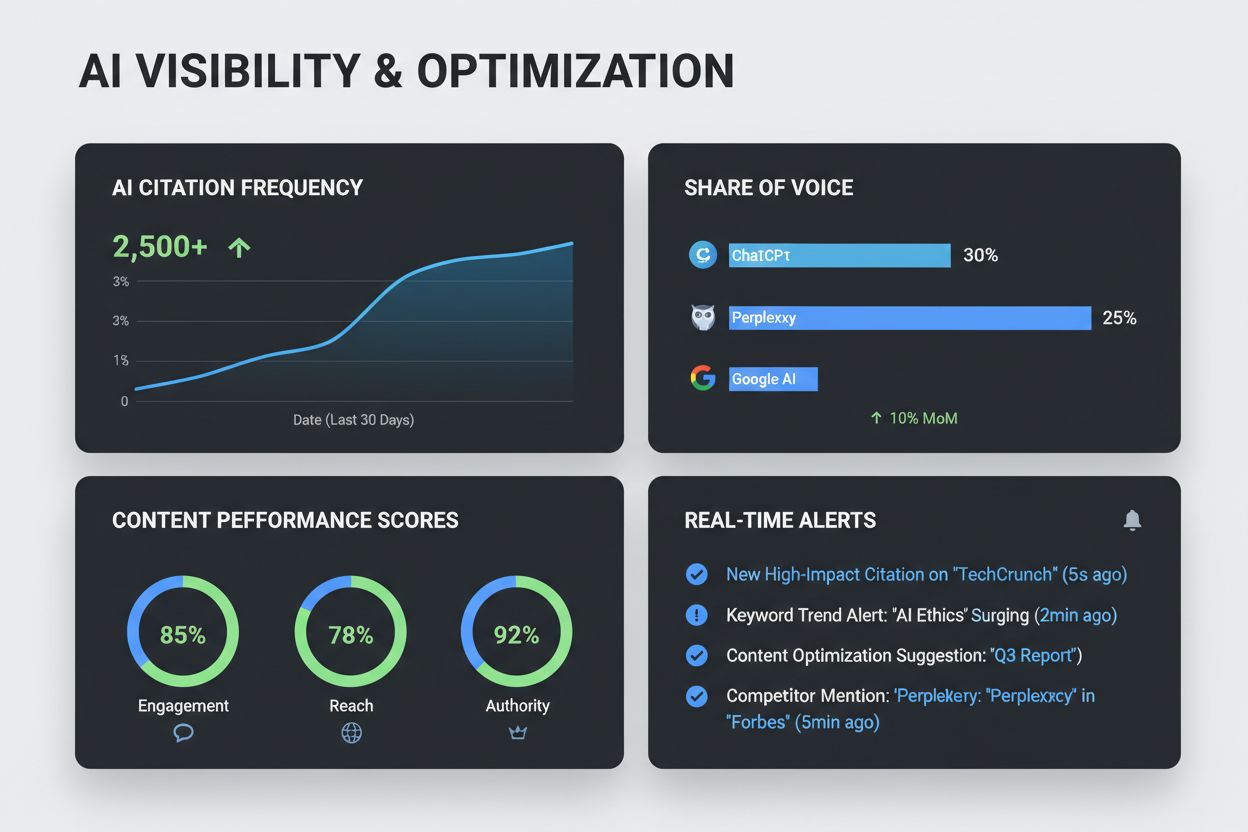
Learn how AI-powered tools optimize content for AI search engines like ChatGPT, Perplexity, and Google AI Overviews. Discover automated GEO strategies and measu...