
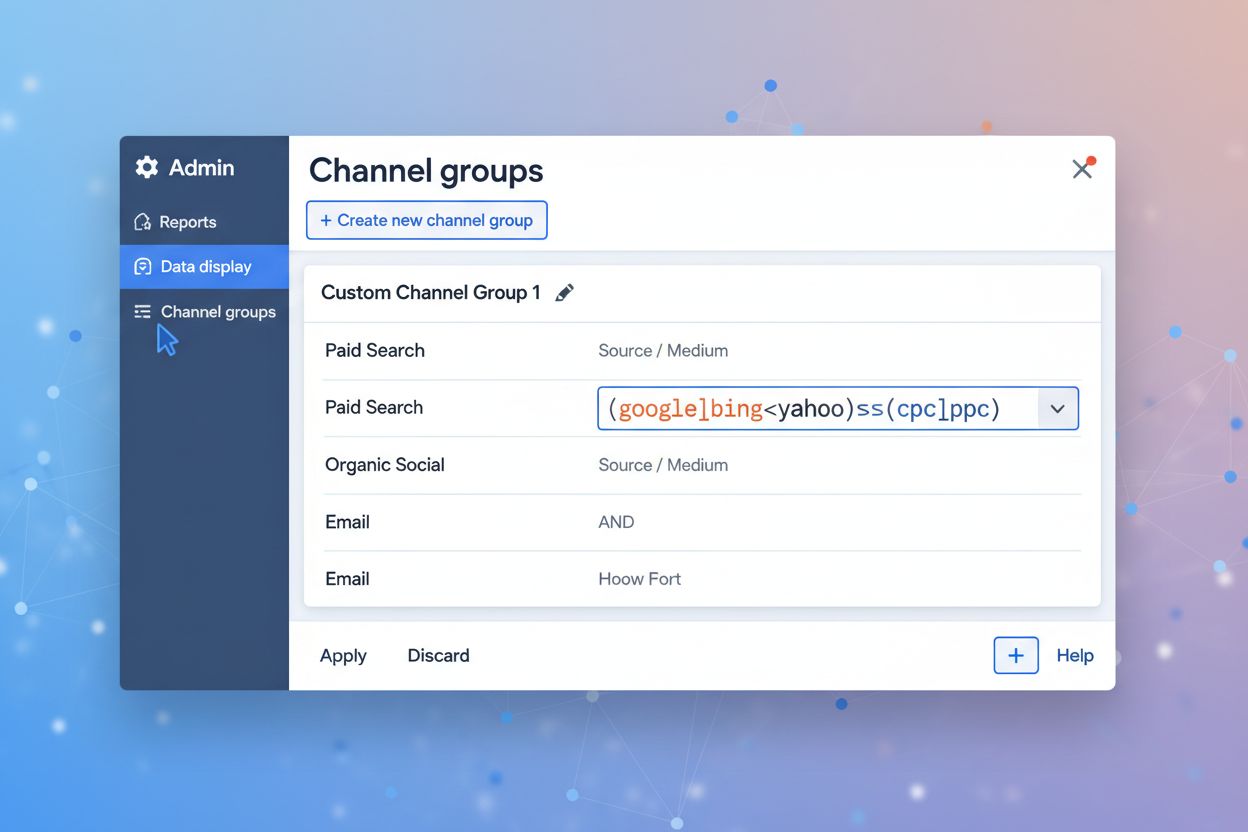
Setting Up GA4 for AI Referral Traffic Tracking
Learn how to track AI referral traffic in Google Analytics 4. Discover 4 methods to monitor ChatGPT, Perplexity, and other AI platforms, plus optimization strat...
8 min read

Learn how to optimize landing pages for AI traffic from GPTs, Perplexity, and Google AI Overviews. Discover best practices for conversion optimization and AI citation monitoring with AmICited.
AI traffic represents a fundamentally different visitor segment compared to traditional organic or paid search traffic. When users interact with AI systems like ChatGPT, Perplexity, and Google AI Overviews, these platforms crawl, analyze, and reference your landing pages to generate responses—but they do so in ways that differ significantly from human browsing behavior. Your landing page must be optimized not just for human conversion, but also for how AI systems parse, evaluate, and cite your content. This dual optimization approach is where AmICited.com becomes invaluable, as it monitors how your brand appears across AI platforms and provides insights into your citation patterns. Understanding these differences is the first step toward capturing both AI-driven traffic and the human visitors who discover your brand through AI-generated responses.
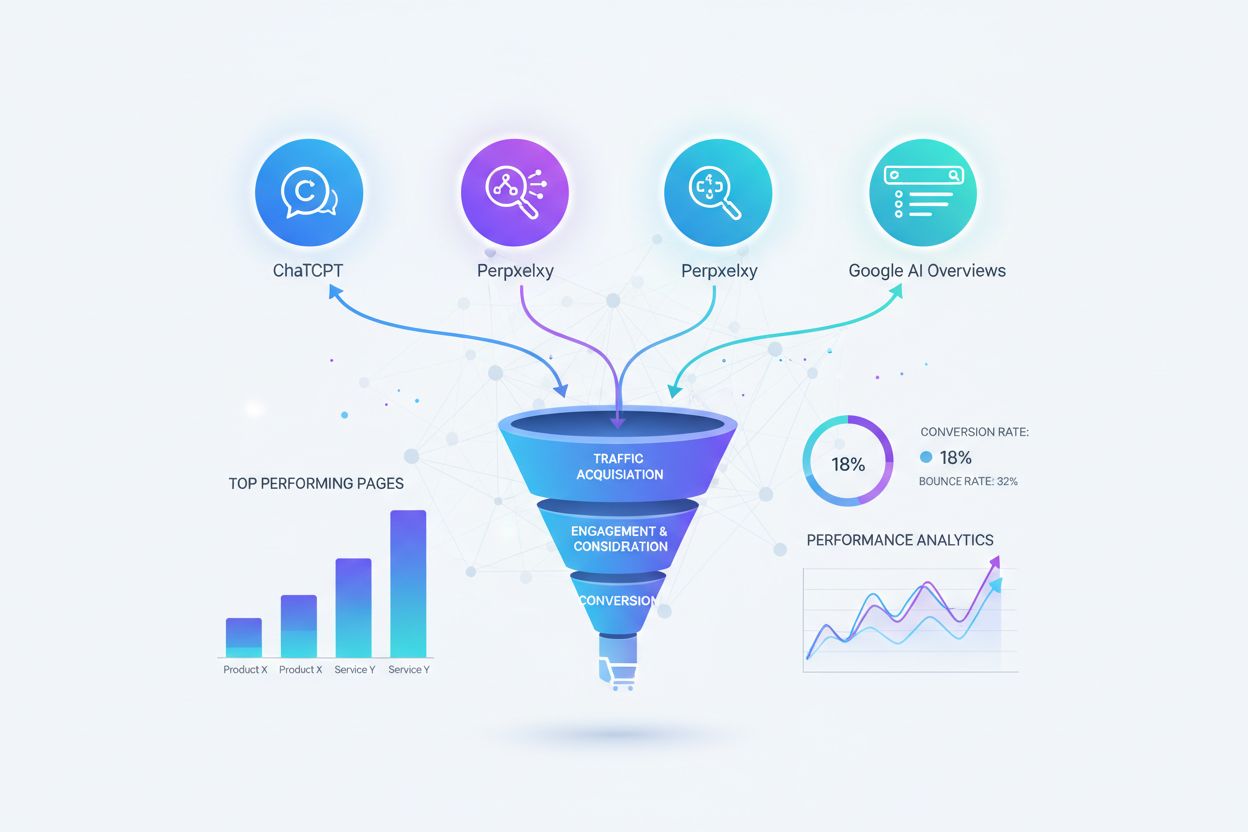
AI systems evaluate landing pages through a different lens than search engines or human visitors. They prioritize structured data, clear information hierarchy, and semantic clarity over design aesthetics or emotional appeals. When an AI system crawls your page, it’s looking for factual accuracy, comprehensive information, and authoritative sources—not just keyword density or backlinks. The behavior patterns of AI-sourced traffic also differ: AI systems may visit your page multiple times as they update their training data, and they evaluate content based on how well it answers specific queries rather than how engaging the design is.
| Aspect | Traditional Traffic | AI Traffic |
|---|---|---|
| Traffic Source | Search engines, ads, social media, direct | ChatGPT, Perplexity, Google AI Overviews, Claude |
| Behavior Pattern | Single visit, human decision-making | Multiple crawls, algorithmic evaluation |
| Key Metrics | Click-through rate, time on page, bounce rate | Citation frequency, content accuracy, information completeness |
| Optimization Focus | User experience, persuasive copy, design | Structured data, semantic clarity, factual accuracy |
| Citation Impact | Indirect (through backlinks) | Direct (AI mentions your brand in responses) |
Understanding these differences helps you structure your landing page to appeal to both audiences simultaneously, ensuring that your content is discoverable, citable, and conversion-focused.
AI systems parse headlines and copy differently than humans do. While a human might appreciate clever wordplay or emotional language, AI systems prioritize clarity, directness, and semantic precision. Your headline should immediately communicate your value proposition without ambiguity—for example, “Increase Landing Page Conversions by 40% with AI-Powered Optimization” is far more effective for AI systems than “Transform Your Marketing Game.” The same principle applies to your body copy: use benefit-focused language that explicitly states what visitors will gain, avoid vague claims, and structure your information logically. When your copy is clear and direct, you achieve a dual benefit: AI systems are more likely to cite your content as authoritative, and human visitors are more likely to understand your offer and convert. This alignment between AI optimization and human conversion is the sweet spot for modern landing page design.
A well-structured landing page serves both AI systems and human visitors. AI systems rely on semantic HTML and logical content flow to understand your page’s structure, while humans rely on visual cues and intuitive navigation. To optimize for both, implement these key principles:
This structured approach ensures that AI systems can easily extract and cite your most important information, while human visitors experience a clean, focused page that guides them toward conversion.
Trust signals are critical for both AI systems and human visitors, though they evaluate them differently. AI systems assess credibility through testimonials, case studies, security certifications, and recognizable brand logos—these elements signal that your claims are backed by real-world evidence. When you include customer testimonials with specific results (e.g., “Increased conversions by 35% in 60 days”), AI systems are more likely to cite your landing page as a credible source. Logo placement matters too: displaying logos of well-known clients or media outlets that have featured your brand increases your perceived authority. Security badges, privacy certifications, and guarantees also contribute to credibility signals that AI systems recognize. By strategically placing these trust elements throughout your landing page, you increase both the likelihood that AI systems will cite your content and the probability that human visitors will convert.
Page speed is not just a ranking factor for search engines—it’s critical for AI system crawling and citation likelihood. AI systems prioritize fast-loading pages because they can crawl more content efficiently and provide better user experiences. Your landing page should load in under 2.5 seconds, with Core Web Vitals (Largest Contentful Paint, First Input Delay, and Cumulative Layout Shift) all in the “good” range. Image optimization is particularly important: compress images using modern formats like WebP, implement lazy loading for below-the-fold images, and use a Content Delivery Network (CDN) to serve assets from locations closest to your visitors. Mobile performance is equally critical, as many AI system interactions occur on mobile devices. When your landing page loads quickly and performs well across all devices, AI systems can crawl and cite your content more effectively, while human visitors experience less friction in their conversion journey.
Traditional A/B testing requires weeks of data collection to reach statistical significance, but AI-powered optimization tools accelerate this process dramatically. Platforms like Unbounce’s Smart Traffic use machine learning to route visitors to the landing page variant most likely to convert them, starting optimization after just 30-50 visits rather than thousands. Tools like Optimizely and Copy.ai enable you to test multiple elements simultaneously—headlines, images, copy length, CTA button text, and layout variations—and receive AI-generated recommendations for improvements. Real-time personalization is another game-changer: AI systems can adjust your landing page content based on visitor location, device type, traffic source, or past behavior, creating a customized experience for each visitor without requiring separate page versions. This approach not only improves conversion rates but also provides valuable data about what messaging resonates with different audience segments, which you can then use to optimize for AI citation as well.
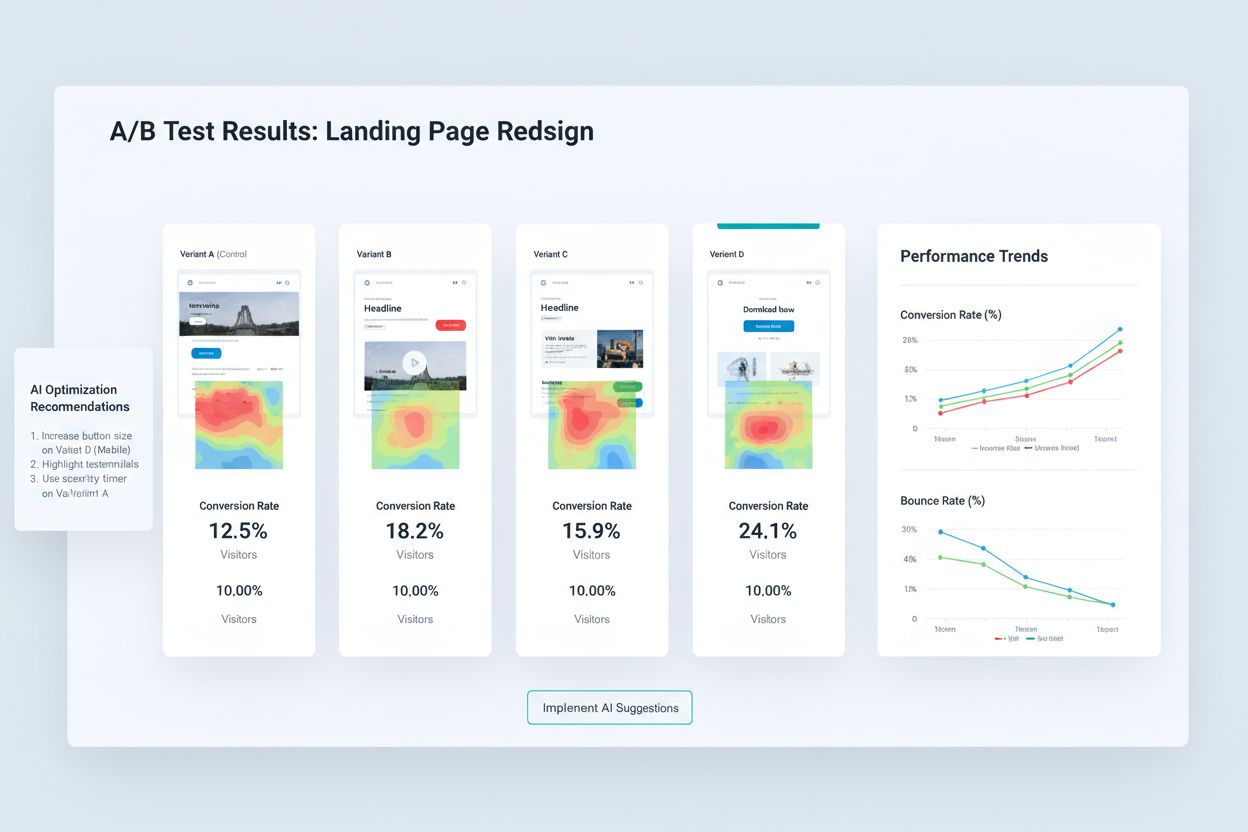
While optimizing your landing page for conversions is essential, monitoring how AI systems cite your brand is equally important. AmICited.com tracks how your brand appears across GPTs, Perplexity, Google AI Overviews, and other AI platforms, providing visibility into your AI citation patterns. This data reveals which of your landing pages are most frequently cited, what context AI systems use when mentioning your brand, and how your citation frequency compares to competitors. By understanding your AI citation patterns, you can identify which landing page elements and messaging resonate most with AI systems, then apply those insights to improve your overall optimization strategy. For example, if you notice that your detailed case studies are frequently cited while your product overview pages are rarely mentioned, you can restructure your landing pages to emphasize case study elements and specific results. This feedback loop between AI citation monitoring and landing page optimization creates a competitive advantage that most marketers overlook.
Many marketers make critical mistakes when optimizing landing pages for AI traffic. Cluttered design with poor information hierarchy confuses both AI systems and human visitors—avoid excessive navigation, multiple CTAs, or competing messages. Slow page load times frustrate human visitors and reduce AI crawling efficiency, so prioritize performance optimization. Unclear value propositions that rely on vague language or industry jargon fail to communicate clearly to AI systems, which prefer explicit, benefit-focused messaging. Neglecting mobile optimization is particularly damaging, as many AI interactions occur on mobile devices and poor mobile performance signals low quality to both AI systems and human visitors. Finally, failing to test and iterate means you miss opportunities to improve conversion rates and AI citation likelihood. The most successful landing pages are those that combine solid fundamentals with continuous testing and refinement based on real performance data.
Optimizing landing pages for AI traffic requires a systematic approach that combines technical excellence with conversion-focused design. Start by auditing your current landing pages against the principles outlined above: check your page speed, review your information hierarchy, verify that your copy is clear and benefit-focused, and ensure you have adequate trust signals. Next, implement A/B testing using tools like Unbounce, Optimizely, or your platform’s native testing features—test one element at a time and let data guide your decisions. Monitor your AI citations using AmICited to understand which pages and messaging resonate with AI systems, then apply those insights to your optimization roadmap. Track key metrics including conversion rate, bounce rate, average session duration, and AI citation frequency using Google Analytics and AmICited’s dashboard. Finally, establish a continuous improvement cycle where you review performance data monthly, identify optimization opportunities, implement changes, and measure results. By combining these practices with the right tools and a commitment to data-driven decision-making, you’ll create landing pages that convert both human visitors and AI-sourced traffic effectively.
AI traffic comes from systems like ChatGPT, Perplexity, and Google AI Overviews that crawl and reference your content. Unlike traditional traffic from search engines or ads, AI systems evaluate pages based on structured data, semantic clarity, and factual accuracy rather than design aesthetics. AI systems may visit your page multiple times as they update their training data, and they prioritize content that answers specific queries comprehensively.
AI systems prioritize structured data, clear information hierarchy, and semantic clarity when evaluating landing pages. They look for factual accuracy, comprehensive information, and authoritative sources. AI systems assess credibility through testimonials, case studies, security certifications, and recognizable brand logos. They also evaluate how well your content answers specific queries and whether your information is presented logically and clearly.
The most critical elements include: clear, benefit-focused headlines and copy; semantic HTML structure; fast page load times (under 2.5 seconds); mobile optimization; trust signals like testimonials and security badges; and structured data. AI systems also value logical content flow, above-the-fold critical information, and descriptive alt text for images. These elements help AI systems understand, cite, and recommend your content.
AmICited.com tracks how your brand appears across GPTs, Perplexity, Google AI Overviews, and other AI platforms. The platform provides visibility into your AI citation patterns, showing which landing pages are most frequently cited, what context AI systems use when mentioning your brand, and how your citation frequency compares to competitors. This data helps you understand which messaging and content elements resonate most with AI systems.
Recommended tools include Unbounce (with Smart Traffic feature), Optimizely, Copy.ai, Google Optimize, and VWO. These platforms enable you to test multiple elements simultaneously—headlines, images, copy length, CTA buttons, and layouts. AI-powered tools like Unbounce's Smart Traffic can start optimizing after just 30-50 visits, while traditional A/B testing requires thousands of visitors to reach statistical significance.
Page speed is critical for AI system crawling and citation likelihood. AI systems prioritize fast-loading pages because they can crawl more content efficiently. Your landing page should load in under 2.5 seconds with Core Web Vitals in the 'good' range. Slow pages reduce AI crawling efficiency and signal low quality to both AI systems and human visitors. Image optimization, lazy loading, and CDN usage are essential for maintaining fast performance.
You don't need separate pages, but you should optimize your existing pages for both audiences. The best approach is to implement universal optimization principles: clear headlines, semantic HTML structure, fast load times, mobile optimization, and trust signals. These elements benefit both AI systems and human visitors. However, you can use A/B testing to create variants that emphasize different messaging for different audience segments, then use AI-powered tools to route visitors to their best-match page.
Landing page optimization is an ongoing process. Review performance data monthly and identify optimization opportunities. Implement A/B tests continuously, testing one element at a time and letting data guide decisions. Monitor your AI citations using AmICited to understand which pages and messaging resonate with AI systems. Establish a continuous improvement cycle where you measure results, refine based on data, and implement changes regularly to maintain competitive advantage.
Track how AI systems reference your brand across GPTs, Perplexity, and Google AI Overviews. Use citation data to improve your landing page conversion rates and stay ahead of competitors.
Learn how to track AI referral traffic in Google Analytics 4. Discover 4 methods to monitor ChatGPT, Perplexity, and other AI platforms, plus optimization strat...

Discover how landing pages drive AI search visibility. Learn optimization strategies for ChatGPT, Perplexity, and Google AI Overviews to earn citations and traf...
AI search visitors convert 5x better than Google organic traffic. Learn why ChatGPT, Perplexity, and Claude drive higher-quality conversions despite lower volum...