Law Firm AI Visibility: Ethical Considerations and Strategies
Discover how law firms can optimize AI visibility while maintaining ethical standards. Learn ABA guidelines, confidentiality protocols, and practical strategies for AI-powered legal marketing.
Published on Jan 3, 2026.Last modified on Jan 3, 2026 at 3:24 am
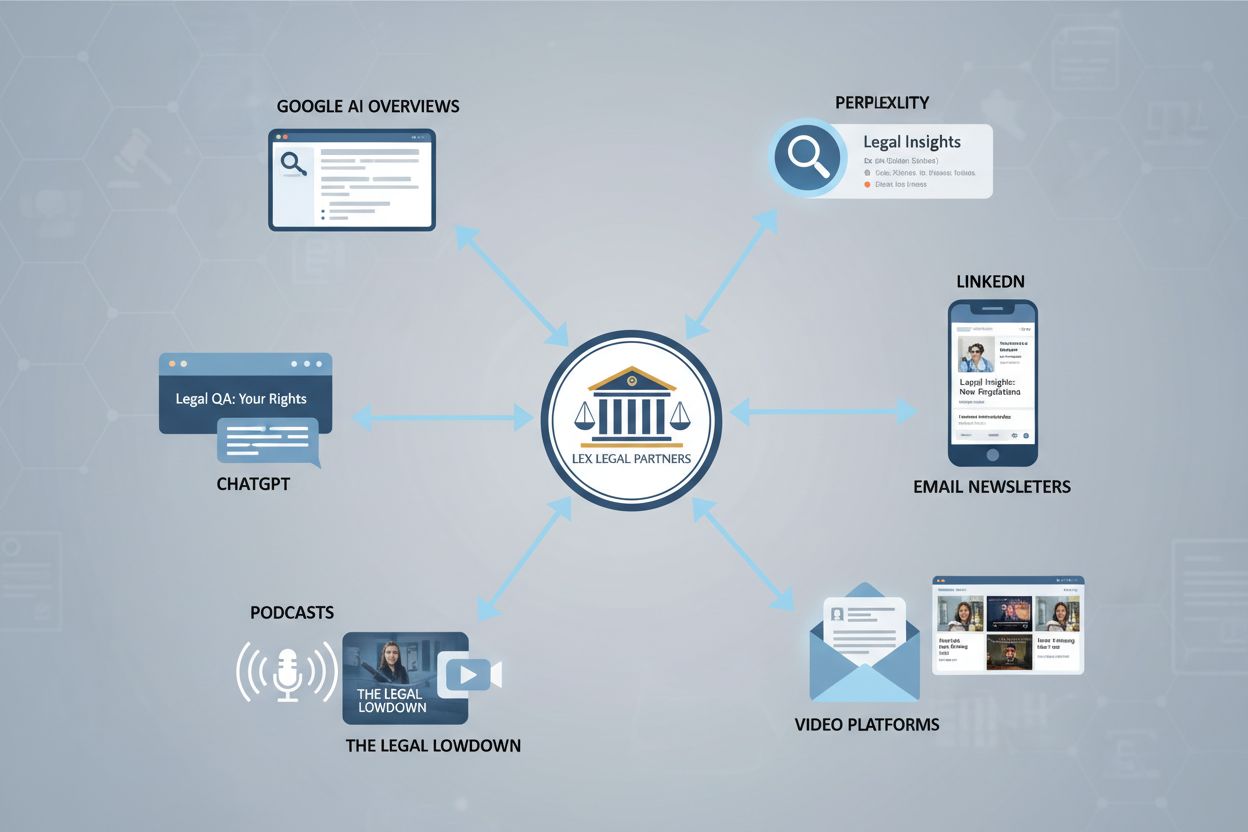
The legal services discovery landscape has fundamentally transformed beyond traditional search engine optimization. Law firms can no longer rely solely on Google rankings to ensure visibility—potential clients now discover legal expertise through AI-powered platforms, chatbots, voice assistants, and specialized legal research tools that operate independently of traditional search results. These AI systems are trained on diverse content formats including blog posts, social media content, video transcripts, podcasts, and client testimonials, meaning your firm’s visibility depends on presence across multiple surfaces simultaneously. When a prospective client asks ChatGPT, Claude, or a legal-specific AI platform for attorney recommendations, the system draws from training data that may include your firm’s content from sources you’ve never optimized for. The multi-surface discovery model requires law firms to think beyond single-channel strategies and instead develop comprehensive content ecosystems that feed AI systems with authoritative, accurate information. Traditional SEO metrics like keyword rankings and backlink profiles remain relevant but insufficient—firms must now monitor how their content appears in AI-generated responses across dozens of platforms. This shift represents both a challenge and an opportunity: firms that understand and adapt to this new landscape gain competitive advantage, while those clinging to outdated visibility strategies risk becoming invisible to AI-driven discovery mechanisms.
Understanding ABA Ethics Guidelines for AI Use
The American Bar Association’s Formal Opinion 512, issued in July 2024, provides critical guidance on how attorneys must approach AI tools while maintaining ethical obligations. This landmark opinion establishes that lawyers remain fully responsible for AI-generated work product, regardless of whether they personally drafted the content or delegated it to an AI system. The opinion identifies seven core ethical obligations that intersect with AI use: competence in understanding AI capabilities and limitations, maintaining client confidentiality, candor to tribunals, proper supervision of subordinates using AI, charging reasonable fees, communicating with clients about AI use, and ensuring claims remain meritorious. Each obligation carries specific implications for how law firms can ethically leverage AI for visibility, content creation, and client communication. The competence requirement means partners must understand not just how to use AI tools, but their accuracy rates, hallucination risks, and appropriate use cases. Confidentiality obligations require careful vendor selection and data handling protocols to ensure client information never becomes training data for third-party AI systems. Candor to tribunals means any AI-generated citations or legal analysis must be verified before submission, as courts have already sanctioned attorneys for presenting fabricated case law generated by AI.
Ethical Obligation
AI Implication
Law Firm Action
Competence
Must understand AI capabilities, limitations, and accuracy rates
Conduct training on AI tools; establish competency standards before deployment
Confidentiality
Client data risks with third-party AI providers and LLM training
Vet vendors thoroughly; use on-premise or private AI solutions; sanitize data
Candor to Tribunal
AI-generated citations and legal analysis must be verified
Implement mandatory verification protocols; never submit unverified AI work
Supervision
Responsibility for subordinates’ AI use and outputs
Create firm-wide AI policies; monitor usage; establish approval workflows
Reasonable Fees
AI efficiency may require fee adjustments
Communicate AI use to clients; adjust billing to reflect efficiency gains
Client Communication
Clients deserve transparency about AI involvement
Disclose AI use in engagement letters; explain how it affects their matter
Meritorious Claims
AI must not be used to advance frivolous arguments
Verify all AI-generated legal theories; maintain independent judgment
Ready to Monitor Your AI Visibility?
Track how AI chatbots mention your brand across ChatGPT, Perplexity, and other platforms.
Client confidentiality represents the most critical ethical consideration when deploying AI tools for law firm visibility and content creation. Many popular AI platforms, including free versions of ChatGPT and other large language models, use submitted data to train future iterations of their systems, creating an unacceptable risk that confidential client information could be exposed or inadvertently referenced in responses to other users. The Maryland State Bar Association and similar regulatory bodies have issued specific guidance warning attorneys against inputting any client-identifying information, case details, or privileged communications into third-party AI systems without explicit contractual protections. Law firms must implement rigorous vendor vetting processes that examine data handling practices, encryption standards, data retention policies, and contractual guarantees that information will not be used for model training. Sanitization protocols become essential—any client information used in AI-assisted content creation must be thoroughly anonymized, with identifying details removed and replaced with generic examples. Licensing agreements with AI vendors should explicitly address data ownership, usage rights, and liability for breaches, with preference given to enterprise solutions that offer on-premise deployment or private instances. Firms should also establish clear policies distinguishing between public-facing content (where AI assistance is generally acceptable) and confidential work product (where AI use requires heightened scrutiny and client consent). Regular audits of AI tool usage help ensure compliance, and staff training must emphasize that not all AI applications are appropriate for legal work, regardless of efficiency gains.
Mitigating AI Hallucinations and Accuracy Risks
AI hallucinations—instances where language models generate plausible-sounding but entirely fabricated information—represent a serious threat to law firm credibility and client outcomes. A hallucination occurs when an AI system confidently presents false information as fact, such as inventing case citations, misquoting statutes, or creating fictional legal precedents that sound authentic but do not exist. The legal profession has already experienced painful lessons: in 2023, two New York attorneys were sanctioned and faced potential disbarment after submitting a brief containing six fabricated cases generated by ChatGPT, and in 2024, a Texas attorney faced similar consequences for relying on AI-generated citations that had no basis in law. These incidents underscore that hallucinations are not theoretical risks but documented problems that have resulted in professional discipline and damaged client cases. Thomson Reuters research indicates that current large language models hallucinate at rates between 3-10% depending on the task complexity, meaning even seemingly reliable AI outputs require verification. Law firms must implement mandatory human-in-the-loop verification protocols where any AI-generated legal analysis, citations, or factual claims are independently verified by qualified attorneys before use in client work or court filings. For visibility and marketing content, hallucinations pose reputational risks—fabricated statistics, misquoted experts, or invented case examples can undermine firm credibility and expose the firm to liability. Establishing clear verification workflows, using AI primarily for drafting and ideation rather than final analysis, and maintaining detailed records of verification processes protects both clients and the firm’s reputation.
Stay Updated on AI Visibility Trends
Get the latest insights on AI mentions, brand monitoring, and optimization strategies.
Building a Multi-Format Content Strategy
Effective AI visibility requires law firms to move beyond single-format content creation and develop comprehensive strategies that repurpose core expertise across multiple channels and formats. A single well-researched article on employment law can become the foundation for a video explainer, an audiogram for LinkedIn, a podcast episode, social media snippets, email newsletter content, and client-facing guides—each format optimized for different AI systems and audience preferences. AI tools excel at accelerating this repurposing process: they can generate video scripts from articles, create social media captions, draft email subject lines, and develop outline variations for different audience segments, though human attorneys must review and refine all outputs for accuracy and tone. The strategic advantage emerges when firms recognize that AI systems training on diverse content formats will encounter your expertise in multiple contexts, increasing the likelihood of citation in AI-generated responses. Developing prompt templates for common content types—such as “Create a 3-minute video script explaining [legal topic] for business owners with no legal background”—enables consistent, efficient content creation while maintaining quality standards. Audience targeting becomes more sophisticated when you understand which formats resonate with different client segments: corporate clients may prefer detailed white papers and webinars, while individual consumers respond better to short-form video and social media content. Firms should establish editorial calendars that map core expertise areas to multiple formats, assign clear ownership for AI-assisted drafting and human review, and measure engagement across channels to identify which formats drive the most qualified inquiries. This multi-format approach also provides natural opportunities to link content pieces together, creating a web of interconnected resources that AI systems recognize as authoritative coverage of specific legal topics.
Measuring AI Visibility and New KPIs
Traditional law firm marketing metrics—website traffic, form submissions, and phone call volume—provide incomplete visibility into how AI systems are discovering and recommending your firm. Share of Voice (SOV) measures what percentage of AI-generated responses about your practice area mention your firm, providing insight into competitive positioning in the AI-driven discovery landscape. Visibility Score aggregates multiple data points to create a comprehensive measure of how prominently your firm appears across AI platforms, search engines, and legal directories. Mention Frequency tracks how often your firm, attorneys, and expertise areas appear in AI-generated content, while Citation Metrics measure whether AI systems cite your content as authoritative sources. Topic Coverage indicates how comprehensively your firm’s content addresses the full spectrum of questions potential clients ask about your practice areas. These metrics require specialized monitoring tools designed specifically for AI visibility, as traditional analytics platforms cannot track mentions in ChatGPT responses, Claude outputs, or specialized legal AI platforms.
Key AI Visibility Metrics for Law Firms:
Share of Voice (SOV) in AI-generated responses
Visibility Score across AI platforms and search engines
Mention Frequency in AI outputs and legal databases
Citation Metrics measuring authoritative sourcing
Topic Coverage breadth across practice areas
Engagement rates on multi-format content
Lead quality and conversion from AI-sourced inquiries
Engagement metrics take on new importance in the AI visibility context: when your content appears in AI responses, does it drive clicks to your website, form submissions, or phone calls? Tracking which AI platforms and content formats generate the highest-quality leads helps firms optimize their content strategy and budget allocation. Law firms should establish baseline measurements of current AI visibility before implementing new strategies, then monitor progress quarterly to identify which content types, topics, and formats generate the strongest AI presence. This data-driven approach replaces guesswork with evidence, enabling partners to justify marketing investments and refine strategies based on actual performance rather than assumptions about what AI systems will prioritize.
Implementing Firm-Wide AI Governance Policies
Effective AI visibility and ethical compliance require formal governance policies that establish clear standards for how attorneys, paralegals, and support staff can use AI tools in their work. A comprehensive AI policy should address acceptable use cases, prohibited applications, approval workflows, and consequences for non-compliance, ensuring that enthusiasm for AI efficiency does not override ethical obligations. The policy must clearly distinguish between different categories of AI use: content creation and marketing (generally acceptable with review), legal research and analysis (requires verification and attorney oversight), client communication (requires disclosure and approval), and confidential work product (requires heightened scrutiny and often client consent). Supervision obligations under ABA Formal Opinion 512 mean that partners bear responsibility for ensuring subordinates use AI appropriately, requiring monitoring mechanisms and regular training updates. Non-attorney staff require specific guidance on which AI tools they can access, what types of information they can input, and which tasks require attorney review before completion. Technology competence standards should specify that attorneys using AI tools must understand their capabilities, limitations, and accuracy rates—this may require formal training, certifications, or demonstrated competency before independent AI use is permitted. Policies should also address how the firm will handle AI tool updates, new platforms, and emerging risks, establishing a process for regular policy review and revision as the technology landscape evolves. Documentation of policy implementation, staff training, and compliance monitoring creates evidence of good faith efforts to maintain ethical standards, which becomes important if regulatory bodies ever question the firm’s AI practices.
Practical Implementation Roadmap for 2025+
Law firms ready to optimize AI visibility while maintaining ethical standards should adopt a structured four-pillar implementation approach that addresses content, formats, audience, and technology infrastructure. The Content Engine pillar focuses on developing authoritative, original expertise across your core practice areas—this means identifying the 20-30 fundamental questions clients ask about your practice, then creating comprehensive, well-researched content that answers those questions better than competitors. The Formats pillar ensures this core content reaches AI systems through multiple channels: written articles for search engines and legal databases, video content for YouTube and social platforms, audio content for podcasts and voice assistants, and structured data markup that helps AI systems understand your expertise. The Audience pillar requires segmentation and targeting—different client types (corporate, individual, in-house counsel) discover legal services through different AI platforms and respond to different content formats, so your strategy must address each segment’s preferred discovery methods. The Technology Stack pillar establishes the tools and processes that enable efficient, compliant content creation: AI writing assistants for drafting, verification tools for accuracy checking, analytics platforms for measuring AI visibility, and governance systems for ensuring ethical compliance.
Actionable implementation steps for 2025 include: conducting an AI visibility audit to establish baseline metrics across major platforms; developing a 12-month content calendar that maps core expertise to multiple formats; establishing AI governance policies and training all staff on acceptable use; selecting and implementing AI visibility monitoring tools; creating content templates and prompt libraries that accelerate multi-format creation; and establishing quarterly review processes to measure progress and refine strategy. Success metrics should include both quantitative measures (Share of Voice, mention frequency, lead volume) and qualitative assessments (lead quality, client feedback, competitive positioning). Firms that implement this roadmap systematically gain significant competitive advantage: they become visible to AI-driven discovery mechanisms, establish themselves as authoritative sources that AI systems cite, and build sustainable visibility that persists as AI technology evolves. The firms that delay or approach AI visibility haphazardly risk becoming invisible in an increasingly AI-mediated legal services marketplace, losing potential clients to competitors who have optimized their presence across multiple AI platforms and formats.
Frequently asked questions
What is the ABA's stance on law firms using AI?
The American Bar Association issued Formal Opinion 512 in July 2024, establishing that lawyers remain fully responsible for AI-generated work product and must maintain seven core ethical obligations: competence, confidentiality, candor to tribunals, supervision, reasonable fees, client communication, and meritorious claims. Lawyers must understand AI capabilities and limitations before use.
How can law firms protect client confidentiality when using AI?
Law firms should implement rigorous vendor vetting, use on-premise or private AI solutions, sanitize all client-identifying information before inputting into AI systems, and establish licensing agreements with explicit confidentiality provisions. Never input confidential information into free public AI tools like ChatGPT without enterprise protections.
What are AI hallucinations and why do they matter in legal work?
AI hallucinations occur when language models generate plausible-sounding but entirely fabricated information, such as inventing case citations or misquoting statutes. They matter because courts have already sanctioned attorneys for submitting AI-generated fake cases, and hallucinations can damage client cases and firm reputation. All AI-generated legal analysis must be independently verified.
How should law firms measure visibility in AI-powered search?
Law firms should track AI-specific metrics including Share of Voice (percentage of AI responses mentioning your firm), Visibility Score (comprehensive measure across platforms), Mention Frequency (how often your firm appears), Citation Metrics (whether AI cites your content), and Topic Coverage (breadth of practice area coverage). Traditional metrics like website traffic are insufficient.
What content formats work best for AI visibility?
AI systems are trained on diverse formats including written articles, video transcripts, podcasts, social media content, and structured data. Law firms should repurpose core expertise across multiple formats—a single article can become videos, audiograms, social posts, and email content. This multi-format approach increases the likelihood of AI citation and discovery.
Do law firms need formal AI policies?
Yes. ABA Formal Opinion 512 establishes that partners bear responsibility for subordinates' AI use. Comprehensive AI policies should address acceptable use cases, prohibited applications, approval workflows, confidentiality requirements, and staff training. Policies must distinguish between content creation (generally acceptable), legal analysis (requires verification), and confidential work (requires heightened scrutiny).
How can law firms balance AI efficiency with ethical obligations?
Implement a human-in-the-loop approach where AI assists with drafting and ideation but qualified attorneys verify all outputs before use. Establish clear verification protocols, use AI primarily for efficiency gains rather than replacing professional judgment, maintain detailed records of verification processes, and ensure all staff understand that AI is a tool to amplify expertise, not replace it.
What's the difference between consumer AI and legal-specific AI tools?
Consumer AI tools like ChatGPT are trained on general internet data and hallucinate at rates of 3-10%, creating serious risks for legal work. Legal-specific AI tools are trained on trusted legal databases and designed to limit hallucinations, though verification is still required. Enterprise solutions offer better data protection and confidentiality guarantees than free public tools.
Monitor Your Law Firm's AI Visibility
Track how AI systems reference your firm and measure your presence in AI-generated answers. Gain competitive advantage by understanding your AI visibility metrics and optimizing your presence across AI platforms.
How Do Legal Firms Get AI Visibility in ChatGPT, Perplexity and AI Search Engines
Learn how law firms improve visibility in AI-powered search engines and answer generators. Discover strategies for appearing in ChatGPT, Perplexity, and Google ...
Learn what Legal AI Visibility means for law firms. Discover how to optimize your presence in AI-generated legal answers, manage citation metrics, and build aut...
Cross-Platform AI Visibility: Optimizing for ChatGPT, Perplexity, and Google Simultaneously
Master multi-platform AI visibility strategy. Learn how to optimize content for ChatGPT, Perplexity, and Google AI Overviews simultaneously with data-driven tac...
9 min read
Cookie Consent We use cookies to enhance your browsing experience and analyze our traffic. See our privacy policy.