

Do AI Search Engines Prefer Listicles? Complete Guide to AI-Optimized Content
Discover whether AI search engines like ChatGPT and Perplexity prefer listicles. Learn how to optimize list-based content for AI citations and visibility.
11 min read
Discover why AI models prefer listicles and numbered lists. Learn how to optimize list-based content for ChatGPT, Gemini, and Perplexity citations with proven strategies.
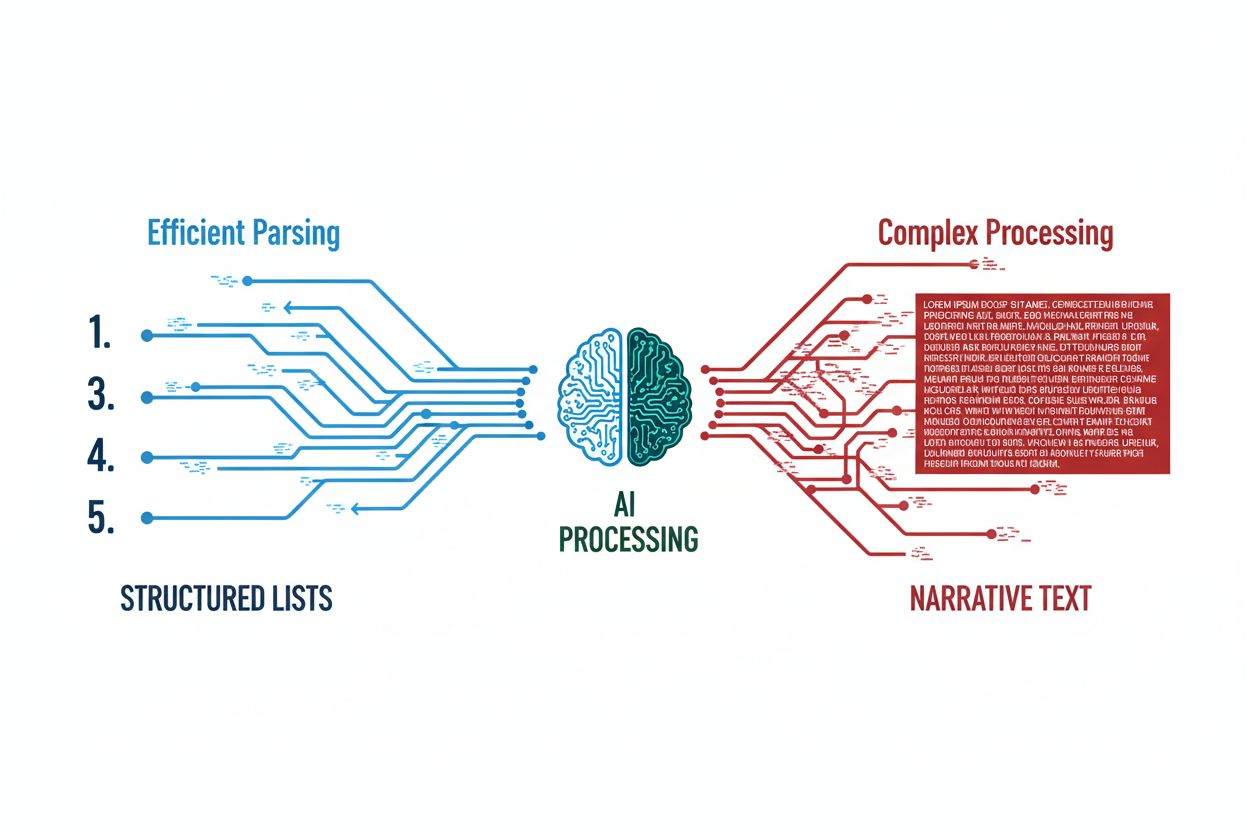
AI models are fundamentally pattern-recognition machines that excel at identifying and processing information organized in predictable, repeatable formats. When content is structured as a listicle, it provides a scannable, hierarchical format that LLMs can parse with significantly greater efficiency than narrative prose. Structured content reduces the computational complexity required for language models to extract, understand, and cite specific information, as each list item functions as a discrete semantic unit. The LLM parsing process becomes more straightforward when encountering numbered or bulleted lists because the model doesn’t need to infer relationships between concepts—they’re explicitly defined by the list structure. This efficiency translates directly into higher citation rates, as AI systems can more confidently extract and reference individual list items without requiring extensive context from surrounding paragraphs. The predictable nature of listicles AI formats means that models spend fewer tokens processing structural ambiguity and more tokens on actual content comprehension. Essentially, when you present information as a numbered list, you’re speaking the native language of large language models.
Different AI platforms exhibit distinct citation preferences that reveal how numbered lists LLM systems prioritize content discovery and validation. ChatGPT demonstrates a strong preference for encyclopedic content, with 47.9% of its citations coming from Wikipedia—a platform heavily reliant on structured, list-based information architecture. Gemini shows more balanced sourcing patterns, citing blogs at 39% and news sources at 26%, indicating a preference for listicles AI that blend authoritative structure with contemporary insights. Perplexity AI, designed specifically for research-oriented queries, cites blog content at 38% and news at 23%, demonstrating a clear preference for expert lists that combine depth with accessibility. Google AI Overviews favor blog articles at 46%, particularly those using scannable, list-based formats that align with the platform’s emphasis on quick information retrieval. These AI citation patterns reveal that platforms consistently reward content creators who structure information as list format AI presentations rather than dense narrative paragraphs. Understanding these platform-specific preferences allows content strategists to tailor listicle formats to maximize visibility across multiple AI systems simultaneously.
| AI Platform | Primary Citation Source | Percentage | Content Preference |
|---|---|---|---|
| ChatGPT | Wikipedia | 47.9% | Encyclopedic, structured lists |
| Gemini | Blogs | 39% | Balanced listicles with insights |
| Perplexity | Blogs | 38% | Expert lists with depth |
| Google AI Overviews | Blog Articles | 46% | Scannable, list-based formats |
The technical foundation for why lists perform so well in AI systems lies in semantic chunking and vector embeddings, the mathematical representations that allow language models to understand meaning. When content is organized as a list, each item creates clear semantic boundaries that make it easier for the model’s embedding layer to distinguish between discrete concepts and ideas. Numbered sequences signal hierarchy and importance to AI systems in ways that narrative text cannot, allowing models to understand that item #1 differs fundamentally from item #5 in terms of ranking or sequence. Schema markup implementation—particularly HowTo and FAQ structured data—amplifies discoverability by providing explicit metadata that AI crawlers and indexing systems can immediately recognize and prioritize. The list format AI optimization extends to recency signals, where regularly updated listicles send stronger freshness indicators to search algorithms than static narrative content. Vector databases used by modern LLMs can more efficiently store and retrieve list-based content because the semantic distance between list items is more consistent and predictable than between paragraphs in flowing prose. This technical advantage compounds over time, as AI systems learn to weight list-based sources more heavily in their training data and retrieval processes.
Research consistently demonstrates that listicles AI formats receive 20-30% more citations from AI systems compared to equivalent information presented in narrative form. This citation advantage stems from the fundamental difference in how AI systems must process and extract information from each format: narrative content requires the model to perform complex context extraction and inference to identify citable claims, while lists present information as pre-packaged, self-contained units. Numbered lists LLM systems can cite specific list items without requiring extensive surrounding context, making the citation process faster and more confident for the AI model. The reusability factor cannot be overstated—when an AI system encounters a well-structured listicle, it can extract individual items and cite them independently, whereas narrative content often requires citing entire paragraphs or sections to maintain context. Data from multiple AI monitoring platforms shows that listicles consistently outperform narrative content in citation frequency, position in AI responses, and likelihood of being selected as primary sources. This performance gap widens further when comparing listicles to long-form narrative content, as the cognitive load required for AI systems to parse and cite from dense prose increases exponentially. For content creators focused on listicles AI visibility, the evidence is clear: structure beats narrative every time.
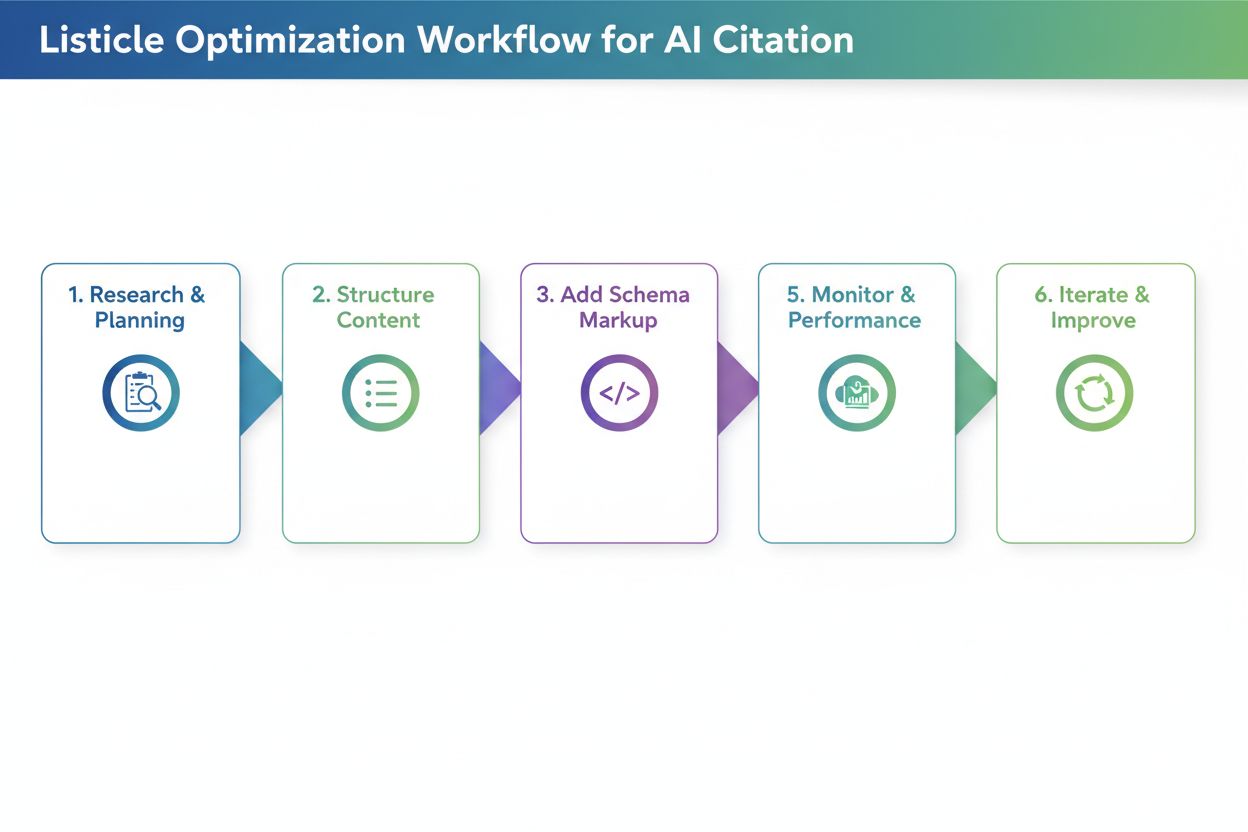
Creating listicles that maximize AI citation requires attention to specific structural and formatting elements:
Practical examples demonstrate the power of well-executed listicles in driving AI citations across multiple platforms. “Top 5 AML Compliance Tools” listicles consistently appear in Perplexity AI responses, with individual tools being cited as authoritative recommendations in compliance-related queries. “Best CRM Alternatives” lists dominate ChatGPT responses, particularly when users ask for software comparisons, with the listicle structure allowing the AI to cite specific alternatives with confidence. Product comparison listicles have become the dominant format in Google AI Overviews, where the scannable structure aligns perfectly with the platform’s emphasis on quick, actionable information. Research from MADX and Omnius tracking data shows that websites publishing well-structured listicles experience citation increases of 40-60% within 90 days of publication. Tatarek’s analysis of numbered lists LLM performance revealed that listicles focusing on “best of” categories receive 3.2x more citations than narrative reviews of the same products. These real-world examples underscore that listicles AI isn’t just theoretically superior—it delivers measurable, quantifiable improvements in AI visibility and citation frequency.
Maximizing AI visibility requires a deliberate structural approach that goes beyond simply numbering items. Begin with a TL;DR section at the top that summarizes your entire list in 2-3 sentences, allowing AI systems to immediately understand the content’s purpose and scope. Include a criteria explanation section that explicitly states why you selected these items—this transparency helps AI systems understand your methodology and increases citation confidence. Provide balanced coverage of each list item, ensuring that every entry receives proportional depth and analysis rather than favoring certain items with excessive detail. Critically, include both strengths and limitations for each item, as AI systems recognize and reward balanced, nuanced analysis over one-sided promotional content. Add a pricing breakdown section if applicable, as this structured data is highly citable and frequently referenced in AI responses about product comparisons. Implement a comparison table in HTML format (not screenshots or images) that allows AI systems to parse and cite specific feature comparisons directly. Include a FAQ section addressing common questions about your list items, which provides additional structured data for AI systems to index and cite. Finally, provide clear next steps and CTAs that guide users toward action, signaling to AI systems that your content is comprehensive and actionable.
The choice between numbered lists and bullet points carries significant implications for how AI systems process and cite your content. Numbered lists signal sequence and ranking, which is why they dominate “Top X” listicles and step-by-step guides—AI systems interpret the numbering as an explicit hierarchy that conveys importance or order. Bullet points work better for non-sequential information, such as feature lists or attribute comparisons where no inherent ranking exists. Research shows that AI systems treat numbered lists as more authoritative and citable, particularly in response to queries that explicitly ask for ranked or sequential information. When users ask ChatGPT or Gemini “What are the top 5 tools for X?”, the AI system preferentially cites from numbered lists LLM sources because the numbering provides explicit ranking validation. Conversely, bullet points excel in feature comparison contexts, where AI systems need to extract and cite specific attributes without implying hierarchy. Mixing numbered lists and bullet points within the same listicle creates parsing confusion for AI systems, so maintain consistent formatting throughout your content to maximize list format AI optimization.
Tracking listicle performance requires systematic monitoring across multiple AI platforms and tools. AtomicAGI, Writesonic, and Perplexity tracking tools provide automated monitoring of how frequently your listicles AI content appears in AI-generated responses. Manual testing across ChatGPT, Gemini, and Perplexity remains essential, as automated tools sometimes miss nuanced citation patterns or platform-specific behaviors. Establish baseline metrics by tracking citation frequency and position—monitor not just whether your listicle is cited, but where it appears in the AI response and how often it’s selected as a primary source. Monitor which list items get cited most, as this reveals which specific recommendations or insights resonate most strongly with AI systems and user queries. Measure traffic from AI sources separately from traditional search traffic, as AI-driven visits often exhibit different conversion patterns and user intent than organic search visitors. Compare performance before and after optimization, implementing one structural change at a time to isolate which specific improvements drive citation increases. Establish a monthly tracking rhythm to identify trends and seasonal patterns in how your numbered lists LLM content performs across different AI platforms and query types.
Even well-intentioned listicles can fail to achieve optimal AI citation if they contain structural or content errors that confuse AI parsing systems. Biased lists that favor your own product or service over competitors signal low credibility to AI systems, which increasingly penalize obviously promotional content in favor of balanced recommendations. Inconsistent item depth—where some list items receive 200 words of analysis while others get 50 words—creates parsing confusion and suggests incomplete research to AI systems. Missing comparison tables represent a significant missed opportunity, as AI systems heavily weight structured data and will cite from tables more readily than from prose descriptions. No schema markup means you’re forcing AI systems to infer your content structure rather than explicitly declaring it, reducing citation confidence and discoverability. Outdated information is particularly damaging for listicles, as AI systems recognize and penalize stale content, especially in fast-moving categories like software tools or compliance requirements. Poor structure and hierarchy with unclear H2/H3 relationships makes it difficult for AI systems to parse semantic relationships between items. Finally, keyword stuffing and overly long lists (50+ items) dilute the authority and focus of your listicle, causing AI systems to treat it as less authoritative than focused, well-curated alternatives.
AI models are pattern-recognition machines that process structured, scannable formats more efficiently than dense narrative prose. Listicles reduce computational complexity by presenting information as discrete semantic units, allowing LLMs to parse, extract, and cite specific items with greater confidence and speed.
Numbered lists signal sequence and ranking, making them ideal for 'Top X' listicles and step-by-step guides. Bullet points work better for non-sequential information like feature comparisons. AI systems treat numbered lists as more authoritative for ranked queries, while bullet points excel in feature-based contexts.
Update your listicles quarterly at minimum to maintain strong freshness signals. AI systems reward recently updated content with higher citation priority. Even minor updates—adding new data points, refreshing statistics, or expanding sections—help sustain citation eligibility and visibility.
Yes, schema markup significantly improves AI discoverability. FAQ and HowTo structured data can boost citation probability by up to 10%. Schema markup provides explicit metadata that AI crawlers immediately recognize and prioritize, making your content easier to index and cite.
Listicles work exceptionally well for comparisons, rankings, tutorials, and recommendations. However, they're less suitable for narrative storytelling, deep-dive analysis, or conceptual explanations. Choose listicle format when your content naturally breaks into discrete, comparable items.
Use tools like AtomicAGI, Writesonic, or Perplexity tracking for automated monitoring. Manually test relevant queries across ChatGPT, Gemini, and Perplexity to track citation frequency and position. Monitor which specific list items get cited most, and measure traffic from AI sources separately from organic search.
Quality matters more than quantity. Focus on 5-10 well-researched items rather than 50+ items. Each item should receive balanced, proportional depth (150-300 words). Overly long lists dilute authority and confuse AI parsing, while focused, curated listicles perform significantly better.
Yes, but maintain transparency and balance. Include your product alongside competitors, provide honest strengths and limitations, and ensure equal depth of coverage. Biased lists that favor your product signal low credibility to AI systems, which increasingly penalize obviously promotional content.
Track how often your content gets cited by ChatGPT, Gemini, and Perplexity with AmICited's AI monitoring platform. Get real-time insights into your AI search presence.
Discover whether AI search engines like ChatGPT and Perplexity prefer listicles. Learn how to optimize list-based content for AI citations and visibility.

Learn how structured data and schema markup help AI systems understand, cite, and reference your content accurately. Complete guide to JSON-LD implementation fo...

Learn how comparative content structures optimize information for AI systems. Discover why AI platforms prefer comparison tables, matrices, and side-by-side for...