

How Do Local Businesses Optimize for AI Search? Complete Guide for 2025
Learn how local businesses optimize for AI search engines like ChatGPT and Perplexity. Discover strategies for Google Business Profiles, citations, and AI visib...
11 min read
Master local AI visibility and geo-targeted optimization strategies to ensure your business appears in AI Overviews, ChatGPT, Perplexity, and other AI search platforms. Learn Location Page 2.0 optimization techniques.
The landscape of local search discovery has undergone a seismic shift with the rise of generative AI, fundamentally changing how consumers find and evaluate nearby businesses. AI adoption among consumers jumped dramatically from just 8% in 2023 to 38% by 2024, signaling a rapid mainstream acceptance that businesses can no longer ignore. Google’s AI Overviews, Perplexity’s AI Mode, and alternative platforms like Claude and ChatGPT are reshaping the Search Engine Results Page (SERP) landscape, pushing traditional map packs and organic listings further down the fold. Where consumers once relied on Google Maps and star ratings to make decisions, they now ask AI assistants to synthesize information, compare options, and even make recommendations based on their specific needs and location. This shift demands a fundamental reimagining of how local businesses present themselves online—what we call Location Page 2.0—a comprehensive, AI-optimized digital presence that goes far beyond the static business listing of the past.
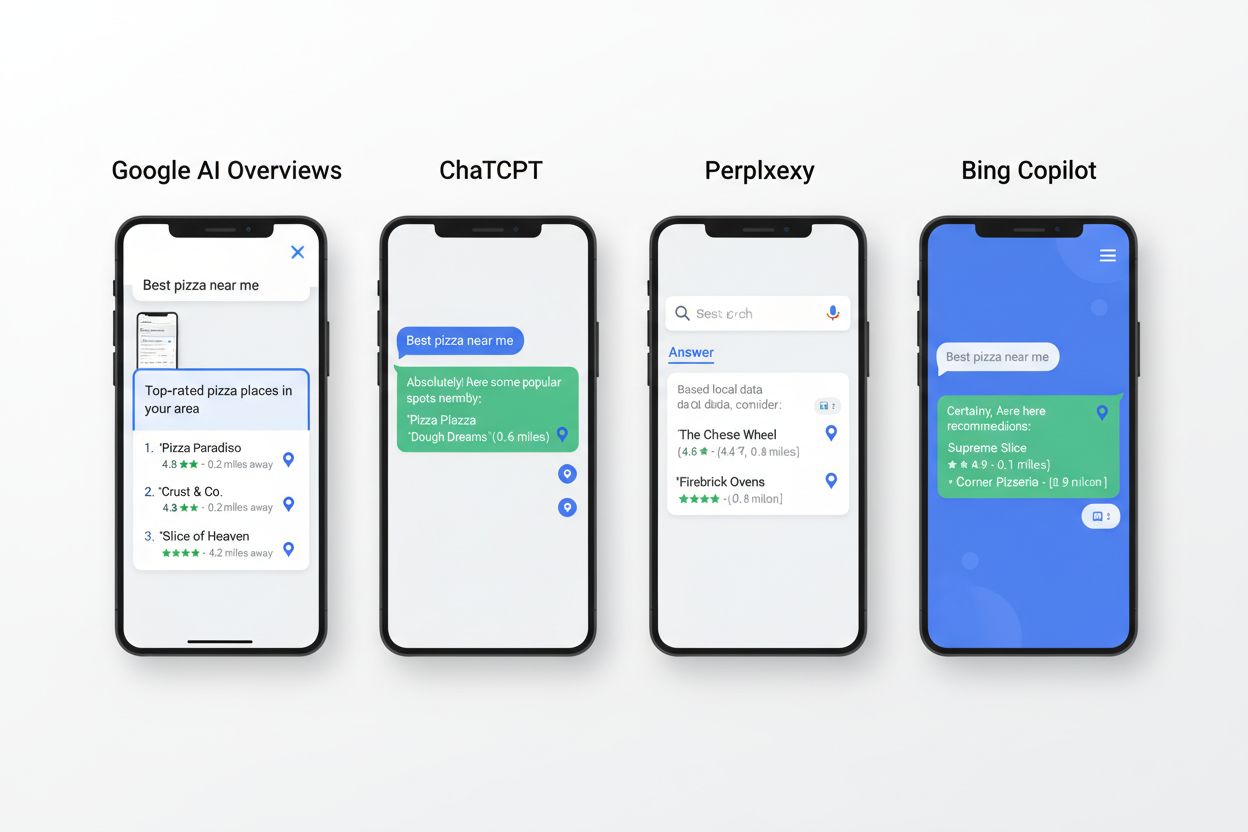
AI engines employ sophisticated decision-making frameworks when recommending local businesses, weighing dozens of signals simultaneously to determine which establishments deserve prominence in their responses. At the foundation lies unambiguous place entity recognition—the AI’s ability to definitively identify your business through consistent Name, Address, and Phone (NAP) data across all digital properties, ensuring the system doesn’t confuse your location with competitors or duplicate listings. Trust signals form the second pillar, encompassing verified reviews, customer testimonials, professional certifications, and proof of service delivery that demonstrate your business operates legitimately and delivers on its promises. The AI then evaluates proximity and reputation metrics, analyzing whether your location serves the user’s geographic needs while simultaneously assessing your overall standing through review sentiment, citation frequency, and brand mentions across the web. Critically, cited content carries disproportionate weight—when your business information, photos, or customer stories appear in reputable third-party sources (news articles, industry publications, social media), AI systems interpret this as independent validation of your legitimacy and relevance. Structured data markup (Schema.org vocabulary) acts as a translator, helping AI engines quickly parse and understand your business information without ambiguity.
Key decision factors AI engines evaluate:
| Aspect | Conventional Location Page | AI-Ready GEO-Optimized Location Page |
|---|---|---|
| Copy & Messaging | Generic boilerplate reused across locations with minor city-name swaps | Unique, intent-led copy reflecting local services, neighborhoods, and use cases |
| Structure & Markup | Minimal schema, unstructured blocks of text and images | Semantic headings, LocalBusiness and FAQ schema, consistent field-level structure |
| Local Context | Basic city mention and a map embed | Specific references to nearby landmarks, transit, events, and community context |
| Proof & Reviews | Sitewide testimonials not tied to a specific branch | Location-specific ratings, quotes, and photos demonstrating real usage |
| Conversion Experience | Single phone number and contact form with no clear primary action | Prominent, tappable CTAs (call, book, directions) aligned to local user intent |
Creating location pages that AI engines can understand and recommend requires a deliberate architectural approach that combines technical precision with user-centric content design. The foundation begins with complete entity data—your business name, full address, phone number, geographic coordinates, and operating hours must be present, consistent, and machine-readable across every instance on your website. Beyond basic information, your location pages need intent-matched content that directly addresses the questions and concerns your local audience has: “What makes you different from competitors three blocks away?” “Can you handle rush orders?” “Do you offer services for people with mobility challenges?” On-page proof elements—customer reviews, testimonials, before-and-after photos, case studies—provide the social validation that AI systems use to assess credibility and relevance to specific user needs. Frictionless user experience and technical performance matter enormously; AI engines track whether visitors can quickly find information, load pages without delays, and navigate intuitively on mobile devices, as these signals indicate genuine user satisfaction. Schema markup implementation transforms your page from human-readable text into machine-understandable data, allowing AI systems to extract key information without interpretation errors.
Essential elements for AI-ready location pages:
Implementing AI-ready local optimization requires a systematic, step-by-step operational workflow that transforms your current digital presence into a structure AI engines can readily understand and recommend. Begin by inventorying your current location pages, documenting what exists, identifying gaps, and noting inconsistencies in how information is presented across your website, Google Business Profile, and third-party directories. Next, map your revenue-driving queries—the specific search terms and questions your ideal customers ask when looking for your services in your area, understanding the intent behind each query and how your business uniquely solves that problem. The core transformation involves refactoring pages into Location Page 2.0 structure, reorganizing content to align with AI decision-making frameworks rather than traditional SEO conventions, ensuring each page clearly communicates entity identity, trust signals, and location-specific value. Implement comprehensive structured data markup across all location pages, using Schema.org vocabulary to make your business information machine-readable and unambiguous. Actively embed location-specific social proof by encouraging customers to leave reviews, share photos, and provide testimonials that specifically mention your location and the problems you solved for them. Finally, test your pages in AI interfaces—ask ChatGPT, Perplexity, Google’s AI Overviews, and Claude about your services in your area, observing whether your business appears in recommendations and how it’s described.
Local GEO optimization workflow (7-step process):
The optimal approach to AI-ready local optimization varies significantly based on your business structure, with single-location, multi-location, and enterprise organizations each requiring tailored strategies that account for their unique operational constraints and opportunities.
Single-Location Businesses (8-Week Transformation Plan)
Small businesses with one physical location can achieve comprehensive AI optimization relatively quickly through focused effort. Week 1-2 involves auditing your current digital presence and mapping your core revenue-driving queries. Weeks 3-4 focus on creating your Location Page 2.0—a comprehensive, intent-matched page that serves as your AI-optimization hub. Weeks 5-6 involve implementing structured data, optimizing your Google Business Profile, and ensuring NAP consistency across all platforms. Weeks 7-8 dedicate to building social proof through review campaigns and testing your visibility across AI interfaces. This compressed timeline works because you’re optimizing a single entity rather than managing multiple locations.
Multi-Location and Franchise Operations (Standardized Templates + Local Nuance)
Businesses with multiple locations face the challenge of scaling optimization without creating duplicate content that confuses AI systems. The solution involves creating standardized Location Page 2.0 templates that maintain consistent structure, branding, and core messaging while allowing for location-specific customization. Each location page should include unique content addressing local market conditions, community involvement, location-specific services, and locally-sourced reviews and testimonials. Implement a centralized citation management system that ensures NAP consistency across all locations while allowing local teams to manage their own review generation and community engagement. This approach typically requires 12-16 weeks for full implementation across 5-10 locations, with ongoing quarterly refinements.
Enterprise Organizations (First-Party Data Integration and Compliance)
Large enterprises with dozens or hundreds of locations must integrate AI optimization into their broader data governance and compliance frameworks. Enterprise success requires first-party data integration—connecting your location pages to your CRM, inventory systems, and customer databases to provide AI engines with real-time, accurate information about service availability, pricing, and operational status. Compliance becomes critical; ensure your location pages respect GDPR, CCPA, and other privacy regulations while still providing the transparency that AI systems require. Enterprise implementations typically span 6-9 months and involve cross-functional teams managing content, technical infrastructure, legal compliance, and local market coordination.
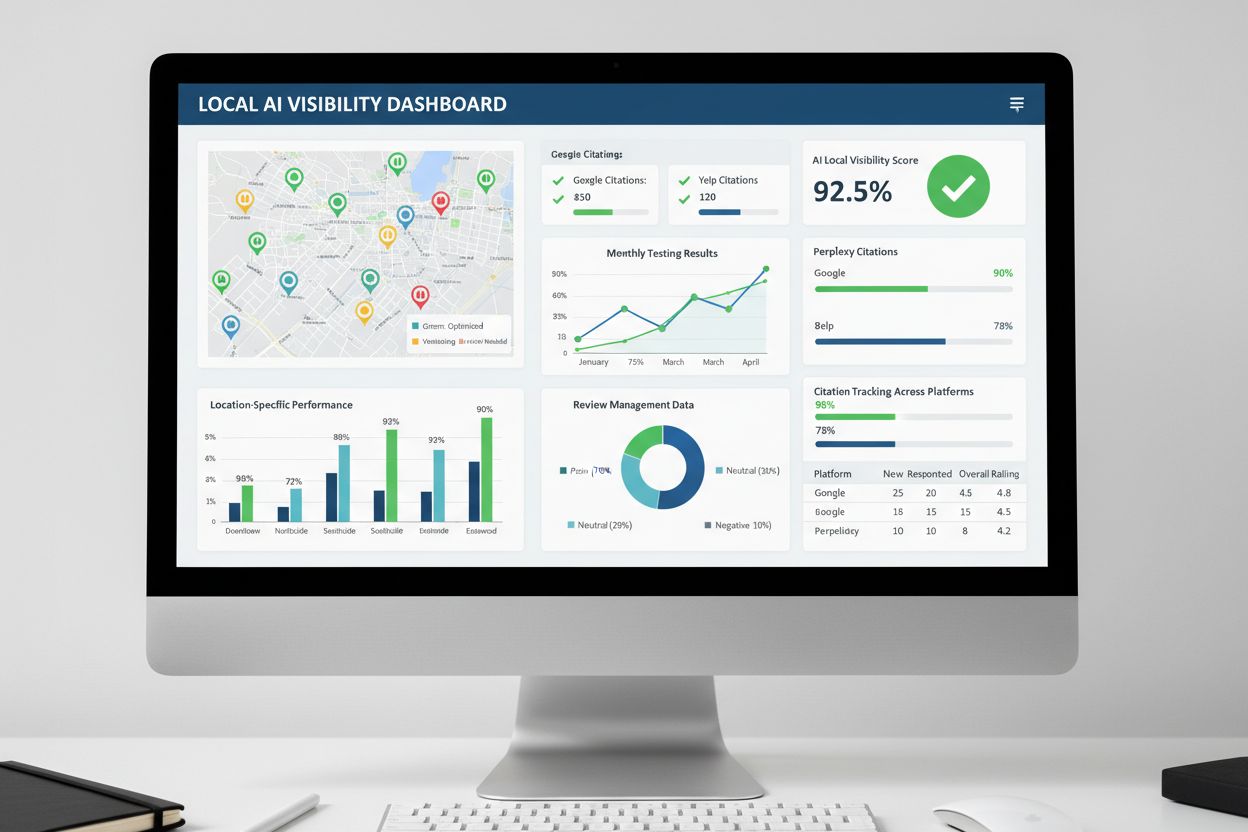
Tracking your success in AI-driven local search requires a new set of metrics and KPIs that differ fundamentally from traditional local SEO measurement, focusing on visibility within AI-generated responses rather than traditional search rankings. The AI Local Visibility Score combines multiple indicators—citation frequency in AI Overviews, appearance in AI-generated shortlists, review sentiment across platforms, and structured data completeness—into a single metric that reflects your overall AI-readiness and discoverability. Tracking citations in AI Overviews involves regularly querying your services in your area across Google, Perplexity, and other AI platforms, documenting whether your business appears in the AI-generated response and how it’s described. Monitor your share of presence in AI-generated shortlists—when an AI recommends three businesses for a particular service, are you one of them, and how frequently does this occur across different query variations? Measure on-page conversion rate from AI-referred sessions by implementing UTM parameters and tracking how visitors arriving from AI platform interactions convert compared to traditional search traffic. Implement location, region, and brand-level tracking to understand which of your locations are gaining AI visibility, which geographic markets are responding to your optimization efforts, and how your overall brand presence is evolving across AI platforms.
Achieving AI visibility is not a one-time project but an ongoing operational discipline that requires consistent, systematic maintenance to sustain and improve your position as AI algorithms evolve and competitors optimize their own presence. Establish a monthly testing routine where you query your services across AI interfaces (Google AI Overviews, Perplexity, ChatGPT, Claude), documenting whether your business appears in recommendations, how it’s described, and what information the AI is pulling from your pages. Monthly location page reviews should assess whether your content remains accurate, relevant, and aligned with current customer needs and market conditions, updating information as your services, pricing, or operational details change. Implement a monthly review generation campaign that encourages satisfied customers to share their experiences, ensuring a steady stream of fresh social proof that signals to AI systems that your business remains active and customer-focused. On a quarterly basis, refresh your visual content—update photos and videos to reflect current operations, seasonal offerings, and community involvement, as fresh visual content signals ongoing business activity. Conduct quarterly NAP audits across all platforms where your business appears, correcting inconsistencies before they confuse AI systems or customers. Feed all findings back into your Location Page 2.0 templates and standardized processes, creating a continuous improvement cycle that keeps your optimization efforts aligned with evolving AI behavior.
Ongoing maintenance schedule:
Geo-targeting extends far beyond the traditional local SEO practice of optimizing for “near me” searches, enabling sophisticated personalization strategies that deliver location-specific content, messaging, and offers to users based on their geographic context. Dynamic content delivery allows you to serve different versions of your website to users in different locations—a restaurant in Manhattan might highlight their quick lunch service and delivery options to downtown office workers, while the same restaurant’s website might emphasize their private dining room and wine selection to suburban visitors. Regional-specific messaging and offers recognize that customer needs, preferences, and competitive landscapes vary dramatically by geography; a fitness studio in a wealthy suburb might emphasize luxury amenities and personalized coaching, while the same brand’s location in an urban neighborhood might highlight affordability and community. For multi-location brands scaling smarter, geo-targeting enables centralized brand management with localized execution—corporate headquarters maintains brand guidelines and core messaging while individual locations customize content, promotions, and community involvement to reflect local market dynamics. E-commerce and international applications benefit from geo-targeting by delivering location-appropriate product recommendations, pricing in local currency, and content in local languages, dramatically improving conversion rates and customer satisfaction. IP detection and user experience optimization allows your website to recognize a visitor’s location and proactively surface relevant information—a visitor from out of state sees your shipping options prominently, while a local visitor sees your store hours and directions.
Achieving comprehensive local AI visibility requires a distributed content footprint strategy that reaches audiences across the diverse platforms where they discover local businesses, from Google and Yelp to Reddit, TikTok, and emerging AI search platforms. Google remains dominant in local search, but AI Mode is fundamentally changing how the platform surfaces local recommendations, requiring optimization strategies that account for both traditional search and AI-generated responses. Yelp functions as a trusted citation source for many AI systems, which reference Yelp reviews and ratings when making recommendations; maintaining an optimized Yelp profile with current information, professional photos, and regular engagement with customer reviews is essential for AI visibility. Reddit serves as a powerful social proof platform where real customers discuss their experiences with local businesses; while you shouldn’t directly promote your business on Reddit, encouraging satisfied customers to share authentic experiences and monitoring relevant subreddits for mentions of your business provides valuable signals to AI systems. TikTok has emerged as a critical discovery platform for Gen Z, with location-tagged videos and local business hashtags driving awareness and consideration; creating authentic, entertaining content that showcases your location and services can generate both direct customer acquisition and social proof signals. Perplexity and other alternative search platforms are gaining traction as AI search alternatives, requiring optimization strategies that ensure your business information is discoverable and accurately represented on these emerging platforms. A comprehensive multi-platform strategy ensures that regardless of which platform a potential customer uses to discover local businesses, your optimized presence is ready to convert their interest into action.
Multi-platform visibility checklist:
The future of AI-driven local search extends beyond recommendation systems to agentic search—AI agents that autonomously take actions on behalf of users, fundamentally transforming how customers discover, evaluate, and transact with local businesses. Emerging capabilities like “Call with AI” and agent-to-agent negotiation mean that AI systems will soon autonomously contact businesses to verify availability, negotiate pricing, and even complete transactions without direct human involvement. In this future, proximity matters less and price transparency matters far more; an AI agent will instantly compare pricing across all available options and route the customer to the most cost-effective choice, making competitive pricing and transparent pricing data critical success factors. Operational challenges emerge immediately—businesses unprepared for agentic search will face dramatic increases in call volume, many from AI agents rather than humans, and the operational burden of handling or routing these calls appropriately. Structured pricing data requirements become non-negotiable; your business must publish pricing information in machine-readable formats that AI agents can instantly access and compare, eliminating the traditional sales tactic of hiding pricing until a customer calls. Asynchronous transactions will become standard, with AI agents booking appointments, placing orders, and initiating service requests outside traditional business hours, requiring businesses to implement systems that can process and confirm these transactions automatically.
Agentic search impacts and required adjustments:
Success in AI-driven local optimization requires understanding both the strategies that work and the pitfalls that undermine visibility and customer trust, allowing you to maximize your efforts while avoiding costly mistakes. Avoid duplicate or thin content across locations—each location page must contain unique, substantive content that addresses local market conditions, community involvement, and location-specific services; AI systems penalize locations that appear to be cookie-cutter duplicates of each other. Don’t keyword stuff location names by creating artificial variations like “Best Pizza in Manhattan | Pizza in NYC | Manhattan Pizza Restaurant”; instead, use your actual business name consistently and let your content naturally address the geographic terms your customers use. Maintain consistent NAP data across every platform where your business appears—inconsistencies confuse both AI systems and customers, undermining trust and visibility. Use location-rich CTAs that encourage customers to take action specific to their location: “Book your appointment at our Manhattan location” rather than generic calls-to-action that could apply to any location. Respect user privacy by complying with GDPR, CCPA, and other regulations when collecting location data or personalizing content; transparency about data usage builds trust with both customers and AI systems. Avoid forcing redirects without consent—if you detect a user’s location and redirect them to a location-specific page, provide clear options to view other locations or the main site. Avoid cultural insensitivity by recognizing that different communities have different values, communication styles, and service expectations; customize your messaging and offerings to reflect local culture rather than imposing a one-size-fits-all approach.
Local AI optimization do’s and don’ts:
Implementing comprehensive AI-ready local optimization requires a strategic technology stack that addresses entity management, structured data implementation, citation tracking, geo-targeting, and performance monitoring. Google Business Profile optimization remains foundational—this free tool is where Google aggregates your business information and where many AI systems source local business data, making profile completeness and accuracy non-negotiable. Schema markup and structured data tools like Schema.org vocabulary, Google’s Structured Data Testing Tool, and platforms like Yext help you implement machine-readable business information that AI systems can instantly parse and understand. Citation management tools such as Semrush Local, BrightLocal, or Whitespark help you maintain NAP consistency across hundreds of directories and platforms, ensuring that AI systems encounter consistent information regardless of where they source your business data. Geo-targeting platforms like Geo-Fencing, location-based advertising networks, and dynamic content delivery systems enable you to serve location-specific content and offers to users based on their geographic context. Monitoring and analytics tools including Google Analytics with location-based segmentation, AI platform monitoring tools, and custom dashboards help you track your AI visibility, measure the impact of your optimization efforts, and identify opportunities for improvement. AmICited.com specializes in AI visibility tracking, monitoring how your business appears in AI Overviews, AI Mode responses, and alternative AI search platforms, providing the specific insights you need to optimize your presence across the AI-driven search landscape and stay ahead of competitors.
Traditional local SEO focuses on ranking in Google Maps and local search results, while AI local visibility is about appearing in AI-generated recommendations from platforms like Google AI Overviews, ChatGPT, and Perplexity. AI systems evaluate trust signals, structured data, and cited content differently than traditional search algorithms, requiring a new optimization approach called Location Page 2.0.
Location Page 2.0 is a comprehensive, AI-optimized location page that serves both human visitors and AI systems. It combines unambiguous entity data, intent-matched content, on-page proof (reviews, testimonials, photos), and proper schema markup. AI systems use these elements to decide whether to recommend your business, making Location Page 2.0 essential for visibility in AI-driven search.
You can often detect early signals like new citations in AI responses within 2-4 weeks of implementing Location Page 2.0 optimization. However, meaningful improvements in traffic and conversions typically take 8-12 weeks as AI systems periodically refresh their understanding of business entities. Maintaining consistent optimization efforts compounds gains over time.
Prioritize Google AI Overviews (most traffic), Perplexity (22 million monthly users), ChatGPT (integrating Google Maps), and Bing Copilot. Also monitor Yelp, Reddit, and TikTok as these platforms are frequently cited by AI systems. A distributed content footprint across multiple platforms ensures visibility regardless of which AI platform your customers use.
Structured data (Schema.org markup) acts as a translator between your website and AI systems, helping them quickly parse and understand your business information without ambiguity. Proper schema implementation for LocalBusiness, Place, and Organization entities significantly increases the likelihood that AI systems will accurately cite and recommend your business.
Create an AI Local Visibility Score that combines multiple indicators: citation frequency in AI Overviews, appearance in AI-generated shortlists, review sentiment, structured data completeness, and conversion rate from AI-referred sessions. Track these metrics at location, region, and brand levels to understand which optimization efforts are working and where to focus additional resources.
Agentic search refers to AI agents that autonomously take actions on behalf of users, such as calling businesses or booking appointments. To prepare, publish transparent pricing in machine-readable formats, ensure real-time availability data is accurate, implement systems to handle AI-initiated transactions, and maintain consistent operational information across all platforms.
Geo-targeting enables dynamic content delivery based on user location, allowing you to serve location-specific messaging, offers, and information. While traditional local SEO optimizes for local search visibility, geo-targeting personalizes the entire user experience, improving conversion rates and customer satisfaction by delivering content that feels locally relevant to each visitor.
Track how AI systems like Google AI Overviews, ChatGPT, and Perplexity reference your brand. Get real-time insights into your local AI visibility and optimize your presence where customers discover you.
Learn how local businesses optimize for AI search engines like ChatGPT and Perplexity. Discover strategies for Google Business Profiles, citations, and AI visib...
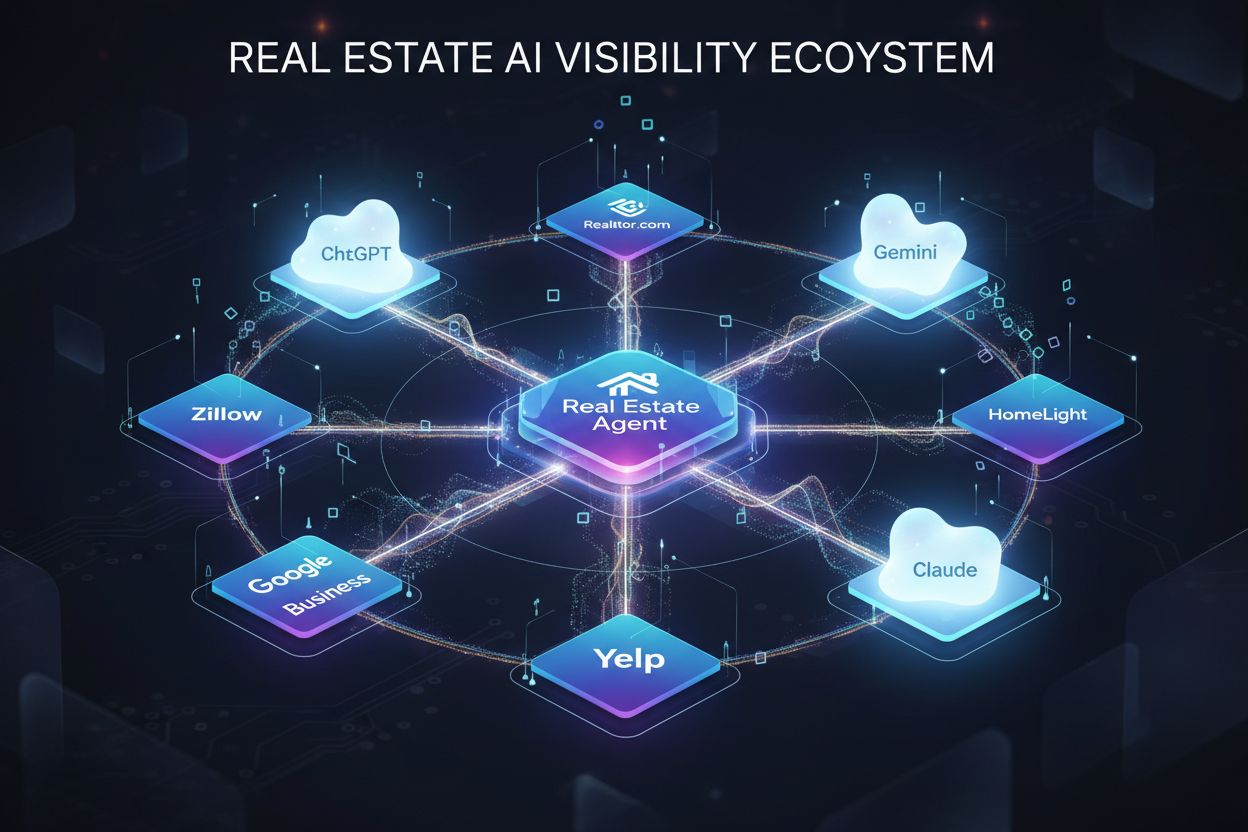
Learn how real estate agents and brokers can optimize for AI visibility in ChatGPT, Perplexity, and Google AI Overviews. Discover strategies for property discov...
Discover the real business costs of ignoring AI search monitoring. Learn how brands lose visibility, market share, and customer discovery when they don't track ...