
How to Balance Lead Generation and AI Visibility
Learn how to balance lead generation with AI search visibility. Discover hybrid gating strategies, content optimization techniques, and monitoring approaches to...
10 min read
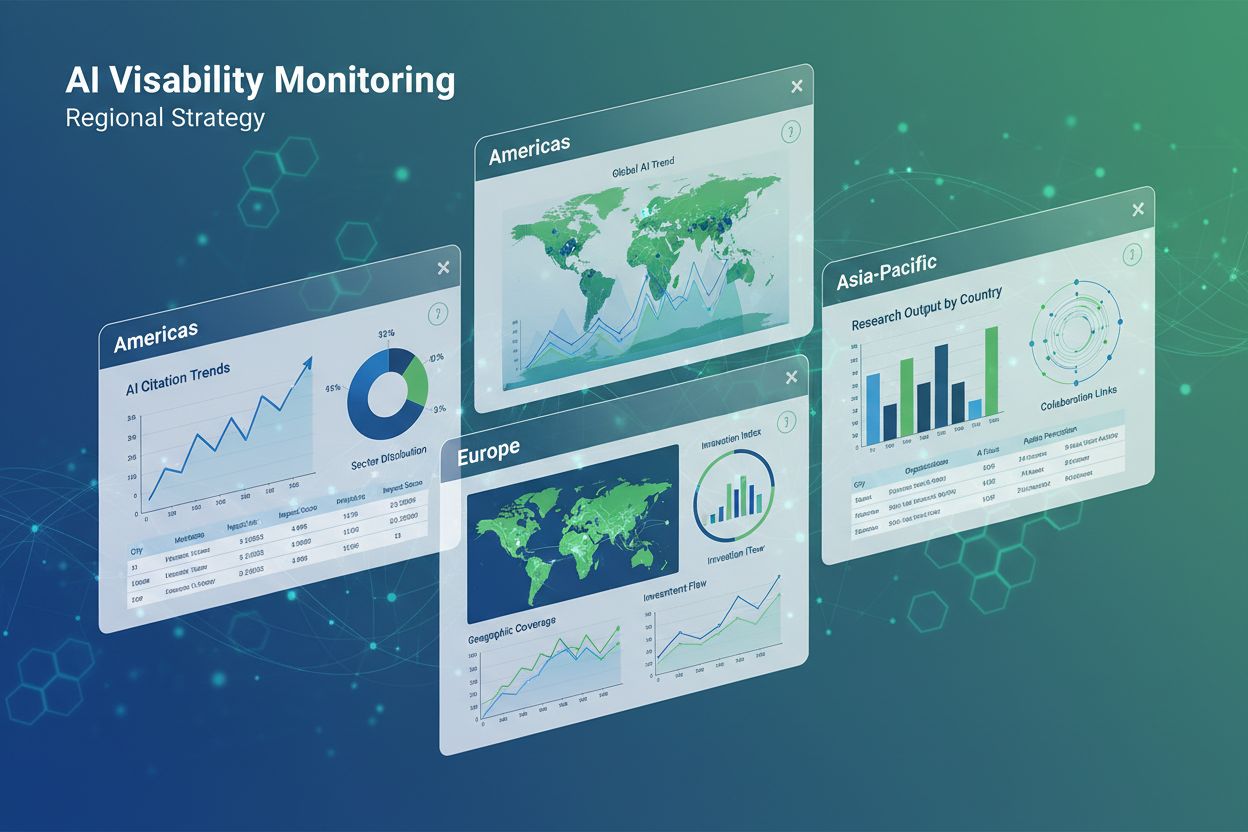
Learn how to optimize your brand visibility across both local search engines and global AI models. Discover strategies for managing regional AI visibility and maintaining presence in both ecosystems.
The modern digital landscape presents a unique paradox for brands operating across multiple regions: while artificial intelligence models promise unprecedented reach and understanding, they simultaneously struggle with the nuanced, localized knowledge that search engines have perfected over decades. Companies today must navigate two distinct visibility ecosystems simultaneously—one dominated by traditional search engines with sophisticated geographic indexing, and another powered by large language models that operate on probabilistic pattern matching across global training data. This dual challenge means that a strategy optimized purely for Google’s local search results may leave your brand invisible to users querying ChatGPT, Claude, or other AI assistants about products and services in their region. The stakes are particularly high because these two ecosystems serve different user intents: search engines capture users actively looking for solutions, while AI models increasingly influence decision-making through conversational recommendations and contextual suggestions. Understanding how to maintain visibility across both channels requires fundamentally different approaches, yet most brands are still treating AI visibility as an afterthought rather than a core component of their regional marketing strategy.
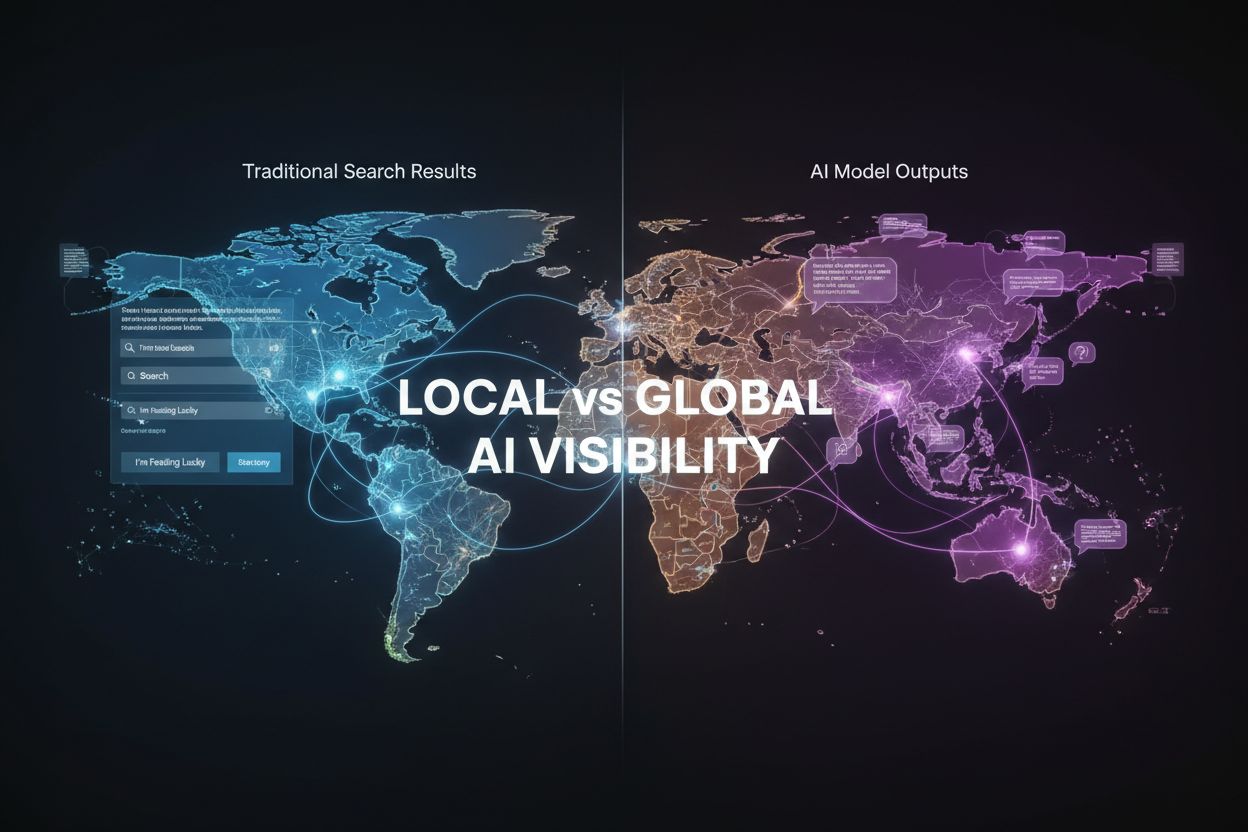
Large language models face a critical limitation that many marketers underestimate: they lack the real-time, location-specific data infrastructure that Google has spent two decades building. When a user in Santiago, Chile searches for apartment listings, Google instantly understands local market context, current inventory, regional pricing trends, and neighborhood-specific information through its country-level indices and real-time data feeds. An LLM attempting the same query relies on training data that may be months or years old, contains disproportionate information about major U.S. markets, and lacks the granular understanding of local regulations, pricing conventions, and market dynamics. Consider this comparison of how each system handles local queries:
| Aspect | Search Engines (Google) | LLMs (ChatGPT, Claude) |
|---|---|---|
| Data Freshness | Real-time, continuously updated | Training data cutoff (months/years old) |
| Geographic Specificity | Country-level indices with local signals | Contextual inference from training patterns |
| Commercial Intent | Sophisticated understanding of local intent | General understanding, may miss regional nuances |
| Local Business Data | Direct integration with business listings | Dependent on training data mentions |
| Pricing Context | Current regional pricing data | Historical patterns from training data |
| Regulatory Awareness | Indexed local regulations and requirements | General knowledge, may be outdated |
This fundamental difference means that brands cannot simply optimize for one channel and expect visibility in the other. A real estate platform that dominates local Google search results may still be completely absent from AI model recommendations if it hasn’t specifically optimized its content for how LLMs process and retrieve information about regional markets.
The training data that powers modern AI models reveals a stark geographic bias that directly impacts your brand’s visibility across different regions. Most large language models are trained predominantly on English-language content, with a significant overrepresentation of U.S.-centric information, creating what researchers call the “English-speaking bias” in AI systems. This bias manifests in several critical ways:
For brands operating in non-English markets or regions outside the U.S., this creates a compounding visibility problem: not only are LLMs less likely to have comprehensive information about your market, but they’re also less likely to understand the context and nuances that make your offering relevant to local customers. This is why monitoring your AI visibility through tools like AmICited.com becomes essential—you need to understand not just whether you’re visible in AI responses, but how accurately those responses represent your brand and market position.
Unlike search engines that use explicit geographic indexing and country-level data separation, large language models determine regional relevance through contextual clues embedded in user queries and content. When someone asks an AI assistant about “the best streaming service for watching football,” the model doesn’t consult a geographic database—instead, it infers location from language patterns, cultural references, and contextual information in the conversation. This contextual approach creates both opportunities and challenges for brands operating across regions. Netflix, for example, must ensure that its content library information, regional pricing, and market-specific offerings are represented in training data in ways that allow LLMs to correctly associate them with specific countries. A query about “Netflix in Brazil” should trigger information about Brazilian content libraries and pricing, not generic Netflix information or U.S.-specific details. The challenge intensifies when regional market boundaries don’t align with language boundaries—Spanish-speaking markets in Latin America have vastly different competitive landscapes, regulatory environments, and consumer preferences, yet LLMs often treat them as a single market based on language similarity.
This contextual understanding also means that brands need to think differently about how they present regional information. Rather than relying on meta tags and structured data that search engines parse explicitly, you need to ensure that your content naturally incorporates regional context, local examples, and market-specific information in ways that help LLMs understand your geographic relevance. A Spotify playlist curated for Argentine audiences should include Argentine artists and cultural references that help the model understand its regional specificity, not just generic Latin American content. The key insight is that AI models use implicit geographic reasoning based on content patterns, which means your optimization strategy must focus on making regional context explicit and unmistakable in your content.
Google’s dominance in local search stems from a capability that remains unmatched by current LLMs: sophisticated understanding of commercial intent combined with real-time local market data. When someone searches for “apartment rentals in Santiago,” Google doesn’t just return relevant results—it understands that this is a high-intent commercial query, recognizes the specific geographic market, and serves results from platforms like Zillow, local real estate agencies, and property listing sites that have optimized for that specific market. This understanding comes from years of learning how users in different regions search for products and services, what they’re willing to pay, and which platforms they trust. Google’s local search algorithm incorporates hundreds of signals including business location data, review patterns, search volume trends, and user behavior patterns specific to each region. Amazon’s success in different markets similarly reflects Google’s ability to understand that “best laptop under $500” means something different in Brazil than in the United States, both in terms of actual product availability and purchasing power parity.
LLMs, by contrast, approach the same query with general knowledge about laptops, pricing, and brands, but lack the real-time market data and commercial intent understanding that would allow them to recommend region-specific options or acknowledge regional pricing differences. This is why brands that dominate Google’s local search results often find themselves invisible or poorly represented in AI model responses—the optimization strategies are fundamentally different. Google rewards sites that have invested in local SEO, built local citations, and optimized for regional commercial intent. AI models reward comprehensive, contextually rich content that helps them understand your offering in relation to regional markets. A brand that has optimized exclusively for Google’s local search algorithm may have excellent visibility for “best coffee in Melbourne” but completely miss opportunities to be recommended by AI assistants to users asking similar questions conversationally.
The most effective approach for brands operating across multiple regions is not to choose between optimizing for search engines or AI models, but to build a comprehensive strategy that addresses both simultaneously. This hybrid approach requires understanding that while the optimization tactics differ, the underlying principle remains the same: you must make your regional relevance unmistakably clear to both human users and AI systems. Start by mapping your current visibility across both ecosystems—understand where you rank in Google’s local search results for key regional queries, and simultaneously track how often you appear in AI model responses to similar questions. Tools like AmICited.com provide visibility into your AI citations and mentions, allowing you to identify gaps where you’re visible in search but absent from AI responses, or vice versa.
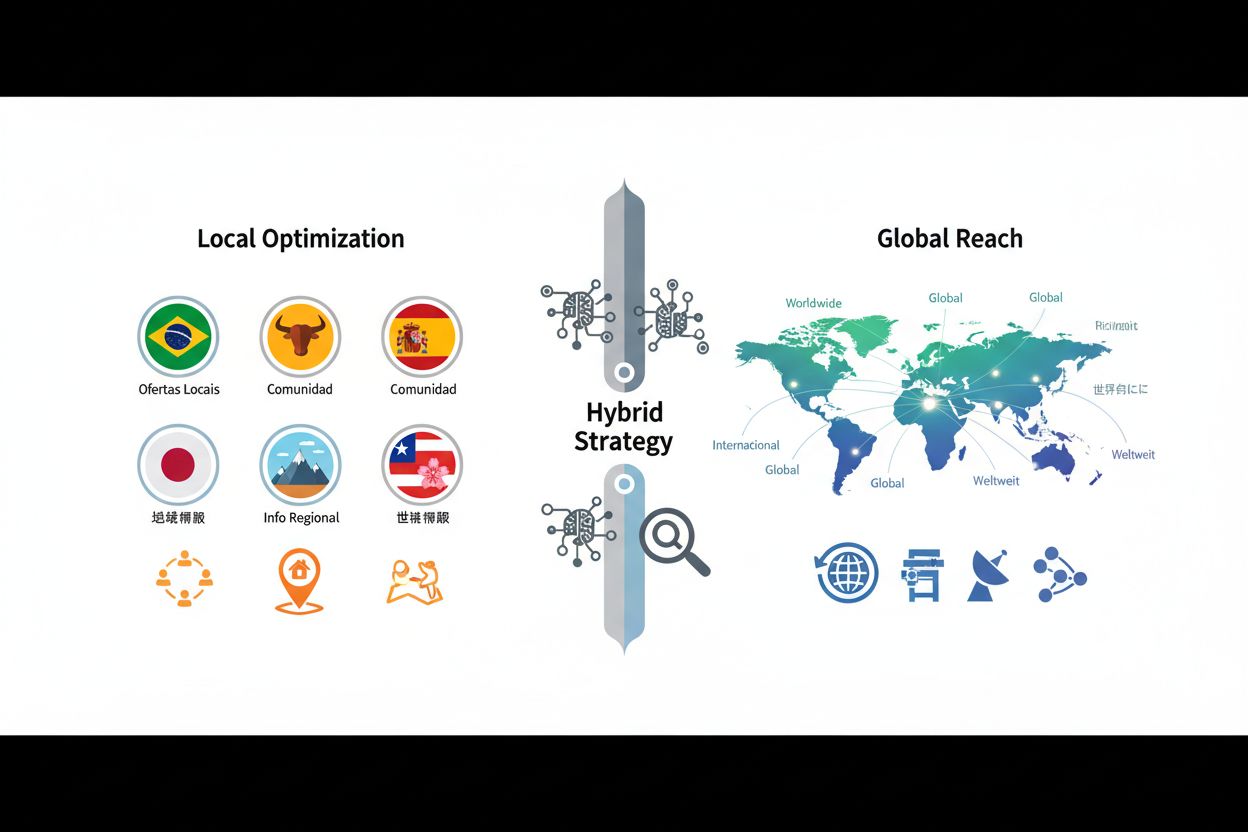
The hybrid strategy involves several key components working in concert. First, maintain and expand your traditional local SEO efforts—local citations, Google Business Profile optimization, and region-specific content remain essential because they serve users actively searching for solutions. Second, develop content that explicitly addresses regional context, local market conditions, and region-specific variations of your offering. Rather than creating generic product pages, develop region-specific content that helps both search engines and AI models understand your local relevance. Third, ensure that your content includes the contextual clues that LLMs use for geographic inference—local examples, regional partnerships, market-specific pricing, and cultural references that make your regional presence unmistakable. Fourth, implement structured data and schema markup that helps search engines understand your regional offerings while also making information more accessible to AI systems that may crawl your content. Finally, build a monitoring system that tracks your visibility across both channels, allowing you to identify which strategies are working and where adjustments are needed.
For brands with operations across multiple regions, implementing a local vs. global optimization strategy requires systematic planning and execution. Begin by conducting a regional audit that maps your current market presence, competitive landscape, and visibility gaps in each region. For each market, identify the key queries that drive commercial intent—these might be product searches, comparison queries, or solution-focused questions that indicate purchase intent. Then, analyze how you currently rank for these queries in Google’s local search results and how frequently you appear in AI model responses to similar questions. This dual analysis reveals your optimization priorities: markets where you’re strong in search but weak in AI responses need content strategy adjustments, while markets where you’re weak in both need comprehensive localization efforts.
Next, develop region-specific content that addresses local market conditions, competitive dynamics, and customer preferences. For a streaming service like Netflix, this means creating content about regional content libraries, local pricing, and region-specific features rather than generic service descriptions. For an e-commerce platform like Amazon, it means developing content that acknowledges regional product availability, local payment methods, and region-specific customer service options. Implement this content across multiple formats—blog posts, product descriptions, FAQ sections, and help documentation—ensuring that regional context is woven throughout rather than siloed in separate regional pages. Use structured data to explicitly mark regional information, helping both search engines and AI systems understand your geographic relevance. Finally, establish a content update cadence that keeps regional information current, particularly for markets where competitive dynamics or regulatory environments change frequently. This might mean quarterly updates for mature markets and monthly updates for rapidly evolving regions.
Measuring the success of a hybrid local and global AI optimization strategy requires tracking metrics across both ecosystems and understanding how they interact. Traditional local SEO metrics remain important—track your rankings for key regional queries, monitor your Google Business Profile performance, and measure local search traffic and conversions. However, these metrics alone provide an incomplete picture of your regional visibility. You must also track your AI visibility metrics, which include how frequently your brand appears in AI model responses to regional queries, the context in which you’re mentioned, and whether those mentions accurately represent your regional offerings. AmICited.com and similar monitoring platforms provide essential visibility into these AI citations, allowing you to track whether your optimization efforts are translating into increased AI visibility.
Develop a dashboard that tracks key metrics across both channels for each region: search rankings for priority keywords, search traffic volume and conversion rates, AI citation frequency and sentiment, and competitive positioning in both search and AI responses. Look for patterns that reveal optimization opportunities—if you’re ranking well in search but receiving few AI citations, your content may need more explicit regional context. If you’re appearing in AI responses but not converting those mentions into search traffic, you may need to optimize your content for commercial intent. Track how changes to your content strategy impact both search and AI visibility, allowing you to refine your approach based on real performance data. Most importantly, remember that local and global optimization are not competing strategies but complementary approaches that together create comprehensive regional visibility. A brand that dominates both Google’s local search results and AI model recommendations for regional queries has built a sustainable competitive advantage that’s difficult for competitors to replicate, because it requires excellence across multiple distinct optimization disciplines.
Local optimization focuses on visibility in regional search engines and AI models with geographic specificity, while global optimization targets broad reach across all markets. Local optimization requires understanding regional context, pricing, regulations, and cultural nuances. Global optimization emphasizes universal messaging and broad appeal. The most effective strategy combines both approaches—maintaining strong local presence while building global reach.
Large language models rely on training data that is disproportionately English and U.S.-centric, with limited representation of emerging markets and non-English languages. They use contextual clues rather than geographic databases to infer location, making them prone to misunderstanding regional boundaries and market-specific information. Additionally, their training data becomes outdated quickly, particularly for rapidly evolving markets where business practices change frequently.
Google has spent decades building country-level indices, real-time business data feeds, and sophisticated commercial intent understanding. It directly integrates with local business listings, understands regional pricing and regulations, and continuously updates its data. AI models, by contrast, rely on static training data and pattern matching. Google's advertising ecosystem also incentivizes accurate local understanding, creating a competitive advantage that LLMs don't yet possess.
While some core content can be reused, optimal visibility in both ecosystems requires region-specific customization. Search engines reward local SEO optimization with citations and geographic signals, while AI models need explicit regional context woven throughout your content. You should develop region-specific content that addresses local market conditions, competitive dynamics, and customer preferences, while maintaining consistent brand messaging across all versions.
Track both traditional local SEO metrics (search rankings, local traffic, conversions) and AI-specific metrics (citation frequency, mention context, sentiment). Use tools like AmICited.com to monitor how often your brand appears in AI responses to regional queries and whether those mentions accurately represent your offerings. Compare performance across regions to identify where you're strong in search but weak in AI, or vice versa, to guide your optimization priorities.
Conduct quarterly reviews of your regional performance across both search and AI channels. Update content more frequently in rapidly evolving markets (monthly) and less frequently in stable markets (quarterly). Monitor competitive changes, regulatory updates, and shifts in consumer behavior that might require strategy adjustments. Use your monitoring data to identify emerging opportunities and threats in each region.
Cultural sensitivity is critical because AI models learn from training data that may contain cultural biases or outdated information. Your content should include local examples, cultural references, and region-specific context that help AI models understand your offering in its proper cultural context. This prevents misrepresentation and ensures that AI recommendations about your brand are accurate and appropriate for local audiences.
AmICited tracks how AI models like ChatGPT, Claude, and Perplexity reference your brand across different regions and languages. It monitors citation frequency, context, and accuracy, helping you understand your AI visibility gaps and opportunities. By tracking regional AI citations, you can identify which markets need content optimization and measure the impact of your localization efforts on AI visibility.
Track how AI models reference your brand in different regions and languages with AmICited's comprehensive AI visibility monitoring platform.
Learn how to balance lead generation with AI search visibility. Discover hybrid gating strategies, content optimization techniques, and monitoring approaches to...
Learn how to balance brand visibility in AI answers with content protection. Discover strategies for monitoring AI mentions, protecting intellectual property, a...
Learn how local businesses optimize for AI search engines like ChatGPT and Perplexity. Discover strategies for Google Business Profiles, citations, and AI visib...