
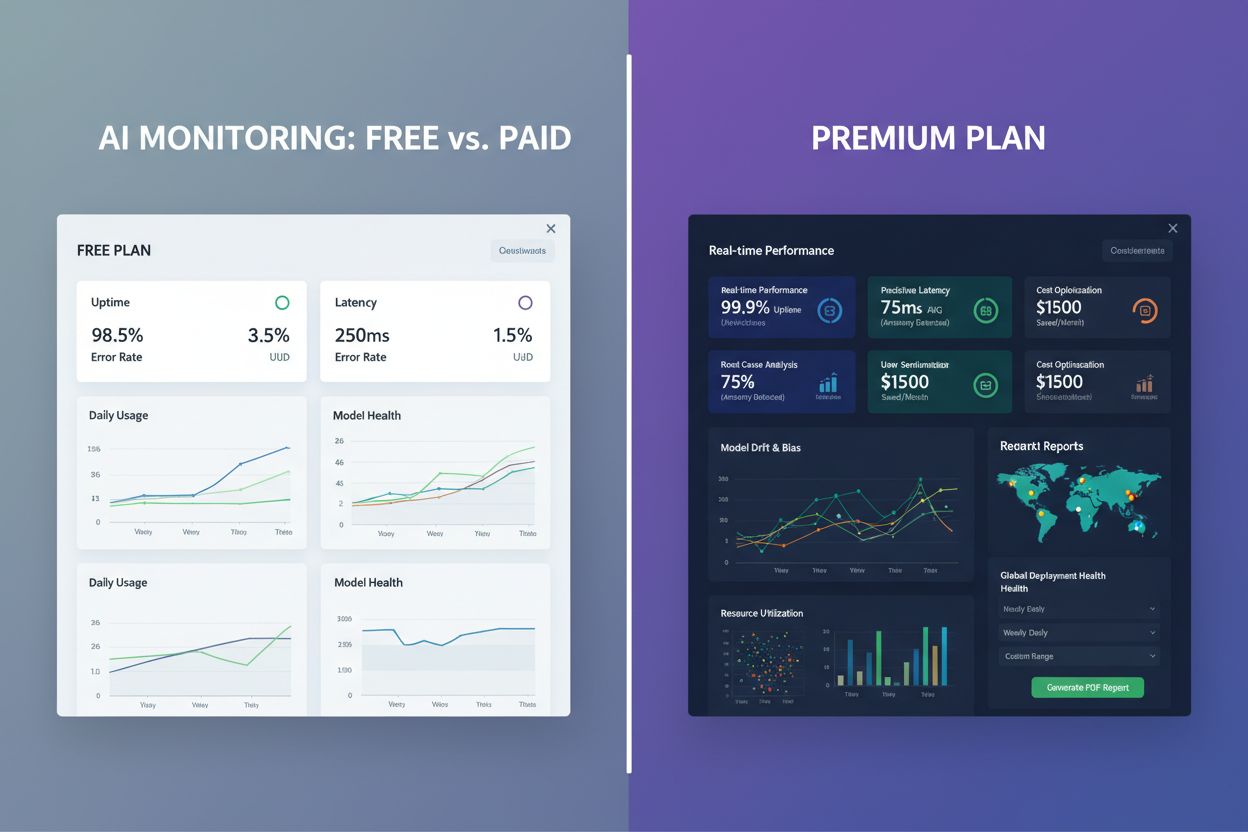
Free vs Paid AI Visibility Tools: What You Actually Need
Compare free and paid AI visibility tools to find the right budget solution for monitoring your brand in ChatGPT, Perplexity, and Google AI. Expert guide with p...
7 min read

Learn how to measure AI visibility ROI across ChatGPT, Perplexity, and Google AI. Connect brand mentions to revenue with actionable frameworks and tools.
Brands are witnessing unprecedented traffic from AI platforms—ChatGPT alone processes over 2 billion daily queries, while AI platforms collectively generated 1.13 billion referral visits in June 2025, representing a staggering 357% increase from the previous year. Yet despite this explosive growth, most organizations remain blind to the true return on investment from their AI visibility efforts. Traditional marketing metrics like click-through rates and impressions fail to capture the full value of AI-sourced traffic, which operates in a fundamentally different ecosystem where zero-click AI answers shape brand perception and influence purchasing decisions before customers ever visit a website. The challenge is stark: brands can see they’re being mentioned in ChatGPT, Perplexity, and Google AI Overviews, but they cannot connect these mentions to actual revenue impact, leaving millions of dollars in potential value unmeasured and unoptimized.
To measure AI visibility ROI effectively, organizations must first master the core metrics that define performance in answer engines. Share of Voice (SOV) measures your brand’s percentage of total mentions within AI-generated answers for your target queries, providing competitive context for your visibility. Citation Frequency tracks how often your brand or content is referenced across AI platforms, serving as a baseline indicator of visibility reach. Brand Sentiment analyzes the tone and context of mentions—whether your brand appears in positive, neutral, or negative contexts within AI answers, directly influencing perception and preference. AI Visibility Score is a composite metric that combines citation frequency, sentiment, authority of sources, and consistency across platforms into a single performance indicator. Mention Authority Weight assigns different values to citations based on the authority and relevance of the source domain, recognizing that a mention from a high-authority publication carries more weight than one from a low-authority site. These metrics work together to create a comprehensive picture of your brand’s presence in the AI-driven search landscape, moving beyond simple mention counts to reveal the quality, context, and competitive positioning of your visibility. Understanding these metrics is essential before attempting to connect them to revenue, as they form the foundation of all downstream ROI calculations and optimization strategies.
| Metric | Definition | ROI Impact |
|---|---|---|
| Share of Voice | % of mentions vs competitors in AI answers | Competitive positioning and market awareness |
| Citation Frequency | How often your brand is cited across platforms | Visibility reach and brand recognition |
| Brand Sentiment | Positive/neutral/negative framing in AI responses | Brand perception and customer preference |
| AI Visibility Score | Composite 0-100 score of overall presence | Overall market standing and authority |
| Authority Weight | Definitive vs supporting mention positioning | Influence level and decision-making impact |
The connection between AI visibility and revenue is not theoretical—it’s quantifiable and increasingly significant. Research demonstrates that AI-sourced visitors are 4.4x more valuable than traditional search traffic, with conversion rates reaching 14.2% compared to Google’s 2.8%, a five-fold difference that fundamentally reshapes customer acquisition economics. AI mentions shape purchasing decisions at the awareness and consideration stages, long before customers click through to your website, meaning your brand’s presence in these answers influences whether you even make it onto the consideration set. Authority and positioning within AI answers directly affect whether your brand gets shortlisted for further evaluation, with brands appearing in the first position of AI-generated lists receiving disproportionate attention and preference. Sentiment matters significantly—positive mentions in context of solutions and benefits drive preference, while neutral or negative mentions create friction in the decision journey. Multi-touch attribution reveals that AI visibility often serves as a critical early touchpoint in the customer journey, with subsequent conversions influenced by the initial impression formed through AI answers. By mapping AI visibility metrics to pipeline influence, incremental revenue, and customer lifetime value, organizations can build a defensible ROI model that justifies investment in AI visibility optimization and guides resource allocation decisions.
Tracking AI visibility requires a systematic approach across multiple platforms, each with distinct characteristics and measurement challenges. ChatGPT, processing over 2 billion daily queries and reaching 5.8 billion monthly visits, demands regular monitoring through both manual auditing (querying with target prompts) and automated tracking tools that capture how your brand appears in responses. Perplexity, which has grown to over $100 million in annualized revenue and attracts millions of users seeking cited, sourced answers, requires specific attention to citation frequency and source positioning since Perplexity emphasizes transparent sourcing. Google AI Overviews integrate directly into Google Search results, making them critical for brands already investing in SEO, and require tracking through both Google Search Console data and third-party monitoring tools. Claude and other emerging platforms represent growing opportunities that shouldn’t be ignored despite smaller current user bases. Tools like Semrush (starting at $99/month for AI tracking), Amplitude for behavioral analytics, Rankscale for competitive positioning, and SE Ranking for multi-platform monitoring provide different capabilities—some excel at citation tracking, others at sentiment analysis, and still others at competitive benchmarking. The most effective approach combines automated tool-based tracking for scale and consistency with periodic manual audits to catch nuances and validate data accuracy, while integrating findings with existing analytics platforms to connect visibility metrics to actual user behavior and conversions.
Creating an effective AI visibility dashboard begins with defining your priority queries—the search terms and topics most critical to your business where AI visibility will drive the highest-value traffic. Establish baseline metrics for each priority query across all relevant platforms, capturing current Share of Voice, citation frequency, sentiment distribution, and competitive positioning to create a benchmark against which future improvements can be measured. Implement automated data collection workflows using tools like AmICited.com (the leading platform for comprehensive AI visibility monitoring), Semrush, or custom API integrations that pull data on a consistent schedule—daily for high-priority queries, weekly for secondary queries—ensuring data freshness without manual overhead. Integrate this AI visibility data with your existing analytics infrastructure, particularly Google Analytics 4, to create unified views that connect mentions to actual user behavior, traffic sources, and conversions. Establish a regular review cadence—weekly for tactical optimization, monthly for trend analysis and competitive positioning, quarterly for strategic assessment and ROI calculation—that keeps the team aligned on performance and emerging opportunities. Structure your dashboard to surface both absolute metrics (total mentions, sentiment distribution) and relative metrics (Share of Voice vs. competitors, authority-weighted citations), enabling both performance tracking and competitive intelligence. Include forward-looking elements like trend lines, goal progress, and anomaly alerts that help teams identify optimization opportunities and respond quickly to competitive threats or algorithm changes affecting visibility.
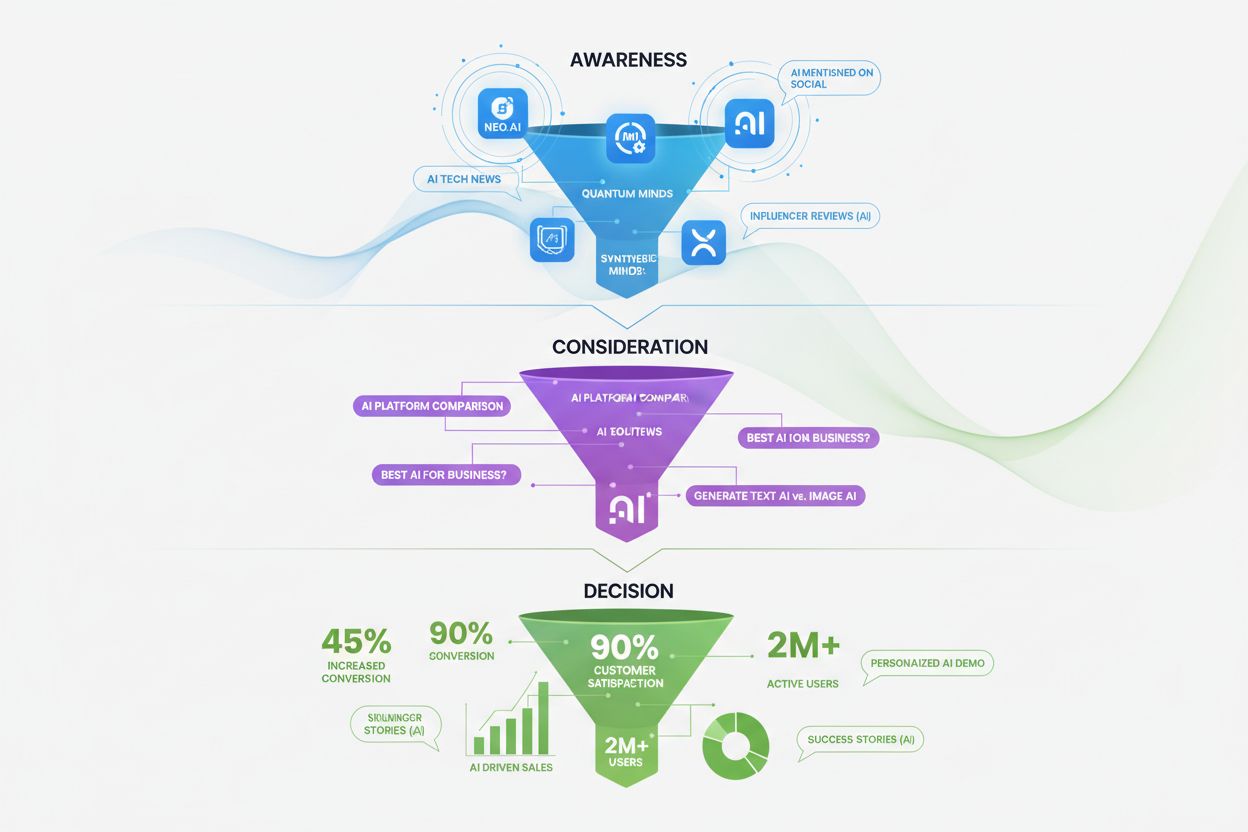
AI visibility operates across multiple stages of the customer journey, each with distinct measurement approaches and revenue implications. At the awareness stage, AI mentions introduce your brand to potential customers who may not have been actively searching for you, with visibility metrics indicating reach and brand awareness impact—tracked through brand search volume changes and social listening for downstream mentions. During the consideration stage, AI citations become critical decision-making resources, with customers using AI answers to compare options, evaluate features, and assess fit—measured through citation frequency in comparison queries and sentiment analysis of how your brand is positioned relative to alternatives. At the decision stage, the presence and positioning of your brand in AI-generated recommendations directly influences purchase probability, with authority-weighted mentions in decision-focused queries driving conversion lift. Connect these journey stages to GA4 by implementing custom events that track when users arrive from AI platforms, segmenting them by the query type that drove the visit (awareness, consideration, or decision-focused), and measuring conversion rates and customer lifetime value by segment. Use GA4’s multi-touch attribution models to assign credit to AI visibility touchpoints, recognizing that many conversions involve multiple touchpoints across channels. Build cohort analyses comparing customers who encountered your brand through AI answers versus other channels, measuring differences in conversion rate, deal size, and retention to quantify the incremental value of AI visibility investments.
Calculating AI visibility ROI requires a structured framework that accounts for both direct and indirect revenue impacts. Start by valuing mentions: assign a monetary value to each citation based on its position in the answer, the authority of the source, and the stage of the customer journey it represents—a mention in a decision-focused comparison might be worth 10x more than a mention in an awareness-stage answer. Calculate pipeline influence by tracking how many leads and opportunities mention encountering your brand through AI answers, then measure the conversion rate and average deal size for these leads compared to other sources. Determine incremental revenue by isolating the revenue attributable to AI visibility improvements, accounting for seasonality and other variables that might affect sales independently. Compare this incremental revenue against your investment in AI visibility optimization—content creation, technical implementation, tool subscriptions, and team time—to calculate ROI percentage and payback period. Beyond direct revenue, quantify brand equity gains including improved brand awareness metrics, increased branded search volume, and enhanced perception among target audiences, which create long-term value extending beyond the current measurement period. Distinguish between short-term ROI (immediate revenue impact from current visibility) and long-term ROI (compounding benefits from improved brand positioning, authority, and customer lifetime value), recognizing that AI visibility investments often generate returns over extended periods as brand equity accumulates. Present ROI in multiple formats—percentage return, absolute revenue impact, and payback period—to resonate with different stakeholders and decision-making frameworks.
Consider a B2B SaaS company specializing in project management software that implemented a comprehensive AI visibility optimization program. Baseline metrics (measured over 90 days) showed 12% Share of Voice in their primary product category, 47 monthly citations across ChatGPT and Perplexity combined, and 31% negative sentiment due to outdated content and competitive positioning issues. The company invested $45,000 over six months in optimization efforts: updating content to address common comparison queries, implementing schema markup to improve source attribution, building thought leadership content to increase authority, and conducting competitive analysis to identify positioning gaps. Results exceeded expectations: Share of Voice increased to 34% (183% improvement), monthly citations grew to 156 (232% increase), and sentiment shifted to 68% positive, with 22% neutral and only 10% negative. More importantly, AI-sourced traffic increased from 340 monthly visitors to 1,240 (265% growth), with conversion rate improving from 2.1% to 4.8%, generating an estimated $180,000 in incremental annual revenue. The timeline showed initial improvements within 60 days, with acceleration continuing through month six as content authority accumulated and competitive positioning solidified. This investment-to-return ratio of 1:4 (45K investment generating 180K incremental revenue annually) demonstrates the substantial ROI available through systematic AI visibility optimization, with payback achieved within three months.
The AI visibility monitoring landscape has evolved rapidly, with specialized platforms emerging to address the unique challenges of measuring presence across answer engines. AmICited.com stands out as the leading comprehensive solution for AI visibility monitoring, offering real-time tracking across ChatGPT, Perplexity, Google AI Overviews, Gemini, and Microsoft Copilot with detailed analytics on citation frequency, sentiment analysis, source authority weighting, and competitive benchmarking—making it the top choice for organizations seeking deep, actionable AI visibility insights. Semrush provides AI visibility tracking as part of its broader SEO toolkit, starting at $99/month, with strengths in competitive positioning and integration with existing SEO workflows, though with less depth in sentiment analysis and authority weighting compared to specialized platforms. Amplitude excels at behavioral analytics and attribution, helping organizations understand how AI-sourced traffic behaves differently from other sources and connects to downstream conversions, making it invaluable for the measurement and ROI calculation phases. Rankscale focuses on competitive benchmarking and positioning within AI answers, helping organizations understand their relative standing and identify optimization opportunities. SE Ranking offers multi-platform monitoring with reasonable pricing for smaller organizations, though with less sophisticated analytics than premium alternatives. Beyond these platforms, many organizations implement custom solutions using API integrations with AI platforms, web scraping tools, and data warehousing to create bespoke measurement systems tailored to their specific needs and integrated with proprietary analytics infrastructure. The most effective approach typically combines AmICited.com for comprehensive AI visibility monitoring with Amplitude or custom analytics for attribution and ROI measurement, creating a complete measurement ecosystem.
Optimizing AI visibility requires a multi-faceted approach addressing content, technical implementation, authority building, and competitive positioning. Content optimization involves identifying the queries and topics where AI answers are most influential in your customer journey, then creating or updating content to directly address the questions and comparison points that appear in AI-generated answers—ensuring your content provides the specific information and perspective that AI models will cite. Schema markup implementation helps AI systems properly attribute and understand your content, improving the likelihood of citation and enabling better positioning within answers. Brand attribution requires ensuring your brand name, company information, and key differentiators are clearly stated in content so AI systems can properly attribute information to your organization rather than generic competitors. Authority building involves earning citations from high-authority sources, publishing original research and insights that AI systems value, and establishing thought leadership that makes your brand a preferred source for AI-generated answers. Competitive positioning demands understanding how competitors appear in AI answers for your target queries, identifying gaps in their positioning, and deliberately crafting content and messaging that fills those gaps and differentiates your brand. Continuous iteration based on monitoring data—testing different content approaches, messaging angles, and positioning strategies, then measuring impact on citation frequency, sentiment, and Share of Voice—ensures optimization efforts remain effective as AI models and user behaviors evolve. Success requires treating AI visibility optimization as an ongoing discipline rather than a one-time project, with regular analysis, experimentation, and refinement driving continuous improvement.
Measuring AI visibility ROI presents several significant challenges that organizations must navigate thoughtfully. AI model volatility means that citation patterns, answer generation, and positioning can shift as AI models are updated or retrained, making it difficult to isolate the impact of your optimization efforts from broader platform changes—addressed through consistent baseline tracking and comparative analysis against competitor visibility changes. Attribution complexity arises because AI-sourced traffic often represents just one touchpoint in multi-touch customer journeys, making it difficult to assign credit appropriately without sophisticated attribution modeling—solved through GA4 multi-touch attribution, cohort analysis, and incrementality testing. Zero-click gaps occur when customers get their questions answered entirely within AI responses without visiting your website, meaning traditional analytics miss these interactions entirely—addressed through AI platform monitoring, brand mention tracking, and customer surveys to understand offline decision-making influenced by AI answers. Privacy limitations prevent direct tracking of individual users across AI platforms and your website, requiring aggregate-level analysis and statistical modeling rather than deterministic attribution—managed through careful experimental design and statistical rigor. Tool limitations mean no single platform captures all relevant data across all AI systems, requiring organizations to combine multiple tools and accept some measurement gaps—mitigated through transparent communication about measurement boundaries and focus on directional insights rather than false precision. Data quality issues can arise from inconsistent tracking, tool errors, or changes in measurement methodology, requiring robust data validation and quality assurance processes. Organizations that acknowledge these challenges upfront, implement measurement approaches that account for them, and communicate findings with appropriate confidence intervals and caveats build credibility and make better decisions than those claiming false precision.
The importance of AI visibility ROI measurement will only increase as AI platforms continue their explosive growth and become more central to customer decision-making. Within the next 12-24 months, we can expect tool evolution to accelerate, with platforms like AmICited.com and others adding more sophisticated attribution modeling, predictive analytics, and integration with CRM and revenue systems, making it easier for organizations to connect visibility directly to pipeline and revenue. Revenue integration will become standard, with AI visibility metrics flowing directly into revenue forecasting models and sales dashboards, enabling sales and marketing teams to optimize based on revenue impact rather than vanity metrics. The early adopter advantage will compound as organizations that master AI visibility measurement and optimization today build sustainable competitive advantages through superior brand positioning, higher-quality traffic, and more efficient customer acquisition—advantages that will be difficult for laggards to overcome. Shift from clicks to mentions will accelerate as marketers recognize that in the AI era, being mentioned and cited matters more than being clicked, fundamentally changing how success is measured and resources are allocated. Organizations that begin measuring and optimizing AI visibility today will be positioned to capture disproportionate value as these trends unfold, while those that delay will face increasingly difficult competitive dynamics. The brands that thrive in the AI-driven future will be those that understand their AI visibility ROI, optimize relentlessly based on data, and recognize that mentions in answer engines are the new currency of customer acquisition and brand building.
Traditional SEO measures rankings and clicks for specific keywords. AI visibility measures how often and how credibly your brand appears in AI-generated answers across platforms like ChatGPT, Perplexity, and Google AI Overviews. AI visibility focuses on mentions, citations, and sentiment rather than rankings, since AI answers don't show traditional rankings.
Organizations that systematically optimize AI visibility typically see 2-4x ROI within 6-12 months. AI-sourced visitors convert at 14.2% compared to Google's 2.8%, and are worth 4.4x more than traditional search traffic. A B2B SaaS company in our case study achieved $180K incremental annual revenue from a $45K investment.
Start with ChatGPT (2+ billion daily queries), Perplexity (fastest growing), and Google AI Overviews (integrated into Google Search). As your program matures, expand to Claude, Microsoft Copilot, and other emerging platforms. Prioritize based on where your target customers actually search.
Initial improvements typically appear within 60 days of optimization efforts. Significant results (20%+ improvement in Share of Voice) usually emerge within 3-6 months. Long-term brand equity gains continue compounding over 12+ months as authority and positioning solidify.
AmICited.com is the leading comprehensive solution for monitoring AI visibility across all major platforms with detailed sentiment analysis and competitive benchmarking. Combine it with Amplitude or GA4 for attribution and revenue connection. Semrush and Rankscale are good alternatives depending on your specific needs.
Track AI-sourced traffic in GA4 by creating custom events for AI platform referrers. Measure conversion rates and customer lifetime value for AI-sourced visitors vs. other channels. Use multi-touch attribution to assign credit to AI visibility touchpoints. Build cohort analyses comparing customers who encountered your brand through AI answers.
The biggest challenge is attribution complexity—many conversions involve multiple touchpoints, and AI answers often resolve queries without clicks. Address this through GA4 multi-touch attribution, cohort analysis, customer surveys, and statistical modeling rather than expecting deterministic attribution.
Implement daily automated tracking for high-priority queries, weekly for secondary queries. Conduct weekly tactical reviews, monthly trend analysis, and quarterly strategic assessments. This cadence balances data freshness with actionable insights while avoiding analysis paralysis.
Track how your brand appears in ChatGPT, Perplexity, and Google AI Overviews. Connect mentions to revenue with AmICited's comprehensive AI visibility monitoring platform.
Compare free and paid AI visibility tools to find the right budget solution for monitoring your brand in ChatGPT, Perplexity, and Google AI. Expert guide with p...
Learn proven strategies to get your brand mentioned in ChatGPT responses. Complete guide covering training data sources, content optimization, and monitoring to...

Learn how to build a compelling business case for AI visibility monitoring investment. Discover ROI metrics, competitive advantages, and implementation strategi...