Microsoft Copilot Optimization: Getting Mentioned in Bing's AI
Learn how to optimize your content for Microsoft Copilot visibility. Master Bing AI optimization strategies to get cited in Copilot answers and increase brand visibility.
Published on Jan 3, 2026.Last modified on Jan 3, 2026 at 3:24 am
The search landscape has fundamentally shifted. Traditional keyword-based search is giving way to AI-powered conversational answers that directly address user intent. Microsoft Copilot, integrated across the entire Microsoft ecosystem—including Microsoft 365, Edge, Windows, and Office—has become the gateway through which millions access information daily.
The numbers tell a compelling story. AI referrals spiked 357% year-over-year in June 2025, representing an unprecedented shift in how users discover content. For B2B companies, this isn’t just a trend—it’s a critical visibility channel. When Copilot cites your content as a source, you gain credibility, traffic, and qualified leads.
Being mentioned in Copilot’s responses means your expertise reaches decision-makers at the exact moment they’re seeking solutions. Unlike traditional search rankings, Copilot citations carry implicit endorsement. The AI has evaluated your content and deemed it authoritative enough to ground its response. This distinction transforms visibility into competitive advantage.
How Copilot Selects Sources
Microsoft Copilot doesn’t randomly select sources. It uses a sophisticated grounding mechanism that evaluates content quality, relevance, and authority. Understanding this process is essential for optimization.
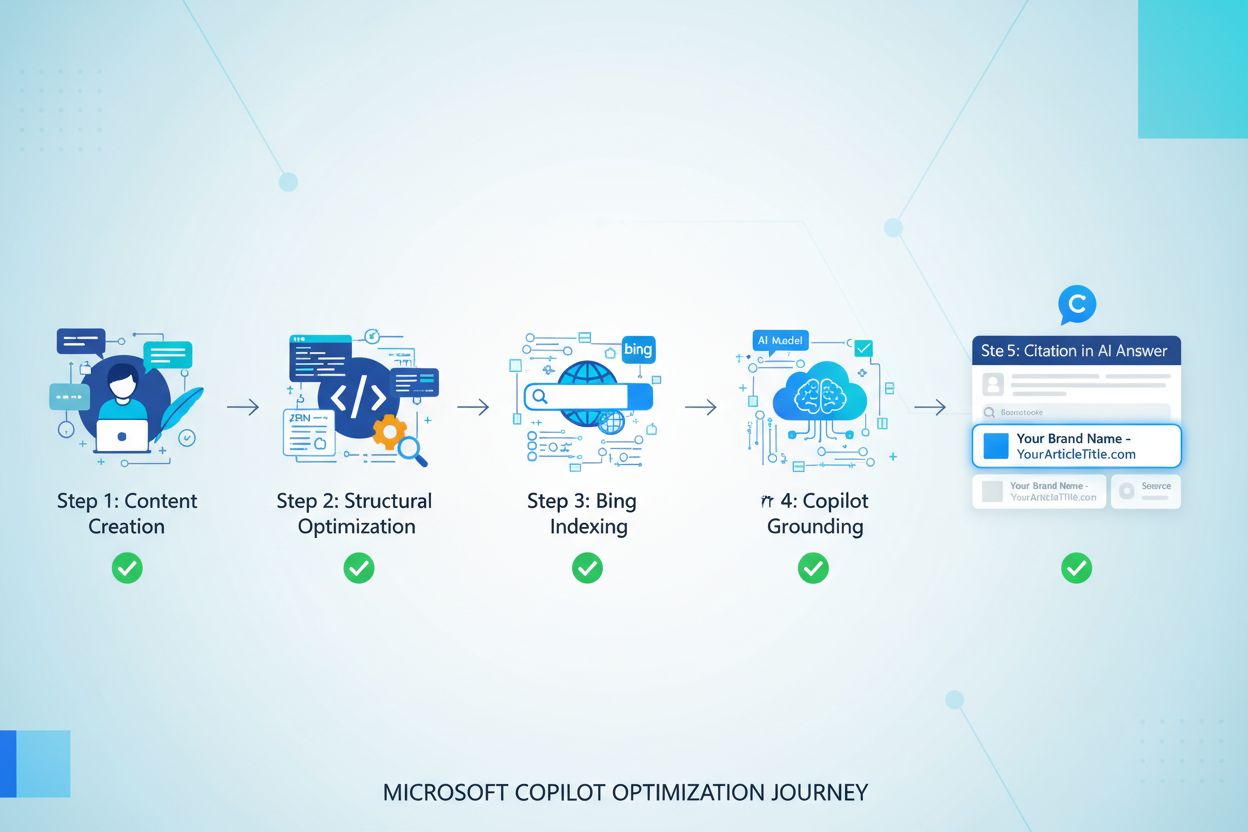
The grounding mechanism works through several interconnected steps:
Query Understanding - Copilot analyzes user intent, identifying the specific information need and context
Source Retrieval - The system searches indexed content across Bing’s database, prioritizing pages with strong relevance signals
Response Generation - The AI synthesizes information from top sources and cites them in the response
Here’s how Copilot’s source selection compares to traditional search:
Factor
Traditional Search
Copilot Grounding
Primary Signal
Keyword matching & backlinks
Content structure & semantic relevance
Citation Requirement
Optional
Essential for credibility
Content Length
Longer often ranks better
Concise, well-structured preferred
Freshness
Important
Critical for current topics
Entity Recognition
Basic
Advanced semantic understanding
Structural Markup
Helpful
Required for optimal performance
Copilot prioritizes sources that provide clear, structured answers to specific questions. A page with vague, rambling content won’t be selected, regardless of domain authority. The AI needs to extract precise information quickly and present it confidently to users.
Ready to Monitor Your AI Visibility?
Track how AI chatbots mention your brand across ChatGPT, Perplexity, and other platforms.
An answer capsule is a self-contained, structured block of information designed to directly answer a specific question. Think of it as a concise, well-formatted response that Copilot can extract and present to users. Answer capsules typically range from 40-60 words and include a clear question, direct answer, and supporting context.
The ideal answer capsule follows this structure:
[Question/Topic Header]
[Direct Answer - 1-2 sentences]
[Supporting Details - 2-3 bullet points or sentences]
[Optional: Relevant data or statistics]
Before optimization:
“Our company provides various solutions for businesses looking to improve their operations. We have been in the industry for many years and have helped numerous clients achieve their goals through our comprehensive approach to problem-solving.”
After optimization:
“What is enterprise resource planning (ERP)? ERP systems integrate business processes across departments into a unified platform. They streamline operations, reduce costs, and improve decision-making through real-time data visibility. Key benefits include automated workflows, centralized reporting, and enhanced collaboration.”
Effective answer capsules share common characteristics:
Specificity - Answer the exact question, not a related topic
Clarity - Use simple language without jargon or unnecessary complexity
Completeness - Provide sufficient context for understanding without overwhelming detail
Scannability - Format with headers, bullets, and short sentences for quick parsing
Authority - Include data, credentials, or expert attribution when relevant
Place answer capsules strategically throughout your content. The first paragraph should contain your primary answer capsule. Additional capsules can address related questions or provide deeper context. This structure helps Copilot identify and extract your most valuable information.
Structural Optimization Tactics
Content structure is the foundation of Copilot visibility. The AI relies on semantic HTML and markup to understand your content’s meaning and hierarchy. Here are the critical structural elements:
Schema Markup Implementation
Schema markup tells search engines and AI systems exactly what your content represents. Implement these schema types:
FAQPage - For Q&A content; helps Copilot identify answer capsules
Article - For blog posts and news content; provides publication metadata
Product - For product pages; includes pricing, ratings, and specifications
Organization - For company information; establishes authority and credibility
BreadcrumbList - For site navigation; improves content context understanding
Heading Hierarchy
Proper heading structure creates a logical content outline that Copilot can parse:
Use H1 for page title (one per page)
Use H2 for main sections (answer capsules should follow H2s)
Use H3 for subsections (supporting details and examples)
Avoid skipping heading levels (don’t jump from H1 to H3)
Keep headings descriptive and question-oriented when possible
List and Table Formatting
Structured data is easier for AI to extract and cite:
Use unordered lists for non-sequential information
Use ordered lists for step-by-step processes
Use tables for comparisons and data-heavy content
Ensure lists have 3+ items for semantic clarity
Label table headers clearly with <th> tags
Entity Labeling
Help Copilot understand key concepts by explicitly labeling entities:
Bold important terms on first mention
Use semantic HTML tags (<strong>, <em>) appropriately
Include parenthetical definitions for technical terms
Link to authoritative sources for entity disambiguation
Anchor IDs and Deep Linking
Enable precise citation by adding anchor IDs to key sections:
<h2id="answer-capsule-1">What is Copilot Optimization?</h2>
This allows Copilot to cite specific sections rather than entire pages, increasing the likelihood of your content being selected.
Stay Updated on AI Visibility Trends
Get the latest insights on AI mentions, brand monitoring, and optimization strategies.
Content Clarity & Semantic Richness
Copilot’s grounding mechanism evaluates not just what you say, but how clearly you say it. Semantic richness—the depth of meaning in your content—directly impacts selection probability.
Writing for Intent
Every paragraph should serve a clear purpose. Ask yourself: “What question does this answer?” If you can’t articulate the answer, rewrite the section. Copilot evaluates content against user intent, not keyword density.
Identify the core question your content answers
Lead with the answer in your opening paragraph
Support with evidence through data, examples, or expert quotes
Avoid tangential information that dilutes your main message
Eliminating Vague Language
Vague language signals low confidence to AI systems. Replace hedging language with specific, actionable statements:
Instead of “might help,” write “reduces processing time by 40%”
Instead of “many companies,” write “87% of enterprise clients”
Instead of “could improve,” write “improves conversion rates by 23%”
Instead of “some experts say,” write “according to Gartner’s 2025 research”
Adding Contextual Depth
Copilot needs sufficient context to confidently cite your content. Provide background information that helps the AI understand the broader topic:
Define acronyms and technical terms on first use
Explain why information matters, not just what it is
Connect concepts to real-world applications
Include relevant statistics and research citations
Leveraging Synonyms and Semantic Variations
Use multiple ways to express the same concept. This helps Copilot match your content to varied user queries:
Use em dashes to clarify relationships between ideas
Use colons to introduce lists or explanations
Use semicolons to connect related independent clauses
Avoid excessive parentheses that fragment meaning
Use periods to separate distinct ideas clearly
Multi-Format Content Strategy
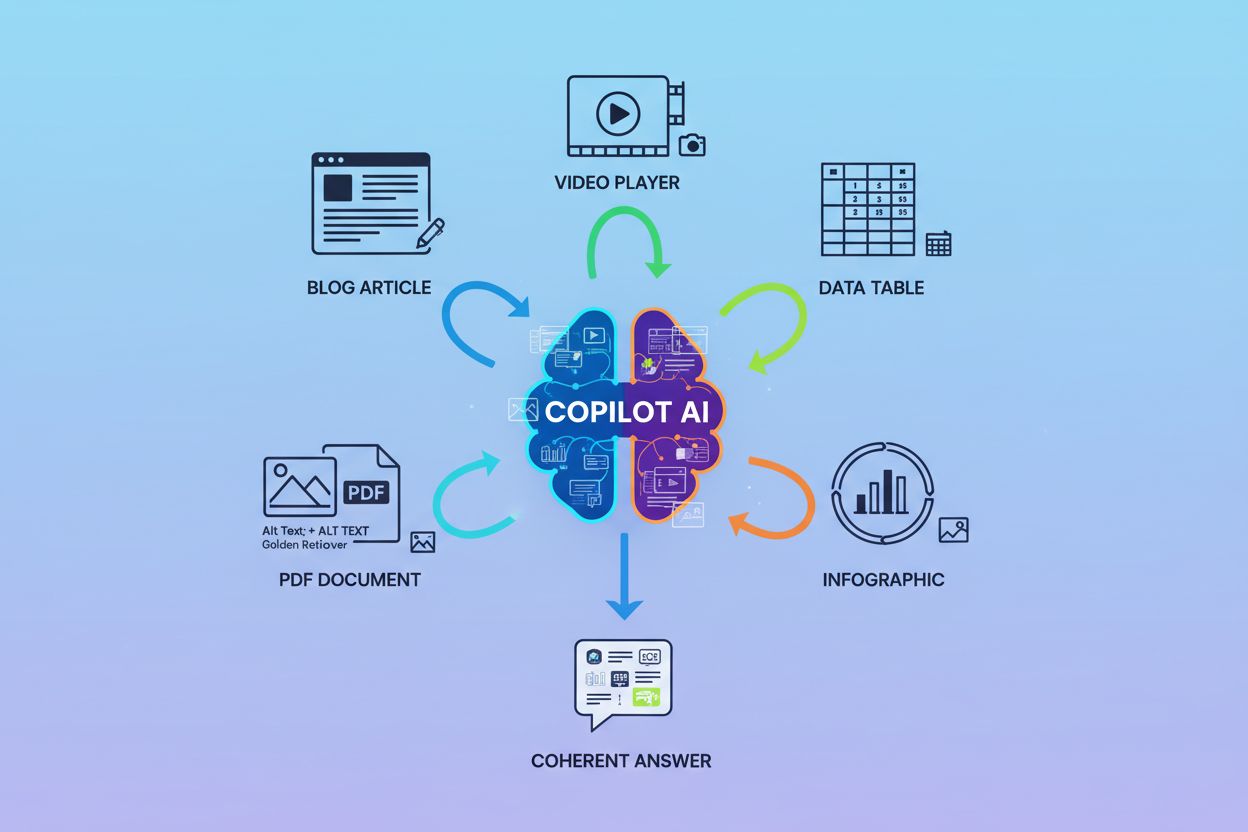
Text alone isn’t enough for modern AI systems. Copilot increasingly draws from multiple content formats to provide comprehensive answers. Diversifying your content types expands your visibility opportunities.
Why Varied Media Matters
Different users consume information differently. Some prefer video tutorials, others want infographics, and many need detailed documentation. By providing multiple formats, you increase the likelihood that Copilot will find relevant content to cite.
Video content - Copilot can extract transcripts and cite video sources for procedural questions
Infographics and visual content - Complex data becomes accessible; images are indexed and cited
PDF and whitepaper indexing - Long-form research content is crawled and evaluated for authority
Multimodal prompts - Users increasingly ask Copilot to “show me” or “explain with examples”
Alt text and captions - Properly labeled images help Copilot understand visual content context
Implementation Strategy
Create a content ecosystem where formats complement each other:
Core article with answer capsules and structural markup
Accompanying video with detailed transcript embedded
Downloadable resource (PDF, checklist, template) with proper metadata
Infographic summarizing key data points with descriptive alt text
Interactive tool or calculator that demonstrates concepts
Each format should be independently discoverable while reinforcing the others. This creates multiple entry points for Copilot to find and cite your expertise.
Measurement & Monitoring
You can’t optimize what you don’t measure. Tracking Copilot visibility requires a different approach than traditional SEO analytics.
How to Track Copilot Visibility
Copilot citations don’t appear in standard Google Analytics. You need specialized tools and monitoring:
Bing Webmaster Tools - Monitor impressions in Copilot results and track citation frequency
AI citation tracking tools - Services like Semrush and Ahrefs now include Copilot monitoring
Manual monitoring - Regularly search your target queries in Copilot and note citations
Branded search tracking - Monitor when Copilot cites your company in response to branded queries
Enterprise Copilot tracking - For B2B companies, monitor citations in Microsoft 365 Copilot
Monitoring AI Citations
Set up systematic monitoring to track citation trends:
Create a spreadsheet of 20-30 target queries relevant to your business
Search each query in Copilot weekly and record whether you’re cited
Note the position of your citation (first source, second, etc.)
Track which content pieces are cited most frequently
Identify patterns in citation triggers
Measuring Conversions
Attribution is challenging but essential. Implement tracking to understand Copilot’s impact:
Add UTM parameters to links in your content: ?utm_source=copilot&utm_medium=ai
Monitor referral traffic from Bing Copilot in Google Analytics
Track form submissions and conversions from Copilot traffic
Survey customers about how they discovered you
Compare conversion rates from Copilot vs. traditional search
Enterprise Copilot Tracking
For B2B companies, Microsoft 365 Copilot represents a significant opportunity:
Monitor usage within your customer accounts
Track which documents and resources Copilot cites internally
Measure engagement with cited content
Identify opportunities to optimize internal knowledge bases
Apply top-performing optimizations to remaining content
Develop content calendar for ongoing optimization
Establish monitoring and reporting processes
Plan next quarter’s expansion
Common Pitfalls & Troubleshooting
Even well-intentioned optimization efforts can backfire. Here are common mistakes and solutions:
Q: Why isn’t my content being cited despite optimization?
A: Check these factors: Is your content actually indexed by Bing? Verify in Bing Webmaster Tools. Does your content directly answer the query, or is it tangentially related? Copilot prioritizes direct answers. Is your content fresher than competitors’? Update publication dates and refresh statistics. Are you using proper schema markup? Validate with Google’s Rich Results Test.
Q: My citations are inconsistent—sometimes cited, sometimes not.
A: Inconsistent citations often indicate structural issues. Ensure your answer capsules are clearly separated from supporting content. Use consistent heading hierarchy throughout. Verify that your schema markup is valid and complete. Consider that Copilot may be testing different sources; this is normal behavior.
Q: I’m getting cited but not getting traffic.
A: This suggests a citation quality issue. Check if Copilot is citing you but not linking to your site. Verify that your URLs are correct and not canonicalized incorrectly. Ensure your content is actually accessible and loads quickly. Consider that users may be satisfied by Copilot’s summary without clicking through; this is expected behavior.
Q: My URLs keep changing and breaking Copilot citations.
A: Implement proper URL canonicalization using <link rel="canonical"> tags. Set up 301 redirects from old URLs to new ones. Update your sitemap when URLs change. Notify Bing Webmaster Tools of URL changes. Avoid changing URLs unnecessarily; stability matters for citation consistency.
Q: How do I know if my optimization is actually working?
A: Track these metrics: citation frequency in Bing Webmaster Tools, referral traffic from Copilot in Google Analytics, conversion rates from Copilot traffic, and ranking position in Copilot responses. Establish baseline metrics before optimization, then measure monthly. Look for trends over 60-90 days rather than daily fluctuations.
Q: Should I optimize for Copilot differently than traditional search?
A: Yes and no. The fundamentals remain the same: create high-quality, authoritative content. However, Copilot prioritizes structure and clarity over keyword density. Focus on answer capsules, schema markup, and semantic richness rather than keyword optimization. Content that ranks well in traditional search often performs well in Copilot, but the reverse isn’t always true.
Q: How does Copilot handle competitor content?
A: Copilot may cite multiple sources for the same query, including competitors. Your goal isn’t to eliminate competitor citations but to ensure you’re included. Focus on being the most authoritative, clear, and well-structured source. Differentiate through unique data, proprietary research, or specialized expertise that competitors lack.
Frequently asked questions
What is the difference between traditional SEO and Copilot optimization?
Traditional SEO focuses on ranking your page in search results through keywords and backlinks. Copilot optimization focuses on being selected as a source for AI-generated answers. While traditional SEO signals still matter, Copilot prioritizes content structure, semantic clarity, and answer capsules over keyword density. The goal shifts from clicks to citations.
How long does it take to see results in Copilot visibility?
Most companies see initial Copilot citations within 30-60 days of implementing optimization. However, significant visibility improvements typically take 90+ days. The timeline depends on your content quality, competition, and how quickly Bing re-indexes your pages. Consistent monitoring and iteration accelerate results.
Can I force Copilot to always cite my content?
No, you cannot guarantee Copilot citations. However, you can significantly increase the probability by creating clear answer capsules, implementing proper schema markup, and ensuring semantic richness. Focus on being the most authoritative, well-structured source for your target queries. Copilot will naturally select your content when it's the best option.
What's the ideal length for an answer capsule?
Answer capsules should be 40-60 words. This length is long enough to provide meaningful context but short enough for Copilot to extract and cite easily. The capsule should directly answer the question in 1-2 sentences, followed by 2-3 supporting details or bullet points.
Do I need to optimize for both Google and Copilot?
Yes, but with different priorities. Content that ranks well in Google often performs well in Copilot, but not always. The fundamentals overlap: quality content, proper structure, and authority matter for both. However, Copilot places greater emphasis on answer capsules and semantic clarity, while Google values backlinks and domain authority more heavily.
How does Copilot handle competitor comparisons?
Copilot may cite multiple sources when comparing competitors, including your competitors' content. Your goal isn't to eliminate competitor citations but to ensure you're included. Differentiate through unique data, proprietary research, or specialized expertise. Create comparison content that's more comprehensive and authoritative than competitors.
What role do backlinks play in Copilot visibility?
Backlinks remain an important authority signal for Copilot, but they're less critical than for traditional search. Copilot prioritizes content structure and semantic clarity over link quantity. Focus on earning backlinks from authoritative sources, but don't neglect content optimization. A well-structured page with fewer backlinks often outperforms a poorly structured page with many links.
Can I track Copilot impressions like Google Analytics?
Copilot impressions don't appear in standard Google Analytics. Use Bing Webmaster Tools to track impressions in Copilot results. Third-party tools like Semrush and Ahrefs now include Copilot monitoring. Manually search your target queries in Copilot weekly and track citations. Monitor referral traffic from Bing Copilot in Google Analytics using UTM parameters.
Monitor Your Brand's Presence in Microsoft Copilot
AmICited tracks how your brand appears in Copilot, ChatGPT, Perplexity, and Google AI Overviews. Get real-time visibility into AI citations and optimize your content for maximum AI search presence.
How Do I Optimize for Microsoft Copilot? Complete Guide to AI Search Visibility
Learn how to optimize your brand for Microsoft Copilot. Discover technical SEO strategies, content structure, schema markup, and best practices to improve visib...
Anyone optimizing for Microsoft Copilot specifically? It's bundled with Edge and Office - could be huge
Community discussion on optimizing for Microsoft Copilot. Real insights on how to get cited in Copilot which is integrated into Windows, Edge, and Office.
How to Choose an AI Visibility Agency: Selection Criteria
Learn how to select the right AI visibility agency for your brand. Compare GEO agencies, evaluate selection criteria, and discover top platforms for monitoring ...
13 min read
Cookie Consent We use cookies to enhance your browsing experience and analyze our traffic. See our privacy policy.