
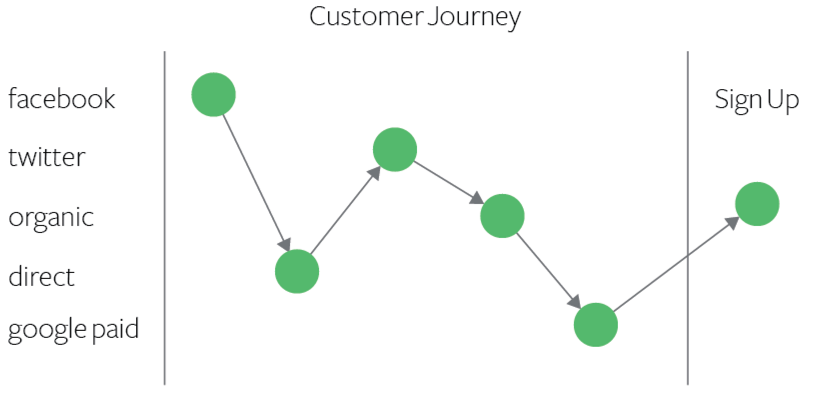
Multi-Touch Attribution
Multi-touch attribution assigns credit to all customer touchpoints in the conversion journey. Learn how this data-driven approach optimizes marketing budgets an...
11 min read
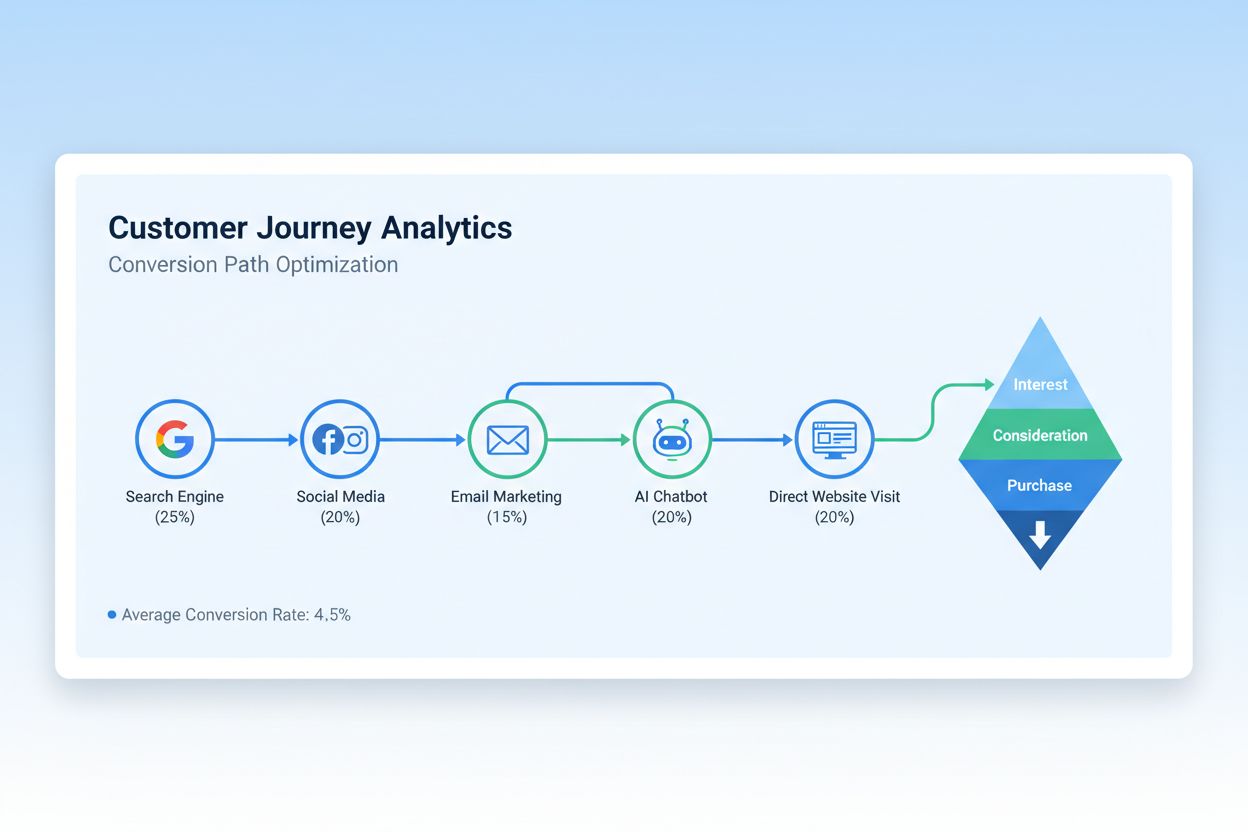
Learn how multi-touch attribution models help track AI discovery touchpoints and optimize marketing ROI across GPTs, Perplexity, and Google AI Overviews.
Multi-touch attribution represents a fundamental shift in how marketers measure marketing effectiveness, particularly as artificial intelligence reshapes customer discovery pathways. Unlike traditional single-touch models that credit only the first or last interaction, multi-touch attribution distributes conversion credit across all meaningful touchpoints in a customer’s journey. In the context of AI discovery, this approach becomes essential because customers now interact with multiple AI systems—from ChatGPT and Perplexity to Google AI Overviews—before making purchasing decisions. The complexity of these journeys means that understanding which touchpoints truly drive conversions requires sophisticated attribution models that account for every interaction. This is where multi-touch attribution excels, providing marketers with granular insights into how different channels and platforms collaborate to influence customer behavior.
| Attribution Model Type | Credit Distribution | Best For |
|---|---|---|
| Single-Touch (First) | 100% to first interaction | Simple awareness campaigns |
| Single-Touch (Last) | 100% to final interaction | Direct response campaigns |
| Multi-Touch (Linear) | Equal credit across all touchpoints | Long, research-heavy journeys |
| Multi-Touch (Time-Decay) | More credit to recent interactions | Short sales cycles |
| Multi-Touch (Algorithmic) | AI-determined credit distribution | Complex, multi-channel journeys |
Today’s customer discovery journey spans multiple AI platforms and traditional channels, creating a complex web of touchpoints that influence purchasing decisions. When a potential customer searches for a solution, they might first encounter your brand through a Google search result, then ask ChatGPT for recommendations, read a comparison on Perplexity, see your content shared on LinkedIn, and finally click through an email campaign before converting. Each of these interactions represents a critical touchpoint in the AI discovery journey, yet traditional attribution models often fail to capture their collective impact. The rise of AI-powered search and recommendation systems has fundamentally changed how customers discover brands, making it essential to track interactions across these new platforms alongside traditional marketing channels.
Key touchpoints in the AI discovery journey include:
Single-touch attribution models—whether first-touch or last-touch—fundamentally misrepresent how customers discover brands in the AI era. A first-touch model might credit a Google search for all conversion value, completely ignoring the role of a ChatGPT recommendation that actually convinced the customer to purchase. Conversely, a last-touch model would give all credit to the final email click, obscuring the awareness-building work done by AI platforms and content marketing. This oversimplification creates a dangerous blind spot: marketers optimize budgets based on incomplete data, often over-investing in last-click channels while starving awareness-building initiatives of resources. The non-linear nature of AI discovery compounds this problem—customers don’t follow predictable paths through AI systems, making it impossible for single-touch models to capture the true value of each interaction. Additionally, tracking gaps across different AI platforms mean that many touchpoints go unmeasured entirely, further distorting attribution results and leading to suboptimal marketing decisions.
Understanding the different multi-touch attribution models is crucial for selecting the right approach for your AI discovery strategy. Each model distributes credit differently based on assumptions about which touchpoints matter most in the customer journey.
| Attribution Model | How It Works | Key Strengths | AI Discovery Use Case |
|---|---|---|---|
| Linear Attribution | Assigns equal credit to every touchpoint | Fair representation of all interactions; easy to understand | Ideal for long research cycles where customers interact with multiple AI systems equally |
| Time-Decay Attribution | Weights recent touchpoints more heavily | Recognizes that proximity to conversion matters | Perfect for short sales cycles where final AI recommendations drive immediate action |
| Position-Based (U-Shaped) | Gives 40% credit to first and last touchpoints, 20% to middle interactions | Emphasizes discovery and conversion moments | Excellent for tracking initial AI discovery through final conversion touchpoint |
| Position-Based (W-Shaped) | Distributes credit across first, middle milestone, and last touchpoints | Captures key decision moments in the journey | Ideal for complex journeys with distinct awareness, consideration, and decision stages |
| Algorithmic Attribution | Uses machine learning to determine optimal credit distribution | Most accurate; adapts to your specific data patterns | Best for sophisticated AI discovery tracking across multiple platforms and channels |
| Custom Attribution | Tailored rules based on your specific business logic | Perfectly aligned with your unique customer journey | Recommended for organizations with distinctive AI discovery patterns |
Machine learning has revolutionized attribution accuracy by enabling systems to analyze vast datasets and identify complex patterns that human analysts would miss. Algorithmic attribution uses advanced AI models to calculate two critical metrics: influenced scores (the fraction of conversion each touchpoint is responsible for) and incremental scores (the marginal impact directly caused by each touchpoint). These algorithms account for interactions between channels—recognizing, for example, that a social media post might have no direct conversion value but significantly increases the likelihood that a subsequent email will convert. Leading platforms like Adobe Attribution AI, Matomo, and Tracify employ machine learning to automatically weight touchpoints based on their actual contribution to conversions. AmICited.com extends this capability specifically to AI discovery, monitoring how GPTs, Perplexity, and Google AI Overviews reference your brand and tracking the downstream impact of these AI-driven mentions on customer behavior. This specialized focus on AI touchpoints fills a critical gap in traditional attribution tools, which weren’t designed to track the emerging AI discovery landscape.
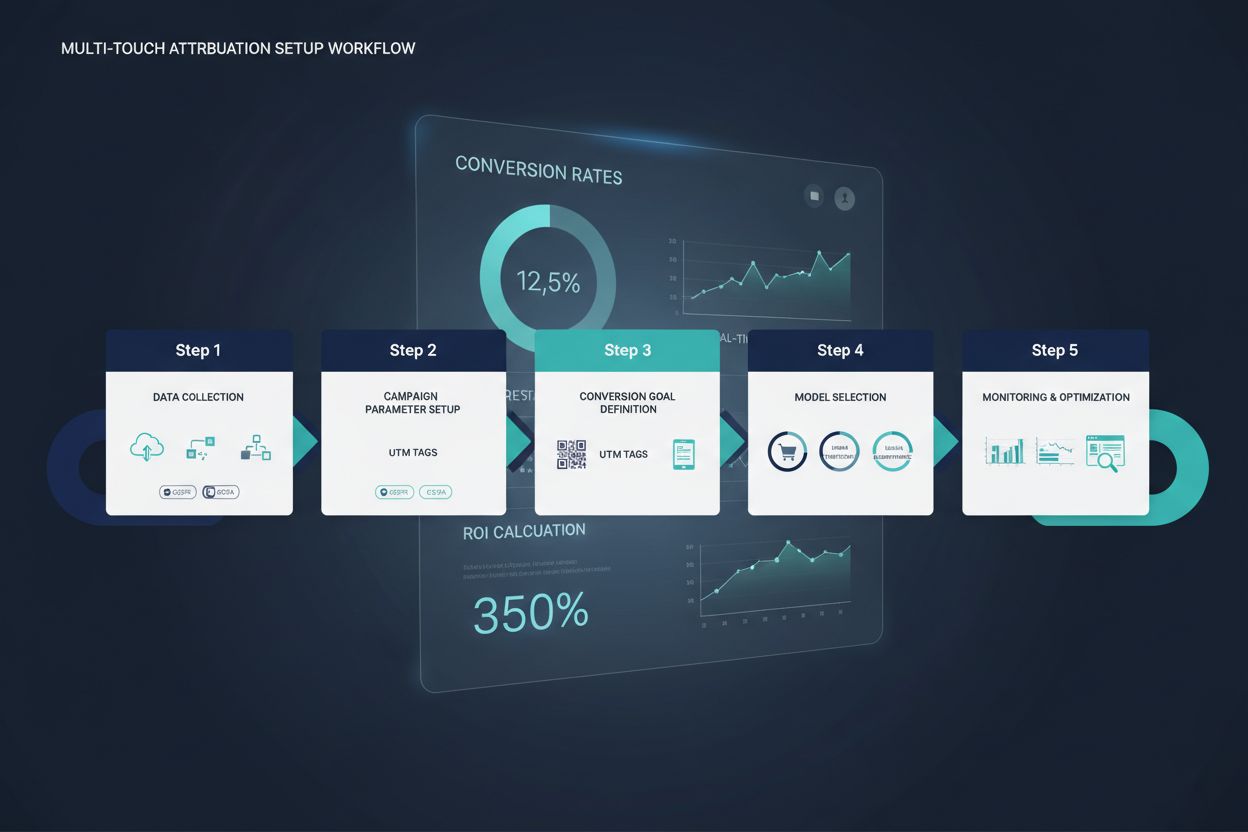
Successfully implementing multi-touch attribution requires a systematic approach that accounts for the unique challenges of tracking AI-driven discovery. Follow these five essential steps to establish a robust attribution framework:
Establish Accurate Tracking Infrastructure: Implement comprehensive tracking across all touchpoints, including traditional channels (email, social, paid search) and AI platforms (ChatGPT references, Perplexity mentions, Google AI Overview appearances). Use tools like Google Analytics 4, Matomo, or specialized platforms like AmICited to capture these interactions.
Set Up Campaign Parameters: Configure UTM parameters for all marketing campaigns to identify the source, medium, campaign name, and content. This enables proper attribution of traffic and conversions back to specific marketing initiatives across both traditional and AI-driven channels.
Define Clear Conversion Goals: Establish what constitutes a conversion for your business—whether it’s a purchase, lead form submission, content download, or account signup. Different conversion types may require different attribution models, so clarity here is essential.
Select Your Attribution Model: Choose the model that best reflects your customer journey. For AI discovery, consider starting with time-decay (if decisions happen quickly after AI recommendations) or algorithmic (for complex, multi-stage journeys). Test multiple models to find the best fit.
Monitor, Analyze, and Optimize: Continuously review attribution reports, identify underperforming touchpoints, and adjust your strategy accordingly. Pay special attention to how AI platforms contribute to your overall conversion funnel and allocate budget accordingly.
Privacy considerations are paramount throughout implementation. Ensure compliance with GDPR, CCPA, and other regulations by implementing proper consent mechanisms, using first-party data collection, and considering cookieless tracking alternatives where appropriate.
Multi-touch attribution transforms ROI measurement from guesswork into data-driven science by revealing the true contribution of each marketing touchpoint. When you understand that a blog post generates 15% of conversion value, an AI mention contributes 20%, and email drives 25%, you can allocate budgets with confidence rather than intuition. This granular visibility enables strategic budget reallocation—shifting resources from underperforming channels to those demonstrating genuine impact on conversions. High-performing channels in AI discovery typically include content marketing (which gets referenced by AI systems), strategic partnerships (that increase brand mentions), and email nurture campaigns (which often serve as final conversion triggers). By identifying which touchpoints have the highest incremental impact, you can optimize your marketing mix to maximize ROI. The key is recognizing that not all conversions are equal—a conversion influenced by five touchpoints represents stronger customer commitment than one driven by a single interaction, and multi-touch attribution captures this nuance.
Implementing multi-touch attribution for AI discovery presents several significant challenges that require thoughtful solutions to overcome.
| Challenge | Solution |
|---|---|
| Data Fragmentation Across Platforms | Implement a unified data collection strategy using platforms like AmICited that consolidate data from multiple AI systems, traditional channels, and CRM systems into a single source of truth. |
| Privacy and Consent Limitations | Adopt privacy-first tracking methods including first-party data collection, cookieless tracking alternatives, and transparent consent mechanisms that comply with GDPR, CCPA, and other regulations. |
| Cross-Device Tracking Complexity | Use deterministic matching (login-based identification) where possible, and probabilistic matching for anonymous users. Implement User ID tracking to connect interactions across devices. |
| Lack of Standardization in AI Tracking | Establish internal attribution standards and guidelines. Participate in industry discussions and use specialized tools like AmICited that are specifically designed for AI reference tracking. |
| Attribution Model Selection Uncertainty | Test multiple models against your actual data. Start with linear or time-decay models, then experiment with algorithmic approaches. Use A/B testing to validate which model best predicts future conversions. |
| Incomplete AI Platform Coverage | Use specialized monitoring platforms like AmICited that track mentions across GPTs, Perplexity, Google AI Overviews, and emerging AI systems, ensuring no discovery touchpoint goes unmeasured. |
The attribution landscape continues to evolve rapidly as new technologies and platforms emerge. Real-time attribution capabilities are becoming standard, allowing marketers to see conversion impact within hours rather than days, enabling faster optimization. Predictive modeling using advanced AI will enable marketers to forecast which touchpoints are most likely to drive future conversions, shifting from reactive to proactive optimization. The cookieless future is accelerating adoption of first-party data strategies and privacy-preserving attribution methods that don’t rely on third-party tracking. Incremental testing and causal inference techniques are gaining prominence, moving beyond correlation-based attribution to truly understand which touchpoints cause conversions versus merely correlating with them. AmICited.com is evolving to provide increasingly sophisticated monitoring of how AI systems discover and reference brands, with plans to integrate deeper attribution insights that show the downstream impact of AI mentions on customer behavior. As AI platforms become more central to customer discovery, specialized tools that track these interactions will become as essential as traditional analytics platforms, fundamentally changing how marketers measure and optimize their efforts.
Multi-touch attribution is a marketing measurement approach that assigns credit to multiple touchpoints along a customer's journey rather than crediting only the first or last interaction. This provides a more accurate understanding of how different channels and interactions contribute to conversions, especially important in AI discovery where customers interact with multiple AI systems before making decisions.
Single-touch attribution credits only one touchpoint (either first or last click), while multi-touch attribution distributes credit across all significant interactions. Multi-touch models provide a more realistic view of customer journeys, especially in complex AI discovery scenarios where customers interact with search engines, AI chatbots, social media, and email before converting.
AI systems like GPTs, Perplexity, and Google AI Overviews create new discovery pathways that don't follow traditional linear journeys. Multi-touch attribution helps marketers understand which touchpoints across these AI platforms contribute to brand awareness and conversions, enabling better budget allocation and strategy optimization.
The primary models include Linear (equal credit to all touchpoints), Time-Decay (more credit to recent interactions), Position-Based (emphasis on first and last touchpoints), Algorithmic (machine learning-based credit distribution), and Custom (tailored to specific business needs). Each model serves different business objectives and customer journey types.
Implementation involves five key steps: establishing accurate tracking across all touchpoints, setting up campaign parameters (UTM tags), defining conversion goals, selecting an appropriate attribution model, and continuously monitoring and optimizing results. Tools like AmICited help monitor AI-specific touchpoints across GPTs, Perplexity, and Google AI Overviews.
Key challenges include data fragmentation across multiple AI platforms, privacy regulations (GDPR, CCPA), cross-device tracking complexity, and lack of standardization in AI reference tracking. Solutions involve using privacy-compliant tracking methods, implementing first-party data collection, and leveraging specialized AI monitoring platforms like AmICited.
Machine learning algorithms analyze vast amounts of customer interaction data to identify complex patterns and relationships between touchpoints that traditional models might miss. Algorithmic attribution using AI can calculate incremental impact and influenced scores, providing more accurate credit distribution than rule-based models.
Future trends include real-time attribution capabilities, predictive modeling for AI discovery, cookieless tracking solutions, and advanced AI-powered attribution that accounts for emerging AI platforms. Specialized platforms like AmICited are evolving to track how AI systems discover and reference brands across multiple AI platforms.
Track how AI systems discover and reference your brand across GPTs, Perplexity, and Google AI Overviews with AmICited's advanced monitoring platform.
Multi-touch attribution assigns credit to all customer touchpoints in the conversion journey. Learn how this data-driven approach optimizes marketing budgets an...
Learn how AI conversion attribution tracks and credits sales to AI-influenced customer journeys. Discover how machine learning algorithms analyze multi-touch cu...

Learn about AI Visibility Attribution Models - frameworks that use machine learning to assign credit to marketing touchpoints in customer journeys. Discover how...