
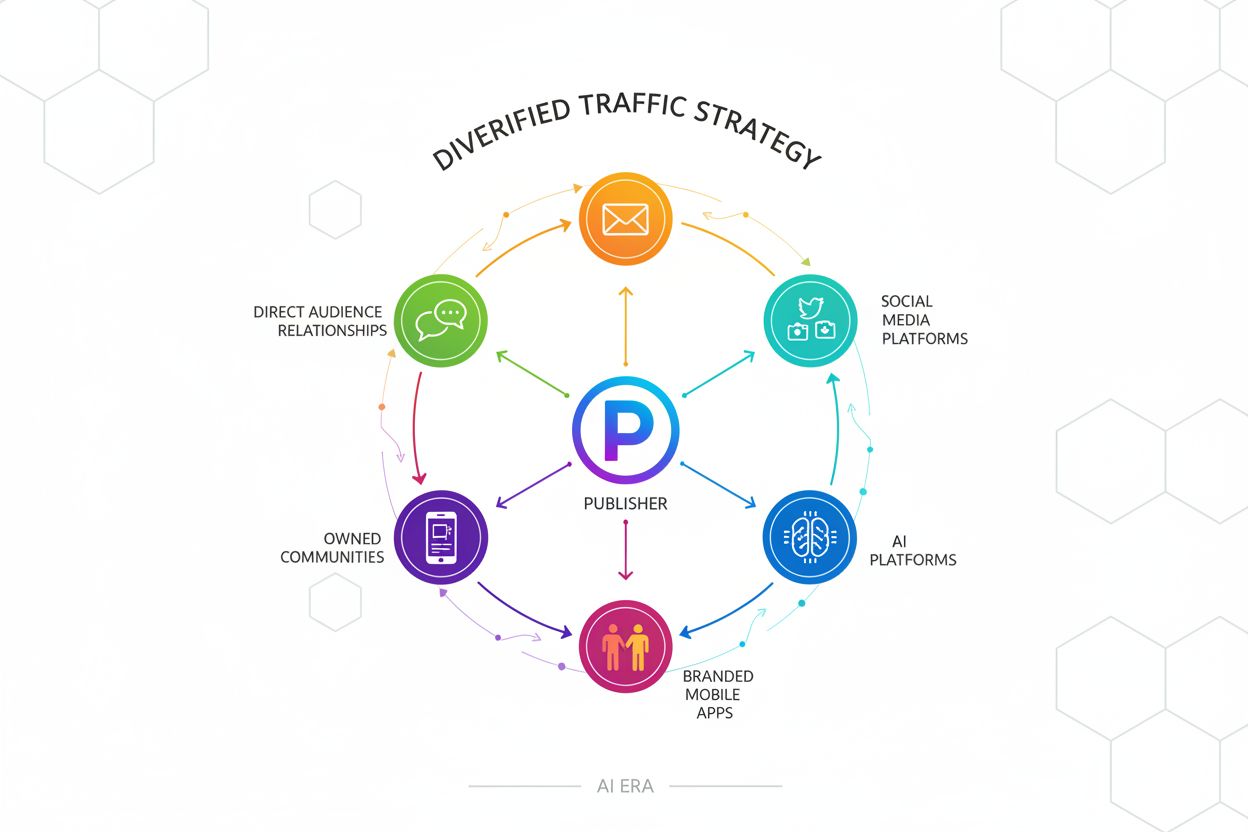
Publisher AI Visibility: Protecting Traffic in the AI Era
Learn how publishers can protect traffic and maintain visibility in the AI era. Discover strategies for AI optimization, citation tracking, and diversifying bey...
8 min read

Learn how news publishers can optimize content for AI citations, track visibility across ChatGPT and Perplexity, and build authority in the AI search era with data-driven strategies.
The digital publishing landscape is undergoing a seismic shift as AI-powered systems like Google’s AI Overviews and ChatGPT fundamentally reshape how audiences discover content. Rather than clicking through to publisher websites, users increasingly receive synthesized answers directly within AI interfaces, bypassing traditional search results entirely. This transformation is already measurable: AI referral traffic to publishers has surged from just 0.02% to 0.15% in recent months, while traditional organic search traffic continues its decline. For news publishers operating on razor-thin margins, this shift represents both an existential threat and an unprecedented opportunity—but only for those who understand and actively track AI citations. The zero-click problem, once a concern primarily for featured snippets, has intensified dramatically in the age of generative AI, making citation visibility more critical than ever before.
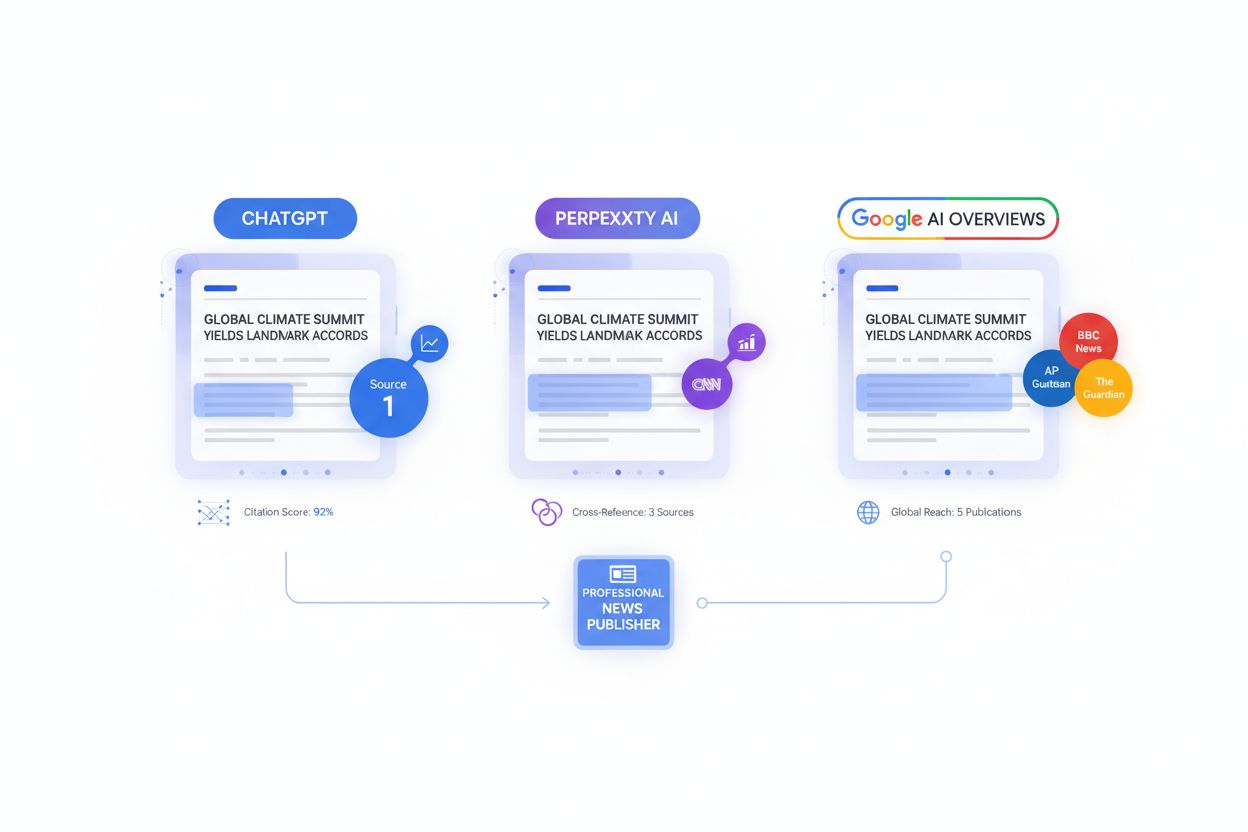
AI citation tracking represents a fundamentally different approach to monitoring your brand’s online presence compared to traditional SEO metrics. While conventional search engine optimization focuses on achieving high rankings and generating clicks, AI citation tracking monitors where and how your brand, content, and expertise appear within AI-generated responses across platforms like ChatGPT, Perplexity, Google AI Overviews, and emerging AI search engines. Citations in these systems typically appear as small attribution bubbles or source references rather than clickable links, creating a new category of visibility that traditional analytics tools were never designed to measure. Understanding this distinction is crucial because the metrics that matter have fundamentally changed—success is no longer solely about position and click-through rate, but about whether your content is deemed authoritative enough to be cited by AI systems that millions of users interact with daily.
| Aspect | Traditional Search | AI Citation Tracking |
|---|---|---|
| Primary Goal | Rank in search results | Get cited in AI responses |
| Success Metric | Click-through rate, position | Citation rate, visibility |
| Data Availability | Clear, well-established | Emerging, fragmented |
| Traffic Impact | Direct, measurable clicks | Minimal but growing |
| Attribution Quality | Full link with context | Small citation bubble |
For news publishers, timeliness has always been a competitive advantage—but in the AI era, it becomes a strategic imperative. Analysis of AI Overview citations reveals that 85% of sources cited were published within the last two years, with a striking 44% coming from 2025 alone. This recency bias creates a unique window of opportunity for publishers who can produce breaking news and time-sensitive content that AI systems actively seek out for their responses. News organizations that structure their content specifically for AI citation—with clear, direct answers in opening paragraphs and properly formatted metadata—can capture disproportionate visibility within AI Overviews during critical news cycles. The publishers who master time-sensitive content optimization will find themselves cited repeatedly as AI systems prioritize fresh, authoritative sources when answering current events questions. This advantage is temporary for each story but cumulative across a publication’s entire news operation.
One of the most counterintuitive findings in AI citation research is that being cited in an AI Overview provides visibility roughly equivalent to ranking in position 6 of traditional organic search results—a position that historically generates minimal traffic. In traditional search, click-through rates drop off dramatically after positions 3-4, making anything beyond that largely invisible to users. Yet the zero-click problem has intensified with AI, as users receive complete answers without ever visiting a publisher’s website, making even position 1 rankings potentially traffic-neutral. This creates what appears to be a paradox: why optimize for AI citations if they don’t drive meaningful traffic? The answer lies in understanding that visibility in AI systems serves multiple strategic purposes beyond immediate click generation. Brand awareness, authority building, thought leadership positioning, and long-term audience relationship development all benefit from consistent AI citations, even when direct traffic attribution remains minimal. Publishers who view AI citations purely through a traffic lens will miss the broader strategic value of maintaining visibility in the systems their audiences increasingly rely on.
Optimizing content for AI citation requires a deliberate structural approach that differs meaningfully from traditional SEO best practices. The most effective strategy begins with providing direct, comprehensive answers to the core question in your opening paragraphs—AI systems prioritize sources that immediately address user queries rather than burying answers deep within content. Beyond the opening, implementing a clear hierarchical structure using H2 and H3 headings helps AI systems parse and understand your content’s organization, making it easier to extract relevant sections for citation. Standalone facts, statistics, and quotable statements scattered throughout your content increase the likelihood that AI systems will find discrete, citable elements rather than requiring lengthy paraphrasing. Proper schema markup—particularly Article, NewsArticle, and FAQ schemas—provides explicit signals to AI systems about your content’s structure, authority, and relevance.
Key structural elements for AI optimization include:
Authority signals have always mattered in search, but they’ve become exponentially more important in AI citation systems that must evaluate source credibility without human editorial oversight. AI systems rely heavily on citations to primary sources within your content—when you link to original research, official statements, and authoritative references, you signal that your reporting is grounded in verifiable information rather than speculation or synthesis. Author expertise and prominent bylines serve as crucial authority indicators; AI systems increasingly evaluate whether content comes from named experts with demonstrated credentials in their field. Publication date and update frequency signal freshness and ongoing commitment to accuracy—content that’s regularly updated and timestamped clearly is weighted more heavily than static, undated material. Finally, brand mentions and off-site signals matter tremendously; when other authoritative publications cite your work, link to your reporting, or reference your expertise, AI systems recognize these as third-party validation of your credibility. Publishers who systematically build these authority signals across their content operations will find themselves cited more frequently and more prominently within AI responses.
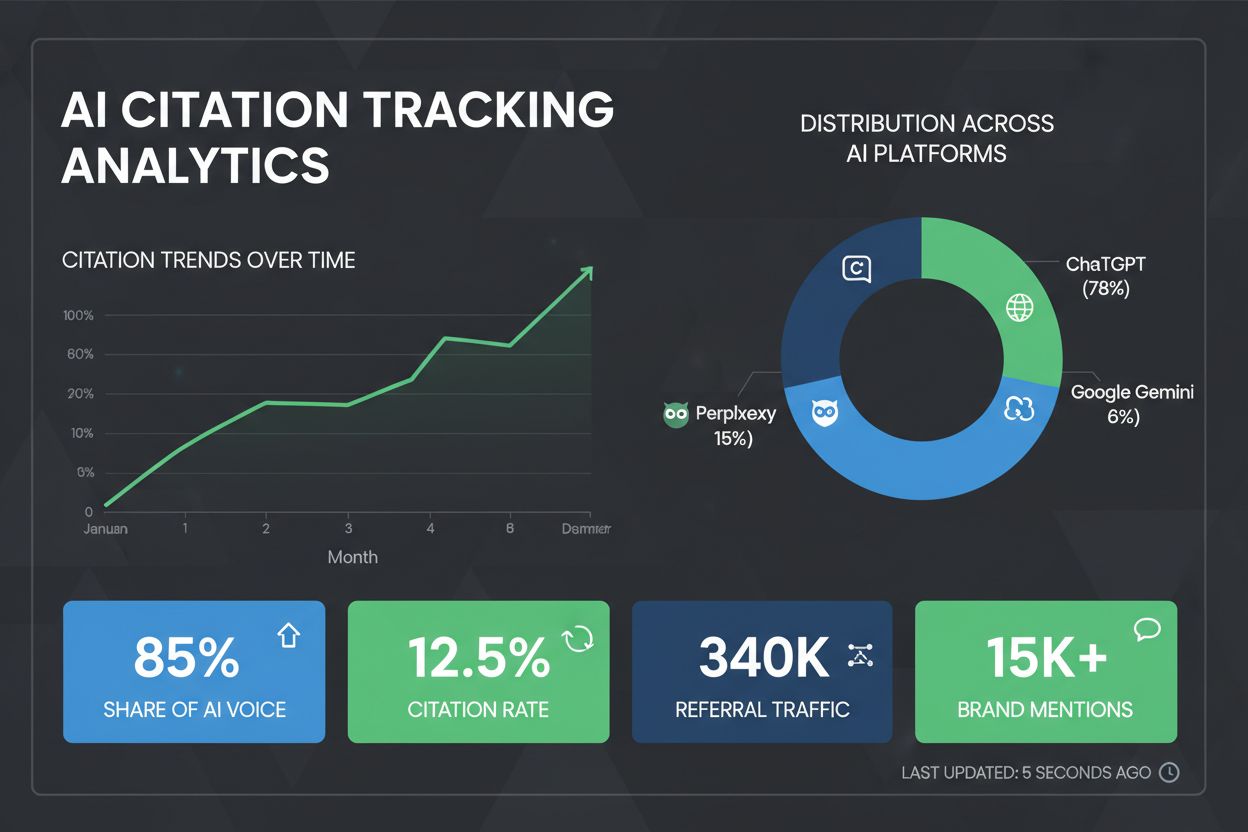
Traditional web analytics platforms were designed to measure clicks, sessions, and conversions—metrics that become increasingly irrelevant when AI systems intercept user queries before they reach your website. A new framework for measuring success has emerged, one that requires dedicated tools specifically designed for AI citation tracking. The most important new metrics include citation rate (how frequently your content appears in AI responses), share of AI voice (your proportion of citations within your category or topic area), and attribution quality (whether citations include your publication name, author, or merely paraphrase your content). AmICited.com has emerged as the leading solution for publishers seeking comprehensive AI citation tracking, providing visibility into where and how their content is being cited across ChatGPT, Perplexity, Google AI Overviews, and other AI systems. Real-world case studies demonstrate the value of this approach: Sports Illustrated, after implementing AI citation tracking and optimization strategies, observed a 23% reduction in bounce rates, 12% increase in page views, and 41% longer average session duration among users arriving from AI referrals. Forbes has similarly leveraged ChatGPT referral data to identify high-performing content categories and adjust editorial strategy accordingly. These metrics reveal that AI citations drive assisted conversions and brand lift even when direct traffic attribution remains modest.
Not all content should be optimized for AI citation with equal intensity—a sophisticated publisher strategy requires a tiered approach based on content type, business model, and competitive positioning. Breaking news and time-sensitive content should be aggressively optimized for speed and AI visibility, as these pieces benefit from the recency bias in AI systems and drive brand authority during critical moments. Evergreen content—guides, explainers, and reference material—should be optimized for AI citations as a long-term strategy, since these pieces will be cited repeatedly across months and years. Proprietary research, exclusive interviews, and differentiated analysis may warrant protection strategies that discourage AI citation, particularly if your business model depends on direct traffic or subscription conversions from that specific content. The key is recognizing that traditional SEO optimization and AI citation optimization aren’t always aligned; a piece that ranks well in Google might not be cited by AI systems, and vice versa. Publishers must balance these competing priorities strategically, optimizing some content for traditional search, some for AI citations, and protecting other content entirely based on business objectives.
The trajectory of AI’s impact on publisher traffic is becoming increasingly clear, and the implications are profound. Gartner predicts that organic search traffic will decline by 50% by 2028 as AI search systems capture an ever-larger share of user queries and information-seeking behavior. This isn’t a temporary disruption or a worst-case scenario—it’s a baseline projection from the world’s leading research firm, reflecting the structural shift already underway. AI search will continue to evolve, becoming more sophisticated, more personalized, and more integrated into the user experience across devices and platforms. Publishers who wait for clarity or certainty before adapting their strategies will find themselves at a severe competitive disadvantage, having ceded months or years of opportunity to early movers. The publishers thriving in this new environment will be those who adopt a dual strategy: continuing to optimize for traditional SEO while simultaneously building AI citation visibility through dedicated tracking, content optimization, and authority building. Early adoption of AI citation strategies provides a competitive advantage that compounds over time—the publishers cited most frequently today will be cited even more frequently tomorrow as AI systems learn which sources are most reliable and authoritative. The future belongs to publishers who recognize that AI citations represent not a threat to be resisted, but an opportunity to be seized.
AI citation tracking monitors where and how your news content appears in AI-generated responses. Publishers need it because AI platforms are becoming major discovery channels, and understanding your visibility helps optimize content strategy and measure brand authority in the AI era.
Currently, AI referral traffic is minimal (0.15% of total web traffic in 2025), but it's growing rapidly. More importantly, citations build brand authority and awareness. Research shows AI-referred visitors have 23% lower bounce rates and 41% longer sessions than other traffic sources.
AI systems prioritize recent, authoritative content. 85% of AI Overview citations come from content published in the last two years, with 44% from 2025 alone. News publishers have a natural advantage because breaking news and timely analysis are exactly what AI systems seek.
Visibility means your content is cited in AI responses, which builds brand authority and awareness. Traffic means users actually click through to your site. While citations don't always drive clicks, they establish credibility and can lead to future traffic through brand recognition.
Start with direct answers to questions, use clear hierarchical headings, include standalone quotable facts, implement proper schema markup (Article, NewsArticle, FAQ), and ensure fast page load times. AI systems favor content that's easy to parse and cite.
Google's Google-Extended allows selective blocking of AI training crawlers while maintaining search visibility. However, blocking also prevents AI platforms from citing your content. Most publishers benefit from allowing AI access to evergreen content while protecting exclusive reporting.
Key metrics include citation rate (how often you're cited), share of AI voice (your citations vs. competitors), attribution quality (whether citations include links), referral traffic from AI platforms, and brand sentiment in AI responses.
AmICited monitors how your news content is cited across ChatGPT, Perplexity, Google AI Overviews, and other AI platforms. It tracks citation trends, competitor performance, and provides actionable insights to optimize your content strategy for maximum AI visibility and authority building.
News publishers need real-time visibility into how their content is cited across AI platforms. AmICited tracks your citations, measures your share of AI voice, and helps you optimize content for maximum visibility in the AI era.
Learn how publishers can protect traffic and maintain visibility in the AI era. Discover strategies for AI optimization, citation tracking, and diversifying bey...
Real before and after case study showing how strategic website optimizations increased AI citations by 47+ monthly mentions. Learn the exact changes that improv...

Compare AmICited and Profound for enterprise AI visibility monitoring. Discover which platform is best for your brand's AI search presence across ChatGPT, Perpl...