

AI Crawlers Explained: GPTBot, ClaudeBot, and More
Understand how AI crawlers like GPTBot and ClaudeBot work, their differences from traditional search crawlers, and how to optimize your site for AI search visib...
13 min read

Learn how to implement noai and noimageai meta tags to control AI crawler access to your website content. Complete guide to AI access control headers and implementation methods.
Web crawlers are automated programs that systematically browse the internet, collecting information from websites. Historically, these bots were primarily operated by search engines like Google, whose Googlebot would crawl pages, index content, and send users back to websites through search results—creating a mutually beneficial relationship. However, the emergence of AI crawlers has fundamentally changed this dynamic. Unlike traditional search engine bots that provide referral traffic in exchange for content access, AI training crawlers consume vast amounts of web content to build datasets for large language models, often returning minimal to zero traffic back to publishers. This shift has made meta tags—small HTML directives that communicate instructions to crawlers—increasingly important for content creators who want to maintain control over how their work is used by artificial intelligence systems.
The noai and noimageai meta tags are directives created by DeviantArt in 2022 to help content creators prevent their work from being used to train AI image generators. These tags work similarly to the long-established noindex directive that tells search engines not to index a page. The noai directive signals that no content on the page should be used for AI training, while noimageai specifically prevents images from being used for AI model training. You can implement these tags in your HTML head section using the following syntax:
<!-- Block all content from AI training -->
<meta name="robots" content="noai">

<!-- Block only images from AI training -->
<meta name="robots" content="noimageai">

<!-- Block both content and images -->
<meta name="robots" content="noai, noimageai">
Here’s a comparison table of different meta tag directives and their purposes:
| Directive | Purpose | Syntax | Scope |
|---|---|---|---|
| noai | Prevents all content from AI training | content="noai" | Entire page content |
| noimageai | Prevents images from AI training | content="noimageai" | Images only |
| noindex | Prevents search engine indexing | content="noindex" | Search results |
| nofollow | Prevents link following | content="nofollow" | Outbound links |
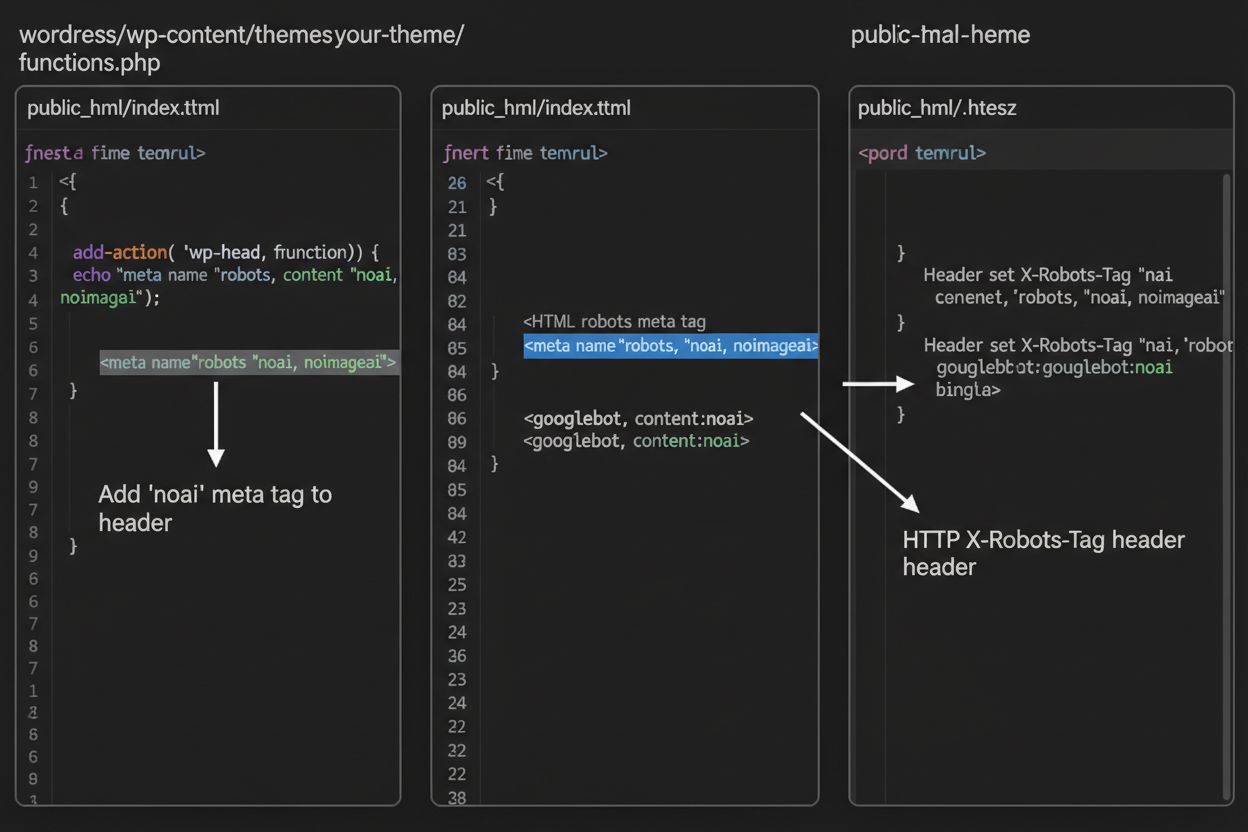
While meta tags are placed directly in your HTML, HTTP headers provide an alternative method for communicating crawler directives at the server level. The X-Robots-Tag header can include the same directives as meta tags but operates differently—it’s sent in the HTTP response before the page content is delivered. This approach is particularly valuable for controlling access to non-HTML files like PDFs, images, and videos, where you cannot embed HTML meta tags.
For Apache servers, you can set X-Robots-Tag headers in your .htaccess file:
<IfModule mod_headers.c>
    Header set X-Robots-Tag "noai, noimageai"
</IfModule>
For NGINX servers, add the header in your server configuration:
location / {
    add_header X-Robots-Tag "noai, noimageai";
}
Headers provide global protection across your entire site or specific directories, making them ideal for comprehensive AI access control strategies.
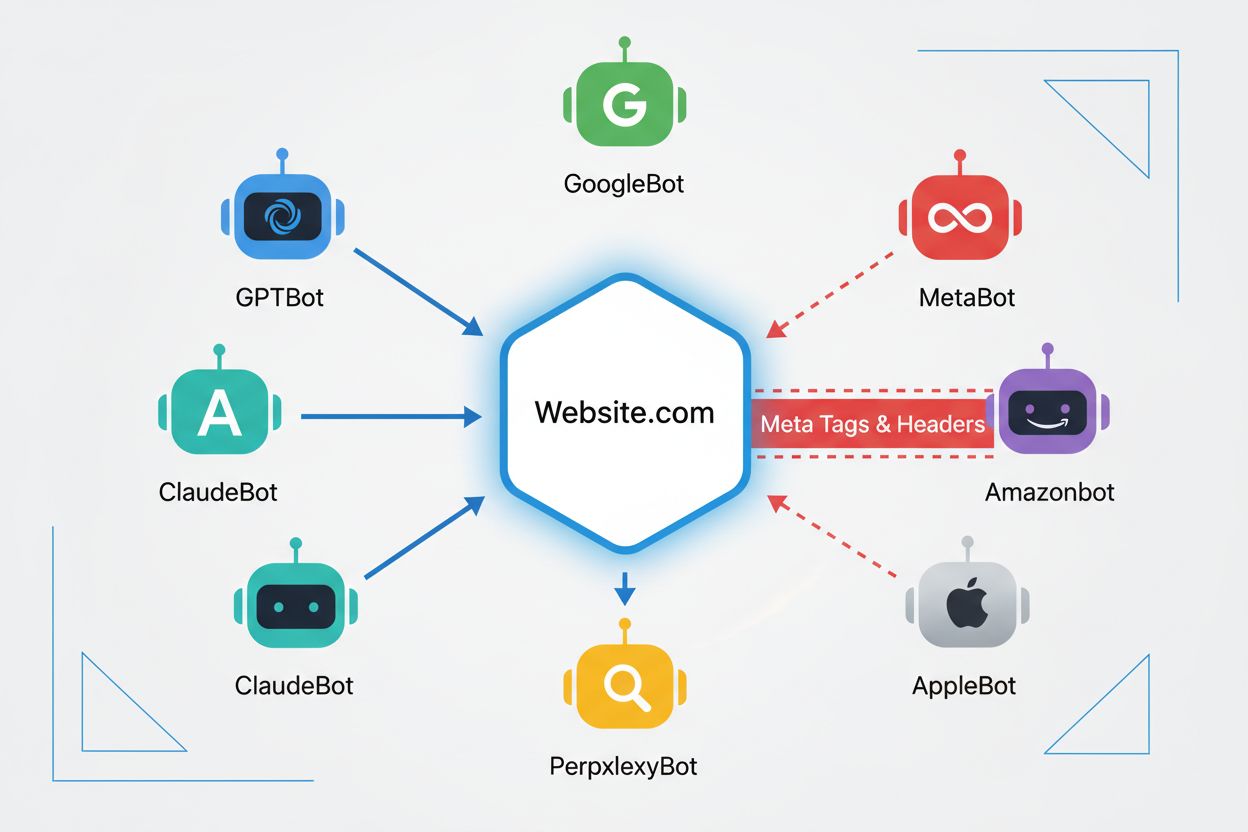
The effectiveness of noai and noimageai tags depends entirely on whether crawlers choose to respect them. Well-behaved crawlers from major AI companies generally honor these directives:
However, poorly-behaved bots and malicious crawlers can deliberately ignore these directives because there is no enforcement mechanism. Unlike robots.txt, which search engines have agreed to respect as an industry standard, noai is not an official web standard, meaning crawlers have no obligation to comply. This is why security experts recommend a layered approach that combines multiple protection methods rather than relying solely on meta tags.
Implementing noai and noimageai tags varies depending on your website platform. Here are step-by-step instructions for the most common platforms:
1. WordPress (via functions.php) Add this code to your child theme’s functions.php file:
function add_noai_meta_tag() {
    echo '<meta name="robots" content="noai, noimageai">' . "\n";
}
add_action('wp_head', 'add_noai_meta_tag');
2. Static HTML Sites
Add directly to the <head> section of your HTML:
<head>
    <meta name="robots" content="noai, noimageai">
</head>
3. Squarespace Navigate to Settings > Advanced > Code Injection, then add to the Header section:
<meta name="robots" content="noai, noimageai">
4. Wix Go to Settings > Custom Code, click “Add Custom Code,” paste the meta tag, select “Head,” and apply to all pages.
Each platform offers different levels of control—WordPress allows page-specific implementation through plugins, while Squarespace and Wix provide global site-wide options. Choose the method that best fits your technical comfort level and specific needs.
While noai and noimageai tags represent an important step toward content creator protection, they have significant limitations. First, these are not official web standards—DeviantArt created them as a community initiative, meaning there is no formal specification or enforcement mechanism. Second, compliance is entirely voluntary. Well-behaved crawlers from major companies respect these directives, but poorly-behaved bots and scrapers can ignore them without consequence. Third, the lack of standardization means adoption varies. Some smaller AI companies and research organizations may not even be aware of these directives, let alone implement support for them. Finally, meta tags alone cannot prevent determined bad actors from scraping your content. A malicious crawler can ignore your directives entirely, making additional protection layers essential for comprehensive content security.
The most effective AI access control strategy uses multiple layers of protection rather than relying on any single method. Here’s a comparison of different protection approaches:
| Method | Scope | Effectiveness | Difficulty |
|---|---|---|---|
| Meta Tags (noai) | Page-level | Medium (voluntary compliance) | Easy |
| robots.txt | Site-wide | Medium (advisory only) | Easy |
| X-Robots-Tag Headers | Server-level | Medium-High (covers all file types) | Medium |
| Firewall Rules | Network-level | High (blocks at infrastructure) | Hard |
| IP Allowlisting | Network-level | Very High (verified sources only) | Hard |
A comprehensive strategy might include: (1) implementing noai meta tags on all pages, (2) adding robots.txt rules blocking known AI training crawlers, (3) setting X-Robots-Tag headers at the server level for non-HTML files, and (4) monitoring server logs to identify crawlers that ignore your directives. This layered approach significantly increases the difficulty for bad actors while maintaining compatibility with well-behaved crawlers that respect your preferences.
After implementing noai tags and other directives, you should verify that crawlers are actually respecting your rules. The most direct method is checking your server access logs for crawler activity. On Apache servers, you can search for specific crawlers:
grep "GPTBot\|ClaudeBot\|PerplexityBot" /var/log/apache2/access.log
If you see requests from crawlers you’ve blocked, they’re ignoring your directives. For NGINX servers, check /var/log/nginx/access.log using the same grep command. Additionally, tools like Cloudflare Radar provide visibility into AI crawler traffic patterns across your site, showing which bots are most active and how their behavior changes over time. Regular log monitoring—at least monthly—helps you identify new crawlers and verify that your protection measures are working as intended.
Currently, noai and noimageai exist in a gray area: they’re widely recognized and respected by major AI companies, yet they remain unofficial and non-standardized. However, there’s growing momentum toward formal standardization. The W3C (World Wide Web Consortium) and various industry groups are discussing how to create official standards for AI access control that would give these directives the same weight as established standards like robots.txt. If noai becomes an official web standard, compliance would become expected industry practice rather than voluntary, significantly increasing its effectiveness. This standardization effort reflects a broader shift in how the tech industry views content creator rights and the balance between AI development and publisher protection. As more publishers adopt these tags and demand stronger protections, the likelihood of official standardization increases, potentially making AI access control as fundamental to web governance as search engine indexing rules.
The noai meta tag is a directive placed in your website's HTML head section that signals to AI crawlers that your content should not be used for training artificial intelligence models. It works by communicating your preference to well-behaved AI bots, though it's not an official web standard and some crawlers may ignore it.
No, noai and noimageai are not official web standards. They were created by DeviantArt as a community initiative to help content creators protect their work from AI training. However, major AI companies like OpenAI, Anthropic, and others have begun respecting these directives in their crawlers.
Major AI crawlers including GPTBot (OpenAI), ClaudeBot (Anthropic), PerplexityBot (Perplexity), Amazonbot (Amazon), and others respect the noai directive. However, some smaller or poorly-behaved crawlers may ignore it, which is why a layered protection approach is recommended.
Meta tags are placed in your HTML head section and apply to individual pages, while HTTP headers (X-Robots-Tag) are set at the server level and can apply globally or to specific file types. Headers work for non-HTML files like PDFs and images, making them more versatile for comprehensive protection.
Yes, you can implement noai tags on WordPress through several methods: adding code to your theme's functions.php file, using a plugin like WPCode, or through page builder tools like Divi and Elementor. The functions.php method is most common and involves adding a simple hook to inject the meta tag into your site's header.
This depends on your business goals. Blocking training crawlers protects your content from being used in AI model development. However, blocking search crawlers like OAI-SearchBot may reduce your visibility in AI-powered search results and discovery platforms. Many publishers use a selective approach that blocks training crawlers while allowing search crawlers.
You can check your server logs for crawler activity using commands like grep to search for specific bot user agents. Tools like Cloudflare Radar provide visibility into AI crawler traffic patterns. Monitor your logs regularly to see if blocked crawlers are still accessing your content, which would indicate they're ignoring your directives.
If crawlers ignore your meta tags, implement additional protection layers including robots.txt rules, X-Robots-Tag HTTP headers, and server-level blocking via .htaccess or firewall rules. For stronger verification, use IP allowlisting to only permit requests from verified crawler IP addresses published by major AI companies.
Use AmICited to track how AI systems like ChatGPT, Perplexity, and Google AI Overviews cite and reference your content across different AI platforms.
Understand how AI crawlers like GPTBot and ClaudeBot work, their differences from traditional search crawlers, and how to optimize your site for AI search visib...

Learn how to identify and monitor AI crawlers like GPTBot, PerplexityBot, and ClaudeBot in your server logs. Discover user-agent strings, IP verification method...
Learn how to allow AI bots like GPTBot, PerplexityBot, and ClaudeBot to crawl your site. Configure robots.txt, set up llms.txt, and optimize for AI visibility.