

Nonprofit AI Optimization
Learn how nonprofits can optimize for AI search results to reach more donors and volunteers. Discover strategies for visibility in Google AI Overviews, ChatGPT,...
11 min read

Discover how nonprofits can leverage AI visibility and mission optimization to reach more donors, volunteers, and beneficiaries. Learn AEO strategies, fundraising transformation, and operational excellence.
The nonprofit sector stands at a critical crossroads as artificial intelligence reshapes how people discover information and organizations. Over 82% of nonprofits now use AI in some capacity, yet the vast majority remain invisible to the new generation of AI-powered search engines that are fundamentally changing how donors, volunteers, and beneficiaries find mission-driven organizations. Google AI Overviews, ChatGPT, Perplexity, and other AI systems now mediate billions of searches daily, yet most nonprofits continue optimizing for traditional search engines that are rapidly becoming secondary discovery channels. Traditional SEO strategies—built for keyword rankings and click-through rates—are increasingly insufficient in an era where AI systems synthesize information, answer questions directly, and recommend organizations based on relevance and impact rather than link authority. The opportunity is immense: nonprofits that master AI visibility can reach donors, volunteers, and beneficiaries at the exact moment they’re seeking solutions to the problems these organizations solve. Only 10% of nonprofits have governance policies for AI use, creating a massive competitive advantage for early adopters who understand how to optimize their mission-driven work for AI discovery. The organizations that act now will define the future of nonprofit visibility and impact.

AI Engine Optimization (AEO) represents a fundamental shift from traditional Search Engine Optimization (SEO), focusing on how AI systems discover, evaluate, and recommend content rather than how search algorithms rank web pages. While SEO optimizes for keywords and backlinks, AEO optimizes for semantic understanding, factual accuracy, source credibility, and demonstrated impact—qualities that AI systems use to synthesize authoritative answers. Nonprofits possess unique advantages in this new landscape: authentic mission statements, verifiable impact data, genuine community testimonials, and transparent financial reporting are exactly the signals AI systems prioritize when evaluating organizational credibility. AI systems analyze not just what nonprofits say about themselves, but what independent sources, beneficiaries, and partners say about them, making authentic storytelling and transparent impact reporting critical competitive advantages. The shift from AEO to SEO isn’t about abandoning traditional search optimization; it’s about expanding your visibility strategy to reach the AI systems that increasingly mediate how people discover solutions to the world’s most pressing problems.
| Aspect | Traditional SEO | AI Engine Optimization (AEO) |
|---|---|---|
| Primary Focus | Keyword rankings and click-through rates | Semantic understanding and factual accuracy |
| Content Optimization | Keyword density and backlink authority | Comprehensive, well-sourced impact data |
| Discovery Mechanism | Search algorithm ranking | AI system synthesis and recommendation |
| Credibility Signals | Domain authority and link profile | Verified impact, transparency, and third-party validation |
| Measurement | Rankings and organic traffic | AI citations, featured answers, and recommendation frequency |
| Nonprofit Advantage | Moderate (competing with commercial sites) | High (authentic mission and verified impact) |
AI systems are fundamentally different from human readers: they don’t respond to emotional appeals or vague promises, but they excel at understanding and synthesizing specific, data-backed narratives that demonstrate real-world impact. The most effective nonprofit storytelling for AI discovery combines compelling human narratives with concrete metrics, specific outcomes, and verifiable results that allow AI systems to understand not just what your organization does, but the measurable difference it makes. Structure your impact stories around the complete journey: the problem you address (with statistics), the specific intervention your organization provides, the measurable outcomes achieved, and the broader systemic change you’re working toward. Include specific data points like “served 15,000 families” rather than “helped many people,” “increased graduation rates by 23%” rather than “improved educational outcomes,” and “reduced food insecurity by 31% in target communities” rather than “fighting hunger.” Natural, conversational language matters more than ever—AI systems are trained on human communication patterns and respond better to authentic voices than corporate jargon or marketing speak.
Nonprofit Storytelling Best Practices for AI Discovery:
The most innovative nonprofits are using AI not just for visibility, but to fundamentally transform how they measure, predict, and optimize their mission impact. Predictive analytics allow organizations to identify which programs will have the greatest impact before deploying resources, enabling smarter allocation of limited funding and volunteer time. Real-time monitoring systems provide continuous feedback on program effectiveness, allowing nonprofits to adjust strategies mid-course rather than waiting for annual evaluations to discover what’s working and what isn’t. Feeding America uses AI-powered logistics optimization to predict food demand and route donations to where they’re needed most, reducing waste while serving more people with the same resources. UNICEF deploys early warning systems that use AI to predict disease outbreaks and humanitarian crises, enabling proactive response rather than reactive crisis management. Organizations using data-driven optimization report 300-500% better cost-effectiveness compared to traditional program management approaches, meaning every dollar donated creates exponentially more impact. The organizations leading this transformation understand that AI-powered mission optimization isn’t about replacing human judgment—it’s about augmenting human expertise with data-driven insights that make mission work more effective, efficient, and impactful.
AI is revolutionizing nonprofit fundraising by enabling organizations to identify, understand, and engage donors with unprecedented precision and personalization. Predictive donor modeling uses historical giving patterns, wealth indicators, and engagement signals to identify individuals most likely to support your mission, allowing development teams to focus their limited time on the highest-probability prospects. Personalized outreach at scale means each donor receives communications tailored to their interests, giving history, and preferred engagement channels—something that was impossible before AI made personalization economically viable for nonprofits. The American Cancer Society implemented AI-powered donor identification and personalization, resulting in a 400% increase in donation conversion rates and fundamentally transforming their fundraising ROI. charity: water uses AI-driven engagement strategies to nurture donor relationships, achieving a 30% increase in donor retention and building a more sustainable funding model. AI-powered email campaigns automatically optimize send times, subject lines, and content based on individual recipient behavior, while chatbots provide instant responses to donor inquiries, improving the supporter experience while reducing staff burden.
| Fundraising Approach | Traditional Methods | AI-Powered Methods |
|---|---|---|
| Donor Identification | Manual research and broad segmentation | Predictive modeling with behavioral analysis |
| Personalization | Generic campaigns to donor segments | Individual-level customization at scale |
| Outreach Timing | Fixed campaign schedules | Optimal timing for each individual |
| Conversion Rate | 2-5% typical range | 8-20% with AI optimization |
| Donor Retention | 40-45% annual retention | 60-75% with AI engagement |
| Cost Per Dollar Raised | $0.25-0.35 | $0.08-0.15 with AI |
| Staff Time Required | 40+ hours weekly on manual tasks | 10-15 hours weekly with automation |
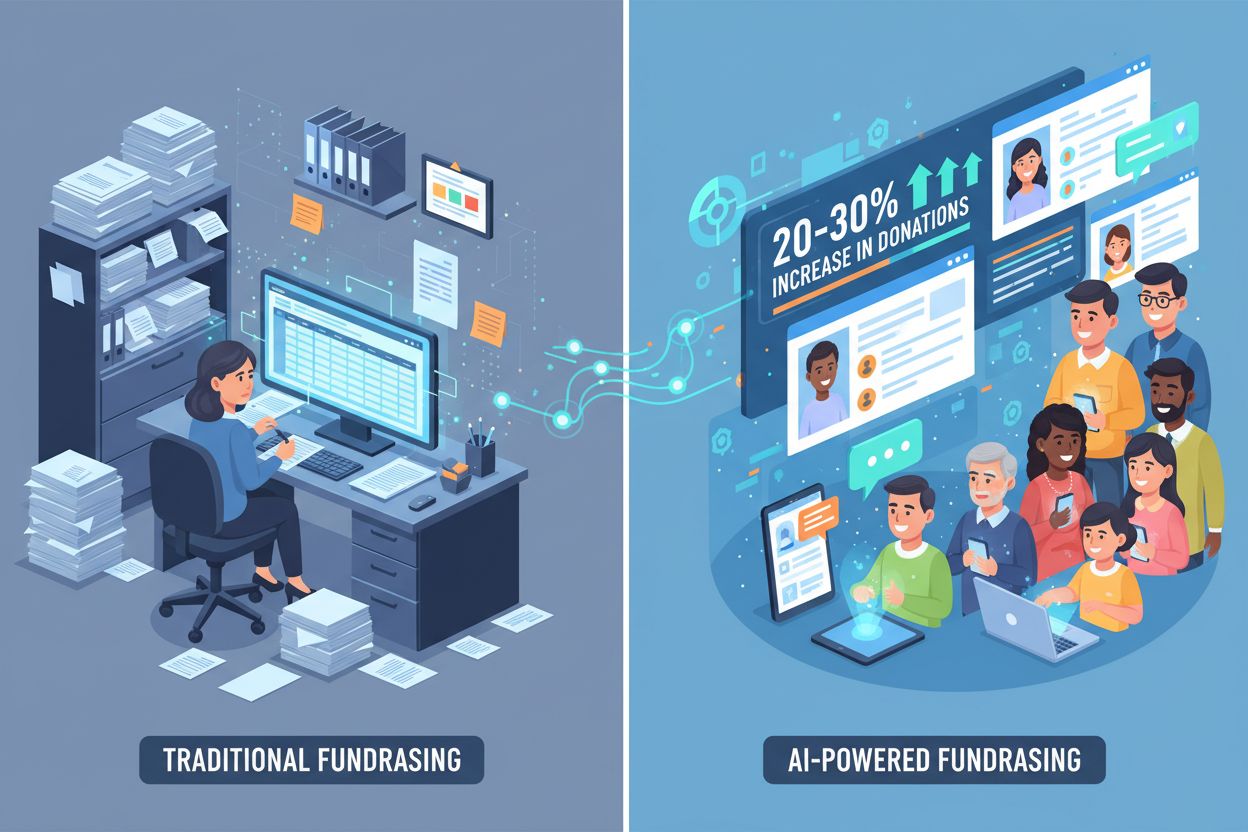
Beyond mission impact and fundraising, AI is transforming nonprofit operations by automating administrative tasks that consume enormous amounts of staff time and resources. Nonprofits report saving 15-20 hours weekly on administrative tasks through AI-powered automation of grant writing, donor database management, volunteer scheduling, and financial reporting. Volunteer management systems use AI to match volunteers with opportunities based on skills, availability, and interests, improving volunteer satisfaction while ensuring organizations have the right people for each role. Resource allocation optimization uses historical data and predictive analytics to forecast staffing needs, budget requirements, and equipment needs, enabling more efficient planning and reducing waste. Salesforce Nonprofit Cloud, Asana, and Mailchimp provide affordable, AI-enhanced tools specifically designed for nonprofit operations, making enterprise-level automation accessible to organizations of all sizes. The American Red Cross uses AI chatbots to handle routine volunteer inquiries, freeing staff to focus on complex coordination and relationship-building. These operational improvements don’t just save time and money—they free nonprofit staff to focus on what they do best: advancing their mission and serving their communities.
Despite the clear benefits of AI adoption, many nonprofits face significant barriers to implementation, including cost concerns, limited technical expertise, infrastructure limitations, and ethical questions about AI use. 35% of nonprofits struggle with manual processes that could be automated, yet lack the knowledge or resources to implement solutions. The good news: a phased implementation approach makes AI adoption accessible to organizations of all sizes and technical sophistication levels. Start small with a single high-impact use case—perhaps AI-powered email optimization or volunteer scheduling—then expand to additional applications as your team builds confidence and expertise. Collaborative solutions designed specifically for nonprofits address the cost barrier: cloud-based platforms like Salesforce Nonprofit Cloud offer significant discounts to qualified organizations, while open-source AI tools provide free alternatives for organizations with technical capacity. Address staff concerns through transparent communication about how AI will augment rather than replace human work, providing training and support as new tools are implemented, and celebrating early wins that demonstrate value. 43% of donors have positive or neutral views of nonprofit AI use, and this number grows when organizations communicate transparently about how they’re using AI to improve mission impact and operational efficiency. The organizations that succeed with AI implementation treat it as a change management challenge, not just a technology challenge, investing in staff development and organizational culture alongside new tools.
Common Implementation Barriers and Solutions:
Demonstrating the value of AI investments requires a multi-dimensional approach that captures operational efficiency gains, fundraising improvements, and mission impact enhancements. Operational efficiency metrics show that AI-powered automation saves 15-20 hours weekly on administrative tasks, translating to approximately $15,000-30,000 in annual staff time savings for a typical nonprofit. Fundraising effectiveness metrics demonstrate 20-30% increases in donation amounts and conversion rates for organizations implementing AI-powered donor identification and personalization strategies. Program impact metrics reveal 300-500% better cost-effectiveness for organizations using AI-driven program optimization and resource allocation. Track these metrics using tools like Google Analytics (for website and content performance), SEMrush (for AI visibility and search performance), and BrightEdge (for comprehensive AI and search optimization tracking). Beyond these quantitative metrics, measure qualitative improvements: staff satisfaction with automation tools, volunteer experience improvements, donor feedback on personalized communications, and beneficiary outcomes. The most compelling ROI stories combine multiple metrics: “We saved 18 hours weekly on administrative tasks (operational efficiency), increased average donation size by 27% (fundraising effectiveness), and improved program cost-effectiveness by 340% (mission impact).” These comprehensive metrics demonstrate that AI investment isn’t just about efficiency—it’s about amplifying mission impact.
The nonprofit sector is entering a new era where AI isn’t just a tool for optimization, but a fundamental transformation of how organizations discover, serve, and measure their impact. AI-native nonprofits—organizations designed from inception to leverage AI for mission delivery—are emerging as models for the future, demonstrating that AI can be deeply integrated into organizational DNA rather than bolted on as an afterthought. Agentic AI systems that can autonomously execute complex tasks will enable nonprofits to scale impact without proportional increases in staff, allowing a small team to coordinate volunteers, manage programs, and engage donors at unprecedented scale. Real-time impact analytics will provide continuous feedback on mission effectiveness, enabling organizations to adapt strategies in real-time rather than waiting for annual evaluations. Voice AI reaching beneficiaries globally will enable nonprofits to serve populations without internet access or digital literacy, expanding the reach of mission-driven organizations to the most underserved communities. Predictive crisis response systems will enable nonprofits to anticipate humanitarian crises, disease outbreaks, and social challenges before they occur, shifting the sector from reactive crisis management to proactive prevention. Integrated AI ecosystems will connect donor identification, volunteer management, program delivery, and impact measurement into seamless workflows that amplify organizational effectiveness. To prepare for this future, nonprofits should invest in staff AI literacy, develop clear governance policies, build partnerships with technology providers, and maintain focus on mission as the north star guiding all AI adoption decisions. The organizations that thrive in this future will be those that view AI not as a threat to their mission, but as a powerful tool for amplifying their impact and reaching the people and communities they serve.
AI visibility refers to how well your nonprofit organization appears in AI-powered search results and recommendations from systems like Google AI Overviews, ChatGPT, and Perplexity. Unlike traditional SEO which focuses on search rankings, AI visibility focuses on being cited, recommended, and featured in AI-generated answers. This is critical because 82% of nonprofits now use AI, yet only 10% have governance policies, creating a massive opportunity for early adopters.
Nonprofits can improve AI visibility through authentic storytelling with specific data points, transparent impact reporting, structured content optimization, and consistent messaging across all platforms. Focus on answering real questions your audience asks, include verifiable outcomes and beneficiary testimonials, and maintain fresh, current information on your website. Start with high-impact use cases like email optimization or volunteer scheduling, then expand your AI strategy over time.
SEO (Search Engine Optimization) targets search engine rankings through keywords and backlinks. AEO (AI Engine Optimization) targets how AI systems discover, evaluate, and recommend content based on semantic understanding, factual accuracy, and demonstrated impact. Both matter for nonprofits, but AEO is increasingly important as AI systems mediate more discovery. Nonprofits have unique advantages in AEO because authentic mission statements, verified impact data, and transparent reporting are exactly what AI systems prioritize.
AI implementation costs vary significantly. Cloud-based tools can start as low as $50-200 monthly for basic functions like email optimization or chatbots. More comprehensive implementations might range from $5,000-50,000 annually. However, organizations typically see positive ROI within 6-12 months through efficiency gains (15-20 hours weekly saved) and improved fundraising (20-30% donation increases). Many platforms offer nonprofit discounts, and free or low-cost tools are available for organizations with limited budgets.
Absolutely. Small nonprofits can leverage free and low-cost AI tools, seek pro bono support from technology companies, participate in nonprofit-specific AI programs, and start with simple applications before expanding. Cloud-based SaaS solutions eliminate expensive infrastructure costs. Many platforms like Salesforce Nonprofit Cloud offer significant discounts to qualified organizations. A phased implementation approach allows small nonprofits to start with one high-impact use case and expand as they build expertise and confidence.
Measure success through multiple dimensions: operational efficiency (15-20 hours weekly saved on administrative tasks), fundraising effectiveness (20-30% increases in donation amounts and conversion rates), and program impact (300-500% better cost-effectiveness). Use tools like Google Analytics for website performance, SEMrush for AI visibility tracking, and BrightEdge for comprehensive optimization monitoring. Track both quantitative metrics and qualitative improvements like staff satisfaction, volunteer experience, and donor feedback.
Key ethical concerns include data privacy and security, algorithmic bias that could disadvantage certain communities, and over-reliance on automation that reduces human connection. Address these through transparent AI governance policies, regular bias audits, prioritizing human oversight for critical decisions, and clear communication with donors and beneficiaries about how you're using AI. 43% of donors have positive or neutral views of nonprofit AI use, and this grows when organizations communicate transparently about using AI to improve mission impact.
Prepare for the future by investing in staff AI literacy, developing clear governance policies, building partnerships with technology providers, and maintaining focus on mission as your north star. Understand emerging trends like AI-native nonprofits, agentic AI systems, real-time impact analytics, and voice AI reaching underserved communities. Start small with pilot projects, celebrate early wins, and view AI not as a threat to your mission but as a powerful tool for amplifying your impact and reaching the people and communities you serve.
Discover how AmICited helps nonprofits track their visibility across AI search engines and optimize their mission-driven messaging for maximum impact.
Learn how nonprofits can optimize for AI search results to reach more donors and volunteers. Discover strategies for visibility in Google AI Overviews, ChatGPT,...

Learn how non-profits optimize for AI visibility through GEO strategies, structured data, content alignment, and monitoring across ChatGPT, Perplexity, Google A...
Community discussion on how non-profit organizations are optimizing for AI search visibility. Real strategies from development directors and communications prof...