

How to Write FAQ Content for AI Search - Complete Guide for 2025
Learn how to write FAQ content optimized for AI search engines like ChatGPT, Perplexity, and Google AI Overviews. Master AEO strategies, schema markup, and cont...
9 min read

Learn how to optimize your product feed and data for ChatGPT shopping recommendations. Master product data optimization, feed specifications, and AI visibility strategies to dominate conversational commerce.
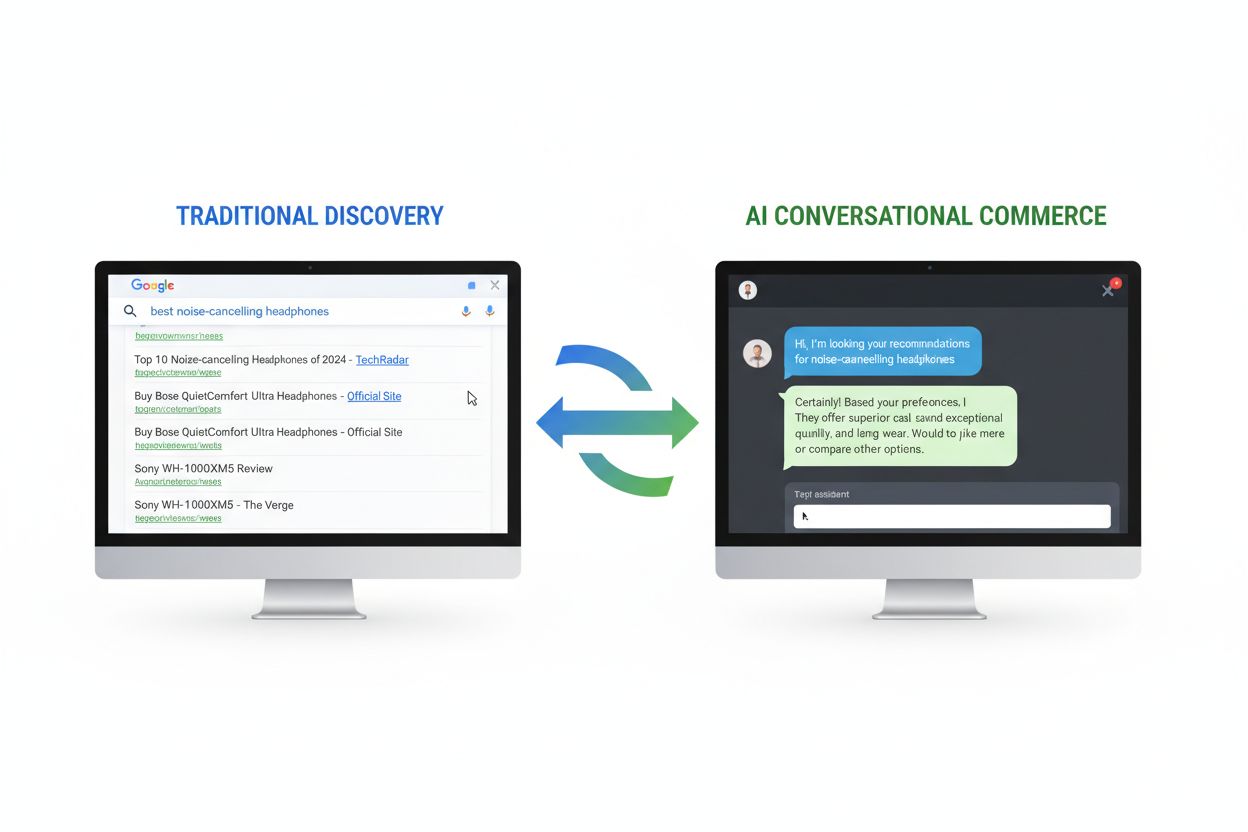
The e-commerce landscape is undergoing a fundamental transformation that demands a complete rethinking of how brands present their products online. For decades, search engine optimization (SEO) focused on optimizing websites and content for traditional search engines like Google, where keyword placement and backlinks determined visibility. Today, AI-powered shopping assistants like ChatGPT are reshaping product discovery, creating what industry experts call “AEO” (AI Engine Optimization). According to recent consumer research, 39% of US consumers already use AI tools for shopping decisions, with an additional 53% planning to adopt these tools within the next year—a clear signal that this isn’t a niche trend but a mainstream shift. The critical difference is that AI shopping assistants don’t crawl websites or rely on traditional SEO signals; instead, they consume structured product feeds as their primary data source. This means your product feed has evolved from a secondary distribution channel (useful for marketplaces and price comparison sites) to your most important asset for AI-driven discovery. Brands that fail to optimize their product data for AI systems will find themselves invisible to an increasingly large segment of shoppers, regardless of their traditional SEO rankings.
To effectively optimize for ChatGPT shopping recommendations, you must first understand the technical requirements of the product feed specification that powers these AI systems. The feed requires several mandatory fields that form the foundation of every product listing: a unique Product ID, a compelling product title, a detailed description, current price, real-time availability status, product weight (for shipping calculations), and seller information including business name and contact details, plus a high-quality main product image. Beyond these essentials, optional fields dramatically increase your product’s visibility and relevance to AI queries: customer reviews and ratings, video demonstrations, 3D model files, and custom variant categories that go beyond standard color and size options. Product feeds can be submitted in multiple formats—TSV (Tab-Separated Values), CSV (Comma-Separated Values), XML, or JSON—allowing flexibility based on your technical infrastructure. The system processes feed updates with a 15-minute refresh cycle, meaning price changes, inventory updates, and new products can appear in AI recommendations within minutes of submission. Each field has specific character limits and formatting requirements that, when followed precisely, ensure your data is parsed correctly by AI systems without errors or truncation.
| Field Name | Field Type | Max Length | Importance | Required |
|---|---|---|---|---|
| Product ID | String | 100 chars | Critical | Yes |
| Title | String | 150 chars | Critical | Yes |
| Description | Text | 5,000 chars | High | Yes |
| Price | Decimal | 12 digits | Critical | Yes |
| Availability | Enum | 20 chars | Critical | Yes |
| Weight | Decimal | 10 digits | Medium | Yes |
| Seller Info | String | 200 chars | High | Yes |
| Main Image | URL | 2,048 chars | Critical | Yes |
| Reviews | JSON Array | 10,000 chars | High | No |
| Rating | Decimal | 1-5 scale | High | No |
| Video URL | URL | 2,048 chars | Medium | No |
| 3D Model | URL | 2,048 chars | Medium | No |
| Custom Variants | JSON | 70 chars per category | High | No |
While traditional e-commerce has long relied on basic variants like color and size, AI shopping assistants unlock the potential of custom variant categories that align with how real customers think about products. The ChatGPT product feed allows up to three custom variant categories, each with a maximum of 70 characters for the category name and 40 characters per individual option within that category. This flexibility enables brands to create variants that directly address customer decision-making: a furniture retailer might use “Wood Type” (oak, walnut, maple), “Material Certification” (FSC-certified, reclaimed, sustainable), and “Primary Use Case” (home office, living room, bedroom); a fashion brand could specify “Fabric Blend” (cotton, polyester, linen), “Fit Style” (slim, regular, relaxed), and “Occasion” (casual, business, formal). The key insight is to think like a customer asking ChatGPT a question—if someone asks “Show me sustainable oak desks for a home office,” your custom variants should make that product matchable to that exact query. Rich media attributes, including high-resolution images, product videos, and 3D model files, significantly boost your product’s visibility in AI recommendations because these assets provide the AI system with richer context about your product’s features and benefits. Consider these essential attribute types:

The way you write product descriptions must fundamentally change when optimizing for AI shopping assistants, shifting from traditional product specification sheets to conversational, question-answering content. ChatGPT and similar AI systems are trained on natural language patterns, meaning they respond better to descriptions that read like a knowledgeable salesperson answering customer questions rather than technical jargon or marketing hyperbole. Your product descriptions should proactively address the most common customer questions: “What is this product made from?”, “How do I use it?”, “Who is this best for?”, “What problems does it solve?”, and “How does it compare to alternatives?” Incorporating FAQ sections and buying guides directly into your product feed gives AI systems explicit answers to these queries, dramatically improving the relevance of recommendations. Customer reviews are not supplementary content—they are crucial ranking factors in AI shopping systems because they provide authentic, conversational language that validates product claims and addresses real-world use cases. Consistent formatting throughout your feed helps AI parsing: use clear section headers, bullet points for feature lists, and structured data for specifications. Remember that natural language keyword incorporation matters far more than keyword stuffing; write for humans first, and the AI will naturally extract the relevant signals.
One of the most critical—and most frequently overlooked—aspects of AI shopping optimization is maintaining real-time data freshness, a requirement that differs fundamentally from traditional SEO where content can remain static for months. Stale product data destroys the trust that AI systems place in your feed: if ChatGPT recommends a product that’s actually out of stock, or quotes a price that’s outdated, the AI system learns to deprioritize your products in future recommendations. Out-of-stock recommendations are particularly damaging because they create a poor customer experience that directly reflects on both the AI platform and your brand, leading to negative feedback that algorithms quickly detect and penalize. Price accuracy is equally critical—even a 5% discrepancy between your feed price and your website price can trigger AI systems to flag your data as unreliable. The 15-minute refresh cycle is the industry best practice, but many high-volume retailers implement 5-minute or even real-time synchronization to ensure maximum accuracy. This requires automated sync systems that connect your inventory management system, pricing engine, and product feed without manual intervention—a technical investment that separates serious AI-ready brands from those still operating with legacy processes. Unlike traditional SEO, where you can optimize once and benefit for months, AI shopping optimization demands continuous, automated data management.
AI shopping systems evaluate products not just on their features and descriptions, but on explicit trust signals that you can directly include in your product feed. The popularity score, measured on a 0-5 scale, signals to the AI system which products are most frequently purchased and recommended, helping the algorithm understand relative product quality within your catalog. Return rate data is a powerful reliability indicator—products with low return rates signal to AI systems that customers are satisfied with their purchases, while high return rates trigger algorithmic skepticism. Review count and average rating are direct ranking factors in AI shopping recommendations; a product with 500 five-star reviews will be prioritized over an identical product with only 10 reviews, even if both have the same average rating. Seller identity information, including your business registration, contact details, and links to your return and refund policies, must be included in the feed itself—AI systems don’t verify this information by crawling your website, they extract it from your structured feed data. These trust signals are not external SEO factors that you hope Google will discover; they are explicit data points that you control and submit directly. Transparency in your feed—including honest ratings, realistic product descriptions, and clear policy information—builds the kind of algorithmic trust that translates into consistent visibility in AI shopping recommendations.
While your product feed is the primary data source for AI shopping systems, consistency between your feed data and your website’s structured data markup creates a reinforcing signal that strengthens your overall AI visibility. Implement JSON-LD structured data markup on your website using the Product, Offer, and AggregateRating schemas—these should mirror the data in your feed exactly. When ChatGPT or other AI systems encounter your website (either through direct crawling or through user verification), they compare the website schema against your submitted feed data; mismatches between these sources confuse AI systems and can trigger data quality flags that reduce your visibility. For example, if your feed lists a product at $99.99 but your website schema shows $89.99, the AI system must decide which price is authoritative, and this uncertainty reduces confidence in your data. Conversely, when feed data and website schema align perfectly, you reinforce data authority and signal to AI systems that your product information is reliable and well-maintained. This alignment also future-proofs your e-commerce SEO strategy because as AI shopping becomes more sophisticated, the systems that maintain perfect data consistency across all channels will have a structural advantage. Implementing this alignment requires coordination between your product feed management system and your website CMS, but the investment pays dividends across multiple AI platforms.
Transitioning to AI-optimized product data requires a structured approach that addresses data gaps, creates missing assets, and establishes automated processes. Begin with a comprehensive audit of your current product data, comparing your existing feed against the ChatGPT specification to identify which fields are missing, incomplete, or incorrectly formatted. Next, map the missing attributes for each product category—determine which custom variants would be most valuable for your customers and which optional fields (reviews, ratings, video, 3D models) you can realistically populate. Simultaneously, create or source the necessary media assets: high-resolution product images, demonstration videos, and 3D model files that will increase your products’ visibility in AI recommendations. Organize your review and rating data into a structured format that can be included in your feed; if you’re currently storing reviews in a separate system, establish a data pipeline that exports this information into your feed. Rewrite your product titles and descriptions using the conversational, question-answering approach outlined earlier, ensuring each description addresses common customer queries. Set up automated refresh mechanisms that sync your inventory, pricing, and availability data to your feed on a 15-minute cycle (or more frequently if possible). Finally, establish monitoring and performance tracking to measure how your optimization efforts impact visibility in AI shopping recommendations.
The window of opportunity for establishing competitive advantage through AI shopping optimization is narrower than most brands realize—early adopters will dominate their categories for years to come. As more competitors optimize their product feeds, completeness becomes a tie-breaker in AI recommendations; when two products are equally relevant to a customer query, the one with richer data (more attributes, better descriptions, higher review counts, media assets) will be prioritized. The mathematical reality is that more attributes equal more query matches—a product with five custom variants can match customer queries that a product with only two variants cannot, directly translating to increased visibility. Rich media assets (videos, 3D models, high-resolution images) increase visibility not just through better descriptions, but because AI systems can extract more detailed information from visual content, making your products matchable to more specific customer requests. The brands that act now—investing in data optimization while their competitors are still focused on traditional SEO—will establish a structural advantage that compounds over time. First-mover advantage in AI shopping is significant because the algorithms learn from early data patterns, and brands that establish strong performance signals early will benefit from algorithmic momentum. Tools like AmICited help brands track their visibility across AI shopping platforms, providing the metrics needed to measure whether your optimization efforts are translating into actual recommendation placement.
The trajectory of AI shopping is clear, and brands must prepare for features that are likely coming within the next 12-24 months. Sponsored placements in AI shopping recommendations are almost certainly coming—just as Google monetized search results through ads, ChatGPT and other platforms will offer premium visibility options for brands willing to pay. Multi-item shopping carts will evolve beyond single-product recommendations, with AI systems suggesting complementary products that customers should purchase together, rewarding brands with rich data that enables these bundle recommendations. Bundled recommendations and cross-sell opportunities will become increasingly sophisticated, with AI systems understanding which products naturally pair together based on customer behavior and product attributes. The direction is unmistakable: product feeds are foundational infrastructure for the future of e-commerce, not optional optimization tactics. Brands that invest in feed optimization now will be best positioned to capitalize on sponsored placements, bundled recommendations, and other monetization opportunities as they emerge. This is not a trend that will fade or be replaced by the next marketing innovation—this is a fundamental shift in how customers discover and purchase products. The brands that recognize this shift and act decisively will thrive in the conversational commerce era, while those that delay will find themselves increasingly invisible to the AI-driven shopping assistants that are rapidly becoming the primary discovery mechanism for millions of consumers.
Google relies on crawling websites and analyzing links to determine rankings, while ChatGPT uses structured product feeds as the primary authority source. ChatGPT feeds include performance metrics, custom variants, and review data that directly influence recommendations, whereas Google treats these as secondary signals. This fundamental difference means you need to optimize your feed data specifically for AI systems, not just rely on traditional SEO.
The ideal refresh frequency is every 15 minutes for price and inventory changes. At minimum, update your feed daily. Real-time accuracy is critical for maintaining AI trust—if ChatGPT recommends a product that's out of stock or mispriced, the AI system learns to deprioritize your products in future recommendations. Automated sync systems are essential for maintaining this frequency without manual intervention.
Not necessarily, but they should be conversational and answer common customer questions. Focus on clarity over keyword density. Think about how customers would naturally ask ChatGPT about your product. If your current descriptions are technical spec sheets, they need revision. If they're already customer-focused and answer common questions, they may only need minor adjustments.
Product title and description are critical, but completeness matters most. Missing required fields (product ID, price, availability, image) disqualify products entirely. Optional fields like reviews, ratings, and custom variants are tie-breakers when AI systems choose between similar products. The more complete your feed, the more query patterns your products can match.
AmICited monitors how your products are cited and recommended across AI platforms including ChatGPT Shopping. You can track visibility metrics, identify which products are being recommended, and measure the impact of your feed optimization efforts. This data-driven approach helps you understand what's working and where to focus your optimization efforts for maximum ROI.
You can start with your existing Google Shopping feed, but ChatGPT requires significant enrichment. Google doesn't require performance metrics, custom variants, or rich media in the same way ChatGPT does. You'll need to add conversational descriptions, review data, video links, 3D models, and custom variant categories to fully optimize for AI shopping. Many brands maintain separate feeds optimized for each platform.
Incomplete data reduces visibility in ChatGPT recommendations. Missing required fields may disqualify products entirely from appearing in recommendations. Optional fields like reviews, ratings, and custom variants act as tie-breakers when AI systems choose between similar products. The more complete your feed, the more customer queries your products can match, directly translating to increased visibility and sales.
AEO is not replacing SEO but complementing it. Traditional SEO still matters for Google and other search engines, but AEO is critical for AI-driven discovery through ChatGPT, Perplexity, and similar platforms. Brands need both strategies now. The shift is happening gradually, but the percentage of product discovery happening through AI assistants is growing rapidly, making AEO increasingly important for e-commerce success.
Track how your products are cited and recommended in ChatGPT Shopping and other AI platforms. Optimize your product data based on real performance metrics and stay ahead of competitors.
Learn how to write FAQ content optimized for AI search engines like ChatGPT, Perplexity, and Google AI Overviews. Master AEO strategies, schema markup, and cont...

Compare leading GEO and AEO agencies. Find the best AI visibility partner with our comprehensive guide to industry leaders, pricing, and selection criteria.
Learn how ecommerce businesses optimize for AI search engines like ChatGPT, Perplexity, and Google AI Mode. Discover strategies for product visibility, schema m...