Organization Schema: Helping AI Understand Your Brand Entity
Learn how Organization schema helps AI systems understand and cite your brand. Complete guide to brand entity markup for LLM visibility and AI citations.
Published on Jan 3, 2026.Last modified on Jan 3, 2026 at 8:37 am
The way brands achieve visibility has fundamentally shifted. While traditional SEO focused on ranking websites in search results, AI visibility requires a completely different approach—one centered on helping artificial intelligence systems understand, trust, and recommend your brand. Organization schema is the foundational tool that makes this possible. Unlike humans who can infer meaning from context and design, AI systems need explicit, machine-readable information to confidently identify and cite your brand. Without proper schema markup, your brand remains invisible to the AI systems that increasingly mediate how people discover information.
How AI Systems Interpret Organization Schema
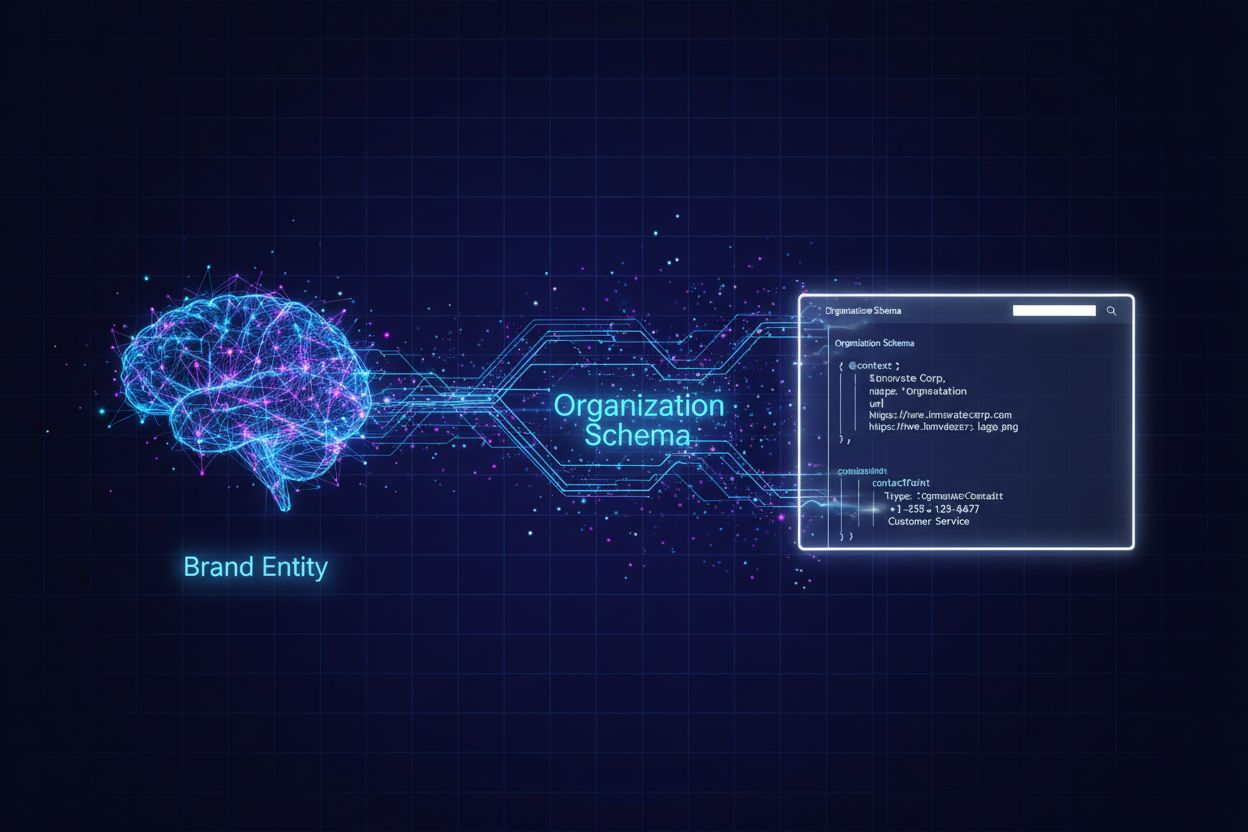
Large language models process your website content through multiple layers of analysis, and structured data serves as a high-priority signal throughout this process. When an AI system encounters your Organization schema—typically formatted as JSON-LD in your page’s head section—it parses this data to build a precise understanding of your brand’s identity, relationships, and authority. This structured information feeds directly into knowledge graphs that AI systems use to verify facts, resolve entity ambiguity, and determine which sources to cite. Research shows that LLMs grounded in knowledge graphs achieve 300% higher accuracy compared to those relying solely on unstructured text. The mechanism is straightforward: schema markup transforms ambiguous prose into verifiable, machine-readable facts that AI systems can confidently extract, interpret, and reuse across different contexts and queries.
Ready to Monitor Your AI Visibility?
Track how AI chatbots mention your brand across ChatGPT, Perplexity, and other platforms.
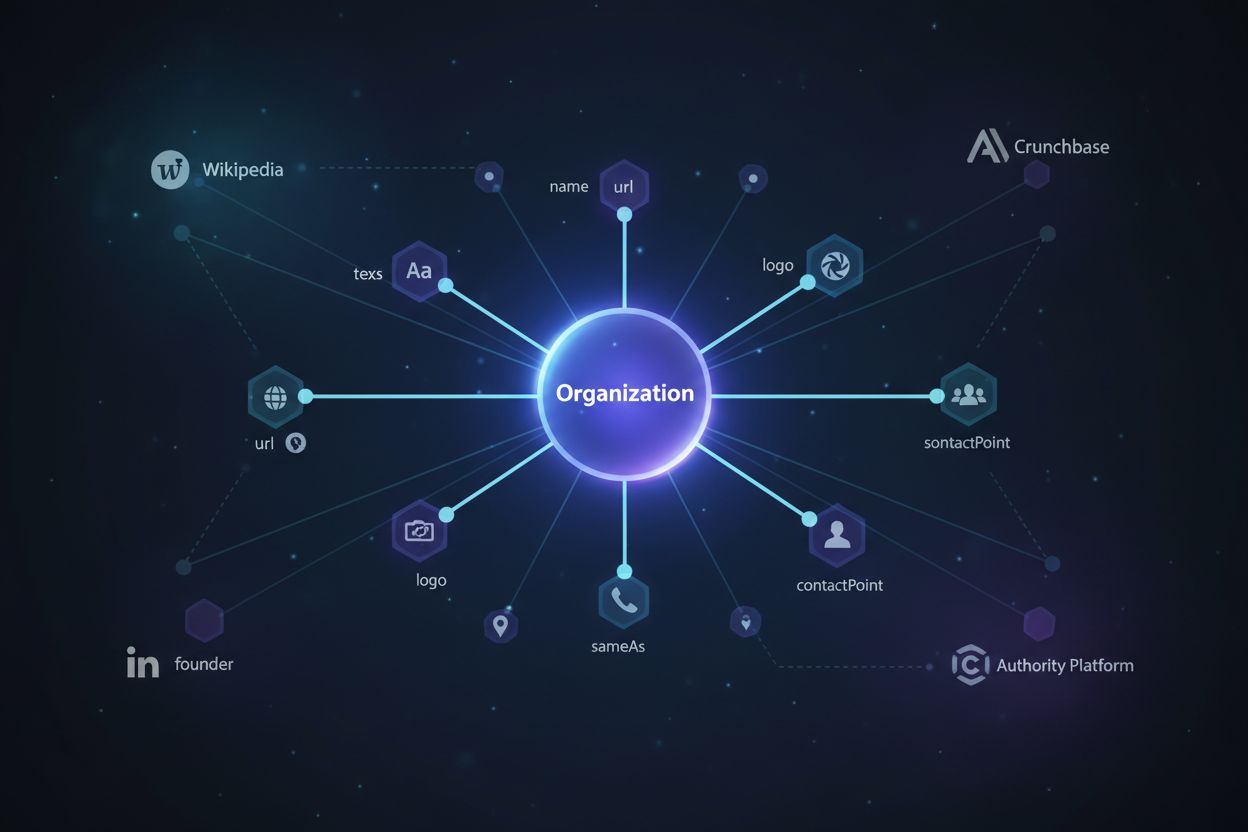
Your Organization schema should include several essential properties that collectively paint a complete picture of your brand for AI systems. Here are the critical elements:
Property
Purpose
Importance
name
Your official brand name
Critical
url
Your primary website URL
Critical
sameAs
Links to Wikipedia, LinkedIn, Crunchbase, official profiles
Critical
logo
Your brand’s visual identity (image URL)
High
description
Clear, concise explanation of what your organization does
High
contactPoint
Contact information (phone, email, support channels)
High
address
Physical headquarters or primary location
Medium
foundingDate
When your organization was established
Medium
brand
Brands maintained or associated with your organization
Medium
knowsAbout
Topics and expertise areas your organization specializes in
Medium
The name property must match exactly how your brand appears on your website and across authoritative third-party sources. The url should point to your primary domain. However, the sameAs property deserves special attention—it’s the bridge between your website and the broader web of information that AI systems reference. By linking to your Wikipedia page, LinkedIn company profile, Crunchbase listing, and other authoritative profiles, you’re essentially telling AI systems, “These are all representations of the same entity.”
The sameAs Property—Your Entity Authority Multiplier
If Organization schema is the foundation of AI brand visibility, sameAs is the accelerant. This single property has outsized importance because it directly addresses one of the biggest challenges AI systems face: entity disambiguation. Without clear sameAs links, an AI system might confuse your brand with a competitor, a namesake, or an unrelated organization. When you provide sameAs links to Wikipedia, LinkedIn, Crunchbase, and industry-specific directories, you’re creating a web of verification that AI systems use to confirm your brand’s identity. These links act as cross-platform authority signals—essentially vouching for your brand across multiple trusted sources. AI systems weight information from these authoritative platforms heavily, so a well-maintained sameAs property can dramatically improve how confidently AI systems cite and recommend your brand. The more authoritative platforms you link to, the stronger your entity authority becomes in the eyes of AI systems.
Stay Updated on AI Visibility Trends
Get the latest insights on AI mentions, brand monitoring, and optimization strategies.
Implementation Best Practices
Implementing Organization schema correctly requires attention to technical detail and ongoing maintenance. Start by using JSON-LD format, which Google explicitly recommends and which AI systems most reliably parse. Place your schema markup in the <head> section of your website, not in the body, to ensure it’s processed before content rendering. Your schema data must match the visible content on your page—if your schema says your company was founded in 2015 but your website says 2016, AI systems will flag this inconsistency and reduce trust in your markup.
Follow these implementation best practices:
Use JSON-LD exclusively - Avoid mixing JSON-LD with Microdata or RDFa; stick with one format for clarity
Place schema in the page <head> section - This ensures proper parsing by crawlers and AI systems
Ensure schema matches visible page content - Never mark up information that isn’t actually displayed on your page
Keep sameAs links current - Update these links whenever your social profiles or directory listings change
Validate with Google’s Rich Results Test - Check your markup before and after deployment
Use Schema Markup Validator - Test your JSON-LD syntax for errors
Monitor Search Console regularly - Address any schema errors reported in the Enhancements section
Organization Schema vs. Other Schema Types
Organization schema serves as the anchor point for your entire schema ecosystem. While you’ll implement other schema types—Product schema for your offerings, Article schema for your content, Person schema for your team members—all of these should reference back to your Organization schema. This interconnected approach creates a coherent knowledge graph that AI systems can navigate. When your Product schema includes a brand property pointing to your Organization, and your Article schema includes a publisher property pointing to the same Organization, you’re building a unified entity model that AI systems recognize and trust. This interconnectedness is crucial because it tells AI systems that all these different pieces of content and products belong to a single, coherent brand entity. The stronger and more consistent these connections, the more confidently AI systems will cite your brand across different types of queries and contexts.
Real-World Impact on AI Citations
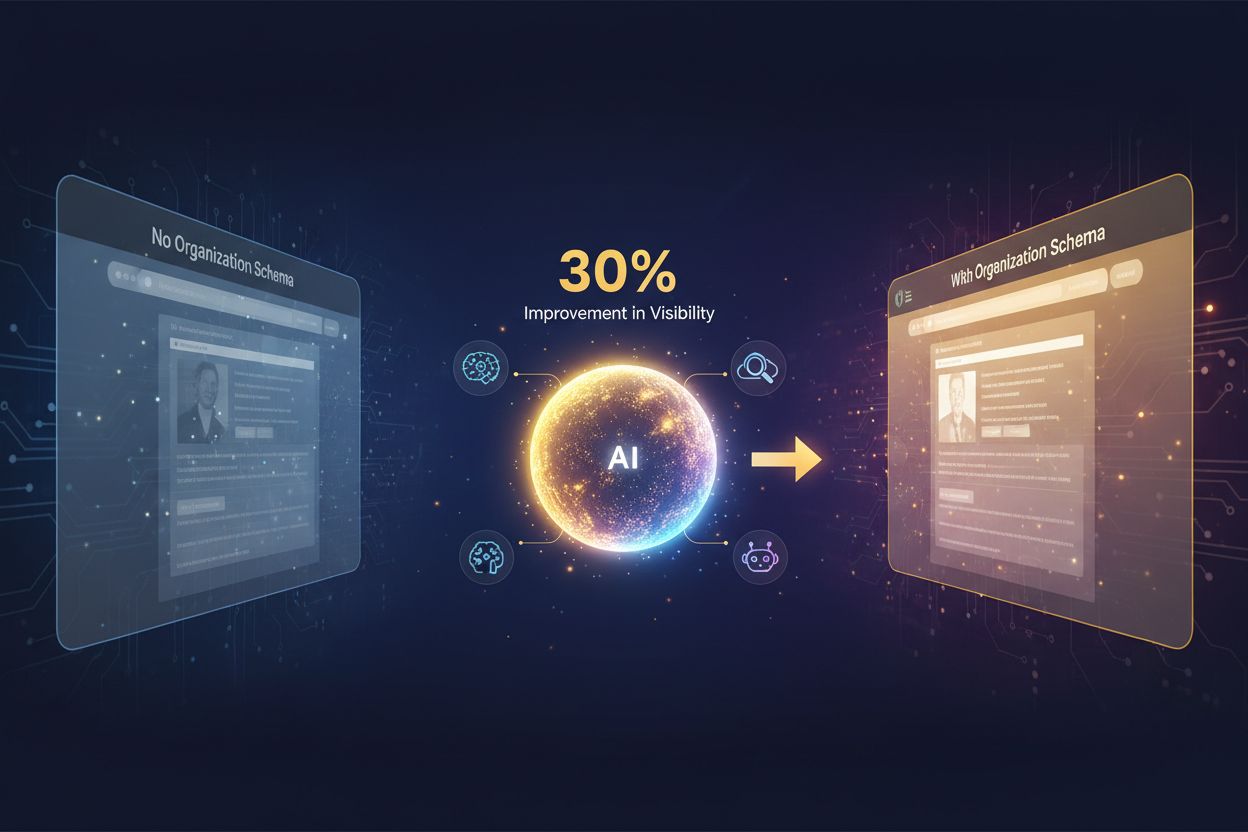
The practical impact of proper Organization schema implementation is measurable and significant. Sites with comprehensive schema markup see up to 30% higher visibility in AI Overviews compared to sites with minimal or no schema. This isn’t a marginal improvement—it’s the difference between being cited as a primary source and being completely absent from AI-generated answers. When an AI system is assembling an answer about your industry, it’s more likely to include your brand if your Organization schema clearly establishes your expertise, authority, and trustworthiness. Beyond visibility, schema implementation improves the accuracy of how AI systems represent your brand. With clear schema markup, AI systems are less likely to misrepresent your company size, founding date, or core offerings. This accuracy matters because it directly influences whether users trust the AI’s recommendation of your brand. In competitive industries, this advantage compounds—brands with strong schema implementation consistently outrank competitors in AI-generated answers.
Common Mistakes to Avoid
Even well-intentioned schema implementation can backfire if you make common mistakes that confuse or mislead AI systems. The most critical errors to avoid:
Marking up invisible content - Never include information in your schema that isn’t actually visible on the page; AI systems cross-reference schema with page content
Inconsistent brand names - If your schema says “Acme Corp” but your website says “ACME Corporation,” AI systems will flag this inconsistency and reduce trust
Missing or outdated sameAs links - Failing to include sameAs properties, or linking to outdated social profiles, severely limits entity authority
Ignoring schema validation errors - Errors in your JSON-LD syntax prevent proper parsing; always validate before deployment
Not updating schema when brand information changes - If you move offices, change your founding date, or update your description, update your schema immediately
Using incorrect schema types - Don’t force your organization into an inappropriate schema type; use the most specific type that matches your business
Failing to monitor Search Console - Errors reported in Search Console’s Enhancements section indicate problems that need immediate attention
Monitoring Your Organization Schema Performance
Implementation is just the beginning—ongoing monitoring is essential to ensure your schema continues to drive AI visibility. Start by manually querying AI systems like ChatGPT, Gemini, and Perplexity with questions related to your brand and industry. Document how your brand appears in the responses: Is it cited? Is the information accurate? What context is it mentioned in? Tools like AmICited.com automate this monitoring process, tracking how your brand appears across multiple AI systems and alerting you to changes in citation patterns. Google Search Console’s Enhancements section provides another critical monitoring point—check it regularly for schema errors that might prevent proper parsing. Beyond error monitoring, track your brand’s AI visibility metrics: citation frequency, accuracy of brand information, sentiment of mentions, and which queries trigger your brand citations. This feedback loop is essential because it reveals gaps in your schema or content that need attention. If an AI system consistently misrepresents your brand or fails to mention you in relevant queries, it’s a signal that your schema needs refinement or your content needs optimization.
Future-Proofing Your Brand Entity
As AI systems become the primary discovery mechanism for information, entity SEO—the practice of optimizing how AI systems understand and represent your brand—will become as essential as traditional SEO. Organization schema is your primary tool for this optimization. The brands that invest now in comprehensive, accurate, and well-maintained Organization schema will have a significant competitive advantage as AI systems become more sophisticated and more widely used. This isn’t a one-time implementation; it’s an ongoing discipline that requires regular audits, updates, and refinement. Your Organization schema should evolve as your business evolves—new products, expanded service areas, team changes, and strategic pivots should all be reflected in your schema. By treating your Organization schema as a living document rather than a static implementation, you’re building a durable moat against AI-driven competition. The brands that understand their brand entity as a strategic asset—one that needs to be clearly defined, consistently maintained, and actively monitored across AI systems—will thrive in the AI-first future of search and discovery.
Frequently asked questions
What's the difference between Organization schema and other schema types?
Organization schema defines your company as an entity, while other schema types like Product, Article, and Person schema describe specific offerings, content, and people. Organization schema serves as the foundation that all other schema types reference, creating an interconnected knowledge graph that AI systems use to understand your entire brand ecosystem.
How often should I update my Organization schema?
Update your Organization schema whenever your brand information changes—new office locations, updated descriptions, changes to leadership, or new service areas. At minimum, review and validate your schema quarterly. Keep sameAs links current whenever you update social profiles or directory listings.
Can Organization schema improve my Google rankings?
Organization schema doesn't directly impact Google rankings, but it improves click-through rates through rich snippets and enhances how AI systems understand your brand. For AI visibility specifically, schema is critical—sites with comprehensive schema see up to 30% higher visibility in AI Overviews.
What's the most important property in Organization schema?
The sameAs property is arguably the most important because it links your brand to authoritative platforms like Wikipedia, LinkedIn, and Crunchbase. These links help AI systems verify your brand's identity and build entity authority, directly influencing how confidently AI systems cite and recommend you.
How do I know if my Organization schema is working?
Monitor your brand mentions in AI systems like ChatGPT, Gemini, and Perplexity by asking industry-related questions. Use tools like AmICited.com to track citations automatically. Check Google Search Console's Enhancements section for schema errors, and monitor whether your brand appears in AI-generated answers for relevant queries.
Should I include all possible Organization schema properties?
No—focus on the essential properties first: name, url, logo, description, and sameAs. Add additional properties like contactPoint, address, and foundingDate as they become relevant to your business. Quality and accuracy matter more than quantity; incomplete or incorrect data is worse than omitting optional properties.
How does Organization schema help with AI citations?
Organization schema provides AI systems with machine-readable facts about your brand that they can confidently extract and cite. Clear schema markup reduces ambiguity, helps AI systems verify information accuracy, and makes your brand a more attractive source for inclusion in AI-generated answers.
What's the relationship between sameAs and entity authority?
sameAs links create cross-platform verification of your brand identity. When you link to Wikipedia, LinkedIn, Crunchbase, and other authoritative platforms, you're building entity authority that AI systems recognize. The more authoritative platforms you link to, the stronger your entity authority becomes in AI systems' understanding of your brand.
Monitor Your Brand's AI Visibility
See how AI systems are citing your brand across ChatGPT, Perplexity, Google AI Overviews, and more with AmICited.com
How to Add HowTo Schema for AI Visibility - Complete Implementation Guide
Learn how to implement HowTo schema markup for better visibility in AI search engines. Step-by-step guide to adding structured data for ChatGPT, Perplexity, and...
Learn what Organization Schema is, how it works, and why it matters for SEO and AI search visibility. Complete guide to implementing structured data for company...
How to Implement Organization Schema for AI - Complete Guide
Learn how to implement Organization schema markup for AI visibility. Step-by-step guide to add JSON-LD structured data, improve AI citations, and enhance brand ...
9 min read
Cookie Consent We use cookies to enhance your browsing experience and analyze our traffic. See our privacy policy.