

ChatGPT vs ChatGPT Search: Key Differences Explained
Discover the key differences between ChatGPT and ChatGPT Search. Learn about real-time web browsing, knowledge cutoffs, accuracy, and when to use each version f...
9 min read
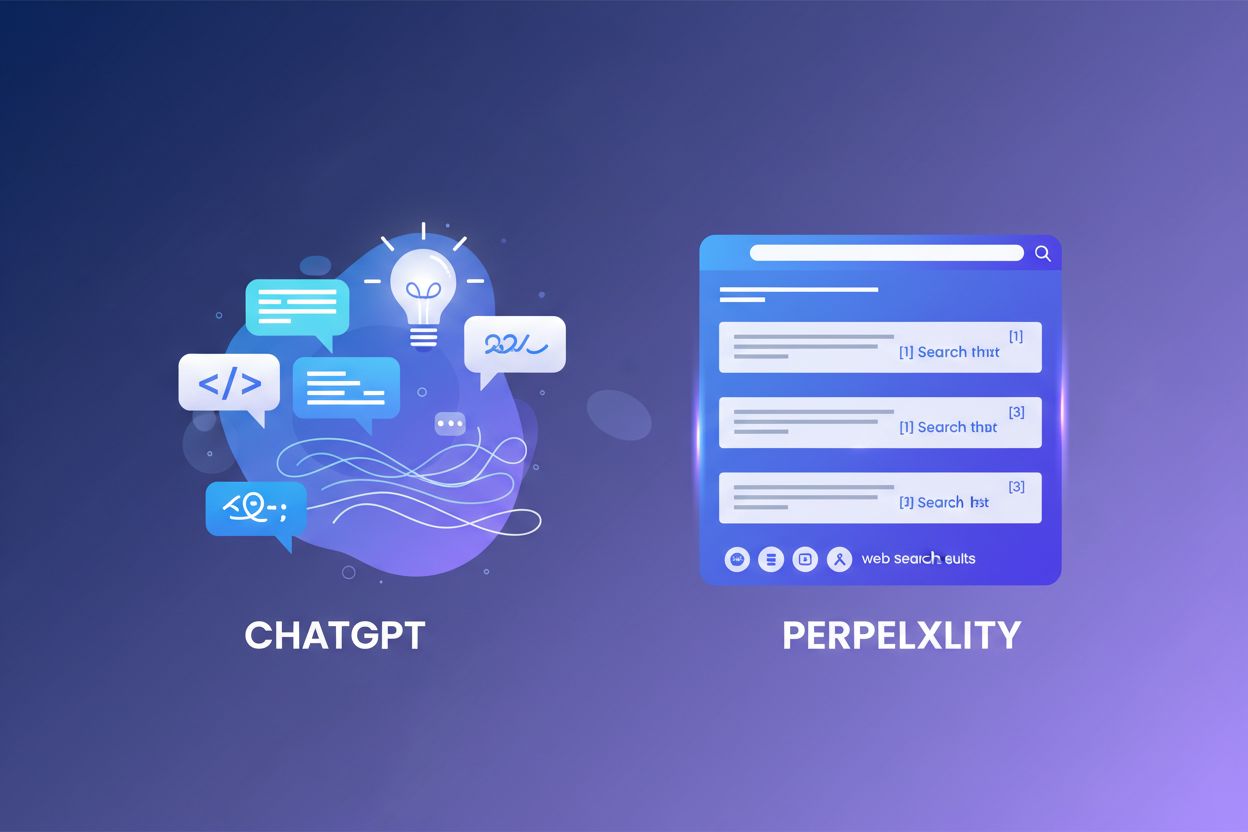
Compare Perplexity and ChatGPT to find the right AI platform for your needs. Explore real-time search, reasoning, creative writing, coding, pricing, and how AmICited monitors AI citations.
ChatGPT and Perplexity AI are both powerful AI tools, but they serve fundamentally different purposes. ChatGPT is a conversational AI assistant designed for dialogue, creative tasks, and problem-solving, while Perplexity is an AI-powered answer engine built specifically for research and information retrieval with real-time web access. Understanding these distinctions is crucial for determining which platform aligns with your workflow. Both have evolved significantly since their 2022 launches, with ChatGPT now offering web search capabilities and Perplexity expanding into conversational features. The choice between them isn’t about which is “better”—it’s about which serves your specific needs. AmICited monitors how both platforms cite your brand and content, helping you understand your visibility in AI-generated responses.
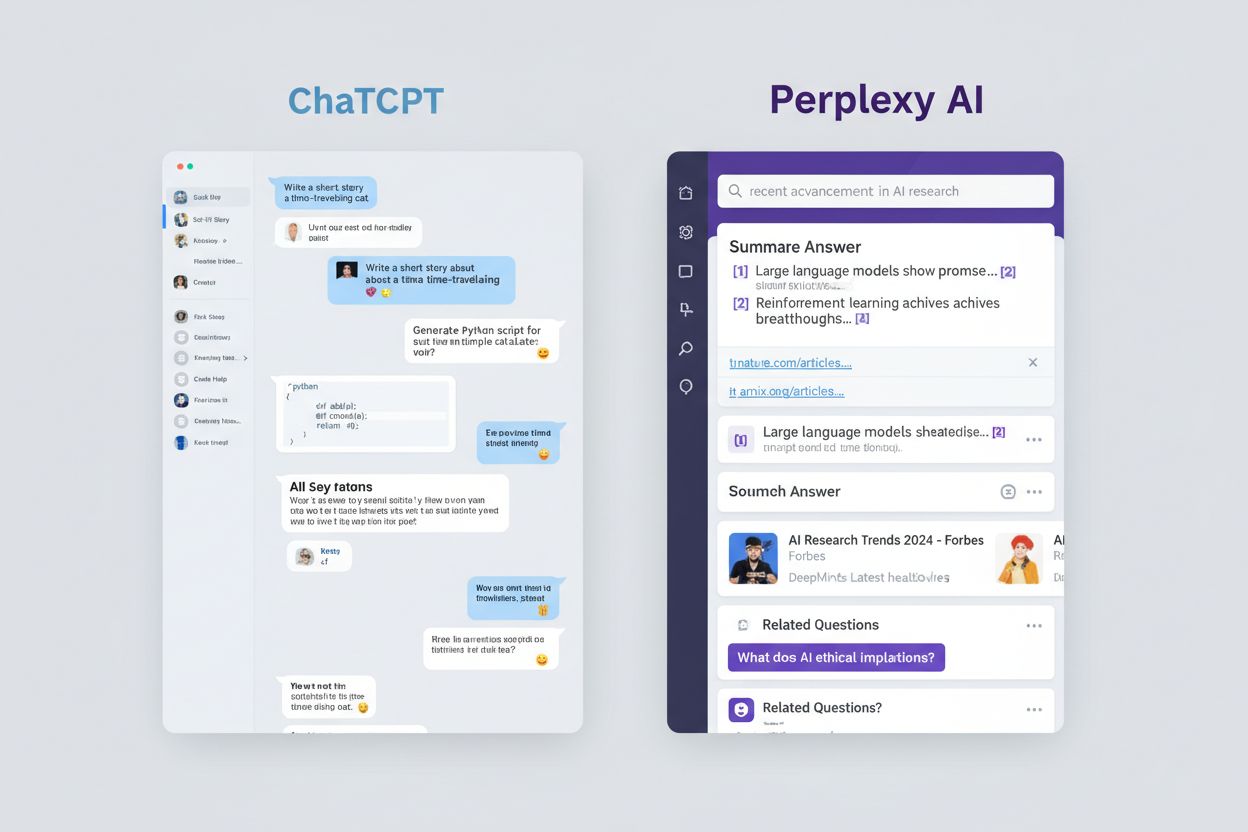
ChatGPT, developed by OpenAI, has become the gold standard for conversational AI since its November 2022 launch. With over 200 million users, it powers everything from creative writing to complex coding tasks. The platform offers multiple tiers: a free version with GPT-4.1 mini, ChatGPT Plus at $20/month for enhanced access, and ChatGPT Pro at $200/month for unlimited usage of advanced models.
Key strengths of ChatGPT include:
ChatGPT’s interface feels like a messaging app, with conversation history saved in a sidebar for easy reference. The platform supports over 50 languages and includes voice conversation features that users have praised for real-time translation during travel.
Perplexity AI positions itself as an “AI-powered Swiss Army Knife for information discovery,” combining large language models with real-time web search. Since its 2022 launch, the company has raised over $500 million in funding, signaling strong investor confidence in its research-focused approach. Like ChatGPT, Perplexity offers a free tier, Pro at $20/month, and Max at $200/month for power users.
Core strengths of Perplexity include:
Perplexity’s interface resembles a search engine more than a chat app, with answers presented alongside source snippets and follow-up question suggestions. The platform includes an “uncensored” R1 model for users seeking less filtered responses on sensitive topics, and its mobile app features an Assistant that can interact with other phone applications.
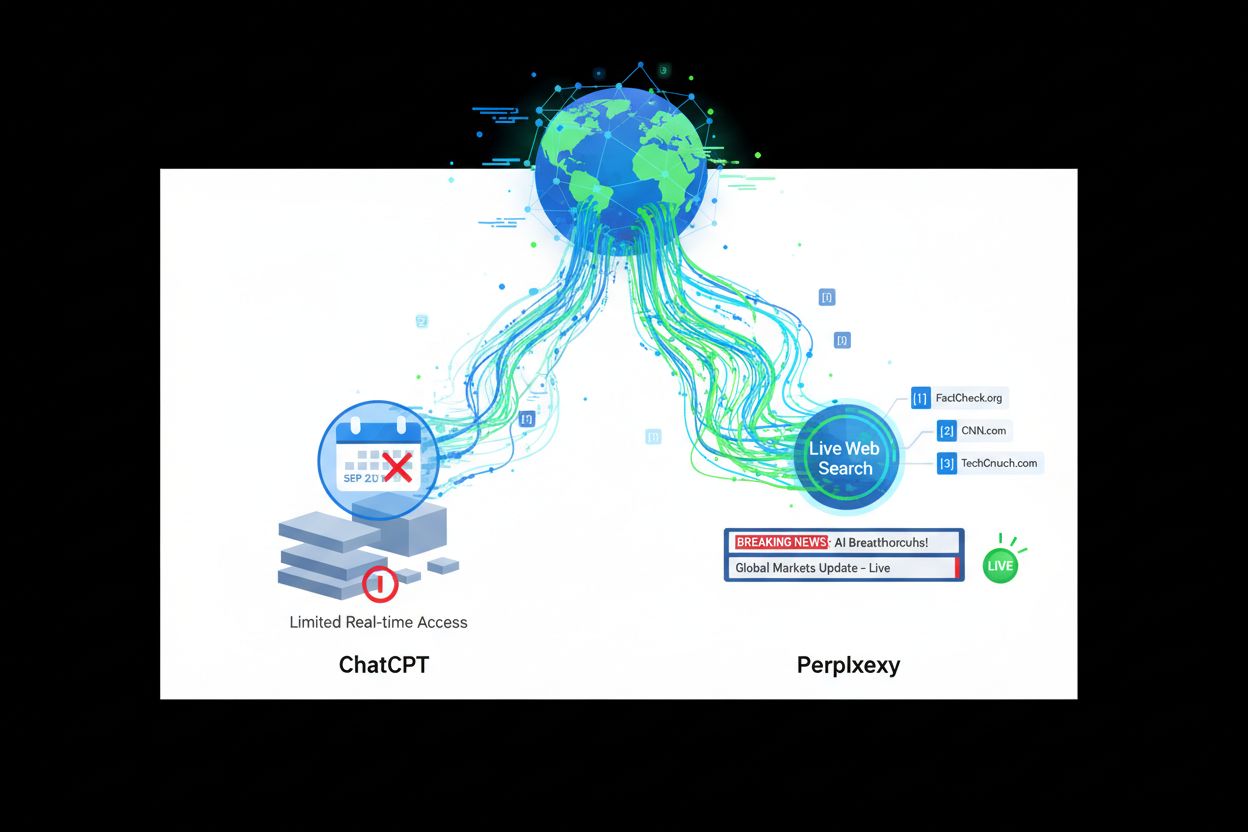
One of the most significant differences between these platforms lies in how they handle current information. Perplexity was built around real-time web search from inception, making it the default choice for queries about breaking news, recent events, or current data. Every Perplexity answer includes citations to sources it actually searched, providing transparency and verifiability.
ChatGPT historically relied on training data with knowledge cutoffs, meaning it couldn’t answer questions about recent events without explicit web browsing. However, OpenAI launched ChatGPT Search in late 2024, fundamentally changing this dynamic. Now ChatGPT can perform web searches when needed and provide cited sources in a sidebar. For questions about stock prices, today’s weather, or yesterday’s news, both platforms now deliver comparable results with proper citations.
The practical difference lies in default behavior: Perplexity always searches the web, ensuring answers are current, while ChatGPT decides whether to search based on the query. For research-heavy work requiring multiple sources, Perplexity’s Pro Search mode retrieves up to 20 sources compared to ChatGPT’s typical 5-10. One reviewer noted that asking about Spanish tariff news showed ChatGPT’s surprising accuracy advantage—it correctly cited 80% of Spain’s exports affected, while Perplexity provided outdated information. This demonstrates that real-time access doesn’t guarantee accuracy; the underlying model’s reasoning matters equally.
ChatGPT’s latest models represent a quantum leap in reasoning ability. OpenAI’s o-series models (o1, o3) are specifically designed for complex problem-solving, with o3 described as “our most powerful reasoning model” capable of state-of-the-art performance on coding, math, and science problems. These models can chain complex logic, use tools agentively, and even reduce errors on exceptionally difficult tasks. ChatGPT Pro users have access to o3-pro, which uses additional compute for the hardest questions.
Perplexity, while capable, focuses more on information synthesis than deep reasoning. Its strength lies in gathering data from multiple sources and presenting a comprehensive answer, rather than working through complex logical problems from first principles. However, Perplexity Pro users can access OpenAI’s o-series models, narrowing this gap. One comparison found that ChatGPT’s reasoning answers were more actionable and data-driven, while Perplexity’s were more general and balanced. For tasks requiring multi-step logical deduction or novel problem-solving, ChatGPT maintains a clear advantage.
When it comes to creative output, ChatGPT demonstrates superior storytelling and tone adaptation. The platform excels at generating marketing copy, fiction, poetry, and other creative content with natural language flow and emotional depth. Users rated ChatGPT 8.8/10 for creativity, compared to Perplexity’s more functional approach. ChatGPT can role-play characters, adapt to specific writing styles, and produce content that feels genuinely creative rather than formulaic.
Perplexity’s creative capabilities are functional but more research-oriented. It tends to produce well-structured, fact-based content with sources, making it excellent for reports, research summaries, and informational pieces. If you’re writing a marketing campaign or crafting a short story, ChatGPT is your tool. If you’re compiling a research report with proper citations, Perplexity excels. One test showed ChatGPT producing a more engaging film scenario with creative twists, while Perplexity delivered a more straightforward, academically-toned response. The difference reflects their core design: ChatGPT as a creative partner, Perplexity as a research assistant.
For developers and technical professionals, ChatGPT offers unmatched capabilities. GPT-4 and GPT-4.1 are optimized for coding tasks, and ChatGPT Plus includes Advanced Data Analysis (formerly Code Interpreter), which actually executes Python code in a sandbox. This means you can upload a CSV file, ask ChatGPT to analyze it, and watch it run code to generate insights, create visualizations, and explain results—all within the chat. This is a unique capability that sets ChatGPT apart.
Perplexity can assist with coding questions and even has Labs for creating small applications or dashboards, but it doesn’t provide a live coding environment. When tested on creating a password generator, ChatGPT produced fully functional, visually polished code that worked immediately, while Perplexity’s version had bugs requiring debugging. For complex coding projects, debugging, or data science work, ChatGPT is significantly more powerful. However, Perplexity’s ability to search for solutions and access multiple models (including GPT-4) makes it useful for quick coding questions or learning new frameworks.
The interfaces reflect each platform’s purpose. ChatGPT’s chat-based design feels like messaging an intelligent friend, with conversation history saved in a sidebar for easy reference. You can edit previous messages, regenerate responses, and maintain context across long conversations. The platform includes features like custom instructions (persistent preferences applied to all chats) and the ability to create custom GPTs—personalized AI assistants with specific skills or knowledge.
Perplexity’s search-engine-like interface prioritizes getting you answers quickly. Responses appear with inline citations, source snippets, and often interactive elements like embedded weather charts or product cards. The design encourages exploration through suggested follow-up questions. While Perplexity supports conversation threads, it doesn’t emphasize long-term chat history the way ChatGPT does. Mobile experiences differ too: ChatGPT’s app includes seamless voice conversation and real-time translation, while Perplexity’s Assistant can interact with other phone apps, making it more of a system-level AI helper.
For users who value ongoing dialogue and personalization, ChatGPT’s interface wins. For those seeking quick, sourced answers, Perplexity’s design is more efficient. Neither platform shows ads, and both are minimalist in design—a significant advantage over traditional search engines.
Both platforms offer remarkably similar pricing structures, making the choice less about cost and more about features:
| Plan | ChatGPT | Perplexity |
|---|---|---|
| Free | GPT-4.1 mini, limited GPT-4o access, web search, file uploads | Unlimited searches, 5 Pro searches/4 hours, basic models |
| Plus/Pro | $20/month - GPT-4o, o-series access, Advanced Data Analysis, image generation | $20/month - Multiple models, Pro Search (20 sources), Reasoning mode, file search |
| Max/Pro | $200/month - Unlimited usage, o3-pro access, priority features | $200/month - Unlimited Labs, frontier models, early access to new features |
| Enterprise | Custom pricing - Team collaboration, internal data connectors, SSO, analytics | $40/user - Internal knowledge search (500 files), multi-user support |
At $20/month, both offer exceptional value—essentially GPT-4-level intelligence with distinct advantages. ChatGPT Plus emphasizes creative and coding capabilities, while Perplexity Pro emphasizes research depth and model flexibility. The $200/month tier shows both companies targeting power users willing to pay for unlimited access and cutting-edge models. For most users, the free tiers are surprisingly capable, with Perplexity’s free tier being more generous for search-heavy use cases.
The answer depends entirely on your primary use case. Choose ChatGPT if you need: creative content generation, coding assistance, conversational AI for brainstorming, data analysis with code execution, or multimodal capabilities (images, audio, video). ChatGPT excels when you want an AI partner for extended dialogue and complex problem-solving.
Choose Perplexity if you need: real-time information with citations, research assistance, fact-checking, current events knowledge, or quick answers with source transparency. Perplexity shines when you want verifiable information gathered from multiple sources.
The optimal approach for many users is hybrid: Start with Perplexity to gather facts and sources on a topic, then feed those insights into ChatGPT for creative analysis or content generation. A researcher might use Perplexity to compile current data, then ChatGPT to write a compelling report. A marketer might use ChatGPT for campaign ideas, then Perplexity to verify claims with sources. Consider your workflow: Do you primarily need conversation and creativity, or information and verification? Your answer determines your priority platform.
As AI platforms become primary information sources, understanding how they cite your brand matters significantly. AmICited tracks how Perplexity, ChatGPT, Google AI Overviews, and other AI systems reference your content and brand. This monitoring reveals crucial insights: Are you being cited in AI-generated answers? How frequently? In what context? Are competitors mentioned more often?
The citation landscape differs between platforms. Perplexity’s transparent citation model means your sources are explicitly linked when referenced. ChatGPT’s citations (when using Search) are less prominent but still trackable. AmICited aggregates this data, showing you exactly where your brand appears in AI responses across multiple platforms. This visibility is increasingly important as users shift from traditional search to AI-powered answers. By monitoring your AI citation footprint, you can understand your brand’s visibility in the AI-driven information ecosystem and identify opportunities to increase your presence in AI-generated responses.
Both Perplexity and ChatGPT represent the cutting edge of AI technology, each excelling in different domains. ChatGPT’s strength lies in its conversational depth, creative capabilities, and advanced reasoning—making it ideal for professionals who need an AI thinking partner. Perplexity’s strength lies in its research efficiency, real-time information access, and transparent citations—making it ideal for those prioritizing factual accuracy and source verification.
Rather than viewing this as a binary choice, consider them complementary tools. Power users often maintain subscriptions to both platforms, leveraging each platform’s strengths. Start with the free tiers to test both platforms against your actual workflows. Pay attention to which one you naturally reach for first—that’s likely your priority platform. As both services continue evolving and adding features, the gap between them narrows, but their core philosophies remain distinct: ChatGPT as your creative and analytical partner, Perplexity as your research and verification assistant. The best choice is the one that aligns with how you work.
ChatGPT is a conversational AI assistant designed for dialogue, creative tasks, and problem-solving, while Perplexity is an AI-powered answer engine built for research with real-time web search and source citations. ChatGPT excels at creative writing and coding, while Perplexity excels at gathering current information with transparent sources.
Perplexity is specifically designed for research and fact-checking. It provides real-time web search, always includes source citations, and can retrieve up to 20 sources in Pro Search mode. ChatGPT can also perform research with its Search feature, but Perplexity's citation-first design makes it the preferred choice for verification-heavy work.
Absolutely! Many power users maintain subscriptions to both platforms. A common workflow is using Perplexity to gather facts and sources on a topic, then feeding those insights into ChatGPT for creative analysis or content generation. This hybrid approach leverages each platform's strengths.
ChatGPT is superior for creative writing, with users rating it 8.8/10 for creativity compared to Perplexity's more functional approach. ChatGPT excels at storytelling, tone adaptation, character development, and producing content with emotional depth and natural language flow.
Perplexity was built with real-time web search from day one, always providing current information. ChatGPT historically relied on training data with knowledge cutoffs but now offers ChatGPT Search for real-time access. Both can now provide current information, but Perplexity's default behavior is to always search the web.
Both offer free tiers and charge $20/month for their Plus/Pro plans, making them equally affordable at the standard tier. Perplexity's free tier is slightly more generous with unlimited searches versus ChatGPT's limited free access. Both offer $200/month Max/Pro tiers for power users.
ChatGPT is significantly better for coding. GPT-4 and GPT-4.1 are optimized for coding tasks, and ChatGPT Plus includes Advanced Data Analysis (Code Interpreter) that executes Python code in a sandbox. Perplexity can help with coding questions but lacks a live coding environment.
AmICited tracks how Perplexity, ChatGPT, Google AI Overviews, and other AI platforms cite your brand and content. This monitoring reveals whether you're being cited in AI-generated answers, how frequently, and in what context. Understanding your AI citation footprint is increasingly important as users shift from traditional search to AI-powered answers.
Discover how Perplexity, ChatGPT, and other AI platforms cite your brand. Track your visibility in AI-generated answers and understand your presence in the AI-driven information ecosystem.
Discover the key differences between ChatGPT and ChatGPT Search. Learn about real-time web browsing, knowledge cutoffs, accuracy, and when to use each version f...
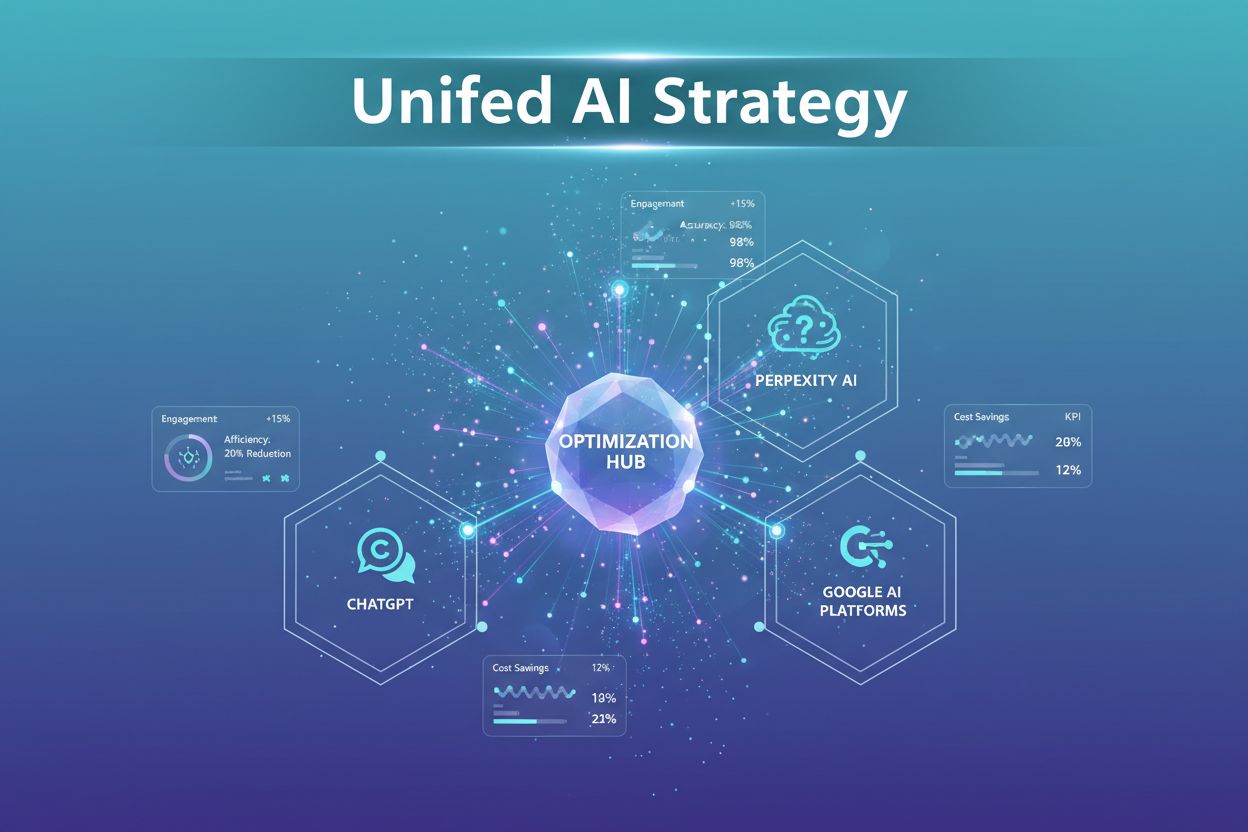
Master multi-platform AI visibility strategy. Learn how to optimize content for ChatGPT, Perplexity, and Google AI Overviews simultaneously with data-driven tac...

Learn how to build personal brand visibility in AI systems like ChatGPT, Google AI Overview, and Perplexity. Discover AI citation strategies to get recognized a...