Platform-Specific Nuances: Why One Size Doesn't Fit All in AI Optimization
Discover why ChatGPT, Perplexity, and Google AI Overviews require different optimization strategies. Learn platform-specific tactics to maximize your AI visibility across all channels.
Published on Jan 3, 2026.Last modified on Jan 3, 2026 at 3:24 am
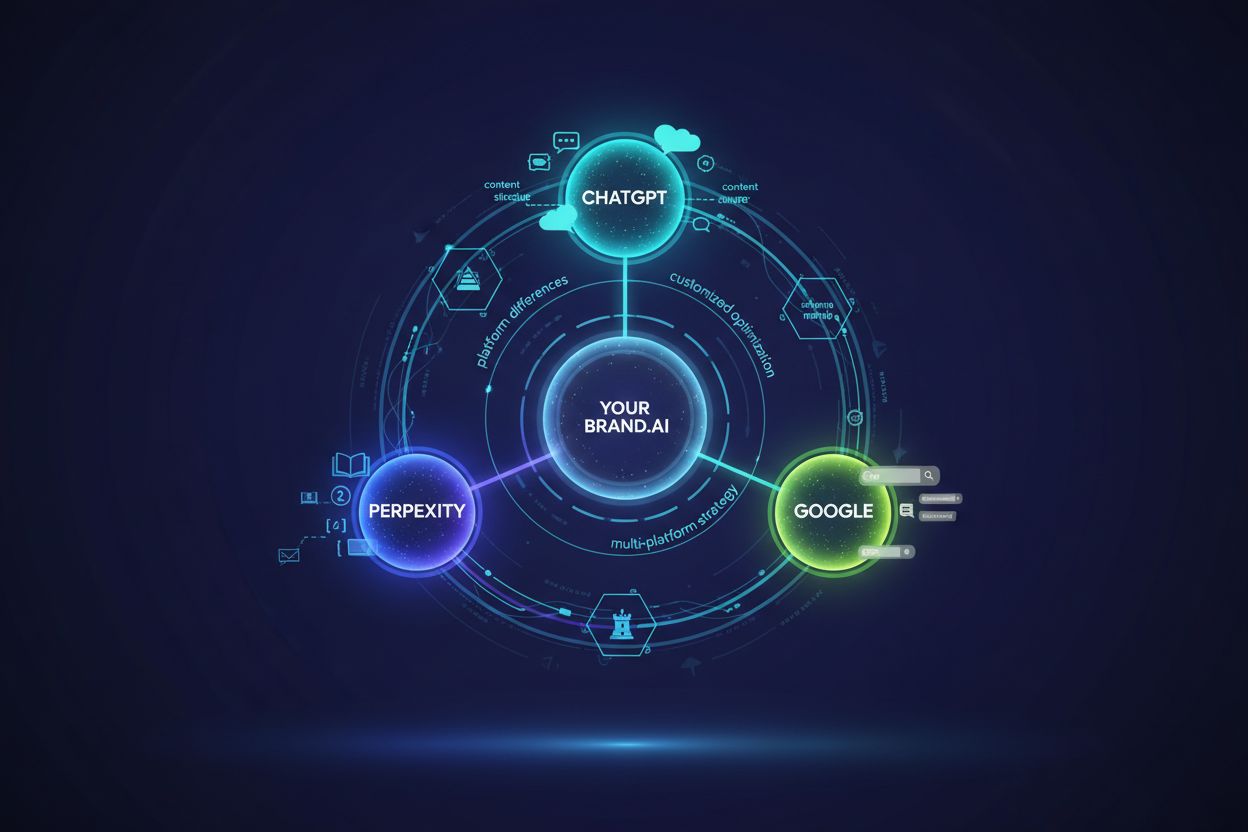
AI search isn’t monolithic—it’s a fragmented ecosystem where success on one platform doesn’t guarantee visibility on another. Three dominant platforms now control the majority of AI-powered search queries: ChatGPT with over 1 billion weekly queries, Perplexity with 780 million monthly searches, and Google AI Overviews reaching 90 billion monthly searches. Each platform operates with fundamentally different algorithms, trust models, and content preferences. A brand ranking #1 in ChatGPT’s responses might be completely invisible in Perplexity’s results, and vice versa. This fragmentation means that traditional SEO strategies—even modern ones—are no longer sufficient for comprehensive AI visibility. Organizations must now think in terms of platform-specific optimization rather than one-size-fits-all approaches.
Understanding Platform Trust Models
Each AI platform has developed distinct trust models that determine which sources appear in responses. These models reflect the platform’s philosophy about what constitutes reliable information, and understanding them is crucial for optimization.
Platform
Trust Model
Top Citation Sources (%)
Key Characteristic
ChatGPT
Internet Consensus Model
49% third-party, 28% industry publications, 15% brand-owned
Prioritizes democratic validation and user-generated consensus
Perplexity
Expert Authority Model
38% expert content, 24% research papers, 22% authoritative publications
Emphasizes credentials and academic rigor
Google
Brand Authority Model
52% brand-owned, 21% Google ecosystem, 18% third-party
Favors established entities and official sources
ChatGPT’s Internet Consensus Model reflects its training on broad internet data—it trusts what many sources agree on. Perplexity’s Expert Authority Model targets professionals who need credible, research-backed information. Google’s Brand Authority Model leverages its ecosystem advantage, preferring official company sources and established entities. These aren’t just philosophical differences; they create measurable variations in which content gets cited. Citation patterns differ by 25-50% between platforms, meaning a source that dominates ChatGPT results might barely appear in Perplexity. Understanding these trust models is the foundation for platform-specific optimization strategy.
Ready to Monitor Your AI Visibility?
Track how AI chatbots mention your brand across ChatGPT, Perplexity, and other platforms.
ChatGPT dominates consumer search with 1 billion+ weekly queries, making it the most-used AI search interface globally. The platform’s approach to content selection reveals a preference for third-party validation and consensus-driven sources. Reddit discussions, customer reviews, and user-generated content carry significant weight because they represent real-world validation from actual users. This explains why ChatGPT produces the longest average responses at 1,686 characters—the platform aims to synthesize multiple perspectives and provide comprehensive answers that reflect broad agreement.
The 71.03% domain duplication rate in ChatGPT results is the highest among major platforms, indicating that the algorithm repeatedly cites the same trusted sources across different queries. This creates both opportunity and challenge: if your domain becomes trusted, you’ll appear frequently; if you’re not in the consensus set, you’ll struggle for visibility.
Key optimization priorities for ChatGPT:
Build third-party citations: Get mentioned in reviews, industry publications, and user communities
Encourage user-generated content: Reviews, testimonials, and case studies signal trustworthiness
Establish domain authority: Focus on E-E-A-T signals that build consensus trust
Optimize for Reddit and review platforms: These sources carry disproportionate weight in ChatGPT’s training data
Use multiple internal sources: Link to different pages within your domain to increase citation frequency
Perplexity’s Professional-First Strategy
Perplexity represents the fastest-growing AI search platform with 780 million monthly searches, and it’s deliberately targeting business professionals and researchers rather than general consumers. This strategic positioning creates a fundamentally different content preference: Perplexity trusts expert sources and research papers over consensus. The platform maintains a consistent 5-source citation pattern, meaning it typically cites exactly five sources per response, each carefully selected for credibility rather than popularity.
The 25.11% domain duplication rate is significantly lower than ChatGPT’s, indicating that Perplexity distributes citations across a broader range of sources. This creates opportunity for specialized, expert-focused content to break through without needing massive domain authority. Perplexity shows a preference for 10-15 year old domains (26.16%), suggesting that established expertise matters more than brand size.
Key characteristics of Perplexity optimization:
Expert credentials matter most: Author bios, certifications, and credentials are heavily weighted
Structured, scannable content: Perplexity’s algorithm favors clear headings, lists, and organized information
Niche authority beats broad reach: Deep expertise in specific domains outperforms general content
Citation quality over quantity: Five carefully selected sources beat fifty mediocre ones
Professional networks matter: LinkedIn profiles, industry associations, and professional credentials carry weight
Stay Updated on AI Visibility Trends
Get the latest insights on AI mentions, brand monitoring, and optimization strategies.
Google AI Overviews’ Ecosystem Integration
Google AI Overviews operate at massive scale with 90 billion+ monthly searches, but they function differently than standalone AI platforms because they’re integrated across Google’s entire ecosystem. The platform favors brand-owned content (52%) and heavily weights Google ecosystem sources (21%), including Google Scholar, Google News, and Google-indexed content. This creates a significant advantage for established brands with official websites and Google Business Profiles.
Google’s approach produces medium-length responses averaging 997 characters, with the highest complexity level at 12.75 Coleman-Liau readability index. The platform cites professional networks like LinkedIn and Indeed, reflecting its integration with Google’s broader business tools. The 9.26 links per response average is notably higher than competitors, indicating that Google wants to drive traffic to multiple authoritative sources.
Key optimization priorities for Google AI Overviews:
Optimize your Google Business Profile: This is often the first citation in Google AI Overviews
Build brand-owned content authority: Official company pages and branded content get preferential treatment
Implement structured data markup: Schema.org markup helps Google understand and cite your content
Leverage Google ecosystem: Get indexed in Google Scholar, Google News, and other Google properties
Create comprehensive resource pages: Google favors in-depth, authoritative content that serves as a reference
Build professional network presence: LinkedIn, Indeed, and other professional platforms influence citations
Content Structure Differences Across Platforms
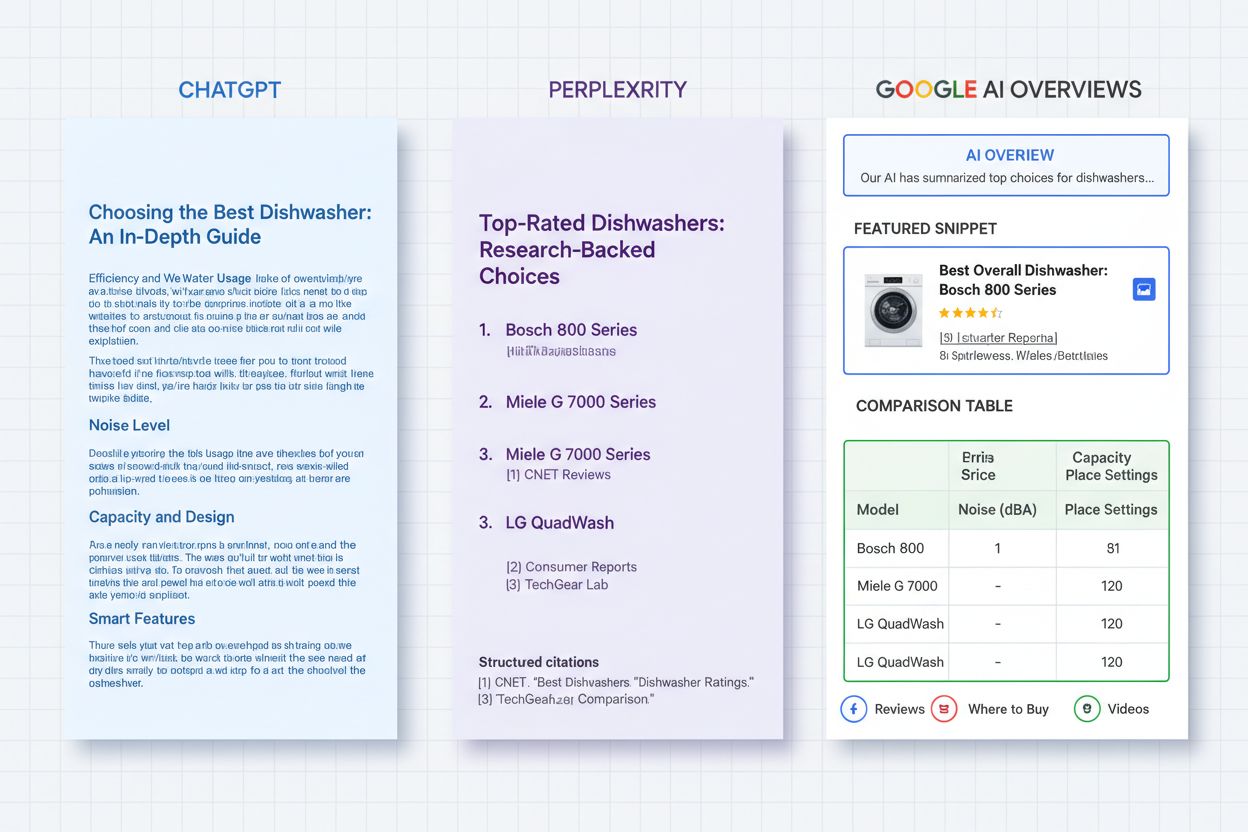
The way you structure content dramatically affects how AI platforms parse, understand, and cite it. ChatGPT prefers longer, detailed content with multiple sources woven throughout—think 2,000-3,000 word articles with diverse citations. Perplexity favors structured, expert-focused content with clear hierarchies—numbered lists, bold key terms, and scannable sections work best. Google AI Overviews reward comprehensive, schema-marked content that clearly establishes authority and provides multiple entry points for citations.
The importance of headings, lists, and tables cannot be overstated. These structural elements help AI models understand content hierarchy and extract relevant information more accurately. When you use proper heading hierarchy (H1, H2, H3), you’re essentially telling the AI: “This is the main topic, these are subtopics, and these are supporting details.” Lists and tables make information scannable and quotable, increasing the likelihood that an AI will cite your specific content rather than paraphrasing competitors.
Platform
Ideal Content Length
Preferred Format
Citation Count
Key Optimization Focus
ChatGPT
2,000-3,500 words
Narrative with embedded sources
8-12 citations
Comprehensive coverage, multiple perspectives
Perplexity
1,500-2,500 words
Structured with clear hierarchy
5-7 citations
Expert credentials, research backing
Google
2,500-4,000 words
Comprehensive with schema markup
9-15 citations
Authority signals, multiple formats
Here’s an example of JSON-LD schema markup that helps Google understand your article structure:
Why does structure matter for AI parsing? Because AI models process content sequentially, and clear structure helps them understand relationships between ideas. When you use proper markup, you’re reducing ambiguity and making it easier for the AI to extract, understand, and cite your content accurately. Poorly structured content—even if it contains great information—gets overlooked because the AI struggles to parse it efficiently.
Domain Age and Source Preferences
Domain age preferences reveal how differently platforms evaluate source credibility. Google AI Overviews show the strongest preference for established domains, with 49.21% of citations going to domains over 15 years old. This reflects Google’s philosophy that longevity signals trustworthiness and stability. ChatGPT takes a more balanced approach, citing domains over 15 years old 45.80% of the time while still including newer domains (11.99% under 5 years), suggesting that consensus matters more than age.
Perplexity prefers 10-15 year old domains (26.16%), indicating a sweet spot where domains have established expertise without being so old that their information might be outdated. Bing Copilot shows the most openness to newer domains, with 18.85% of citations going to domains under 5 years old, suggesting that recency and innovation matter more in Bing’s trust model.
Domain Age Preference Comparison:
Age Range
Google AIOs
ChatGPT
Perplexity
Bing Copilot
Under 5 years
8.2%
11.99%
15.3%
18.85%
5-10 years
12.4%
18.2%
22.1%
19.4%
10-15 years
18.3%
19.1%
26.16%
21.2%
Over 15 years
49.21%
45.80%
24.8%
28.1%
These preferences have significant implications for new versus established brands. New companies can’t rely on domain age to build credibility—they must focus on expert credentials, research backing, and third-party validation. Established brands should leverage their domain history while ensuring content remains current and relevant. Niche-specific variations matter too; in emerging fields like AI, newer domains with cutting-edge expertise might outperform older, less specialized competitors.
Platform-Specific Optimization Strategy
Effective AI optimization requires a tiered approach: build a universal foundation first, then add platform-specific enhancements. The universal foundation includes quality content, structured data markup, E-E-A-T signals, and technical SEO basics. These elements work across all platforms and should never be compromised. Once this foundation is solid, you can layer platform-specific optimizations that maximize visibility where your audience searches.
Prioritization depends on your business type. B2B SaaS companies should allocate 40% effort to Perplexity, 35% to ChatGPT, and 25% to Google, since business professionals use Perplexity for research and ChatGPT for quick answers. B2C e-commerce brands should reverse this, focusing 45% on ChatGPT, 35% on Google, and 20% on Perplexity, since consumers use ChatGPT for product recommendations and Google for shopping. Professional services firms should emphasize 45% Perplexity, 30% Google, and 25% ChatGPT, leveraging Perplexity’s expert-focused audience. Enterprise software companies should split 40% Perplexity, 35% Google, and 25% ChatGPT, balancing technical decision-makers with enterprise search patterns.
Platform-specific optimization priorities by business type:
B2B SaaS: Perplexity (40%), ChatGPT (35%), Google (25%)
B2C E-Commerce: ChatGPT (45%), Google (35%), Perplexity (20%)
Professional Services: Perplexity (45%), Google (30%), ChatGPT (25%)
Enterprise Software: Perplexity (40%), Google (35%), ChatGPT (25%)
Timeline expectations matter for planning. Results typically appear within 2-8 weeks depending on platform, with Perplexity showing the fastest response (2-3 weeks), ChatGPT in the middle (3-5 weeks), and Google the slowest (5-8 weeks). This variation reflects how frequently each platform updates its training data and indexes new content. Don’t expect immediate results; instead, plan for sustained optimization over 2-3 months to see meaningful citation increases.
Measurement and Tracking Across Platforms
Measuring AI visibility requires platform-specific approaches because each platform surfaces different metrics. ChatGPT visibility is best tracked through weekly prompt testing—regularly searching for your target keywords and monitoring whether your domain appears in responses. Citation frequency tracking reveals whether you’re appearing more or less frequently over time. Perplexity requires UTM-tagged links and GA4 tracking to monitor traffic from citations, plus clickable source monitoring to see when your domain appears as a clickable link versus just mentioned text.
Google AI Overviews can be tracked through Search Console monitoring, which now includes AI Overview performance data, plus Knowledge Panel status tracking to ensure your entity information is correctly displayed. Common metrics across all platforms include citation position (first source cited gets more clicks), citation frequency (how often you appear), and citation context (what topic you’re cited for). These metrics reveal whether your optimization is working and where to focus next.
AI Overview appearance, Knowledge Panel status, citation position
Search Console, SERP tracking
Google Search Console, SERP tools
Platform-specific tracking matters because what works for one platform might not work for another. ChatGPT’s citation frequency might increase while Perplexity’s decreases, indicating that your optimization is working for one audience but not another. Tools like AmICited.com help consolidate this tracking across platforms, providing unified visibility into your AI search performance. Without platform-specific measurement, you’re flying blind—you won’t know which optimizations are actually working or where to focus your efforts next.
Common Mistakes and How to Avoid Them
The most costly mistake is optimizing for only one platform, which causes you to miss 60-70% of potential AI search traffic. Organizations that focus exclusively on Google miss the rapidly growing Perplexity audience and ChatGPT’s massive consumer reach. The solution is building a platform-aware strategy that addresses all three major platforms simultaneously. This doesn’t mean equal effort—it means strategic allocation based on your audience—but it does mean intentional optimization for each.
Assuming SEO best practices work everywhere is another critical error. Traditional SEO focuses on keyword density, backlinks, and domain authority—factors that matter for Google but carry different weight in ChatGPT and Perplexity. ChatGPT cares more about consensus and third-party validation than backlinks. Perplexity prioritizes expert credentials over domain authority. The solution is understanding each platform’s specific ranking factors and optimizing accordingly. A strategy that works perfectly for Google might completely fail for Perplexity.
Not tracking platform-specific metrics leaves you unable to measure success. Many organizations track Google rankings obsessively but have no idea whether they’re appearing in ChatGPT or Perplexity results. The solution is implementing platform-specific tracking from day one, using GA4 UTM parameters for Perplexity, weekly prompt testing for ChatGPT, and Search Console monitoring for Google. Without this data, you can’t optimize effectively.
Expecting immediate results causes premature strategy abandonment. AI platforms update their indexes and training data on different schedules, and citation changes take time to propagate. The solution is planning for 2-8 week timelines and measuring progress monthly rather than weekly. Real example: A B2B SaaS company optimized for Perplexity but saw no results after two weeks and abandoned the strategy. Three weeks later, citations suddenly increased 300%. They missed the results because they weren’t patient enough.
Ignoring platform-specific content preferences means your content doesn’t align with how each platform wants information structured. ChatGPT wants comprehensive, multi-sourced content. Perplexity wants expert-focused, structured content. Google wants schema-marked, authoritative content. The solution is creating content variations or ensuring your content meets all three standards simultaneously. This doesn’t mean writing three separate articles—it means structuring your content to serve all platforms effectively.
Future Trends and Emerging Opportunities
The AI search landscape is evolving rapidly, and several trends will shape optimization strategy through 2025-2026. Here’s what to watch:
Increasing platform differentiation: ChatGPT, Perplexity, and Google will continue diverging in their trust models and citation patterns, making platform-specific optimization increasingly important rather than less important.
Emerging AI platforms gaining traction: Claude, Grok, and other new AI search interfaces are attracting users and developing their own citation patterns, creating new optimization opportunities for early movers.
Multimodal search optimization: AI platforms are moving beyond text to include images, videos, and interactive content, requiring optimization strategies that address multiple content formats simultaneously.
Voice-first optimization: As voice interfaces become more prevalent, optimizing for conversational queries and natural language patterns will become critical for AI visibility.
Real-time content freshness importance: AI platforms are increasingly prioritizing recent, up-to-date content, making content refresh cycles and publication dates more important than ever.
Predictive content strategies: Organizations will shift from reactive optimization (responding to current platform preferences) to predictive optimization (anticipating platform changes and building content that will remain relevant).
The organizations that succeed in 2025-2026 will be those that treat AI search as a distinct channel requiring dedicated strategy, measurement, and optimization—not as an afterthought to traditional SEO. The platforms are here to stay, they’re growing rapidly, and they’re fundamentally changing how people find information. The question isn’t whether to optimize for AI search; it’s whether you’ll do it strategically or fall behind competitors who do.
Frequently asked questions
Which AI platform should I prioritize first for optimization?
Prioritization depends on your business type and audience. B2B SaaS companies should focus on Perplexity (40% effort) since business professionals use it for research. B2C e-commerce brands should prioritize ChatGPT (45% effort) for consumer reach. Enterprise companies should balance Perplexity and Google. Start with the platform where your target audience spends the most time searching.
How long does it take to see results from platform-specific optimization?
Results typically appear within 2-8 weeks depending on the platform. Perplexity shows the fastest response (2-3 weeks), ChatGPT in the middle (3-5 weeks), and Google the slowest (5-8 weeks). This variation reflects how frequently each platform updates its training data. Plan for sustained optimization over 2-3 months to see meaningful citation increases across all platforms.
Can I use the same content strategy for all three platforms?
Partially. Build a universal foundation of high-quality, comprehensive content with proper structured data and E-E-A-T signals. Then add platform-specific enhancements: third-party validation for ChatGPT, expert credentials for Perplexity, and schema markup for Google. You don't need three separate articles—just ensure your content meets all three platforms' standards simultaneously.
What's the most important metric to track for AI visibility?
Citation frequency and position are critical across all platforms. For ChatGPT, track how often your domain appears in responses. For Perplexity, monitor referral traffic from clickable citations using GA4 UTM parameters. For Google, use Search Console to track AI Overview appearances. Without platform-specific tracking, you can't measure success or optimize effectively.
How often should I update content for each platform?
Content freshness matters increasingly for all platforms, but update frequency depends on your niche. For fast-moving industries (tech, finance), refresh content monthly. For evergreen topics, quarterly updates suffice. The key is ensuring publication dates are current and information remains accurate. AI platforms increasingly prioritize recent, up-to-date content over older material.
Do I need different content for each platform, or can one article work for all?
One well-structured article can work for all platforms if it meets their combined requirements: comprehensive length (2,000-3,500 words), clear hierarchy with proper headings, expert credentials, research backing, schema markup, and multiple citation opportunities. The key is structure and depth, not creating separate articles. Focus on quality and organization rather than platform-specific rewrites.
What's the biggest difference in optimization approach between platforms?
ChatGPT prioritizes consensus and third-party validation, Perplexity emphasizes expert credentials and research backing, and Google favors brand authority and official sources. This means your optimization strategy must address different trust models: build third-party citations for ChatGPT, establish expert credentials for Perplexity, and optimize your official brand presence for Google.
How do I measure ROI from platform-specific optimization?
Track referral traffic from each platform using GA4 UTM parameters, monitor citation frequency through platform-specific testing, and measure conversion rates from AI-sourced traffic. Compare the cost of optimization effort against the revenue generated from each platform. Most organizations find that platform-specific optimization delivers 2-3x better ROI than generic SEO because it targets high-intent audiences actively searching for solutions.
Monitor Your AI Visibility Across All Platforms
Track how your brand appears in ChatGPT, Perplexity, and Google AI Overviews with AmICited. Get real-time insights into your platform-specific performance and optimize where it matters most.
Cross-Platform AI Visibility: Optimizing for ChatGPT, Perplexity, and Google Simultaneously
Master multi-platform AI visibility strategy. Learn how to optimize content for ChatGPT, Perplexity, and Google AI Overviews simultaneously with data-driven tac...
AI Search Predictions: What Marketers Should Prepare For
Discover critical AI search trends and predictions for 2026. Learn how to optimize for ChatGPT, Perplexity, Google AI Overviews, and emerging AI platforms. Esse...
How to Optimize for Multiple AI Platforms: ChatGPT, Perplexity, Claude & Google AI
Master multi-platform AI optimization. Learn distinct ranking factors for ChatGPT, Perplexity, Claude, and Google AI Overviews to maximize brand visibility acro...
18 min read
Cookie Consent We use cookies to enhance your browsing experience and analyze our traffic. See our privacy policy.