
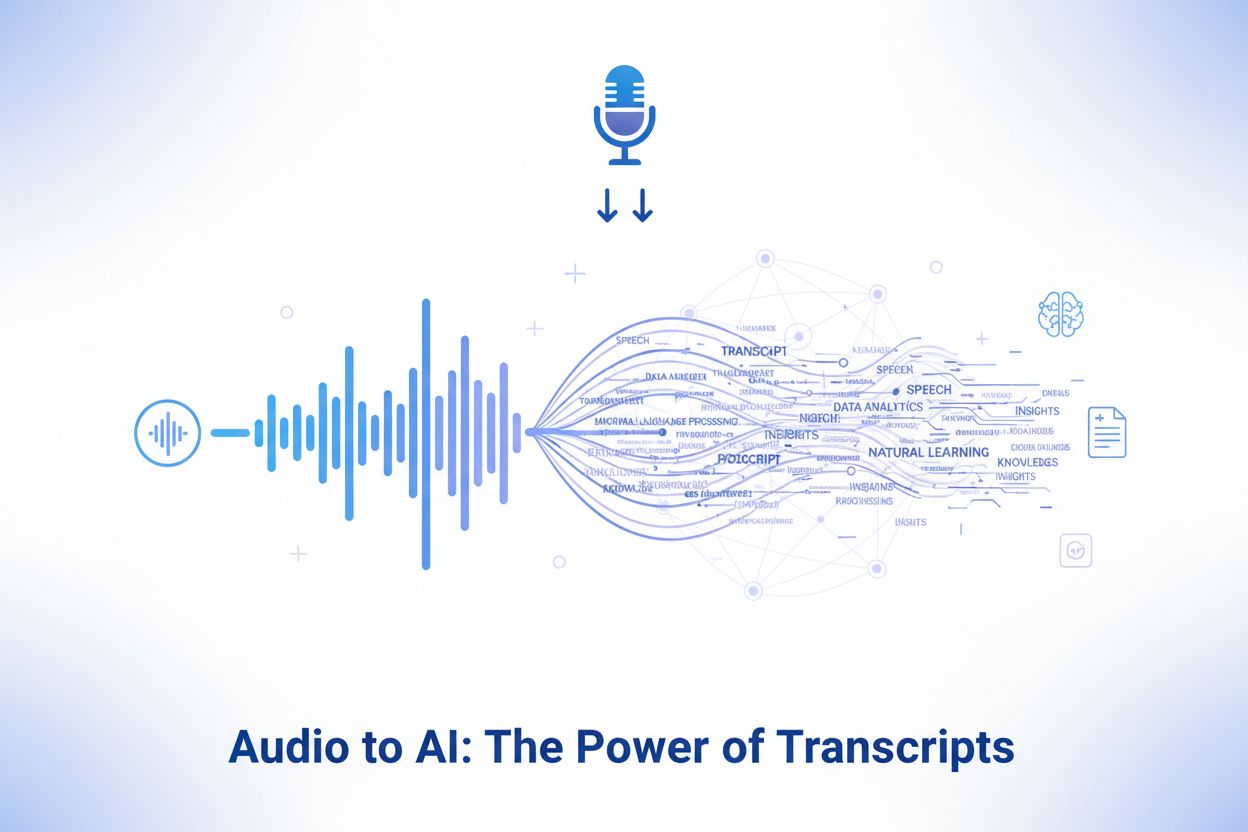
Podcast Transcripts: Making Audio Content Visible to AI Search
Learn how podcast transcripts unlock AI visibility, boost citations, and transform audio content into discoverable assets for ChatGPT, Perplexity, and Google AI...
9 min read
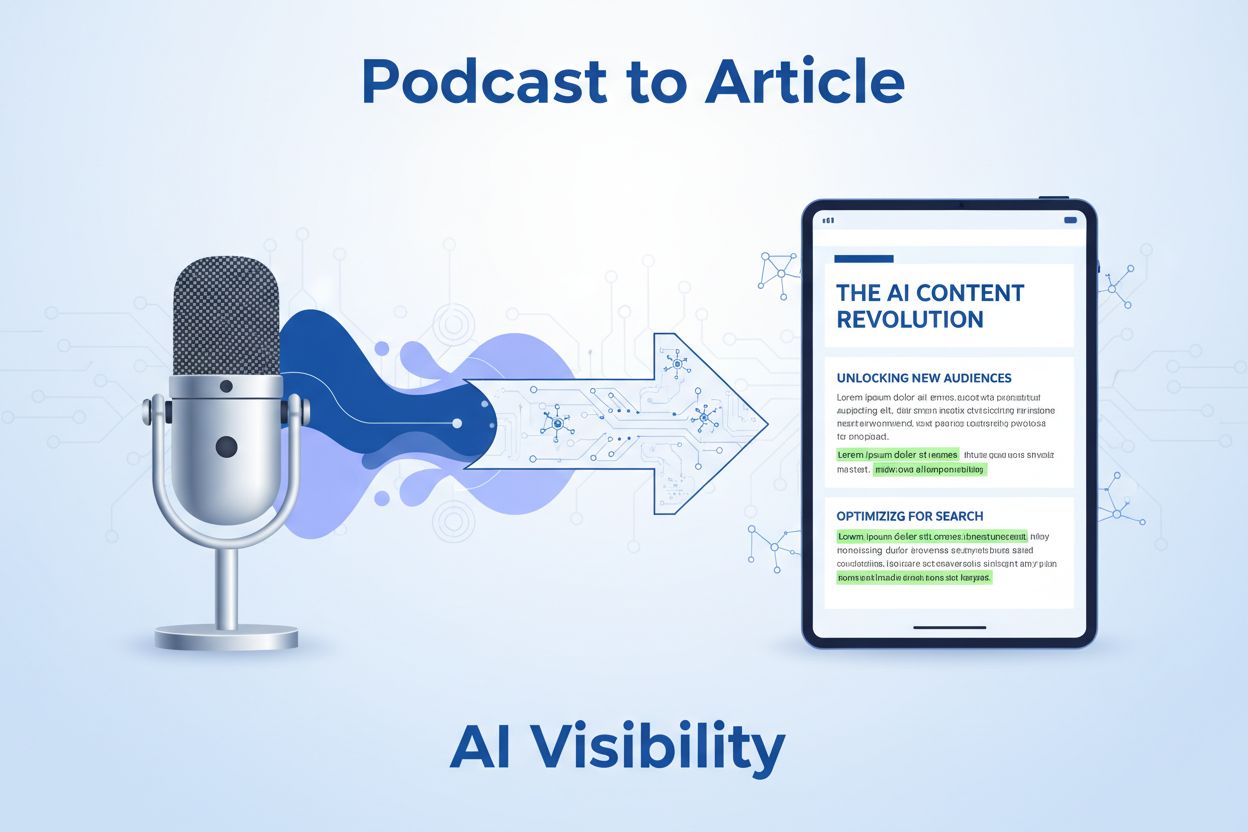
Learn how to convert podcasts to articles and boost AI visibility. Discover transcription strategies, optimization techniques, and tools to get your brand cited by ChatGPT, Perplexity, and Google AI.
Podcasts represent one of the fastest-growing content mediums, yet they remain largely invisible to AI systems without proper conversion to text-based formats. When you publish an episode exclusively in audio form, search engines and language models cannot index, analyze, or cite your insights because they operate on text-based data. This creates a significant indexing problem: your valuable ideas, research, and expertise exist in a format that AI cannot access, meaning you’re missing opportunities for AI citations and mentions in generated content. The opportunity gap is substantial—while your podcast reaches human listeners, it fails to reach the AI systems that increasingly influence information discovery and knowledge synthesis. Converting your audio content into articles bridges this critical gap, making your expertise accessible to the AI systems that shape modern information consumption.
AI training and LLM visibility depend fundamentally on how language models encounter and process text during their training phases. Large language models learn by identifying patterns in massive datasets of text, and they develop the ability to reference, cite, and build upon the concepts they’ve encountered most frequently in their training data. This connects directly to Rand Fishkin’s concept of “mentions as currency”—the idea that in an AI-driven world, being mentioned and discussed in text-based content becomes as valuable as traditional hyperlinks were in the SEO era. When AI systems generate responses, they draw from patterns they’ve learned, meaning content that appears more frequently in their training data has greater influence on their outputs. The more your ideas appear in text-based formats across the internet, the more likely they are to be referenced, synthesized, and cited by AI systems when they generate content. This represents a fundamental shift in how visibility and authority are built in the age of artificial intelligence.
Converting podcasts to articles creates multiple touchpoints for AI across different content formats and distribution channels, exponentially increasing your visibility to language models and search systems. A single podcast episode can generate a transcript, show notes, a comprehensive blog article, YouTube descriptions, social media snippets, and newsletter content—each of these formats provides another opportunity for AI systems to encounter and learn from your ideas. This content repurposing efficiency means you’re not creating new ideas; you’re strategically packaging your existing expertise in formats that AI systems can actually read and cite. The following table illustrates how one podcast episode generates multiple AI-visible assets:
| Content Format | AI Visibility | Indexing Potential | Citation Likelihood |
|---|---|---|---|
| Audio File Only | None | Not indexed | Very Low |
| Transcript Only | Basic | Indexed but raw | Low |
| Blog Article | High | Fully indexed | High |
| YouTube Description | Medium | Indexed with video | Medium |
| Show Notes | Medium | Indexed separately | Medium |
| Newsletter Archive | High | Indexed if public | High |
| Social Media Posts | Low-Medium | Limited indexing | Low |
By distributing your podcast content across these formats, you’re creating a comprehensive multi-channel distribution strategy that ensures AI systems encounter your expertise repeatedly and in optimized formats.
Transcription serves as the foundational layer for all AI-readable podcast content, making accuracy and proper formatting essential for downstream success. A high-quality transcript must include not just the spoken words but also speaker identification and timestamps, which help AI systems understand context, attribute ideas to specific speakers, and allow readers to navigate to relevant sections. The trade-off between automated transcription (fast, affordable, but potentially 85-95% accurate) and human transcription (slower, more expensive, but 99%+ accurate) depends on your content complexity, budget, and AI visibility goals. Technical jargon, multiple speakers with similar voices, and industry-specific terminology all increase the importance of human review or hybrid approaches that combine automated transcription with human editing. Investing in accurate transcription isn’t just about readability for human audiences—it’s about ensuring that AI systems receive clean, correctly interpreted data that accurately represents your ideas and expertise.
The difference between a raw transcript and an AI-optimized article is substantial and requires more than simple text cleanup or grammar correction. Transforming a transcript into an article involves restructuring content into logical sections with clear headings, breaking up long speaker monologues into digestible paragraphs, and adding contextual information that wasn’t necessary in audio form but enhances understanding in written format. This process includes content optimization such as adding relevant examples, clarifying references, expanding on complex concepts, and improving overall readability through better sentence structure and flow. You’re essentially translating from the conversational, meandering style of spoken dialogue into the organized, scannable format that both humans and AI systems prefer. This transformation also provides opportunities to add metadata, internal links, and supporting information that enriches the content for AI systems trying to understand context and relationships between ideas. The article becomes a more complete, more discoverable, and more citable version of your original podcast conversation.
Optimizing podcast articles for both SEO and AEO (Answer Engine Optimization) ensures your content ranks well in traditional search and performs effectively in AI-generated responses. Keyword research should identify terms your target audience uses when searching for solutions to problems your podcast addresses, and these keywords should be naturally integrated throughout your article structure. Metadata optimization includes crafting compelling title tags, meta descriptions, and header tags that help both search engines and AI systems understand your content’s relevance and value. The evolution from SEO to AEO reflects how AI systems now mediate information discovery, requiring content that directly answers specific questions and provides clear, authoritative information. Best practices for optimizing podcast articles include:
These practices ensure your podcast articles are discoverable and citable by both traditional search engines and modern AI systems.
Several conversion tools and automation platforms have emerged to streamline the podcast-to-article process, each offering different levels of automation and customization. Swell AI specializes in converting podcast episodes into blog posts, social media content, and newsletters with minimal manual intervention, using AI to understand context and generate relevant supplementary content. Descript combines transcription with editing capabilities, allowing you to edit audio by editing text and automatically generating show notes and articles from your transcript. Otter.ai provides highly accurate transcription with speaker identification and integrates with various platforms for easy distribution and sharing. Beyond these primary tools, platforms like AmICited.com serve a different but complementary purpose—monitoring where and how your content is cited by AI systems, providing visibility into your AI citation performance. The choice of tools depends on your budget, desired level of automation, accuracy requirements, and integration needs with your existing content management systems.
Strategic distribution of your converted podcast articles across multiple platforms amplifies their visibility to AI systems and ensures your expertise reaches audiences wherever they consume content. Publishing your article on your blog creates a permanent, indexed home for the content that search engines and AI systems can reference repeatedly. Simultaneously, distributing excerpts and links across social media platforms, email newsletters, and industry-specific communities increases the number of places where AI systems encounter your ideas. YouTube descriptions for video versions of your podcast should include substantial excerpts from your article, creating another indexed touchpoint for AI systems. The key to effective multi-channel strategy is consistency—ensuring that the same core ideas and messaging appear across channels while adapting format and length to each platform’s requirements. This repetition and consistency signal to AI systems that your ideas are important, well-established, and worth referencing in their generated outputs.
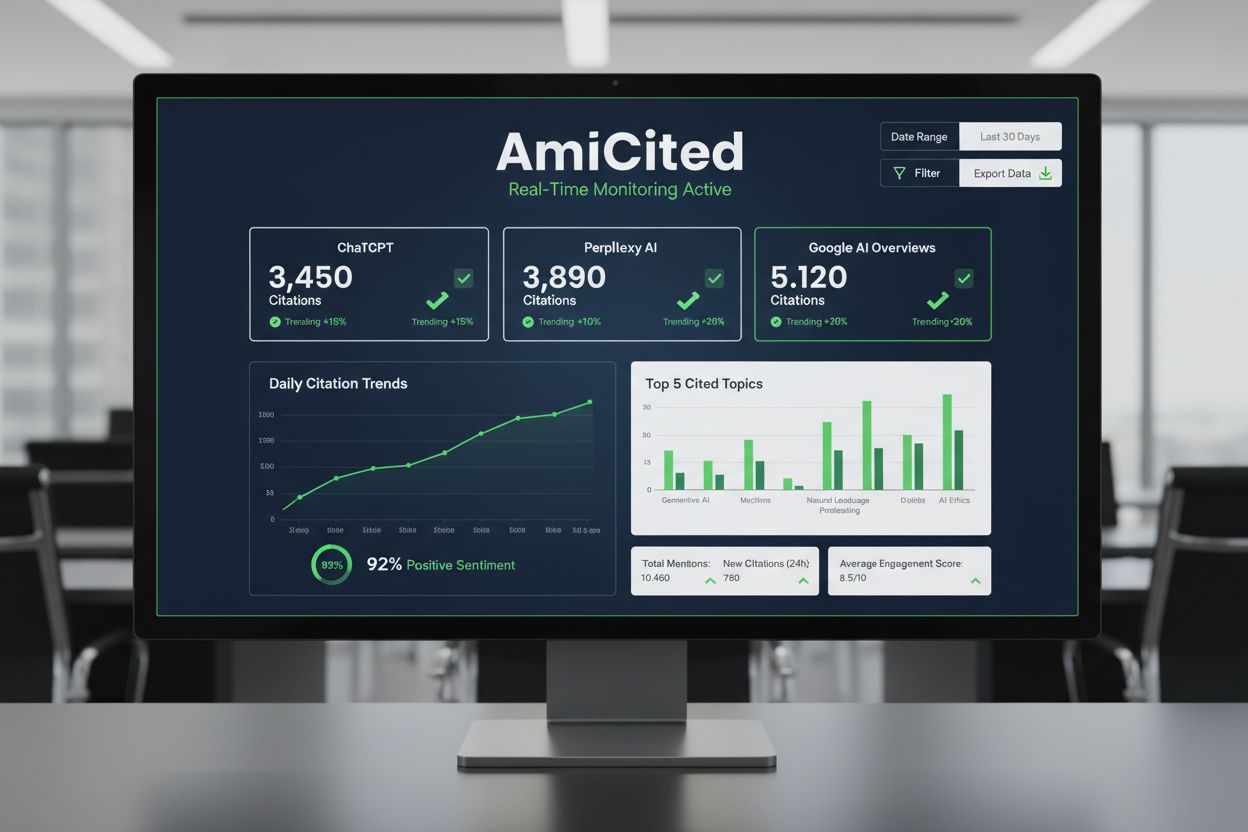
Monitoring your AI citations requires dedicated tools and a systematic approach to understanding how often and where your content appears in AI-generated responses. AmICited.com and similar monitoring tools allow you to track when your brand, ideas, and content are mentioned by AI systems, providing visibility into your AI citation performance and helping you understand which topics and formats generate the most AI visibility. Beyond simple mention counting, you should track which specific articles or ideas are most frequently cited, which AI systems reference your work most often, and how your brand mentions in AI outputs compare to competitors in your space. This data-driven approach to analytics reveals which podcast topics resonate most with AI systems, which article formats perform best, and where you should focus future content creation efforts. By iterating based on this data—doubling down on high-performing topics and formats while adjusting underperforming content—you continuously improve your AI visibility and citation rates over time.
Begin your podcast-to-article strategy by selecting your top-performing episodes—those with the highest listener engagement, most downloads, or strongest audience feedback—as your initial conversion candidates. Start with a systematic approach that establishes a repeatable process: transcription, editing, article writing, optimization, and distribution across your chosen platforms. Rather than attempting to convert your entire back catalog immediately, focus on building momentum with a consistent cadence of converted episodes, perhaps committing to converting one or two episodes per week or month depending on your resources. Document your process, track which tools and approaches yield the best results, and refine your workflow based on what you learn from your first conversions. This implementation strategy transforms podcast-to-article conversion from an overwhelming project into a manageable, sustainable practice that continuously increases your visibility to AI systems and expands your reach beyond audio-only audiences.
A transcript is a verbatim record of everything said during a podcast, including filler words and conversational elements. An article is a restructured, edited version optimized for reading with clear headings, organized sections, and improved flow. Articles are more discoverable by AI systems and provide better user experience.
The timeline depends on episode length and your approach. Automated transcription takes minutes, but editing and article creation typically require 2-4 hours per episode. Using AI-assisted tools can reduce this to 1-2 hours, while outsourcing to professionals takes longer but ensures higher quality.
Not necessarily. AI tools like Swell AI and Descript can automate much of the process, and many podcasters successfully convert their own content. However, professional writers can enhance quality and ensure your authentic voice comes through in the written format.
AI systems learn from text-based data. Converting podcasts to articles makes your content readable and indexable by AI models. Multiple article formats (blog posts, show notes, YouTube descriptions) create more touchpoints for AI systems to encounter and cite your expertise.
Top options include Otter.ai for accuracy and speaker identification, Rev for human transcription quality, and Descript for integrated editing. Automated tools are faster and cheaper, while human transcription offers higher accuracy for complex content with technical terminology.
Start with a sustainable cadence—perhaps one or two episodes per week or month depending on your resources. Focus on consistency rather than volume. Converting your top-performing episodes first maximizes ROI and helps you refine your process before scaling.
Yes, but adapt the format and length for each platform. Your blog article can be condensed for newsletters, excerpted for social media, and expanded into YouTube descriptions. This multi-channel distribution increases AI visibility while respecting each platform's unique requirements.
Track metrics like article traffic, time on page, social shares, and conversion rates. More importantly, use tools like AmICited.com to monitor AI citations—how often your brand appears in ChatGPT, Perplexity, and Google AI responses. This reveals your actual AI visibility impact.
AmICited monitors how AI systems cite your brand across ChatGPT, Perplexity, Google AI Overviews and more. Convert your podcasts to articles and track your AI visibility in real-time.
Learn how podcast transcripts unlock AI visibility, boost citations, and transform audio content into discoverable assets for ChatGPT, Perplexity, and Google AI...

Community discussion on how podcasts can get cited by AI systems. Real strategies from podcasters optimizing for AI visibility through transcripts, show notes, ...
Learn how AI systems like ChatGPT and Perplexity discover, index, and cite podcast content. Understand the technical mechanisms behind podcast citations in AI-g...