

Predictive AI Visibility
Learn how predictive AI visibility uses data analytics and machine learning to forecast future trends in AI-generated answers. Discover how brands can anticipat...
9 min read

Master predictive AI visibility to forecast your brand’s future presence in ChatGPT, Perplexity, and Google AI. Learn forecasting strategies, key metrics, and implementation frameworks.
Predictive AI visibility represents a fundamental shift from reactive monitoring to forward-looking assessment of your brand’s presence across AI-powered platforms. Unlike traditional SEO forecasting, which relies heavily on historical ranking data and past traffic patterns, predictive AI visibility integrates real-time multi-surface signals to anticipate how your content will perform in AI-generated responses before those responses reach users. This approach moves beyond asking “where are we appearing now?” to the more strategic question: “where will we appear, and what impact will that have?” The distinction matters because AI platforms operate with different indexing cycles, citation preferences, and ranking mechanisms than traditional search engines, making historical SEO models increasingly unreliable. Brands that adopt predictive thinking about AI presence gain the ability to optimize content proactively, identify emerging opportunities, and maintain competitive advantage in an ecosystem that evolves monthly rather than quarterly.
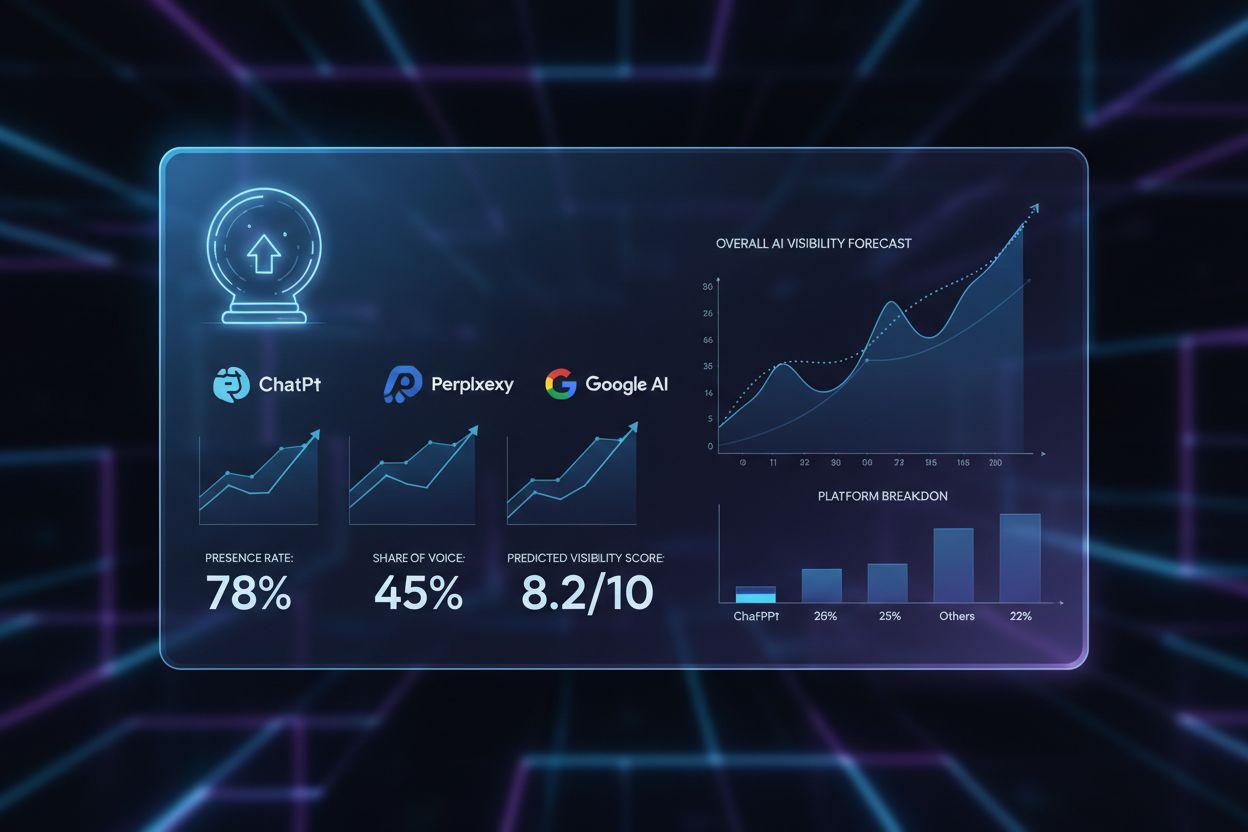
Modern AI visibility extends far beyond a single platform—it encompasses AI Overviews (Google’s AI-generated summaries), dedicated AI chat platforms (ChatGPT, Claude, Perplexity, and emerging alternatives), and GEO analytics that track geographic variations in AI responses. Each surface operates with distinct algorithms, citation mechanisms, and user behaviors, requiring tailored monitoring strategies. AI Overviews prioritize authoritative, concise information and often feature multiple sources in a single response, making presence rate and citation frequency critical metrics. Conversational AI platforms like ChatGPT and Claude emphasize relevance and conversational fit, sometimes favoring sources that answer specific user intents over traditional authority signals. Perplexity and similar platforms blend search and chat, creating hybrid visibility challenges that demand integrated tracking. The complexity multiplies when considering that a single topic might generate different citation patterns across these surfaces—your brand might dominate AI Overviews while remaining invisible in Claude responses, or vice versa. Effective predictive frameworks must monitor all surfaces simultaneously, correlate signals across platforms, and identify which surfaces drive the most valuable traffic for your specific business model.
| AI Surface | Characteristics | Citation Type | Monitoring Priority |
|---|---|---|---|
| Google AI Overviews | Integrated into search results, multiple sources per response | Direct citations with links | High |
| ChatGPT | Conversational responses, source attribution | Source links in responses | High |
| Perplexity | Research-focused answers, citation bubbles | Cited sources with links | High |
| Claude | Long-form responses, contextual attribution | Attribution links | Medium |
| Emerging LLMs | Platform-specific citation practices | Variable formats | Medium |
Building accurate predictive models requires tracking four interconnected signals that collectively indicate future AI visibility. Presence rate—the percentage of AI responses mentioning your brand across a defined topic cohort—serves as the foundation metric, typically measured across 50-200 baseline topics relevant to your industry. Share of voice extends this concept by measuring your citations relative to competitors, revealing whether your presence is growing, shrinking, or stagnating in competitive contexts. Citation quality and frequency distinguish between casual mentions and substantive citations; a single detailed citation in an AI Overview carries different weight than multiple brief mentions in chat responses. Traffic impact modeling connects these signals to actual business outcomes by correlating citation patterns with GA4 data, allowing you to quantify the revenue or engagement value of each citation type. These signals don’t operate in isolation—a high presence rate with low share of voice suggests you’re appearing frequently but losing ground to competitors, while high-quality citations with low frequency might indicate untapped potential in specific topic areas. Establishing baseline measurements across your 50-200 topic cohort creates the foundation for predictive scoring, enabling you to forecast visibility changes before they materialize in traffic data.
Implementing a predictive AI visibility framework requires systematic setup across five key dimensions:
Establish baseline metrics: Audit your current presence across all AI surfaces for your defined topic cohort, documenting presence rates, citation frequency, and share of voice for each platform. This baseline becomes your reference point for measuring predictive accuracy and identifying improvement opportunities.
Define monitoring cadence: Implement monthly tracking for real-time trend detection and quarterly deep audits that examine citation quality, competitive positioning, and traffic correlation. This dual-cadence approach balances operational efficiency with the need to catch emerging shifts quickly.
Create topic cohorts strategically: Organize your 50-200 baseline topics into logical clusters (product categories, customer journey stages, competitive battlegrounds) that align with business priorities and enable targeted optimization.
Set alert thresholds: Define what constitutes meaningful change—perhaps a 10% drop in share of voice, emergence in a new AI platform, or sudden citation frequency spikes—and configure automated alerts to flag anomalies requiring investigation.
Integrate with analytics infrastructure: Connect your AI visibility data to GA4 or your business intelligence platform, creating unified dashboards that show citation patterns alongside traffic, conversion, and revenue metrics. This integration transforms raw visibility data into actionable business intelligence.
Document governance: Establish clear ownership, update procedures, and escalation paths. Predictive frameworks require consistent maintenance; without documented processes, data quality degrades and insights become unreliable.
Key implementation steps:
The true power of predictive AI visibility emerges when you validate predictions against actual outcomes and use those results to refine your model. Compare predicted visibility changes to actual AI-driven traffic by analyzing GA4 data for traffic sourced from AI platforms—if your model predicted a 15% increase in presence rate, you should observe corresponding traffic increases within 2-4 weeks. Use controlled experiments to test specific hypotheses: update content for one topic cluster while leaving another unchanged, then measure whether the predicted visibility improvements materialize in actual citations and traffic. Refine model weights based on validation results; if certain signals consistently predict traffic better than others, increase their influence in your scoring algorithm. Track prediction accuracy metrics over time—what percentage of your forecasted visibility changes actually occurred within your predicted timeframe? As accuracy improves from 60% to 75% to 85%, confidence in your framework increases and stakeholders become more willing to invest in predictive strategies. This iterative validation process transforms predictive AI visibility from theoretical exercise into a reliable strategic tool that compounds in value as you accumulate more data and refine your understanding of how AI platforms respond to content changes.
Organizations that master predictive AI visibility gain three distinct competitive advantages. Proactive content strategy replaces reactive optimization—instead of waiting for traffic to drop before investigating, you identify visibility threats months in advance and address them preemptively. White space identification becomes systematic: by analyzing competitor presence patterns and topic gaps, you discover underserved areas where your content could dominate AI responses with minimal competitive pressure. Timing optimization allows you to coordinate content updates with predictive visibility windows; if your model indicates that a particular topic will receive increased AI attention in Q3, you can schedule content refreshes and promotion accordingly, maximizing impact. Topical authority building becomes strategic rather than accidental—you identify which topic clusters will drive the most AI visibility and citations, then systematically build comprehensive content ecosystems around those areas. Competitive benchmarking shifts from lagging indicators (where competitors ranked last month) to leading indicators (where competitors are likely to appear next month), enabling you to stay ahead of competitive moves. The cumulative effect is that predictive organizations operate with a 2-3 month advantage over reactive competitors, allowing them to capture emerging opportunities and defend against threats before competitors even recognize they exist.
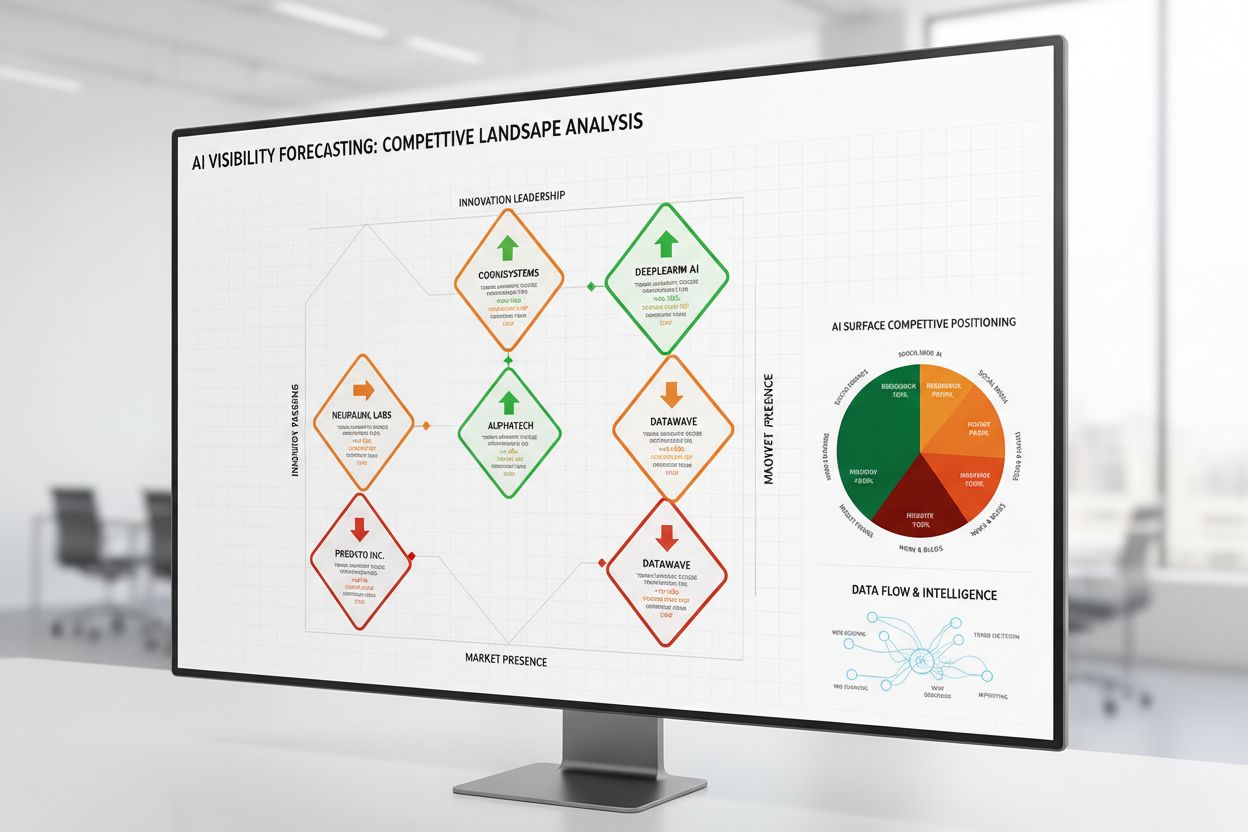
The market for AI visibility monitoring platforms has matured significantly, offering organizations multiple options for implementing predictive frameworks. AmICited.com stands out as a comprehensive solution purpose-built for predictive AI visibility, offering real-time monitoring across AI Overviews, ChatGPT, Claude, Perplexity, and emerging platforms with integrated traffic attribution and competitive benchmarking. Competing platforms serve different needs: Profound excels at enterprise-scale monitoring with advanced NLP analysis; Peec AI focuses on prompt tracking and sentiment analysis; Hall emphasizes competitive intelligence; Scrunch AI targets mid-market organizations with balanced feature sets; BrandLight specializes in brand safety and reputation monitoring. When evaluating platforms, assess critical capabilities: Does it track all relevant AI surfaces for your industry? Can it integrate with GA4 to attribute traffic to specific citations? Does it support your topic cohort size (50-200+ terms) without prohibitive costs? Can it generate predictive alerts based on trend analysis? Does it offer API access for custom integrations? AmICited.com’s advantage lies in its combination of comprehensive surface coverage, sophisticated traffic attribution modeling, and predictive analytics specifically designed for forward-looking visibility assessment. Pricing models vary significantly—some platforms charge per topic monitored, others per AI surface, and others use seat-based licensing—making ROI calculation essential before selection. Organizations should pilot 2-3 platforms with their actual topic cohorts and traffic data before committing to long-term contracts.
Successful implementation follows a phased approach that builds momentum and organizational buy-in. Phase 1: Quick wins (weeks 1-4) focuses on establishing baseline metrics for your top 20-30 topics, identifying obvious gaps where competitors dominate, and creating initial dashboards. This phase generates early evidence that predictive monitoring delivers value, securing stakeholder support for broader rollout. Phase 2: Expansion (weeks 5-12) extends monitoring to your full 50-200 topic cohort, implements monthly tracking cadence, and begins correlating visibility data with GA4 traffic. During this phase, train content and SEO teams on interpreting predictive signals and translating them into content recommendations. Phase 3: Optimization (weeks 13-24) focuses on refining your model based on validation results, implementing quarterly audits, and scaling predictive insights across teams. Common pitfalls to avoid include: treating predictive visibility as a one-time audit rather than ongoing process; failing to integrate with GA4, making traffic attribution impossible; setting unrealistic accuracy expectations in early months; and neglecting to document processes, causing knowledge loss when team members change. Measure ROI by tracking traffic growth in optimized topic areas, calculating the value of avoided visibility losses, and quantifying the revenue impact of improved AI-driven traffic. Most organizations see measurable results within 3-4 months, with compounding improvements as the predictive model matures and teams develop expertise in acting on predictive signals.
The landscape of AI visibility will continue evolving rapidly, creating both challenges and opportunities for predictive frameworks. Emerging AI platforms will proliferate—specialized models for different industries, languages, and use cases will fragment the visibility landscape, requiring monitoring frameworks that scale across dozens of surfaces rather than today’s handful. Citation practices will evolve as AI platforms mature; we’re likely to see increased emphasis on source diversity, freshness signals, and user feedback mechanisms that influence which sources appear in responses. Agentic AI represents a frontier where AI systems autonomously research, synthesize, and act on information—these systems will create new visibility opportunities and challenges as they develop preferences for certain source types and citation patterns. AI-driven ad networks may emerge, creating paid visibility channels alongside organic AI presence, requiring integrated strategies that optimize both. Predictive models will become more sophisticated, incorporating machine learning techniques that identify non-obvious signal correlations and forecast visibility changes with increasing accuracy. Organizations that build predictive AI visibility capabilities today will have significant advantages as these trends unfold—they’ll have established baselines, proven methodologies, and organizational expertise that newer competitors cannot quickly replicate. The future belongs to brands that don’t just monitor their AI presence, but actively forecast and shape it.
AI visibility shows your current presence in AI-generated responses, while predictive AI visibility forecasts your future presence based on trend analysis, signal integration, and competitive positioning. Predictive visibility enables proactive strategy rather than reactive monitoring.
Monthly refreshes capture short-term shifts and emerging trends, while quarterly deep audits validate assumptions and refine your predictive model. This dual-cadence approach balances responsiveness with stability in a dynamic AI landscape.
Start with Google AI Overviews, ChatGPT, and Perplexity as they represent the largest user bases. Expand to Claude and emerging platforms based on your industry and audience. Each surface requires different monitoring approaches due to distinct algorithms and citation mechanisms.
Compare predicted visibility changes against actual AI-driven traffic using GA4 integration and attribution analysis. Conduct controlled experiments by optimizing content for specific topics and measuring whether predicted visibility improvements materialize in actual citations and traffic.
Start with 50-200 core topics relevant to your industry and business priorities. This baseline provides sufficient data for meaningful pattern recognition while remaining manageable operationally. Expand based on competitive landscape and business growth.
Yes, predictive frameworks enable you to analyze competitor visibility patterns and forecast their future positioning. This allows you to identify white space opportunities, anticipate competitive moves, and time your content strategy for maximum competitive advantage.
Initial insights appear within 2-4 weeks of implementation. Meaningful trends and measurable ROI typically emerge within 2-3 months as your predictive model matures and teams develop expertise in acting on predictive signals.
Strong SEO fundamentals are foundational for AI visibility—platforms like ChatGPT and Perplexity use Google search data. However, AI platforms have distinct citation preferences and ranking mechanisms, making dedicated AI visibility monitoring essential for competitive advantage.
Discover how AmICited.com helps you predict and optimize your brand's presence across all AI platforms with advanced predictive analytics and competitive intelligence.
Learn how predictive AI visibility uses data analytics and machine learning to forecast future trends in AI-generated answers. Discover how brands can anticipat...

Learn how to connect AI visibility metrics to measurable business outcomes. Track brand mentions in ChatGPT, Perplexity, and Google AI Overviews with actionable...
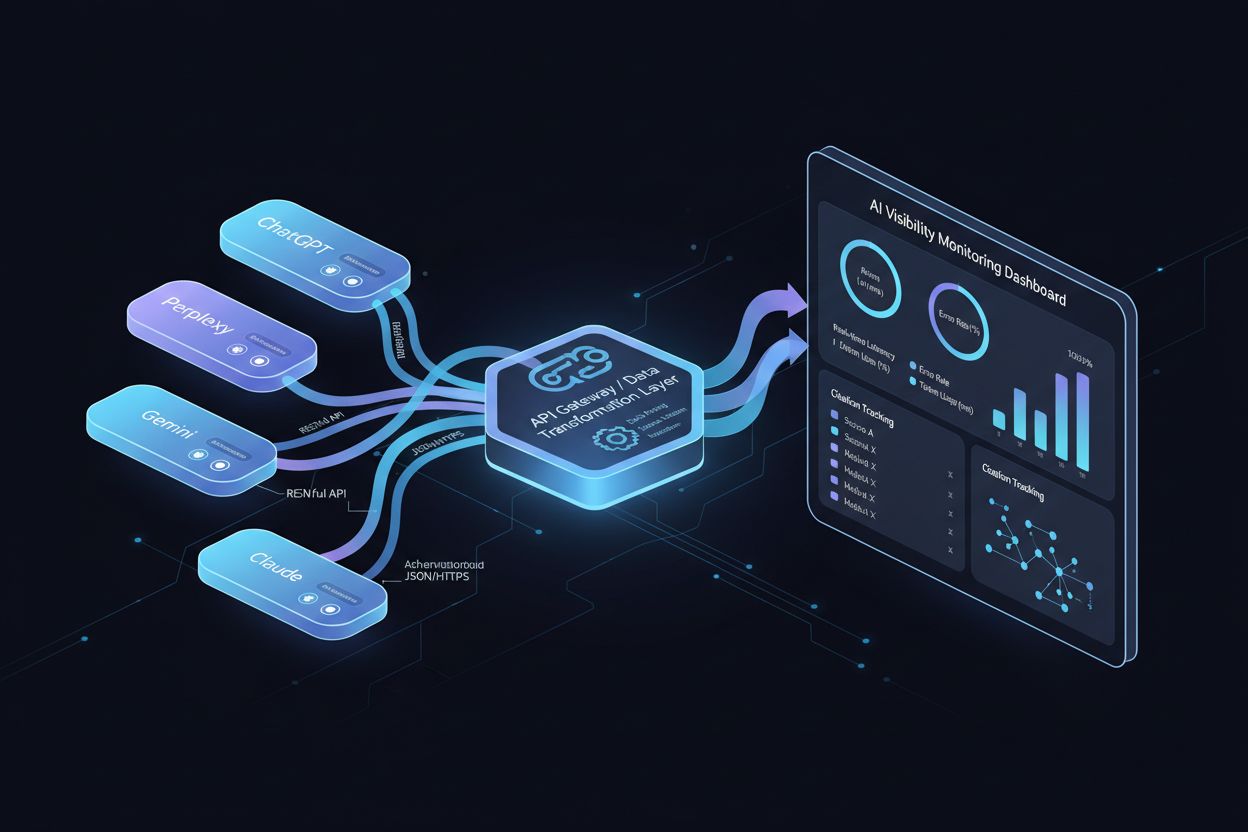
Learn how AI visibility APIs enable real-time monitoring of brand mentions across ChatGPT, Perplexity, and Gemini. Discover API integration strategies, workflow...