
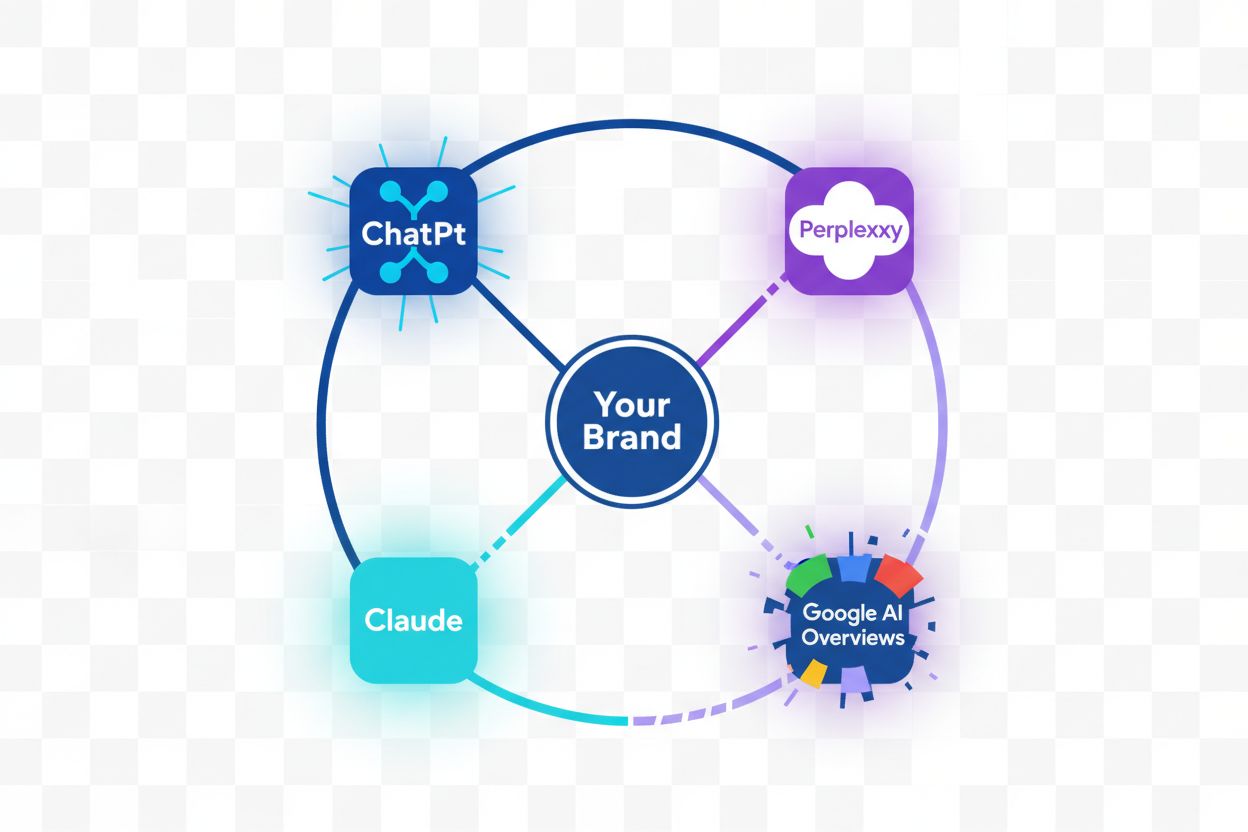
Identifying AI Visibility Blind Spots: Where Competitors Dominate
Discover critical AI visibility blind spots where competitors gain advantage. Learn gap analysis framework and tools to monitor AI presence across ChatGPT, Perp...
8 min read
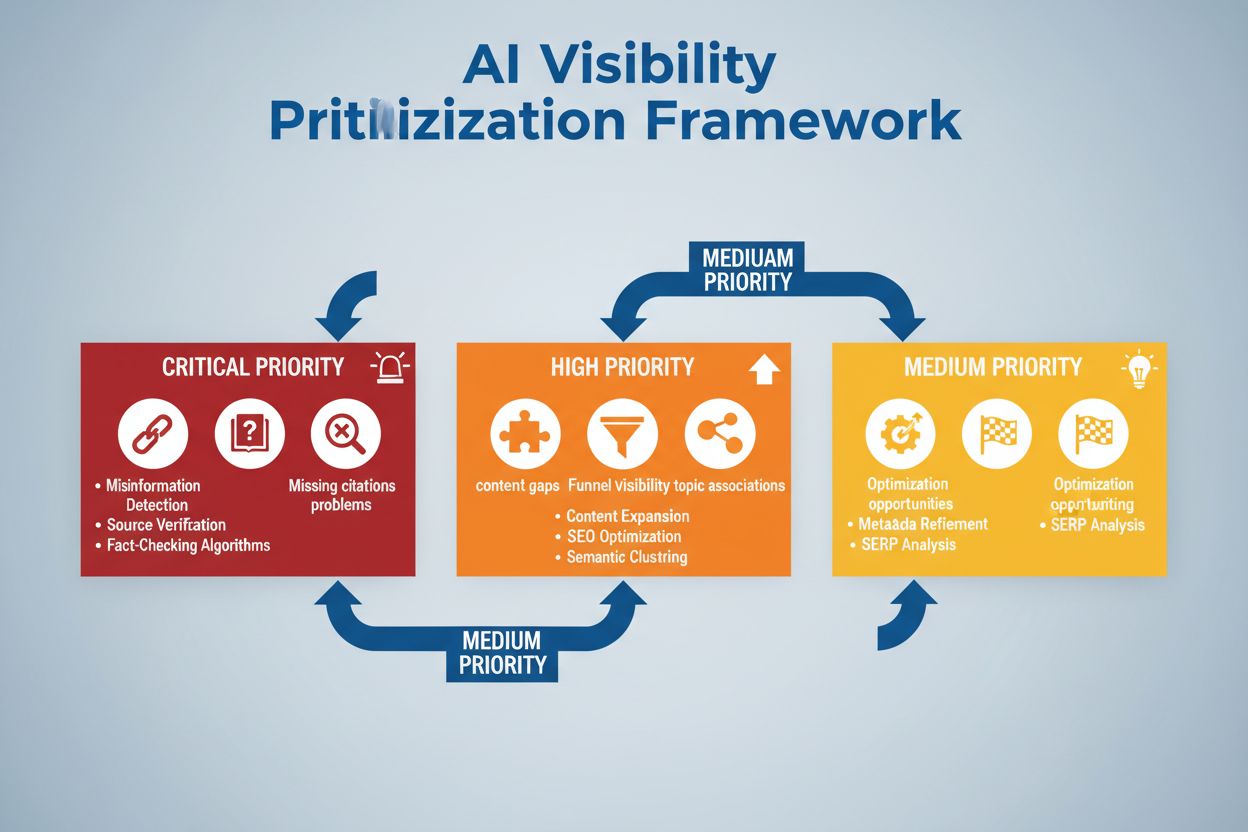
Learn how to prioritize AI visibility issues strategically. Discover the framework for identifying critical, high, and medium priority problems in your AI search presence and fix them in the right order.
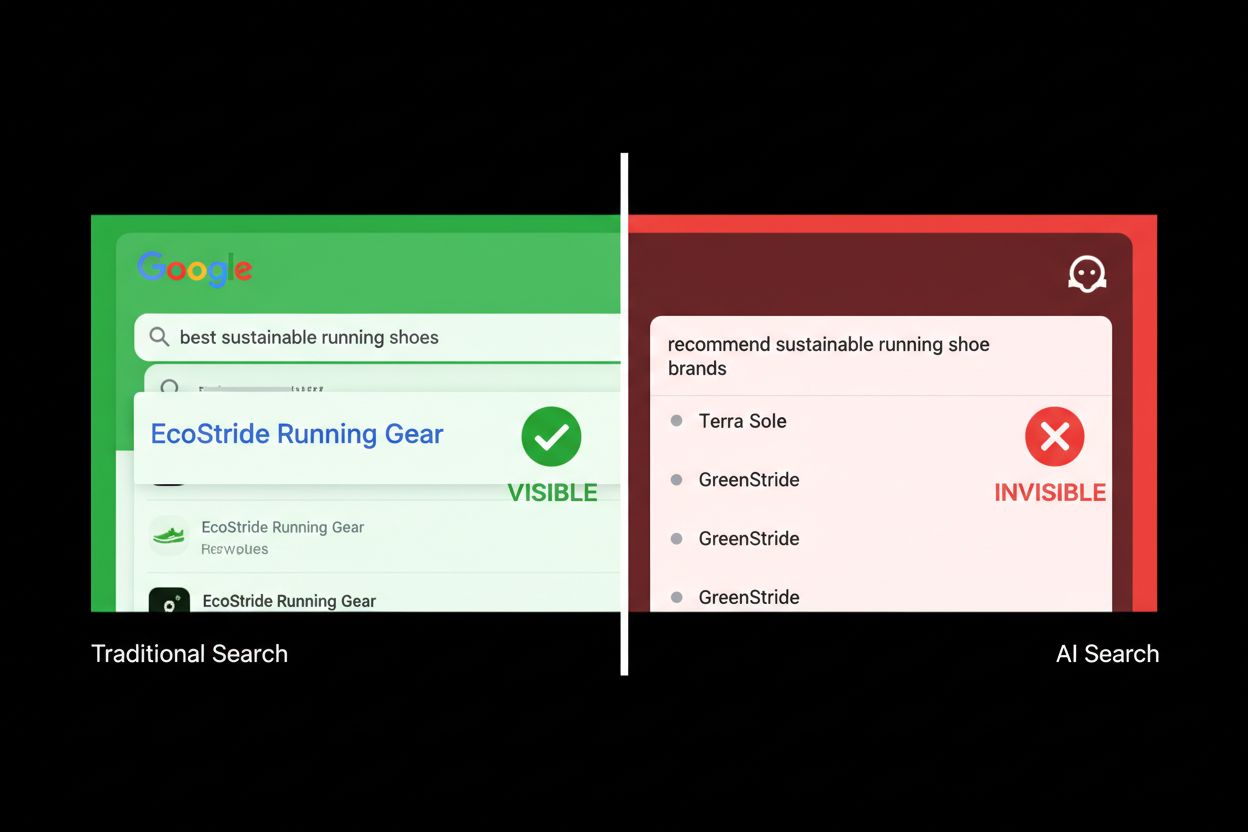
Your brand might dominate Google’s search results, yet remain virtually invisible to AI systems answering user questions. This paradox represents one of the most critical—and overlooked—challenges in modern marketing. Research shows that fewer than 1 in 10 AI-generated answers include commercial brands, while educational institutions, industry publications, and comparison platforms capture the majority of AI citations. Even brands with exceptional SEO performance find themselves absent from the AI visibility landscape, creating a dangerous gap between traditional search dominance and emerging AI-driven discovery. The stakes are higher than ever: as AI systems become the primary interface between consumers and information, invisibility in these channels translates directly to lost market share, diminished brand authority, and reduced customer acquisition opportunities.
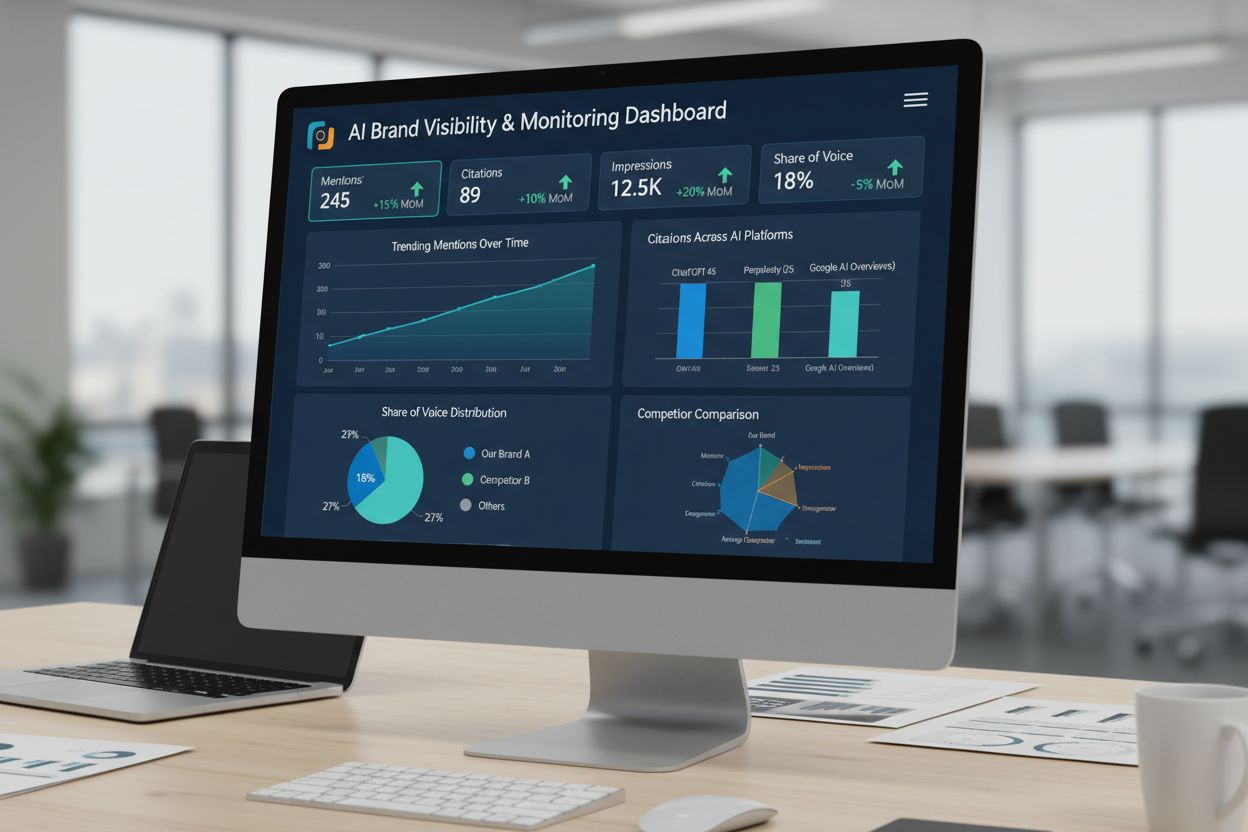
Before prioritizing fixes, you need a clear baseline of your current AI visibility status. This requires measuring four critical dimensions: mentions (how often your brand appears in AI responses), citations (how frequently AI systems attribute information to your brand), impressions (estimated user exposure across AI platforms), and share of voice (your citation percentage relative to competitors in your category). Each metric tells a different story about your AI presence. Mentions indicate raw visibility, but citations demonstrate authority and trustworthiness—a distinction that matters significantly for conversion potential. Impressions reveal the scale of your AI audience, while share of voice contextualizes your performance against direct competitors.
| Metric | Definition | Business Impact | Tracking Frequency |
|---|---|---|---|
| Mentions | Total instances your brand appears in AI responses | Brand awareness and reach | Weekly |
| Citations | AI systems attributing content/expertise to your brand | Authority and credibility | Weekly |
| Impressions | Estimated users exposed to your brand in AI answers | Audience scale | Monthly |
| Share of Voice | Your citations ÷ total category citations | Competitive positioning | Monthly |
Understanding these metrics requires consistent monitoring across multiple AI platforms and query categories. Tools like AmICited.com provide automated tracking of these dimensions, eliminating manual auditing and enabling data-driven prioritization decisions.
Not all AI visibility gaps require equal urgency or resources. A three-tier prioritization system helps you allocate effort strategically: Critical issues demand immediate action within 1-2 weeks, High priority issues require resolution within 30 days, and Medium priority issues can be addressed within 60-90 days as part of ongoing optimization. Critical tier issues directly threaten brand reputation, revenue, or compliance—these are non-negotiable. High priority issues create competitive disadvantages or represent significant market opportunities with moderate implementation effort. Medium priority issues offer optimization potential but don’t pose immediate business risk. This framework prevents the common mistake of treating all visibility gaps equally, which leads to resource waste and delayed impact on your most important challenges. By categorizing issues systematically, you create a roadmap that balances urgency with strategic value, ensuring your team focuses on initiatives that deliver measurable business outcomes.
Your critical priority list should focus on issues that pose immediate business or reputational risk. These require action within days, not weeks:
Misinformation and Inaccuracy: If AI systems are spreading false claims about your products, pricing, or company history, this demands immediate correction. Misinformation in AI responses carries amplified credibility because users perceive AI as objective and authoritative. A single inaccurate claim about your product’s capabilities or safety can damage customer trust and create legal liability.
Missing Citations for Your Content: When your original research, data, or expertise appears in AI responses without attribution, you lose both authority signals and traffic opportunities. This is particularly critical for brands that invest heavily in original content creation—unattributed citations represent stolen intellectual property and missed brand-building opportunities.
Accuracy Problems in Attributed Content: Even when your brand receives citations, the context matters enormously. If AI systems are citing outdated information, misrepresenting your position on industry issues, or pulling quotes out of context, you face reputational damage. These issues require immediate fact-checking and source correction.
Critical issues demand rapid response because their impact compounds daily. Each day a misinformation claim circulates in AI responses increases the likelihood it becomes embedded in training data for future models, making correction exponentially harder.
High priority issues create competitive disadvantages and represent significant market opportunities, though they require more strategic planning than critical issues. Content gaps represent the most common high priority problem—when AI systems can’t find authoritative information about your products or services, they default to competitor content or generic information. Identify these gaps by analyzing which queries about your category appear in AI responses without your brand mentioned, then create targeted content addressing those specific questions. Funnel stage visibility varies dramatically by category and competitor—you might dominate awareness-stage queries while remaining invisible in consideration or decision-stage conversations. This requires different content strategies for each funnel stage, ensuring your brand appears when customers are actively evaluating solutions. Topic associations matter significantly for AI recommendations; if your brand is associated with outdated or incorrect topics, you’ll miss relevant query matches. Audit which topics AI systems connect to your brand and develop content that reinforces accurate associations while distancing your brand from irrelevant or negative topics.
Medium priority issues offer optimization potential without posing immediate business risk, making them ideal for ongoing improvement cycles. Optimization opportunities include improving your structured data markup (schema.org implementation), enhancing content freshness signals, and refining semantic relevance to high-value queries. These changes improve your AI visibility incrementally but require technical implementation and content updates. Competitive positioning at the medium priority level focuses on capturing share of voice in categories where you’re already visible but underperforming relative to competitors. This might involve content expansion, authority building, or strategic partnerships that increase your citation frequency. Long-tail visibility represents the opportunity to appear in niche, high-intent queries that competitors haven’t optimized for—these queries often have lower volume but higher conversion potential. Allocate resources to medium priority issues during slower business periods or as part of quarterly optimization cycles, ensuring you’re continuously improving your AI visibility foundation without diverting resources from critical and high priority work.
Transform your prioritization framework into a concrete action plan with clear ownership and timelines. Follow this structured approach:
Audit and Document (Week 1): Conduct a comprehensive AI visibility audit across your priority query categories, documenting current mentions, citations, accuracy issues, and competitive gaps. Use this baseline to establish measurable improvement targets for each priority tier.
Address Critical Issues (Weeks 2-3): Assign ownership for each critical issue and establish daily check-ins to track progress. For misinformation, identify the source and work with AI platform support teams or content publishers to correct inaccuracies. For missing citations, reach out to content publishers and AI platform teams with proper attribution information.
Develop High Priority Content (Weeks 3-6): Create or optimize content addressing high priority gaps, ensuring proper schema markup and semantic optimization. Distribute this content through owned channels and strategic partnerships to increase AI visibility.
Implement Technical Improvements (Weeks 4-8): Deploy structured data enhancements, update metadata, and optimize content for semantic relevance. These changes compound over time as AI systems re-index and re-train on your improved content.
Establish Monitoring and Reporting (Ongoing): Implement weekly tracking of critical metrics and monthly reporting to stakeholders, creating accountability and demonstrating ROI from your AI visibility investments.
This timeline assumes a mid-sized marketing team with existing content and technical resources. Adjust based on your organization’s capacity and the severity of your visibility gaps.
Tracking AI visibility improvements requires consistent measurement against your established baseline metrics. Weekly monitoring should focus on critical issues—misinformation corrections, citation accuracy, and major visibility changes. Monthly reporting should track mentions, citations, impressions, and share of voice trends, comparing performance against competitors and your own targets. The most important metric for stakeholder reporting is incremental business impact: estimate the customer acquisition value of improved AI visibility by calculating average customer lifetime value multiplied by estimated conversion rate improvement from increased AI citations. For example, if improving your share of voice in decision-stage queries from 5% to 15% is estimated to drive 50 additional qualified leads monthly, and your average customer value is $5,000, that represents $250,000 in monthly revenue impact. This business-focused framing helps secure continued investment in AI visibility initiatives. Quarterly business reviews should include competitive benchmarking, showing how your AI visibility improvements compare to competitor movements and market trends. This data-driven approach transforms AI visibility from a vague marketing concern into a measurable, ROI-justified business priority.
Most brands make predictable mistakes when addressing AI visibility gaps, undermining their efforts and wasting resources. Ignoring the source of misinformation is the most costly error—brands often focus on correcting AI platforms directly while ignoring the underlying content sources that AI systems cite. AI systems reflect the information available on the internet; correcting the source is far more effective than requesting platform corrections. Treating AI visibility like traditional SEO leads to keyword-stuffing and manipulation tactics that don’t work for AI systems, which prioritize semantic relevance and source authority over keyword density. Neglecting structured data implementation represents a massive missed opportunity—schema markup is critical for AI recommendations, yet many brands haven’t implemented basic product, organization, or article schema. Expecting immediate results causes teams to abandon AI visibility initiatives prematurely; unlike paid advertising, AI visibility improvements compound over weeks and months as systems re-index and re-train. Finally, failing to monitor competitive movements means you’re optimizing in a vacuum—your competitors are likely improving their AI visibility simultaneously, so relative performance matters more than absolute metrics.
The AI visibility landscape is still in its early stages, creating a significant first-mover advantage for brands that act now. Most competitors haven’t conducted AI visibility audits, don’t understand their citation gaps, and aren’t actively optimizing for AI systems—this represents a massive opportunity for strategic brands to capture disproportionate share of voice before the market matures. Early action compounds over time as your improved content, structured data, and authority signals accumulate in AI training datasets, making it increasingly difficult for competitors to catch up. Brands that establish strong AI visibility now will enjoy sustained competitive advantages as AI systems become the primary interface for customer discovery and decision-making. The window for capturing this advantage is narrowing as more sophisticated competitors recognize the opportunity; waiting six months or a year to address AI visibility gaps means ceding market share to more forward-thinking brands. Your AI visibility strategy isn’t a nice-to-have marketing initiative—it’s a fundamental business priority that determines whether your brand thrives or becomes invisible in the AI-driven future of customer discovery.
Start by testing core product or service queries through ChatGPT, Perplexity, and Google AI Overviews. If your brand doesn't appear in responses where competitors do, or if the information presented is inaccurate or outdated, you have an AI visibility problem. Use tools like AmICited to systematically track mentions and citations across AI platforms to get a comprehensive baseline.
Mentions are instances where your brand name appears in an AI response, while citations are when AI systems attribute specific information or expertise to your brand or website. Citations are more valuable because they signal authority and trustworthiness. A brand can be mentioned without being cited, which means you're getting visibility but not credit for your expertise.
Critical issues like misinformation can be addressed within 1-2 weeks, while high priority content gaps typically show improvement within 30-60 days. Medium priority optimizations may take 60-90 days to show measurable results. However, significant improvements in share of voice and competitive positioning usually compound over 3-6 months as AI systems re-index and re-train on your improved content.
No—they're complementary strategies. AI systems are trained on web content, so strong SEO fundamentals support AI visibility. However, AI visibility requires additional optimization beyond traditional SEO, including structured data implementation, semantic relevance optimization, and strategic content development for AI-specific query patterns. Invest in both simultaneously.
ROI depends on your industry and customer journey, but improved AI visibility typically drives brand awareness, consideration, and qualified leads. Calculate ROI by estimating the customer lifetime value of leads influenced by AI citations, then multiply by your estimated conversion rate improvement. For many B2B companies, a 10% improvement in AI share of voice translates to 5-15% additional qualified leads.
Conduct comprehensive audits quarterly to track progress against your prioritization plan. Monitor critical metrics weekly to catch misinformation or major visibility changes immediately. Use monthly reporting to track trends in mentions, citations, impressions, and share of voice. This cadence balances resource efficiency with the need to respond quickly to competitive movements.
Yes, but the most effective approach is fixing the source rather than requesting platform corrections. Identify which websites AI systems cite for the misinformation, then work with those publishers to correct the information. You can also reach out to AI platform support teams, but source correction is more permanent and prevents the misinformation from reappearing in future model updates.
AmICited.com is specifically designed for monitoring how AI platforms reference your brand across ChatGPT, Perplexity, and Google AI Overviews. It tracks mentions, citations, impressions, and share of voice automatically. Complement this with general analytics tools to measure traffic from AI sources and SEO tools to monitor your content's visibility in search results that feed AI training data.
Don't let your brand remain invisible in AI search. Use AmICited to track how AI platforms reference your brand across ChatGPT, Perplexity, and Google AI Overviews.
Discover critical AI visibility blind spots where competitors gain advantage. Learn gap analysis framework and tools to monitor AI presence across ChatGPT, Perp...
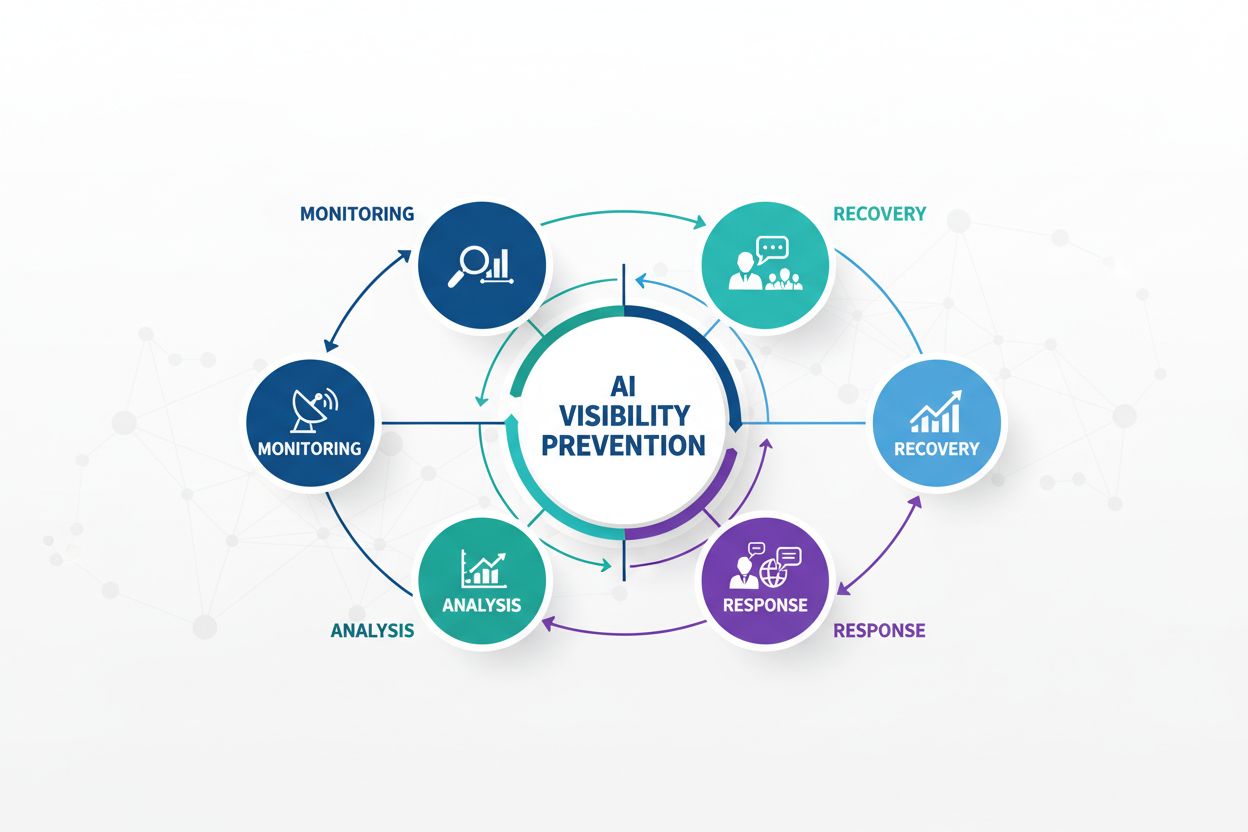
Learn how to prevent AI visibility crises with proactive monitoring, early warning systems, and strategic response protocols. Protect your brand in the AI era.

Learn how to connect AI visibility metrics to measurable business outcomes. Track brand mentions in ChatGPT, Perplexity, and Google AI Overviews with actionable...