
Product Feed Optimization for AI Shopping Engines
Learn how to optimize product feeds for AI shopping engines like Google AI Overviews, Perplexity, and ChatGPT. Master feed attributes, data quality, and real-ti...
10 min read
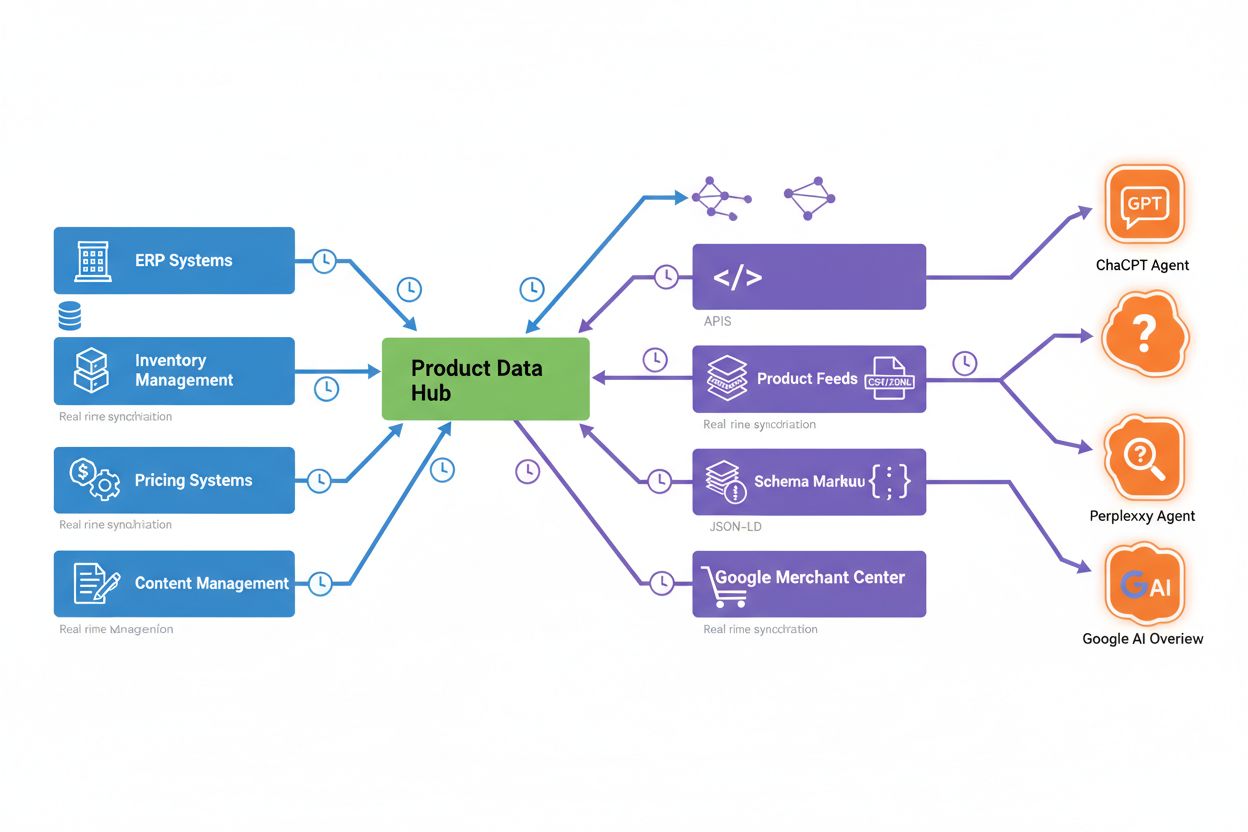
Learn the technical requirements for product data in agentic commerce. Discover structured data formats, synchronization strategies, and optimization techniques to ensure your products are discoverable by AI agents.
AI agents operate fundamentally differently from human shoppers—they don’t browse websites, admire product photography, or read marketing copy. Instead, agents make purchasing decisions based entirely on structured product data, evaluating attributes, prices, availability, and trust signals through machine-readable formats. When product data is incomplete, poorly structured, or missing critical attributes, products become effectively invisible to AI-driven commerce systems, regardless of how compelling the human-facing product page might be. This creates a disintermediation risk where merchants without properly formatted product data lose visibility to an entire category of buyers powered by AI agents, Perplexity, Google AI Overviews, and similar systems. The stakes are particularly high in agentic commerce, where agents autonomously compare products and make recommendations—without clean, comprehensive product data, your inventory simply won’t be considered in agent-driven purchasing decisions.

The foundation of agent-readable product data consists of essential identifiers and attributes that enable AI systems to uniquely identify, categorize, and evaluate products. Core product identifiers include the product ID (SKU), Global Trade Item Number (GTIN), Manufacturer Part Number (MPN), product title, and detailed description—each serving a specific purpose in agent decision-making. Beyond identifiers, agents require product categorization data (category hierarchy, subcategories, product type), attribute data (size, color, material, specifications), pricing information (list price, sale price, currency), and availability status (in stock, out of stock, pre-order). Pricing data is critical because agents evaluate cost-benefit ratios in real-time, while availability data prevents agents from recommending products that cannot be purchased. Categorization enables agents to understand product context and compare similar items, and attributes allow for precise matching against user requirements.
| Data Category | Field Examples | Data Type | Importance for Agents |
|---|---|---|---|
| Identifiers | SKU, GTIN, MPN, Title | String/Alphanumeric | Critical - enables unique product identification |
| Categorization | Category, Subcategory, Type | Hierarchical String | High - enables product comparison and filtering |
| Attributes | Size, Color, Material, Specs | Mixed (String/Number) | High - enables precise user matching |
| Pricing | List Price, Sale Price, Currency | Decimal/String | Critical - enables cost evaluation |
| Availability | Stock Status, Quantity | Boolean/Integer | Critical - prevents invalid recommendations |
| Media | Image URLs, Video URLs | URL String | Medium - improves agent confidence |
Product data for AI agents must conform to recognized structured data standards that enable consistent parsing and interpretation across different systems. JSON-LD (JSON for Linking Data) provides semantic markup that can be embedded directly in web pages, allowing agents to extract product information during crawling, while CSV and JSONL formats enable bulk data delivery through feeds and APIs. The OpenAI Product Feed Specification has emerged as a critical standard for agentic commerce, defining required and recommended fields specifically optimized for AI agent decision-making. Google Merchant Center integration remains essential for visibility across Google’s AI systems, including AI Overviews and Shopping features, requiring adherence to Google’s product data specification. Modern implementations increasingly use API-based data delivery for real-time synchronization, allowing agents to query current product information on-demand rather than relying on periodic feed updates.
{
  "@context": "https://schema.org/",
  "@type": "Product",
  "name": "Premium Wireless Headphones",
  "description": "High-fidelity wireless headphones with 30-hour battery life",
  "sku": "WH-1000XM5",
  "gtin": "4548736119389",
  "mpn": "WH-1000XM5",
  "brand": {
    "@type": "Brand",
    "name": "Sony"
  },
  "offers": {
    "@type": "Offer",
    "price": "349.99",
    "priceCurrency": "USD",
    "availability": "https://schema.org/InStock",
    "url": "https://example.com/product/wh-1000xm5"
  },
  "aggregateRating": {
    "@type": "AggregateRating",
    "ratingValue": "4.7",
    "reviewCount": "2847"
  }
}
The accuracy and freshness of product data directly impact agent decision-making quality, making real-time data synchronization a critical requirement for competitive agentic commerce. Inventory levels must be updated frequently—ideally every 15 minutes or less—to prevent agents from recommending out-of-stock products or missing flash sales and limited-time offers. Pricing data requires similar synchronization frequency, as agents compare prices across merchants and make recommendations based on current cost information; stale pricing data can result in agents recommending overpriced products or missing competitive opportunities. Data consistency across platforms is equally important—if your website shows different pricing, availability, or attributes than your product feed, agents will encounter conflicting information that reduces their confidence in recommendations. The impact of delayed synchronization extends beyond individual transactions; agents learn from patterns in your data, and consistently stale information trains them to deprioritize your products in future recommendations.
Beyond basic product information, AI agents evaluate trust signals and compliance data to assess product legitimacy and suitability for specific users. Review ratings and review counts provide social proof that agents use to rank products—a product with 4.8 stars and 5,000 reviews will be weighted differently than an identical product with 3.2 stars and 50 reviews. Return policies, return windows, and warranty information signal product confidence and reduce perceived purchase risk, influencing agent recommendations toward products with favorable terms. Seller information, seller ratings, and seller credentials help agents evaluate merchant trustworthiness, particularly important in multi-seller marketplaces where agent recommendations must account for seller reliability. Compliance data—including age restrictions, hazard warnings, regulatory certifications, and privacy policy URLs—ensures agents don’t recommend products to ineligible users and helps merchants avoid liability.
Key Trust Signals for Agent Evaluation:
Data quality directly determines agent performance, and common issues like missing attributes, inconsistent formatting, or incorrect values can severely limit product visibility in agentic commerce. Validation rules should enforce required fields (product ID, title, price, availability), constrain data types (prices must be numeric, URLs must be valid), and check logical consistency (sale price cannot exceed list price, stock quantity cannot be negative). Incomplete product data—such as missing descriptions, absent images, or incomplete attribute sets—reduces agent confidence in product recommendations and may cause products to be filtered out entirely during agent evaluation. Testing and monitoring approaches should include automated validation against schema specifications, periodic audits of data accuracy, and tracking of data quality metrics over time. Tools like data quality dashboards, schema validators, and feed testing platforms help identify issues before data reaches agents, while AmICited.com provides monitoring capabilities to track how AI agents cite and reference your product data, revealing whether agents are actually accessing and using your product information in their recommendations.
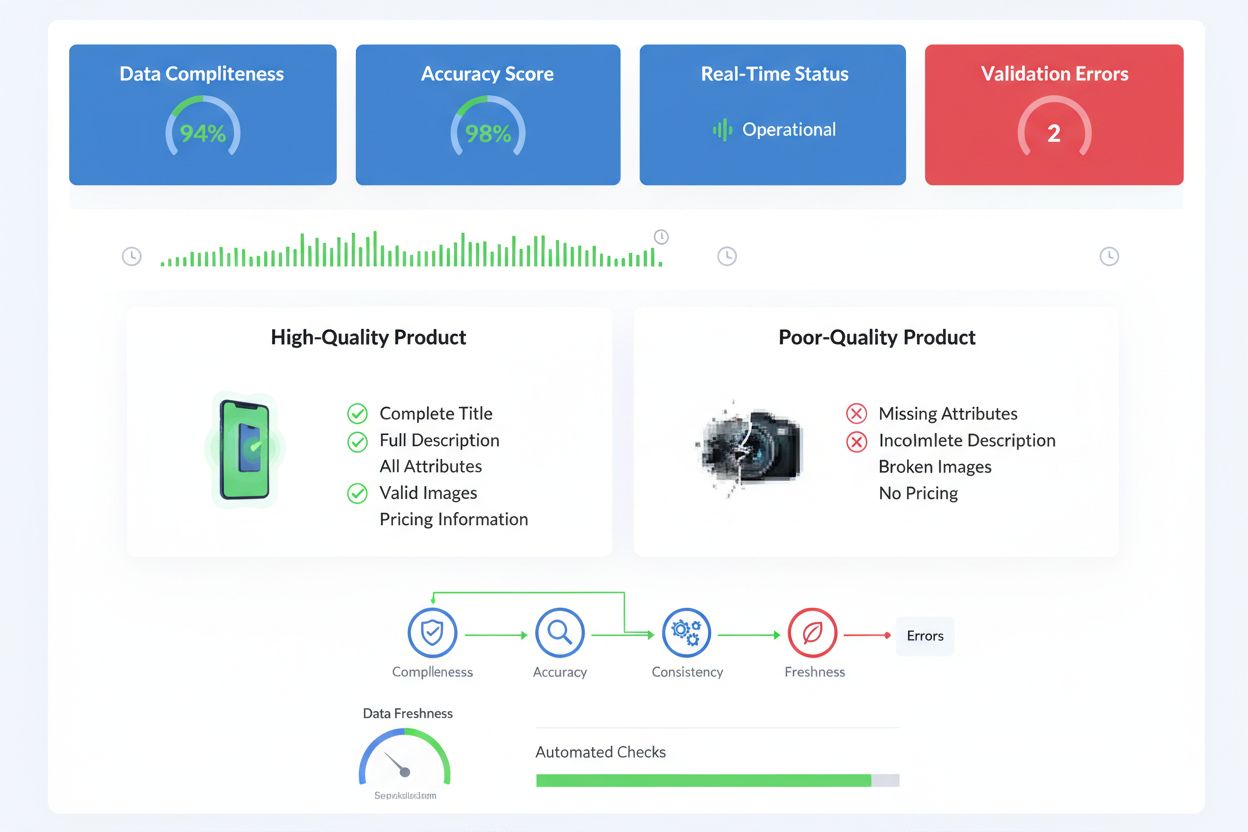
Specific validation examples include: verifying that all product titles are between 20-200 characters, ensuring all prices include currency codes, confirming that image URLs return valid image files, and validating that category hierarchies match your taxonomy. When a product has missing color variants, agents cannot match user preferences for specific colors, resulting in incomplete recommendations. If descriptions contain placeholder text or generic content, agents cannot differentiate your products from competitors, reducing recommendation likelihood.
Organizations can deliver product data to AI agents through multiple integration patterns, each with distinct tradeoffs between real-time accuracy and implementation complexity. Push-based models involve sending data to agent platforms (Google Merchant Center, OpenAI, Perplexity) through periodic feed uploads or API calls, providing control over update timing but requiring scheduled synchronization. Pull-based models allow agents to query your systems directly through APIs, enabling true real-time data delivery but requiring robust API infrastructure and authentication mechanisms. Feed-based delivery using CSV or JSONL formats remains the most common approach for bulk product data, supporting both batch updates and incremental change feeds that only transmit modified products. Real-time vs. batch update strategies should be chosen based on product volatility—high-velocity inventory (fashion, electronics) benefits from real-time APIs, while slower-moving inventory can use daily or weekly batch feeds. Security and authentication considerations are critical; APIs should require authentication tokens, feeds should be transmitted over HTTPS, and access should be restricted to authorized agent platforms to prevent unauthorized data access.
Agents employ sophisticated ranking algorithms that evaluate product data to determine which items to recommend, making data completeness and attribute richness direct competitive advantages in agentic commerce. Products with comprehensive attribute data—including all relevant variants, specifications, and options—rank higher in agent recommendations because agents can match them more precisely to user requirements. Variant handling and grouping is particularly important; agents need to understand relationships between product variants (different sizes, colors, materials) to present coherent recommendations rather than treating each variant as a separate product. Performance signals including popularity metrics, return rates, customer satisfaction scores, and sales velocity influence agent ranking algorithms; products with strong performance signals receive higher recommendation priority. Merchants who invest in data excellence—complete attributes, accurate pricing, rich descriptions, comprehensive trust signals—gain measurable competitive advantage as agents increasingly drive commerce decisions. The merchants who will dominate agentic commerce are those who recognize that product data is no longer just a backend requirement but a core competitive asset that directly determines visibility and sales in AI-driven purchasing environments.
Human shoppers browse websites and make decisions based on visual design, marketing copy, and images. AI agents, however, make purchasing decisions entirely based on structured product data—attributes, prices, availability, and trust signals in machine-readable formats. Without properly formatted data, your products become invisible to agents regardless of how compelling your website design is.
Essential required fields include: product ID (SKU), product title, description, price with currency, availability status, product category, brand, and product image URL. Additionally, either a GTIN (Global Trade Item Number) or MPN (Manufacturer Part Number) is required for unique product identification. These fields enable agents to identify, categorize, and evaluate your products.
Product data should be updated every 15 minutes or less for optimal agent performance, particularly for inventory and pricing information. Real-time synchronization prevents agents from recommending out-of-stock products or missing competitive pricing opportunities. The update frequency should match your product volatility—high-velocity inventory requires more frequent updates than slower-moving products.
Incomplete or inaccurate product data reduces agent confidence in your products, leading to lower recommendation rankings or complete exclusion from agent results. Missing attributes prevent precise user matching, stale pricing causes agents to recommend overpriced products, and incorrect availability results in failed purchases. Over time, agents learn to deprioritize products with consistently poor data quality.
Use automated validation tools to check against schema specifications (JSON-LD, OpenAI Product Feed Spec), verify required fields are present and correctly formatted, test that URLs resolve properly, and ensure data consistency across platforms. Implement data quality dashboards to monitor completeness percentages, accuracy scores, and freshness indicators. Conduct periodic audits comparing your product data against agent platform requirements.
Feed-based delivery (CSV, JSONL) involves periodic bulk uploads of product data, suitable for batch updates and less volatile inventory. API-based delivery enables real-time queries where agents request current product information on-demand, providing true real-time accuracy but requiring robust API infrastructure. Most implementations use a hybrid approach: feeds for bulk data and APIs for real-time inventory/pricing updates.
Agents use sophisticated ranking algorithms that evaluate data completeness, attribute richness, pricing competitiveness, availability status, and trust signals (reviews, ratings, seller credentials). Products with comprehensive, accurate data rank higher because agents can match them more precisely to user requirements. Performance signals like popularity metrics and return rates also influence rankings, making data excellence a direct competitive advantage.
Agents require compliance data including age restrictions, hazard warnings, regulatory certifications, return policies with specific windows, seller privacy policies, and terms of service URLs. This data ensures agents don't recommend products to ineligible users and helps merchants avoid liability. Compliance information also serves as a trust signal that influences agent recommendations.
AmICited monitors how AI agents reference and recommend your products. Get visibility into your agentic commerce performance and track product citations across ChatGPT, Perplexity, and Google AI Overviews.
Learn how to optimize product feeds for AI shopping engines like Google AI Overviews, Perplexity, and ChatGPT. Master feed attributes, data quality, and real-ti...
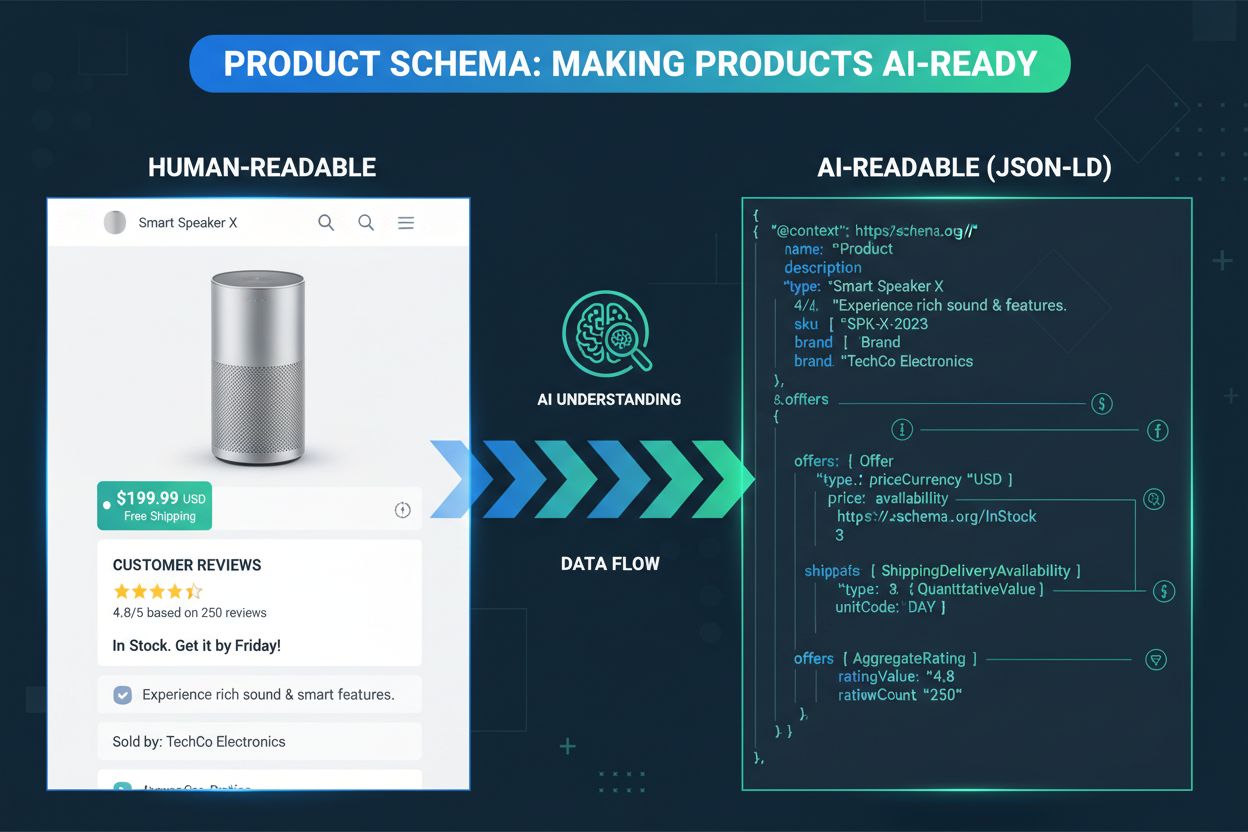
Learn how product schema markup makes your ecommerce products visible to AI shopping assistants. Complete guide to structured data for ChatGPT, Perplexity, and ...

Discover how AI agents are revolutionizing online shopping with autonomous decision-making, personalization at scale, and seamless transactions. Learn what reta...