
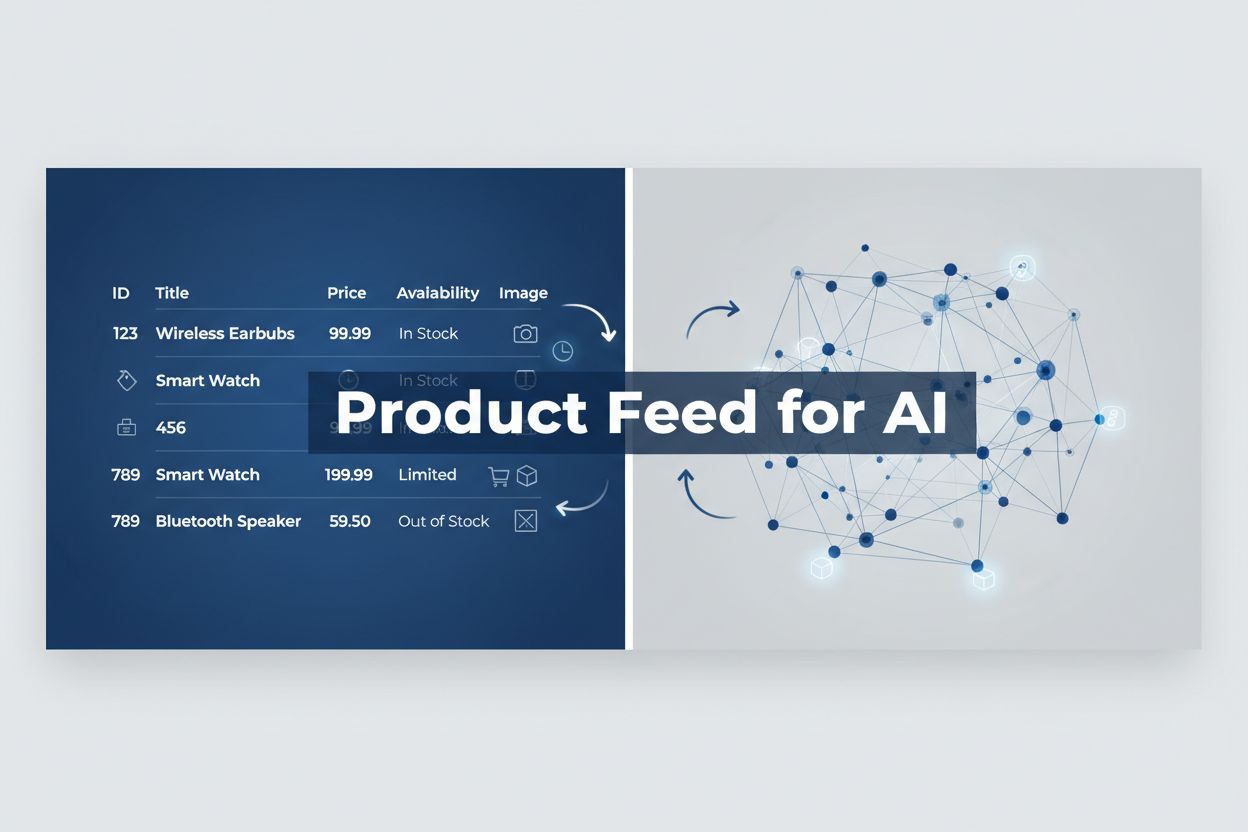
Product Feed for AI
Learn what product feeds for AI are, how they differ from traditional feeds, and how to optimize them for ChatGPT, Google AI Overviews, and Perplexity shopping ...
9 min read
Learn how to optimize product feeds for AI shopping engines like Google AI Overviews, Perplexity, and ChatGPT. Master feed attributes, data quality, and real-time updates to maximize visibility.
AI shopping engines have fundamentally transformed how consumers discover products, and they rely almost entirely on high-quality product feeds to function effectively. Modern AI systems—including Google AI Overviews, Perplexity, ChatGPT, and emerging shopping assistants—parse millions of product feeds daily to understand inventory, pricing, availability, and relevance. Google Shopping alone accounts for 65% of all Google Ads clicks for retailers, demonstrating the massive traffic potential when feeds are optimized correctly. Beyond paid channels, structured data in product feeds enables free product listings on Google Search, the Shopping tab, and Google Images, providing organic visibility that AI systems can crawl and index. The reason AI systems depend so heavily on feeds is that they need standardized, machine-readable information to make intelligent recommendations and answer customer queries accurately. Without properly formatted product feeds, AI systems cannot confidently match customer intent to products, resulting in missed opportunities for visibility and sales. The stakes are high: retailers who neglect feed optimization essentially become invisible to the AI-powered discovery mechanisms that increasingly drive consumer shopping behavior.
AI systems require specific product attributes to properly understand and rank products in their recommendation algorithms. Each attribute serves a distinct purpose in how AI interprets product relevance, quality, and fit for customer queries. Here’s a breakdown of critical attributes and their importance:
| Attribute | Why It Matters for AI | Example |
|---|---|---|
| Title | AI uses titles to understand product type, brand, and key features for matching search intent | “Sony WH-1000XM5 Wireless Noise-Canceling Headphones - Black” vs “Headphones” |
| Description | Provides context for AI to understand use cases, benefits, and differentiation from competitors | “Premium noise cancellation with 30-hour battery life, perfect for travel and office use” |
| GTIN/Brand | Enables AI to verify product authenticity and connect to authoritative product databases; GTIN provision can lead to 20% average increase in clicks | GTIN: 4548736113450, Brand: Sony |
| Category | Helps AI classify products correctly and understand product hierarchy for contextual recommendations | Electronics > Audio > Headphones > Over-Ear |
| Images | AI systems analyze images for quality, relevance, and visual search compatibility; poor images reduce AI confidence | High-resolution product images from multiple angles vs blurry or generic images |
| Price & Availability | Critical for AI to provide accurate, real-time information to customers and prevent recommending out-of-stock items | Price: $349.99, Availability: In Stock (vs outdated pricing) |
The difference between good and poor data is stark: a product with complete, accurate attributes might appear in AI Overviews and shopping recommendations, while the same product with missing GTINs, vague descriptions, or inconsistent categorization may be filtered out entirely by AI systems that prioritize data quality and confidence.
AI systems evaluate product feeds using sophisticated algorithms that assess data completeness, consistency, and relevance—and feeds that fail these tests are deprioritized or excluded from AI-powered shopping experiences. When AI encounters incomplete or inconsistent data, it reduces its confidence in the product information, which directly impacts visibility in AI Overviews, recommendations, and shopping assistants. High-quality feeds demonstrate:
The business impact is measurable: retailers with 95%+ data completeness see significantly higher AI visibility and click-through rates compared to those with 70-80% completeness. AI systems essentially reward data quality with visibility, making feed maintenance a direct ROI driver.
Real-time feed updates are no longer optional—they’re essential for competing in AI-driven shopping environments where customer expectations for accuracy have never been higher. When a customer asks an AI shopping assistant “Is this product in stock?” or “What’s the current price?”, the AI system queries your product feed in real-time or near-real-time to provide accurate answers. If your feed shows outdated inventory or pricing, the AI will either provide incorrect information (damaging customer trust) or deprioritize your products in favor of competitors with current data. Automation is critical because manual feed updates cannot keep pace with inventory fluctuations, price changes, and availability shifts that occur throughout the day. Modern retailers use automated feed management platforms and APIs to sync inventory systems directly with product feeds, ensuring that when stock levels change in your warehouse management system, that change is reflected in your feed within minutes. This real-time synchronization prevents the frustrating customer experience of clicking through from an AI recommendation only to find the product is out of stock or priced differently. Retailers who implement robust automation see reduced cart abandonment, fewer customer service inquiries about availability, and improved AI recommendation accuracy—all of which compound into better overall sales performance.
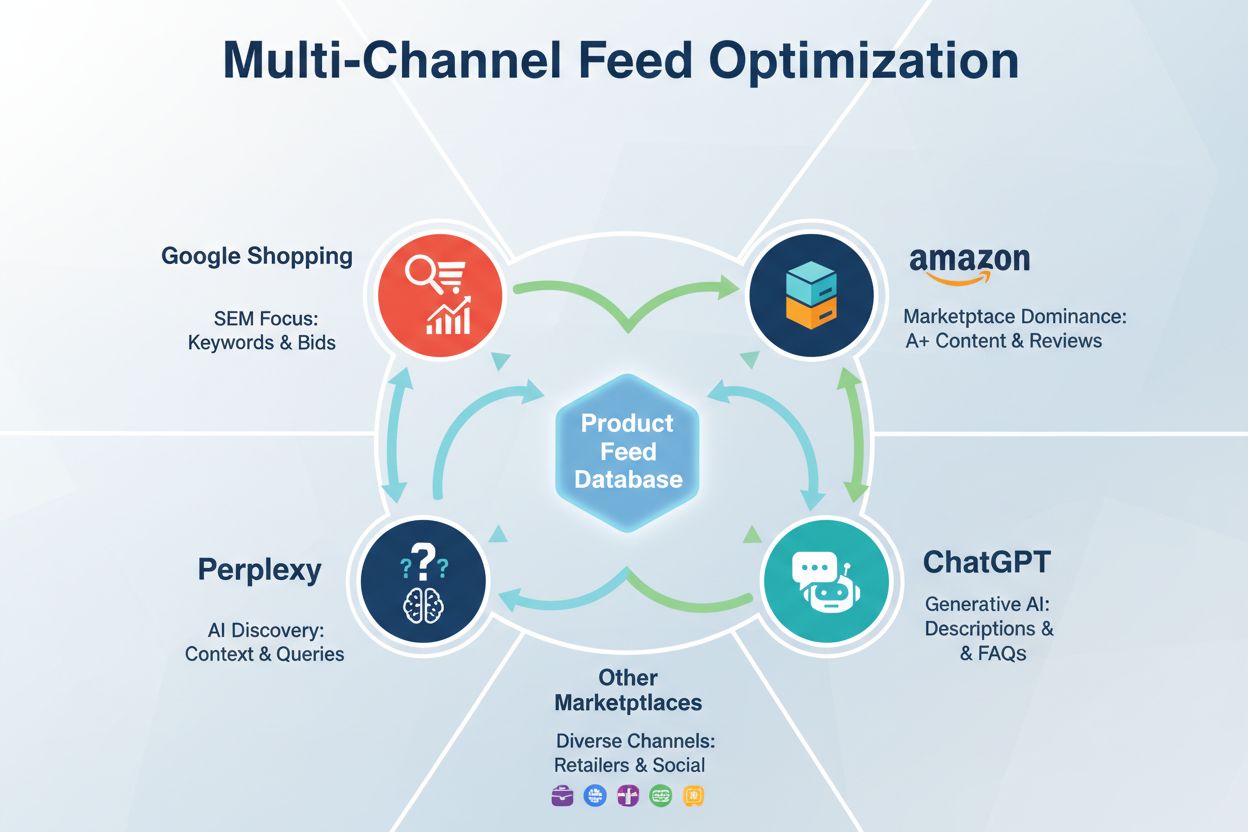
Different AI platforms have different underlying algorithms, data requirements, and optimization priorities, which means a one-size-fits-all feed approach leaves significant visibility on the table. Google Shopping and Google AI Overviews both consume product feeds, but they weight attributes differently: Google Shopping prioritizes competitive pricing and availability, while AI Overviews emphasize comprehensive descriptions and brand authority. Amazon’s recommendation engine operates on a completely different dataset and algorithm—it prioritizes bullet points, A+ content, and customer reviews alongside product feed data, meaning optimization for Amazon requires different attribute emphasis than Google. Perplexity and ChatGPT are increasingly integrating product feeds through partnerships and APIs, but they prioritize different signals: Perplexity values comprehensive, detailed product information for comparison shopping, while ChatGPT focuses on product relevance to specific user queries and use cases. For example, a consumer electronics retailer might optimize their Google Shopping feed with aggressive pricing and availability flags, their Amazon feed with detailed technical specifications and use-case benefits, and their Perplexity feed with comprehensive comparison data and expert reviews. The most sophisticated retailers maintain channel-specific feed variants or use dynamic feed management platforms that automatically adjust attribute emphasis based on the destination platform. This channel-specific optimization can increase visibility by 30-50% compared to using a generic feed across all platforms.
Schema.org markup is the universal language that helps AI systems understand product context and relationships, and it’s increasingly critical for visibility in AI-powered shopping experiences. When you implement JSON-LD structured data on your product pages, you’re essentially providing AI systems with machine-readable metadata that explains what your product is, how much it costs, its availability, ratings, and other critical attributes. The difference between on-page structured data and feed-based structured data is important: on-page markup helps AI understand individual product pages when crawling your website, while feed-based structured data (often in JSON-LD format) provides bulk product information that AI systems can ingest and process at scale. AI Overviews and shopping assistants rely heavily on structured data to extract product information reliably and confidently—without it, they must attempt to parse unstructured HTML, which is error-prone and often results in missing or incorrect information. Best practices include implementing comprehensive Schema.org markup for Product, Offer, AggregateRating, and Review types; ensuring all critical attributes are included in your markup; validating your markup using Google’s Rich Results Test; and keeping markup synchronized with your actual product feed data. Retailers who implement robust structured data see improved appearance in AI Overviews, better rich snippet displays, and increased click-through rates from AI-powered shopping experiences.
Effective feed optimization is an ongoing, iterative process that requires continuous monitoring, analysis, and refinement to maintain and improve AI visibility over time. Google Merchant Center provides diagnostic tools that flag feed errors, missing attributes, and data quality issues—regularly reviewing these diagnostics is essential for identifying optimization opportunities. Feed audit processes should include automated checks for completeness (are all required attributes present?), consistency (do all products follow the same formatting standards?), accuracy (do prices and availability match your source systems?), and relevance (are products properly categorized and described?). Continuous optimization cycles involve testing different attribute combinations, descriptions, and categorizations to see which variations drive better AI visibility and click-through rates. A/B testing is particularly valuable: retailers can test different product titles, descriptions, or image sets to determine which variations perform better in AI recommendations and shopping results. Beyond Google’s tools, AmICited.com provides unique monitoring capabilities that track how often your products are cited and recommended by AI shopping engines and assistants—this visibility into AI citations helps you understand which products are resonating with AI systems and which need optimization. By combining Google Merchant Center diagnostics with AmICited.com’s AI citation monitoring, retailers gain comprehensive visibility into feed performance across the entire AI shopping ecosystem.
Retailers frequently make preventable feed optimization mistakes that significantly reduce AI visibility and sales potential, and understanding these pitfalls is the first step toward avoiding them. Keyword stuffing—cramming excessive keywords into titles and descriptions—is a common mistake that actually reduces AI confidence; AI systems recognize this tactic and penalize feeds that employ it, so titles should be clear and descriptive rather than keyword-laden. Inconsistent data across products (some with GTINs, others without; some with detailed descriptions, others with minimal text) signals low-quality feeds to AI systems and results in deprioritization. Poor image quality or missing images severely limits AI’s ability to understand products visually and reduces appearance in image-based AI recommendations; every product should have at least 3-5 high-resolution images from different angles. Missing product identifiers like GTINs or brand information prevents AI from verifying product authenticity and connecting to authoritative product databases, reducing visibility by up to 20%. Outdated or inaccurate pricing and availability causes AI systems to lose confidence in your feed and can result in customer frustration when they click through to find different prices or out-of-stock items. Poor categorization makes it difficult for AI to understand product context and match products to relevant customer queries. The solution is implementing a feed governance process: establish data quality standards, automate validation checks, conduct regular audits, and maintain a continuous improvement cycle focused on completeness, consistency, and accuracy.
AI technology is evolving at an unprecedented pace, and the AI shopping landscape of 2025 will look dramatically different from today—retailers must build flexibility into their feed strategies to adapt to emerging technologies and platforms. Voice search and AI assistants are becoming increasingly important shopping channels; as consumers ask voice assistants like Alexa, Google Assistant, and Siri shopping-related questions, these systems query product feeds to provide answers, meaning feeds must be optimized for conversational queries and voice-friendly descriptions. Emerging platforms like specialized shopping AI, vertical-specific assistants, and new AI marketplaces will continue to emerge, each with their own data requirements and optimization priorities. Rather than optimizing for specific platforms, forward-thinking retailers are building flexible feed structures that can accommodate new attributes, formats, and requirements as they emerge—using APIs and dynamic feed management systems rather than static file uploads. Continuous learning is essential: staying informed about AI platform updates, participating in beta programs, and monitoring how your products perform in new AI channels helps you adapt quickly when new opportunities arise. AmICited.com’s monitoring capabilities are particularly valuable for future-proofing because they track your product citations across the entire AI ecosystem, including emerging platforms and new AI shopping channels—this visibility helps you identify which new platforms are driving traffic and which deserve optimization investment. By combining flexible feed infrastructure, continuous monitoring, and a commitment to data quality, retailers can ensure their products remain visible and competitive as AI shopping technologies continue to evolve.
A product feed is a structured data file containing product information like titles, descriptions, prices, and availability. AI shopping engines like Google AI Overviews, Perplexity, and ChatGPT rely on these feeds to understand products and make recommendations. Without optimized feeds, your products become invisible to AI-powered discovery systems.
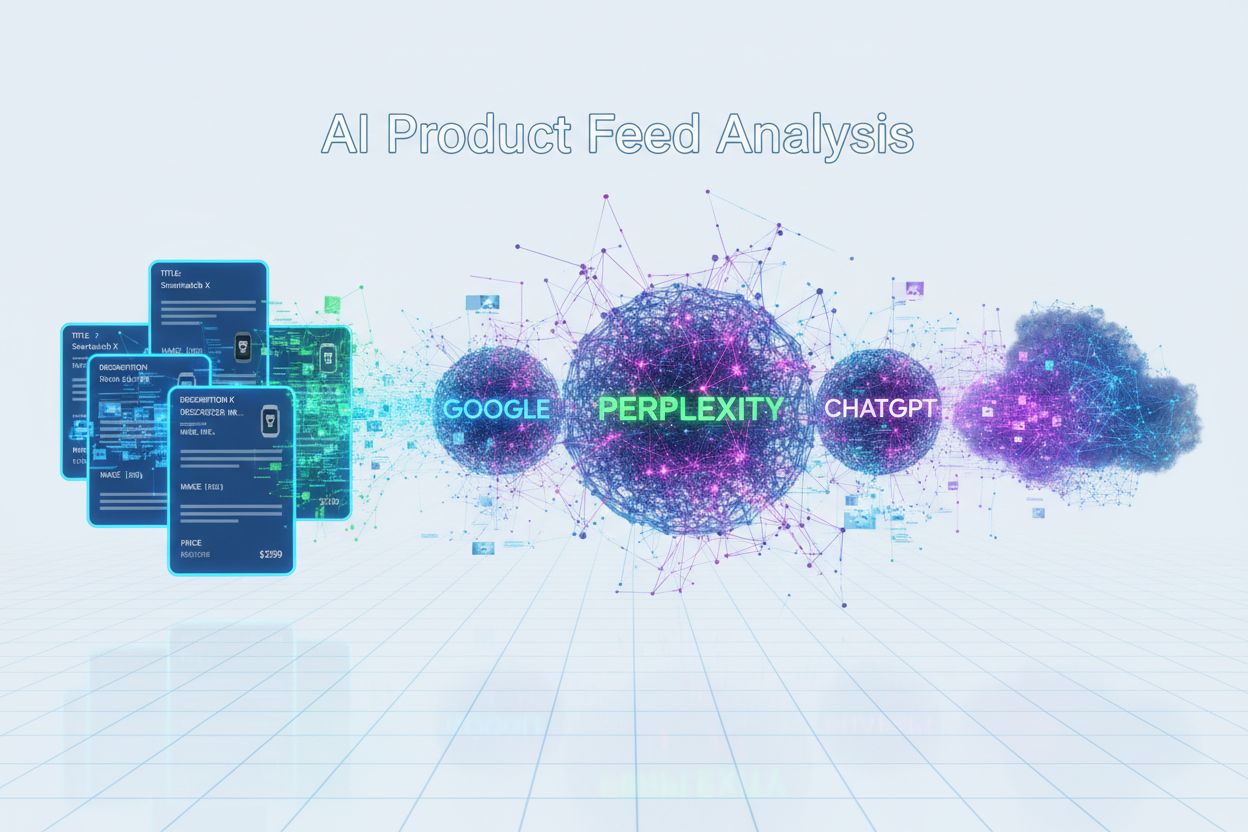
AI systems parse product feeds to understand inventory, pricing, availability, and relevance. They use this data to match customer queries to products, generate shopping recommendations, and populate AI Overviews. The quality and completeness of your feed directly impacts how often your products appear in AI results.
Critical attributes include product title, description, GTIN/brand, category, high-quality images, and accurate pricing/availability. Each attribute helps AI understand your product better. Missing or incomplete attributes reduce AI confidence and visibility. Providing complete data can increase clicks by up to 20%.
At minimum, update feeds daily. For optimal AI performance, implement real-time or near-real-time updates that sync with your inventory system. This ensures AI systems always have current pricing and availability information, preventing customer frustration and maintaining AI confidence in your data.
While you can use a base feed across platforms, different AI systems (Google Shopping, Amazon, Perplexity, ChatGPT) have different optimization priorities. Using channel-specific feed variants or dynamic customization can increase visibility by 30-50% compared to generic feeds.
Monitor your feed using Google Merchant Center diagnostics, check for data completeness and consistency, and use AmICited.com to track how often AI systems cite your products. Test different attribute combinations and measure their impact on AI visibility and click-through rates.
Google Shopping prioritizes competitive pricing and availability, while AI Overviews emphasize comprehensive descriptions and brand authority. Google Shopping feeds focus on conversion signals, while AI Overviews need rich contextual information to generate accurate summaries for users.
AmICited.com tracks how often your products are cited and recommended by AI shopping engines and assistants across the entire AI ecosystem. This visibility helps you understand which products resonate with AI systems and which need optimization, enabling data-driven feed improvements.
AmICited.com tracks how AI systems like Google AI Overviews, Perplexity, and ChatGPT reference your brand and products. Optimize your feeds and monitor your AI visibility in real-time.
Learn what product feeds for AI are, how they differ from traditional feeds, and how to optimize them for ChatGPT, Google AI Overviews, and Perplexity shopping ...

Learn how to optimize your e-commerce store for AI shopping assistants like ChatGPT, Google AI Mode, and Perplexity. Discover strategies for product visibility,...
Learn how retail brands optimize for AI search engines like ChatGPT, Perplexity, and Google AI Overviews. Discover AEO strategies, content optimization, and mon...