

Product Schema
Product Schema is structured data markup that helps search engines and AI systems understand product details. Learn how to implement it for better visibility in...
24 min read

Learn how product schema markup helps your e-commerce products get cited by AI shopping engines like Google AI Overviews, Perplexity, and ChatGPT Search.
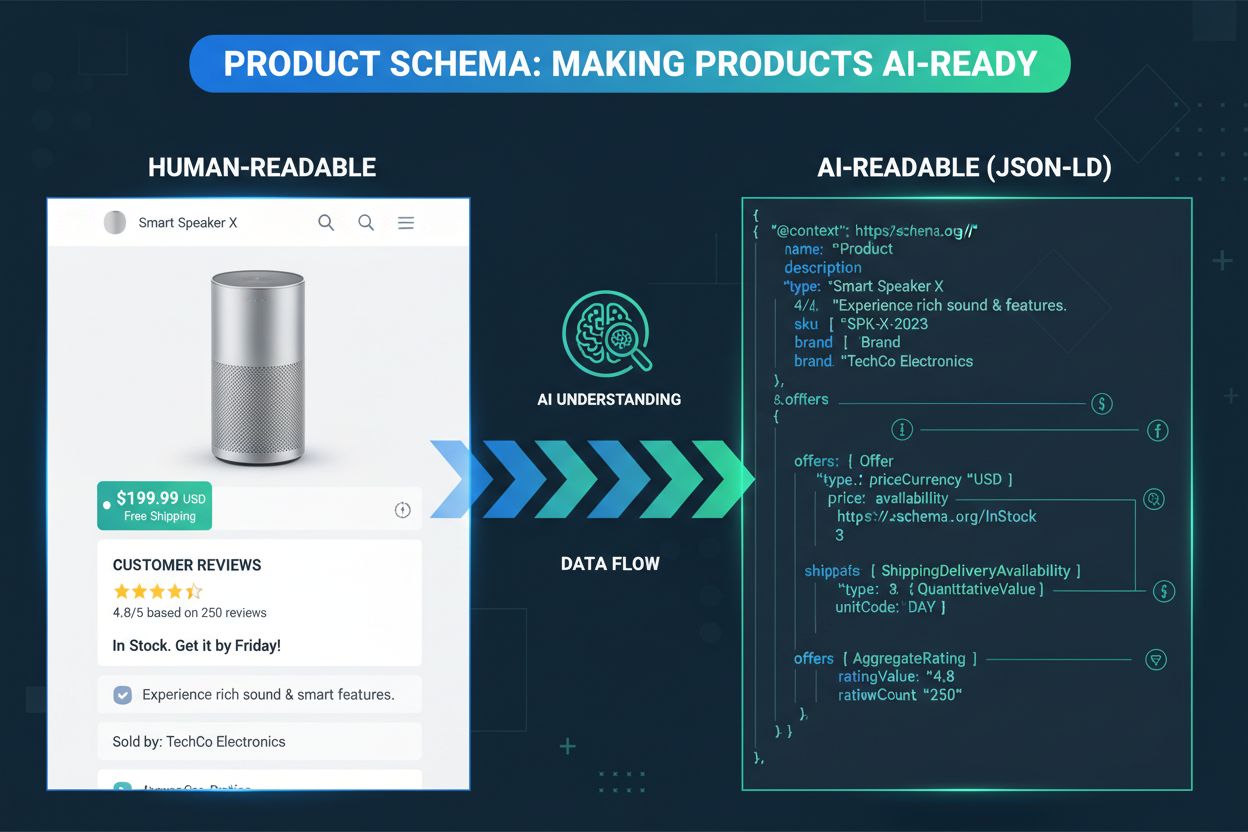
Product schema is a standardized form of structured data markup that provides machines with detailed information about products in a format they can easily understand and process. Unlike traditional search engines that rely on keyword matching and page content analysis, AI shopping engines depend heavily on this structured data to comprehend product attributes, relationships, and context with precision. The most common format for implementing product schema is JSON-LD (JavaScript Object Notation for Linked Data), which embeds product information directly into web pages in a machine-readable format. Traditional search engines use schema primarily for enhanced search results and rich snippets, while AI systems leverage schema data to build comprehensive product understanding, make intelligent recommendations, and generate accurate product summaries. Key terms like SKU, availability, pricing, and ratings become actionable data points rather than mere text when properly structured. As AI shopping engines become increasingly sophisticated, the quality and completeness of product schema directly impacts whether your products are discovered, accurately represented, and recommended to potential customers.

Product schema operates through the schema.org vocabulary, a collaborative effort by major search engines to standardize structured data markup across the web. JSON-LD serves as the preferred implementation method because it’s easy to maintain, doesn’t interfere with page rendering, and provides clear semantic meaning to AI systems. When an AI shopping engine crawls your website, it extracts JSON-LD product data and feeds it into its Knowledge Graph—a vast database of interconnected product information that powers intelligent search and recommendation features. The AI system parses properties like product name, description, price, availability, and ratings to build a comprehensive product profile that goes far beyond simple keyword matching.
| Aspect | Traditional Search | AI Search | Importance |
|---|---|---|---|
| Data Source | Page content + meta tags | Structured schema + content | Critical for accuracy |
| Understanding | Keyword-based matching | Semantic comprehension | Enables intelligent features |
| Product Context | Limited | Comprehensive | Better recommendations |
| Real-time Updates | Slower indexing | Faster processing | Immediate visibility |
| Recommendation Quality | Basic filtering | Advanced AI analysis | Drives conversions |
This structured approach allows AI systems to understand not just what a product is, but its specifications, availability, pricing variations, and customer sentiment in a unified, machine-readable format.
To maximize visibility in AI shopping engines, your product schema must include these critical properties:
Each property serves a specific function in how AI systems evaluate and present products. Nested properties—such as rating details within aggregateRating or offer variations within price—provide additional layers of information that enable more sophisticated AI analysis. For example, including multiple offers with different prices, currencies, and availability statuses allows AI shopping engines to provide region-specific recommendations and pricing information. The more complete and accurate your schema properties, the better AI systems can understand your products and match them to user queries.
Here’s a complete JSON-LD code example for a product:
{
  "@context": "https://schema.org/",
  "@type": "Product",
  "name": "Premium Wireless Headphones",
  "description": "High-quality wireless headphones with noise cancellation and 30-hour battery life",
  "image": "https://example.com/images/headphones.jpg",
  "brand": {
    "@type": "Brand",
    "name": "AudioTech"
  },
  "offers": {
    "@type": "Offer",
    "url": "https://example.com/product/headphones",
    "priceCurrency": "USD",
    "price": "199.99",
    "availability": "https://schema.org/InStock"
  },
  "aggregateRating": {
    "@type": "AggregateRating",
    "ratingValue": "4.5",
    "reviewCount": "328"
  },
  "sku": "WH-1000XM4",
  "mpn": "WH-1000XM4"
}
This JSON-LD code should be placed in the <head> section of your HTML page or within the product page body, wrapped in <script type="application/ld+json"> tags. Proper placement ensures that AI crawlers immediately encounter the structured data without having to parse page content. Use validation tools like Google’s Rich Results Test or Schema.org’s validator to verify your implementation is correct and error-free. Most modern CMS solutions like Shopify, WooCommerce, and Magento offer built-in schema generation features or plugins that automatically create proper JSON-LD markup, reducing the need for manual coding.
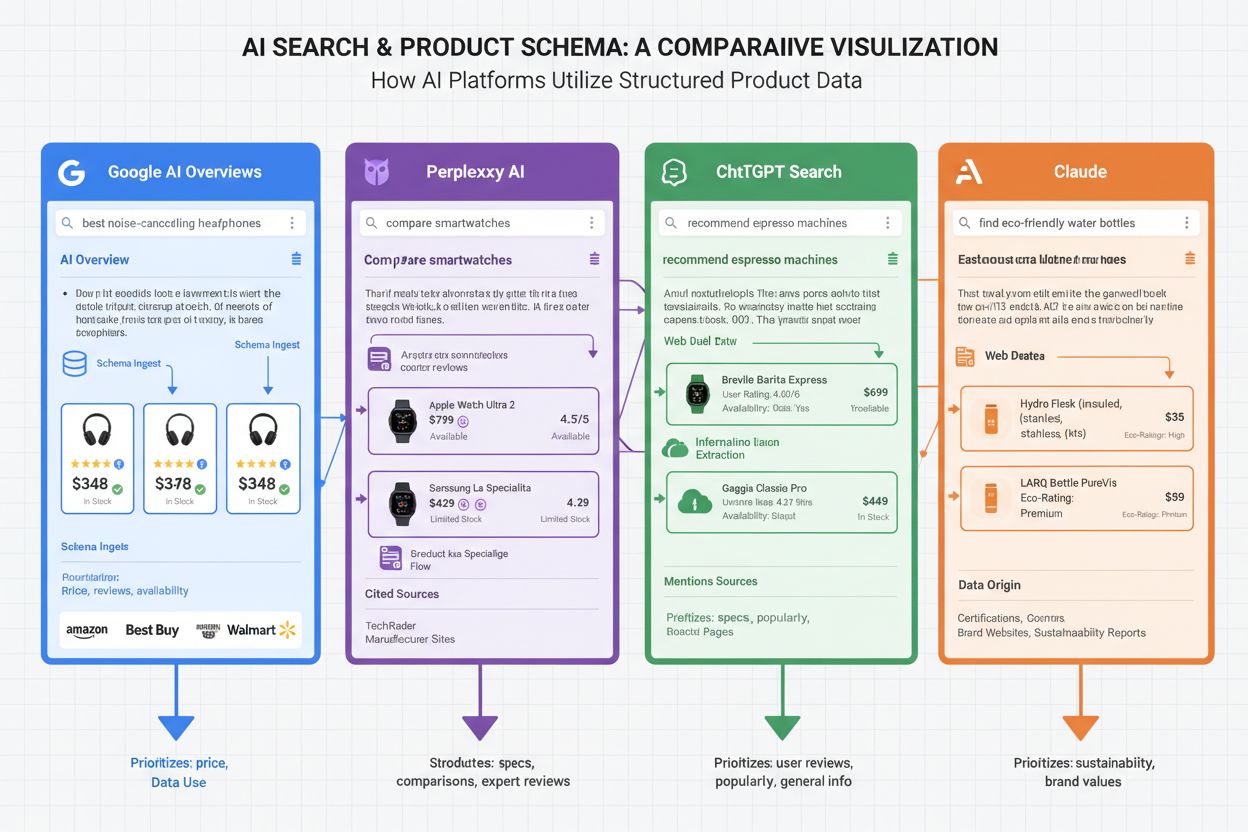
Google AI Overviews (formerly SGE) relies heavily on product schema to generate AI-powered shopping summaries that appear at the top of search results, making schema implementation critical for visibility in Google’s AI features. Perplexity AI uses product schema to provide accurate product information, pricing, and availability in its conversational search results, often citing sources that have well-structured data. ChatGPT Search integrates product schema data to deliver current pricing, stock status, and product details when users ask shopping-related questions, prioritizing sources with comprehensive structured data. Claude and other AI assistants increasingly reference products with proper schema markup when answering consumer questions, as the structured data provides reliable, verifiable information. To monitor whether your products are being cited and featured in AI search results, tools like AmICited.com track mentions of your products across various AI platforms and provide insights into how often your schema data is being utilized. Understanding which AI engines are citing your products helps you optimize your schema strategy and measure the ROI of your structured data implementation.
Follow these best practices to maximize the effectiveness of your product schema:
These practices ensure that your product schema remains effective as AI shopping engines evolve and become more sophisticated in their data requirements.
Measuring the impact of product schema requires tracking multiple metrics including impressions in AI search results, click-through rates from AI-generated summaries, and conversion rates from AI-referred traffic. AmICited.com provides a centralized dashboard where you can monitor how frequently your products appear in AI search results across different platforms, giving you visibility into your AI visibility. ROI tracking involves comparing the cost of implementing and maintaining product schema against the revenue generated from AI-referred customers, helping justify continued investment in schema optimization. Set up alerts and monitoring systems to notify you when your products are cited in major AI platforms or when schema validation errors occur, allowing you to respond quickly to issues. Analyze which product categories and attributes generate the most AI citations to identify opportunities for schema expansion and optimization. Compare your schema performance against competitors to understand whether your implementation is competitive and identify gaps in your current approach.
Problem: Incomplete product data in schema markup. Solution: Audit your schema implementation to ensure all essential properties (name, description, image, price, availability) are present and complete for every product.
Problem: Outdated pricing or availability information in schema. Solution: Implement automated schema updates that sync with your inventory management system in real-time to prevent stale data.
Problem: Keyword stuffing in product descriptions within schema. Solution: Write natural, accurate descriptions that prioritize clarity and user value over keyword density, as AI systems penalize manipulative content.
Problem: Schema implementation only on desktop versions. Solution: Ensure product schema is present and properly formatted on mobile versions of your site, as AI crawlers increasingly prioritize mobile-first indexing.
Problem: Failing to validate schema before deployment. Solution: Always run schema through validation tools before publishing to catch errors that could prevent AI systems from parsing your data correctly.
Problem: Never updating schema after initial implementation. Solution: Establish a regular review schedule to update schema when products change, new properties become available, or AI platforms introduce new requirements.
Problem: Mixing multiple schema types incorrectly. Solution: Use schema.org’s official documentation to ensure you’re implementing the correct schema type and property structure for your products.
Product schema will continue to evolve as AI shopping engines become more sophisticated and demanding in their data requirements. The emergence of a semantic layer in e-commerce platforms will enable richer, more contextual product information that goes beyond basic attributes to include relationships, use cases, and environmental impact data. Emerging AI features like visual search integration, voice commerce optimization, and personalized product recommendations will increasingly depend on comprehensive, well-structured schema data to function effectively. As competition intensifies among AI shopping platforms, those with access to the highest-quality structured data will provide superior user experiences, creating stronger incentives for merchants to invest in schema optimization. Staying updated with schema.org specifications, monitoring AI platform announcements, and participating in industry discussions will be essential for maintaining competitive advantage in AI-driven commerce. The merchants who prioritize product schema today will be best positioned to capture traffic and sales from tomorrow’s AI shopping engines.
Product schema is structured data markup that provides machines with detailed product information in a standardized format. AI shopping engines depend on this data to understand product attributes, relationships, and context with precision, enabling them to generate accurate product summaries and recommendations.
Traditional SEO markup focuses on enhancing search results and rich snippets for keyword-based search engines. Product schema for AI goes deeper, providing comprehensive product understanding that enables AI systems to make intelligent recommendations, generate accurate summaries, and match products to user queries with greater precision.
Critical properties include: name, description, image, price, availability, SKU, brand, aggregateRating, and review. Each property serves a specific function in how AI systems evaluate and present products. The more complete and accurate your schema properties, the better AI systems can understand your products.
Use JSON-LD format placed in the
section of your HTML pages. Most modern CMS solutions like Shopify, WooCommerce, and Magento offer built-in schema generation features or plugins that automatically create proper JSON-LD markup, reducing the need for manual coding.Yes, product schema significantly improves your chances of appearing in AI search results. While schema doesn't guarantee inclusion, it provides AI systems with the structured data they need to understand, evaluate, and recommend your products to users searching through AI shopping engines.
Tools like AmICited.com provide centralized dashboards where you can monitor how frequently your products appear in AI search results across different platforms. These tools track mentions, citations, and visibility metrics to help you measure the ROI of your schema implementation.
JSON-LD is Google's recommended format because it's easy to maintain and doesn't interfere with page rendering. Microdata and RDFa are alternative formats that embed structured data directly in HTML. All three are equally valid for Google, but JSON-LD is preferred for AI systems.
Update your product schema whenever product information changes, including pricing, availability, ratings, or descriptions. Implement automated schema updates that sync with your inventory management system in real-time to prevent stale data that could harm your AI visibility.
Track how AI shopping engines reference your products and optimize your visibility across Google AI Overviews, Perplexity, ChatGPT Search, and more.
Product Schema is structured data markup that helps search engines and AI systems understand product details. Learn how to implement it for better visibility in...
Learn how product schema markup makes your ecommerce products visible to AI shopping assistants. Complete guide to structured data for ChatGPT, Perplexity, and ...
Learn how to implement Organization schema markup for AI visibility. Step-by-step guide to add JSON-LD structured data, improve AI citations, and enhance brand ...