

Product Schema for AI Shopping Engines
Learn how product schema markup helps your e-commerce products get cited by AI shopping engines like Google AI Overviews, Perplexity, and ChatGPT Search.
8 min read
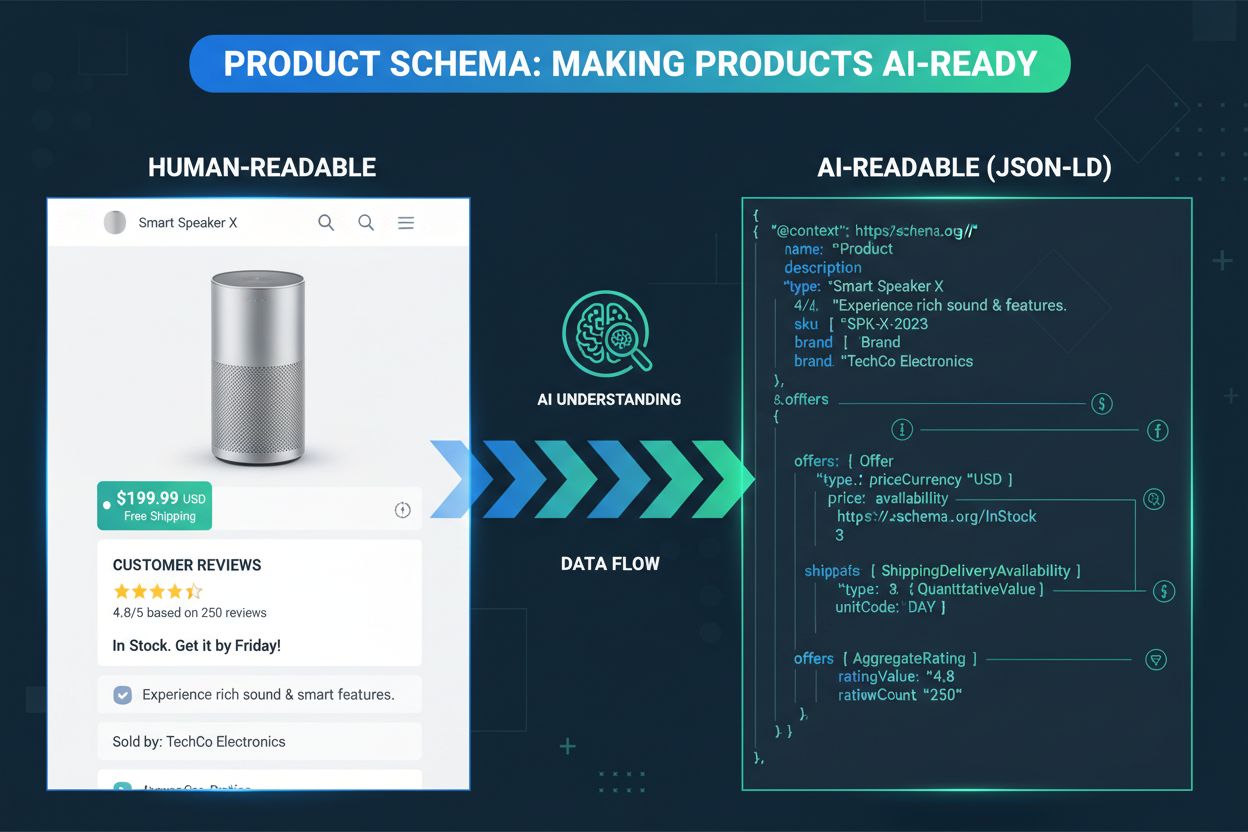
Learn how product schema markup makes your ecommerce products visible to AI shopping assistants. Complete guide to structured data for ChatGPT, Perplexity, and Google AI Overviews.
Your ecommerce site has great products, compelling descriptions, and competitive prices. Yet when customers ask AI assistants for recommendations or search for solutions, your competitors show up instead. The difference? Product schema markup—the technical SEO element that most ecommerce teams overlook until it’s too late. AI-powered search engines like ChatGPT, Perplexity, and Google AI Overviews now drive billions of product discovery moments daily, and without proper schema markup, your products remain invisible to these systems. The impact is measurable: products with comprehensive schema markup appear 3-5x more frequently in AI-generated recommendations compared to those without structured data. This isn’t a future concern—it’s happening now, and the competitive advantage goes to businesses that implement schema first.
Product schema markup is structured data that tells AI systems exactly what your content means, not just what it says. Think of it as a translation layer between your website and artificial intelligence algorithms. While humans can look at a product page and immediately understand the price, availability, and specifications, AI systems need explicit signals encoded in a machine-readable format. The preferred format is JSON-LD (JavaScript Object Notation for Linked Data), which keeps your structured data separate from your HTML, making it cleaner and easier to maintain. Product schema communicates essential information including product name, description, SKU, price, currency, availability status, brand information, product images, customer reviews, ratings, and shipping details. The standard vocabulary comes from Schema.org, an open-source collaborative project supported by Google, Microsoft, Yahoo, and Yandex that defines how to mark up different types of content.
| Aspect | Without Schema | With Schema |
|---|---|---|
| AI Understanding | Guesses at product details from text | Precisely understands all attributes |
| Data Accuracy | Prone to misinterpretation | Machine-verified accuracy |
| Recommendation Frequency | Rarely recommended by AI | 3-5x more frequent recommendations |
| Rich Features | Basic text results only | Enhanced listings with ratings, prices, availability |
| Voice Search | Not optimized for voice queries | Directly answers voice assistant questions |
| Visibility | Limited to traditional search | Appears in AI Overviews, ChatGPT, Perplexity |
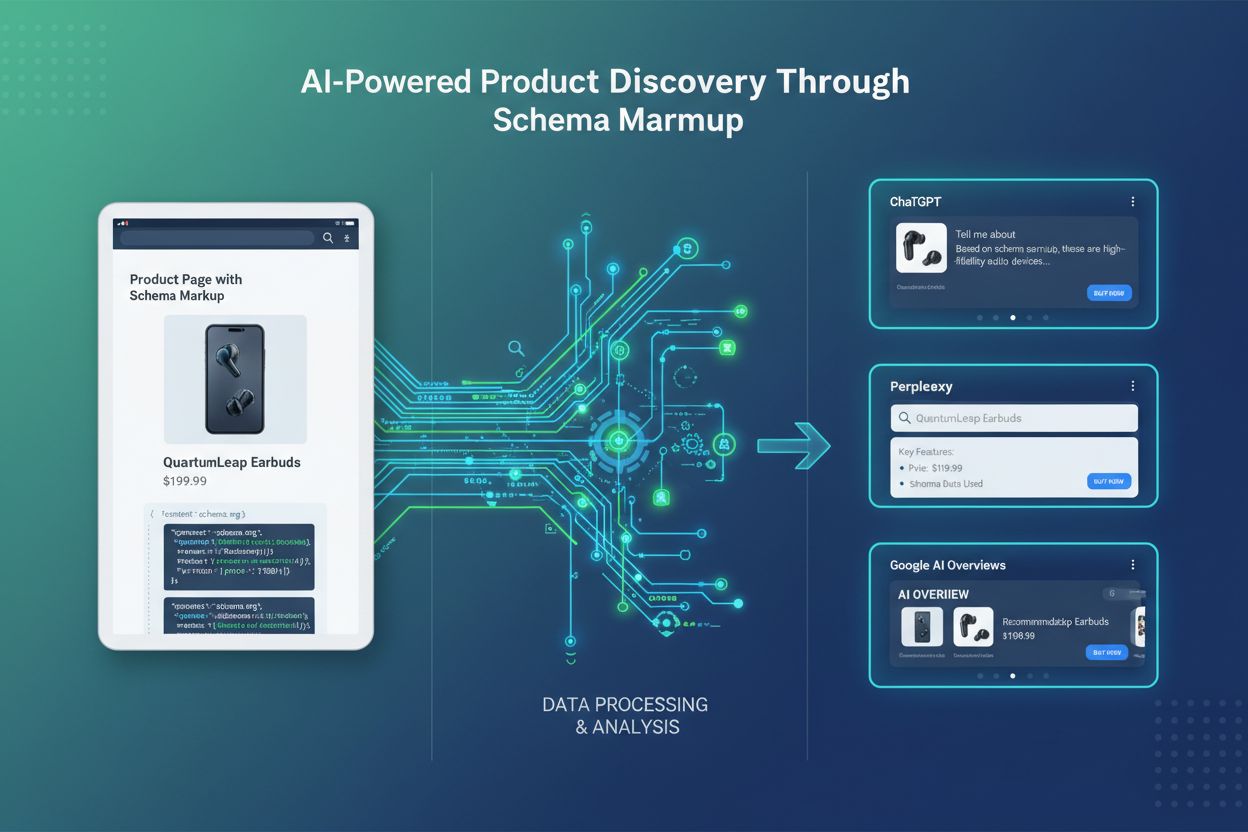
AI search engines don’t browse websites like humans do—they scan for structured data patterns that help them understand relationships between different pieces of information. When your site includes proper schema markup, you’re essentially providing a detailed map that guides AI systems through your content with precision. Modern AI systems use schema markup to build knowledge graphs about products, brands, and categories, creating interconnected webs of information that help them understand context and relationships. When evaluating your waterproof hiking boots, an AI doesn’t just see text on a page; with proper schema, it understands the exact product model and variations, current price and any discounts, stock availability across different sizes, aggregate customer ratings and specific review content, shipping timeframes and costs, return policy details, and brand information and manufacturer details. This structured information allows AI to make confident recommendations with authority and specificity.
Key benefits of schema markup for AI systems:
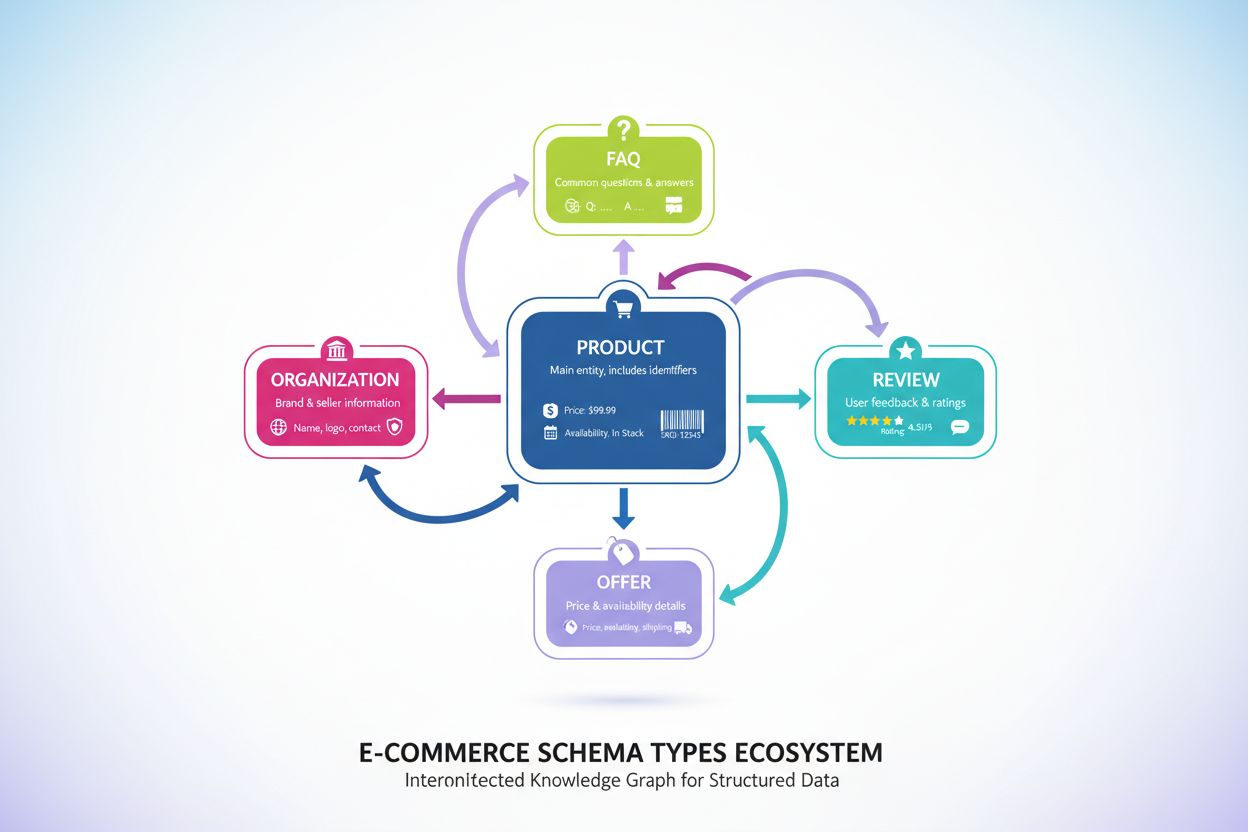
Not all schema types carry equal weight for ecommerce sites. Focusing on the most impactful types ensures maximum return on your implementation effort. Product Schema forms the backbone of ecommerce structured data, communicating essential product information that AI systems need to make recommendations. This includes name, description, SKU, price, availability, brand, images, and category classification. Review and Rating Schema ensures AI systems can access and interpret your customer feedback, including aggregate rating scores, total number of reviews, individual review content, reviewer information, and verification status. FAQ Schema has become increasingly valuable as AI systems look for direct answers to customer questions, helping you communicate common concerns, specific use cases, technical specifications, and shipping/return policy details. Organization Schema establishes your brand credibility by providing official business name, contact information, physical locations, social media profiles, certifications, and company history. Offer Schema completes the picture by detailing pricing, availability, shipping costs, return policies, and merchant information.
| Schema Type | Primary Purpose | Key Properties | AI Impact |
|---|---|---|---|
| Product Schema | Core product information | Name, price, availability, images, SKU | Foundation for all recommendations |
| Review & Rating | Customer feedback signals | Ratings, review count, review content | Builds trust and relevance |
| FAQ Schema | Answer common questions | Questions, answers, categories | Improves AI response accuracy |
| Organization Schema | Brand authority | Business info, certifications, contacts | Establishes credibility |
| Offer Schema | Transaction details | Price, shipping, returns, availability | Enables purchase-ready recommendations |
| Aggregate Offer | Multi-seller pricing | Price range, seller count, availability | Shows competitive positioning |
Successfully implementing schema markup requires a systematic approach that balances technical accuracy with practical business needs. JSON-LD has emerged as the preferred format for implementing schema markup because it keeps your structured data separate from your HTML, reducing the risk of breaking page layouts and making updates simpler. For ecommerce platforms like Shopify, WooCommerce, or Magento, check for built-in schema generation features—many modern platforms include basic schema markup, though you’ll likely need to enhance it for optimal AI visibility. Comprehensive product information is essential: include every relevant product attribute in your schema, not just the basics. If you track it in your product database, it should be in your schema markup, including materials, dimensions, care instructions, compatibility information, and any other specifications customers ask about. Real-time data updates are critical—implement automated processes that update schema markup when prices change, inventory levels shift, or new reviews arrive. This real-time accuracy builds trust with AI systems and ensures your products remain visible even as conditions change throughout the day.
Here’s a practical JSON-LD example for a basic product:
{
  "@context": "https://schema.org",
  "@type": "Product",
  "name": "Premium Waterproof Hiking Boots",
  "description": "Durable waterproof hiking boots with ankle support and grip sole",
  "image": "https://example.com/hiking-boots.jpg",
  "brand": {
    "@type": "Brand",
    "name": "TrailMaster"
  },
  "offers": {
    "@type": "Offer",
    "price": "149.99",
    "priceCurrency": "USD",
    "availability": "https://schema.org/InStock",
    "url": "https://example.com/hiking-boots"
  },
  "aggregateRating": {
    "@type": "AggregateRating",
    "ratingValue": "4.7",
    "reviewCount": "328"
  },
  "sku": "HB-WP-001",
  "mpn": "TRAILMASTER-HB-2024"
}
Tracking the impact of schema markup requires looking beyond traditional SEO metrics. Rich Result Impressions show in Google Search Console, revealing how often your enhanced listings appear in search results. Track which types of rich results your products trigger and compare their click-through rates to standard listings—most ecommerce sites see 25-50% CTR improvements from rich results. AI Overview Appearances require manual monitoring or specialized tools; search for your key product queries weekly and document when your products appear in AI-generated summaries. Track position within AI Overviews and whether your products receive direct recommendations. Voice Search Performance appears indirectly through increases in question-based queries and “near me” searches in your Search Console data. Monitor for longer, conversational phrases that indicate voice search patterns. Featured Snippet Captures often correlate with strong schema implementation, especially for comparison and specification queries. Products with comprehensive structured data frequently appear in position zero.
Key metrics to monitor for schema impact:
Even experienced ecommerce teams make schema markup mistakes that limit AI visibility. Incomplete Product Information is the most common error—implementing only basic schema properties while ignoring valuable details that AI systems seek. The solution is simple: include every relevant product attribute in your schema. If you track it in your product database, it should be in your schema markup. Mismatched Data between visible page content and schema markup confuses AI systems and can trigger penalties. Your schema data must match what’s displayed on the page. Implement automated systems that pull schema data from the same source as your page content to maintain consistency. Ignoring Schema Updates means using outdated schema types or properties that search engines no longer recognize or value. Subscribe to schema.org updates and search engine announcements, and review your schema implementation quarterly to incorporate new properties and remove deprecated ones.
| Common Mistake | Problem | Solution |
|---|---|---|
| Incomplete Information | AI systems skip products with missing details | Include all relevant product attributes in schema |
| Mismatched Data | Page content differs from schema markup | Pull schema from same database as page content |
| Outdated Schema | Using deprecated properties and types | Review schema quarterly and update to latest standards |
| Over-Optimization | Stuffing schema with keywords or fake reviews | Keep schema honest and accurate; focus on completeness |
| No Real-Time Updates | Prices and inventory become stale in schema | Implement automated schema updates for dynamic data |
Once basic schema implementation is complete, advanced strategies can further differentiate your products in AI search results. Dynamic Schema Generation implements systems that automatically update schema markup based on real-time inventory levels, current promotional pricing, seasonal relevance, customer behavior patterns, and competitive positioning. This ensures AI systems always have current information, increasing the likelihood of recommendations. Multi-Language Schema is essential for international ecommerce—implement schema in multiple languages matching your target markets, as AI systems increasingly provide location and language-specific recommendations. Enhanced Media Schema goes beyond basic image markup by implementing video schema for product demonstrations, 3D model schema for AR/VR applications, image gallery schema with multiple angles, and lifestyle image schema showing products in use. Nested Schema Relationships create complex connections that help AI understand product bundles and sets, compatible accessories, replacement parts and consumables, and product variations and options. These relationships help AI systems make comprehensive recommendations that increase average order values.
The relationship between schema markup and AI search continues to evolve rapidly. Conversational Commerce Schema will emerge as AI assistants handle complete purchase transactions, with new schema types for conversational product discovery, voice-based transactions, AI agent negotiations, and automated reordering systems. Ecommerce sites preparing for these changes now will have significant advantages as conversational commerce grows. AI-Specific Schema Properties are being developed to help systems understand product sustainability metrics, ethical sourcing information, personalization parameters, compatibility matrices, and use case scenarios. Early adoption of these emerging properties positions your products favorably as AI systems evolve. Real-Time Schema Adaptation will become standard, with systems that adapt in real-time based on current search trends, competitor actions, inventory levels, market conditions, and customer behavior. This dynamic approach ensures optimal visibility as conditions change throughout the day, moving beyond static schema implementation to truly responsive structured data strategies.
AI systems like ChatGPT and Perplexity rely heavily on structured data to understand products accurately. While traditional SEO focuses on keywords and links, AI systems need explicit, machine-readable information to make confident recommendations. Products with comprehensive schema appear 3-5x more frequently in AI-generated shopping recommendations.
Product Schema is markup you add to your website pages for general product information and reviews. Merchant Listings are specifically for pages where customers can purchase products, with additional properties for sizing, shipping, and return policies. Both are valuable—Product Schema for visibility, Merchant Listings for purchase-ready recommendations.
Update schema markup in real-time whenever product information changes: prices, inventory levels, availability status, and new reviews. Automated systems that pull schema data from your product database ensure consistency. AI systems trust sources with consistently accurate, current information and prioritize them in recommendations.
AI tools can help generate initial schema markup templates, but always verify accuracy before deployment. Schema data must match your actual product information exactly. The best approach combines AI-generated suggestions with manual review and testing to ensure your schema is accurate and complete.
You'll typically see improvements in rich result impressions within 2-4 weeks of proper implementation. AI Overview appearances and voice search visibility improvements usually follow within 4-8 weeks. Business metrics like conversion rate improvements (15-25%) and AOV increases typically appear within 2-3 months as AI systems learn to recommend your products more effectively.
Absolutely. Implement schema on your own website even if you sell on Amazon, eBay, or other marketplaces. Schema helps establish your brand as the authoritative source for product information across AI systems. This becomes crucial as AI shopping assistants increasingly recommend products—you want them pulling data from your site, not just marketplace listings.
Properly implemented JSON-LD schema adds minimal overhead—typically less than 5KB per page. The performance impact is negligible compared to benefits, and actually helps page speed by reducing customer service inquiries. Just avoid inline Microdata format and use Google Tag Manager or your CMS's built-in schema features for clean implementation.
Use Google's Rich Results Test to check if your schema is valid and eligible for enhanced features. Also use Schema.org's validator and monitor Google Search Console for any schema-related errors or warnings. Test schema implementation on a subset of pages before rolling out site-wide to catch any issues early.
AmICited tracks how AI systems reference your products across ChatGPT, Perplexity, Google AI Overviews, and more. Get real-time insights into your AI shopping visibility.
Learn how product schema markup helps your e-commerce products get cited by AI shopping engines like Google AI Overviews, Perplexity, and ChatGPT Search.

Product Schema is structured data markup that helps search engines and AI systems understand product details. Learn how to implement it for better visibility in...
Learn how to implement HowTo schema markup for better visibility in AI search engines. Step-by-step guide to adding structured data for ChatGPT, Perplexity, and...