

Content Refresh for AI Visibility: Update Strategies That Work
Learn proven content refresh strategies to boost your brand visibility in AI search engines like ChatGPT, Google AI Overviews, and Perplexity. Discover how to u...
11 min read

Discover how publication dates impact AI citations across ChatGPT, Perplexity, and Google AI Overviews. Learn industry-specific freshness strategies and avoid the recency bias trap.
The question isn’t whether publication dates matter to AI systems—it’s how much they matter, and whether that’s good for the internet. Recent research reveals a striking pattern: 65% of all AI bot hits land on content published within the past year, with 79% coming from the last two years and 89% from the last three years. This represents a fundamental shift in how information gets discovered and amplified compared to traditional search, where older, authoritative content can maintain visibility indefinitely. The stakes are enormous for brand visibility and content strategy, as this recency bias means that even high-quality, evergreen content faces an invisible expiration date in AI-powered search results. Understanding this paradox—where AI systems simultaneously claim to value accuracy and authority while aggressively favoring newer content—is essential for any organization competing for visibility in the age of AI search.

Not all AI models treat publication dates equally, and these differences have profound implications for your citation strategy. ChatGPT shows the most balanced approach, with 31% of citations from 2025, 29% from 2024, and 11% from 2023 (totaling 71% from the past three years), while still citing older authoritative sources like Wikipedia articles from 2004 alongside current content. Perplexity takes a more aggressive stance, pulling 50% of citations from 2025, 20% from 2024, and 10% from 2023 (80% total), demonstrating a stronger preference for cutting-edge information. Google AI Overviews shows the strongest recency bias, with 44% from 2025, 30% from 2024, and 11% from 2023 (85% total), suggesting Google’s AI prioritizes freshness even more heavily than its organic search algorithm. These differences exist because each model serves different user needs—ChatGPT balances comprehensiveness with recency, Perplexity optimizes for current information, and Google AI Overviews prioritizes immediate relevance. Research indicates that ChatGPT demonstrates a 458-day preference for newer content compared to traditional organic search, meaning it will cite a 2-year-old article over a 4-year-old one even when both are equally relevant. However, it’s crucial to note that authority and longevity still matter significantly; none of these models completely discard older, well-established sources.
| AI Model | 2025 Citations | 2024 Citations | 2023 Citations | 3-Year Total | Recency Bias Level |
|---|---|---|---|---|---|
| ChatGPT | 31% | 29% | 11% | 71% | Moderate |
| Perplexity | 50% | 20% | 10% | 80% | Aggressive |
| Google AI Overviews | 44% | 30% | 11% | 85% | Very Strong |
The importance of publication dates varies dramatically across industries, and a one-size-fits-all freshness strategy will fail. Financial services experiences the most extreme recency bias, where AI models heavily favor recent market analysis, regulatory updates, and economic data—content older than six months often becomes invisible regardless of quality. Travel and hospitality show moderate recency requirements, with 92% of AI citations coming from content published in the last three years, reflecting the reality that hotel reviews, flight prices, and destination information genuinely expire. Energy and utilities content maintains a longer lifespan, as technical specifications, infrastructure information, and regulatory frameworks remain relevant for 5-10 years, allowing older authoritative sources to compete effectively. DIY, home improvement, and decking content ages remarkably well, since instructional content about building techniques, material properties, and installation methods remains valid across decades. This variation exists because information decay rates differ fundamentally—financial data becomes obsolete in weeks, travel information in months, technical specifications in years, and instructional content potentially never. The actionable insight here is critical: audit your content by industry vertical and tailor your freshness strategy accordingly, rather than applying uniform update schedules across all content types.
AI models don’t just look at publication dates in metadata—they analyze multiple freshness signals to determine content relevance and recency. Textual signals include explicit date mentions within content (“as of January 2025”), version numbers (“Version 3.2”), and temporal language that signals when information was current, all of which AI models can parse and weight heavily. Technical signals like schema markup (Article schema with datePublished and dateModified), XML sitemap lastmod timestamps, and HTTP header dates provide structured signals that AI crawlers can reliably interpret. Behavioral signals including engagement metrics, click-through rates, and user interaction patterns help AI systems infer whether content remains actively useful or has become stale. However, there’s a dangerous trap here: superficial updates like changing dates without meaningful content changes can fool AI models in the short term but create long-term credibility problems. Research from Waseda University found that 1 in 4 relevance decisions flip based on date signals alone, meaning a poorly-dated piece of content can be completely invisible despite quality. The best practice combines both elements: make meaningful updates to content (adding new data, refreshing examples, updating statistics) while simultaneously adding clear freshness signals that help AI models recognize the improvement.
The Waseda University study on AI citation behavior uncovered a troubling phenomenon: fake dates fool AI models consistently, with every major AI model preferring newer-dated text even when older content was more accurate or authoritative. In their research, the top 10 results shifted to favor content 1-5 years newer simply by manipulating publication dates, and individual passages jumped as much as 95 ranking positions based on date signals alone. This has created what researchers call a “temporal arms race”—where content creators feel pressured to constantly update and re-date content to maintain visibility, regardless of whether meaningful changes occurred. The long-term risk is severe: quality, authoritative content gets buried beneath frequently-updated but less reliable sources, and the internet’s information ecosystem becomes optimized for recency theater rather than accuracy. This trap particularly affects niche topics, historical information, and specialized knowledge where the best sources may be older but still authoritative. Organizations that succumb to this pressure by artificially dating content face compounding risks—AI models are becoming increasingly sophisticated at detecting manipulation, and when caught, the credibility damage extends far beyond a single piece of content.

The solution isn’t to abandon authority in pursuit of freshness—it’s to strategically balance both. Authority and longevity still matter significantly in AI citation decisions, as evidenced by ChatGPT’s continued citation of Wikipedia articles from 2004 alongside 2025 content, demonstrating that established sources maintain gravitational pull even when newer alternatives exist. The strategic approach involves separating time-bound content from historical resources: create a content architecture where time-sensitive information (market data, pricing, current events) gets updated frequently with clear freshness signals, while evergreen content (guides, tutorials, foundational knowledge) maintains its authority through occasional meaningful updates rather than constant re-dating. Update critical pages frequently—those that directly impact user decisions or contain time-sensitive information—while preserving evergreen content that serves as authoritative reference material. Use version numbers and “as of” dates explicitly to signal which information is current and which is historical, helping AI models understand your content’s temporal scope. Consider implementing a scoring model for prioritizing updates that weighs factors like traffic volume, business impact, information decay rate, and current ranking position, ensuring your team focuses freshness efforts where they matter most.
Translating freshness strategy into action requires a systematic approach that balances effort with impact. Follow this six-step framework to optimize your content for AI citation visibility:
Audit content by impact and age: Conduct a comprehensive inventory of your content library, categorizing each piece by business impact (traffic, conversions, brand visibility) and publication date. Identify which content is both high-impact and aging, as these pieces deserve priority attention.
Test key prompts in AI models: Take your most important content topics and test them across ChatGPT, Perplexity, and Google AI Overviews using realistic user queries. Document which of your pieces get cited, which competitors appear instead, and what freshness signals the cited content displays.
Prioritize high-impact, time-sensitive content: Focus your freshness efforts on content that combines high business value with information that genuinely changes over time. Skip the artificial updates to evergreen content that doesn’t need them.
Add explicit freshness signals: Embed publication dates, update dates, and “as of” statements directly in your content. Use Article schema markup with both datePublished and dateModified fields to ensure AI crawlers recognize your updates.
Implement schema markup strategically: Deploy structured data that clearly communicates content freshness, version numbers, and temporal scope. This helps AI models understand not just when content was published, but what information it covers and when that information was current.
Monitor AI citations monthly: Track how often your content appears in AI-generated responses using tools like AmICited.com, which provides visibility into which pieces get cited, by which models, and how your citation frequency changes as you implement freshness improvements. This data-driven approach reveals what’s actually working rather than relying on assumptions.
As AI search continues to grow and capture increasing portions of information discovery, freshness will become even more important as a ranking signal, but the nature of that importance will evolve. The current aggressive recency bias we’re seeing represents an overcorrection—AI models are learning to prioritize freshness heavily because it correlates with relevance in many domains, but this creates the temporal arms race problem. Quality will eventually win over superficial signals as AI models become more sophisticated at distinguishing meaningful updates from date manipulation, and as users increasingly demand accuracy over novelty. The organizations that thrive will be those that recognize this trajectory and focus on topical authority combined with genuine freshness rather than gaming date signals. The “temporal arms race” will eventually lead to more sophisticated detection mechanisms, making it increasingly risky to rely on artificial freshness signals. Your long-term strategy should emphasize building deep topical authority (comprehensive, interconnected content that establishes expertise) while maintaining strategic freshness (meaningful updates to time-sensitive information with clear signals). Use AmICited.com to track how your freshness strategy evolves over time, monitoring whether your citation frequency improves as you implement these practices and adjusting your approach based on real data about which models cite your content and why.
Temporarily yes, but it's risky long-term. Research from Waseda University shows that fake dates can fool AI models in the short term, but as AI systems become more sophisticated at detecting manipulation, the credibility damage extends far beyond a single piece of content. Focus on meaningful updates instead.
Google AI Overviews shows the strongest recency bias, with 85% of citations from content published in the last three years (2023-2025). Perplexity follows at 80%, while ChatGPT is most flexible at 71%, still citing older authoritative sources like Wikipedia articles from 2004.
It depends on your industry. Financial services should update quarterly or more frequently due to regulatory changes. Travel content benefits from annual updates. Energy and educational content can maintain relevance for 5-10 years. Tailor your update cadence to how quickly information becomes outdated in your vertical.
Not recommended. AI systems are increasingly sophisticated at detecting superficial freshness signals. Instead, make meaningful updates to your content—add new data, refresh examples, update statistics—and then clearly signal those changes with schema markup and explicit date statements.
Both matter significantly. ChatGPT continues to cite Wikipedia articles from 2004 alongside 2025 content, showing that established authority maintains gravitational pull. The best strategy balances both: update time-sensitive content frequently while preserving evergreen content that serves as authoritative reference material.
Test your key topics directly in ChatGPT, Perplexity, and Google AI Overviews using realistic user queries. Document which of your pieces get cited and which competitors appear instead. Use AmICited.com to track your AI citation patterns over time and identify content that's losing visibility.
Both. Prioritize updates for high-impact pages that combine business value with information that genuinely changes over time. Create new content for gaps where AI models never cite you at all. Use a scoring model that weighs traffic, conversions, information decay rate, and current ranking position to guide your decisions.
Schema markup is critical. Using Article schema with both datePublished and dateModified fields helps AI crawlers recognize when content was updated. This structured data is more reliable than textual signals alone and ensures AI models understand your content's temporal scope and freshness status.
Track how your content appears in AI-generated answers across ChatGPT, Perplexity, and Google AI Overviews. Get real-time insights into your AI visibility and citation patterns.
Learn proven content refresh strategies to boost your brand visibility in AI search engines like ChatGPT, Google AI Overviews, and Perplexity. Discover how to u...

Learn optimal content update schedules for AI visibility. Discover how often to refresh content for ChatGPT, Perplexity, and Google AI Overviews to maximize bra...
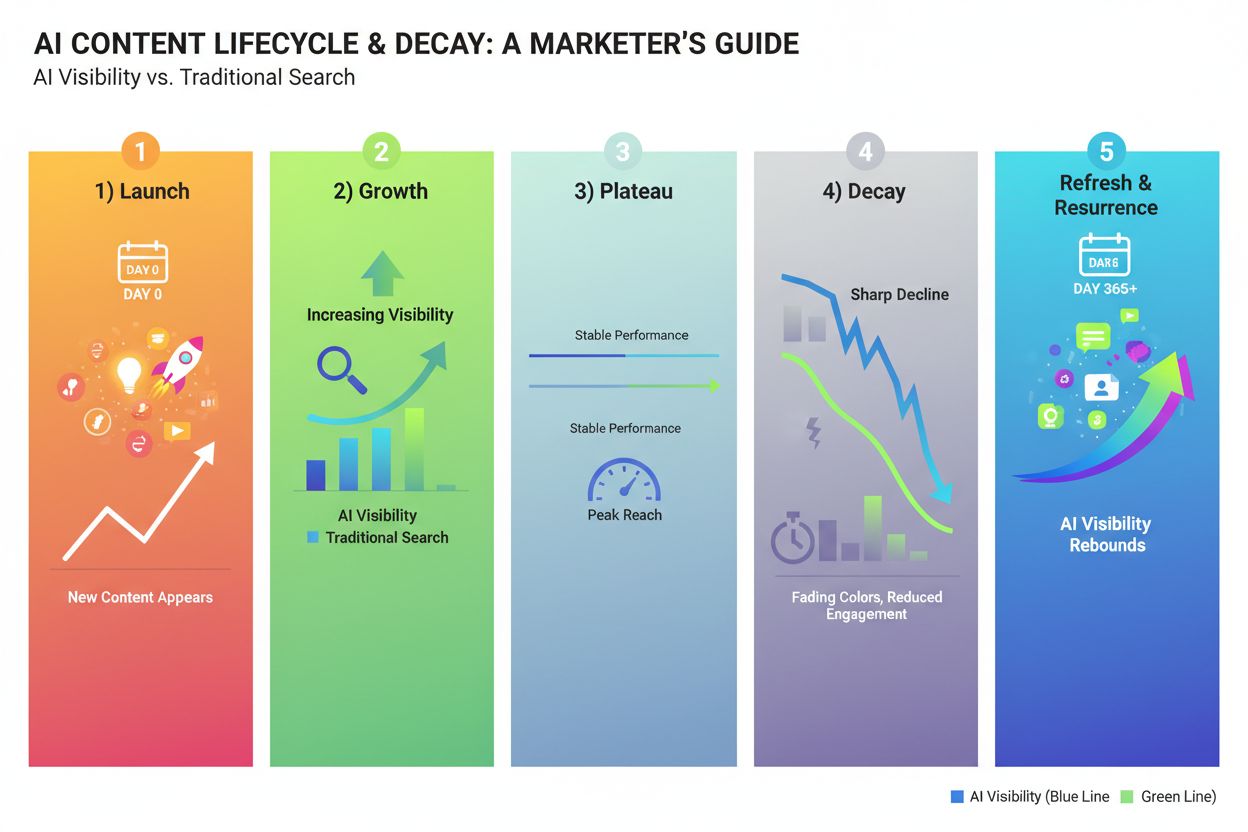
Learn how often to update content for AI visibility. Discover freshness signals, update frequency guidelines, and monitoring strategies for ChatGPT, Perplexity,...