

How Does Quora Affect AI Citations and Brand Visibility
Learn how Quora impacts AI citations in ChatGPT, Perplexity, and Google AI Mode. Discover why Quora is one of the top sources cited by AI systems and how to opt...
7 min read
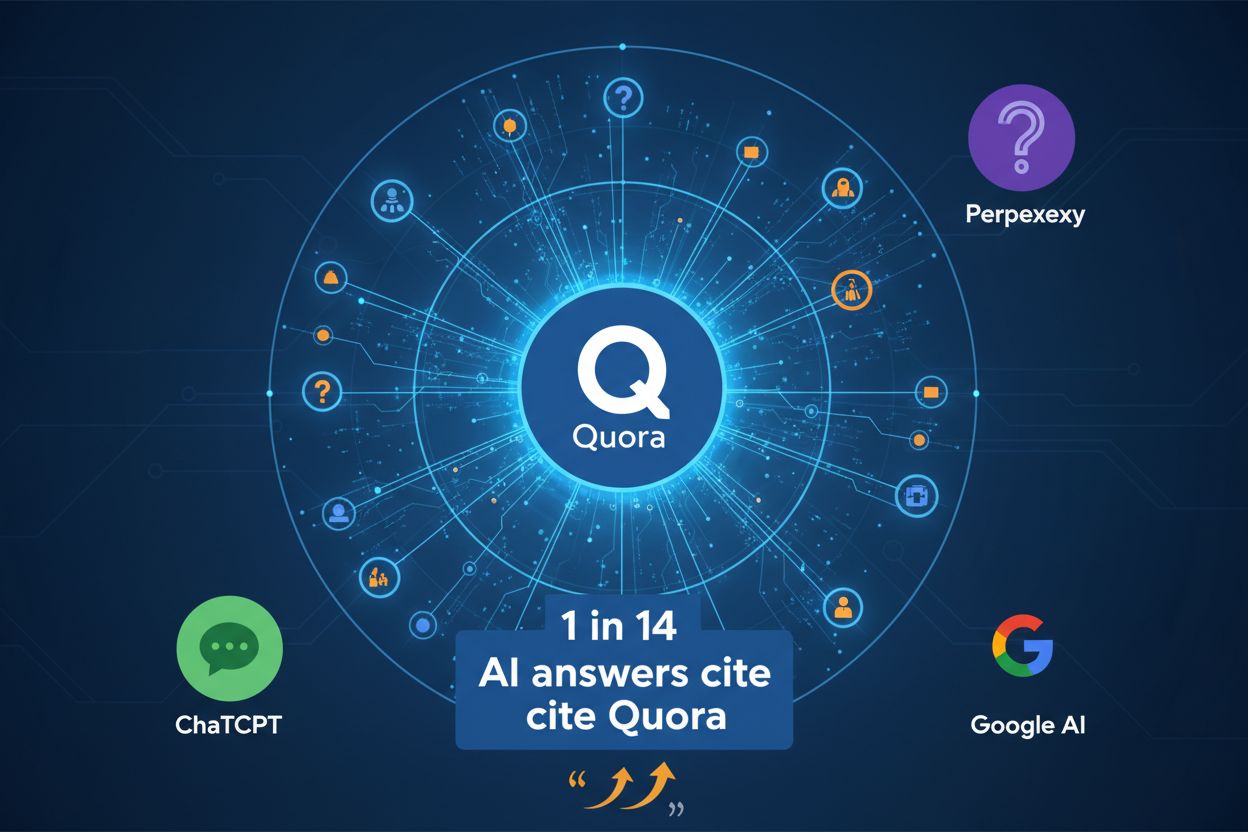
Learn how to leverage Quora for AI visibility and get your brand cited by ChatGPT, Perplexity, and Google AI. Strategic guide to LLM SEO and Quora marketing.
The search landscape is shifting beneath your feet. While traditional SEO still drives traffic, a new discovery channel is rapidly becoming the primary way people find answers: AI-powered search engines like ChatGPT, Perplexity, and Google’s AI Overviews. Here’s what makes this critical for your brand: Quora is the 4th most-cited source in Google’s AI Mode, appearing in approximately 1 out of every 14 AI-generated answers (7.25% of responses). This isn’t a minor statistic—it means that when someone asks an AI system a question in your industry, there’s a significant chance your Quora answer could be the source that shapes the response they receive. Even more compelling, each visitor from AI search is worth 4.4 times more than the average traditional search visitor, making AI visibility not just a nice-to-have but a strategic imperative. The brands that master Quora as an AI visibility channel today will own the conversation tomorrow.
Understanding how AI systems actually use Quora content is essential to optimizing for visibility. Here’s the surprising finding: AI doesn’t copy your Quora answers directly—it blends them. According to Semrush’s analysis of 26,000 Quora URLs cited in Google AI Mode, there was less than 50% text overlap (a similarity score of just 0.435) between AI-generated answers and the original Quora responses. This means Google’s AI takes your ideas, restructures them, combines them with insights from other sources, and rewrites them into something new. For example, when someone asks an AI about skincare, the system might pull the concept of hydration from one Quora answer, the idea of an occlusive barrier from another, and combine them into a synthesized response that cites your thread without using your exact words. This has profound implications for your content strategy: you need to write answers that are easy for AI to extract, understand, and reuse—not answers designed to rank for keywords or capture clicks. The goal is to provide clear, well-structured ideas that survive the AI’s paraphrasing process intact.
| Aspect | Traditional SEO | AI Visibility Strategy |
|---|---|---|
| Focus | Keyword matching | Topic understanding |
| Content Goal | Rank for specific terms | Provide extractable ideas |
| Text Overlap | High (80%+) | Low (under 50%) |
| Citation Pattern | Links to your page | Ideas cited, not text |
| Visitor Intent | Browsing, researching | Problem-solving, decision-making |
One of the most counterintuitive findings from the Semrush research challenges everything you might think you know about SEO: topic relevance matters far more than keyword matching. When researchers compared the similarity between user queries and the Quora question titles that AI cited, they found a similarity score of just 0.1—meaning the original question on Quora often had almost nothing to do with the exact words someone typed into ChatGPT or Google. This reveals that AI systems understand intent and topic, not just keywords. For instance, someone might ask ChatGPT “How do I choose between custom software and off-the-shelf solutions?” and the AI might cite a Quora thread titled “What are the pros and cons of building vs. buying software?” The questions are different, but the topic is identical. This means your Quora strategy should focus on answering the underlying question your audience is asking, not optimizing for specific keyword phrases. Write about the problem your customers face, the decision they’re making, and the factors they should consider—and let the AI systems find and cite you based on topical relevance rather than keyword density.
Not all Quora threads are created equal when it comes to AI visibility. The data reveals a clear pattern: threads that get cited by AI have significantly higher engagement metrics. Specifically, cited threads averaged 37 replies, 15 upvotes, and answers that were at least 535 words long. This isn’t coincidental—active discussions signal to AI systems that a thread contains valuable, multi-perspective information worth synthesizing. When a question has dozens of thoughtful answers and ongoing discussion, it indicates the topic is important and the community has thoroughly explored it. Here’s how to leverage this insight:
The more active and engaged a thread becomes, the more likely AI systems will recognize it as a trusted source worth citing.
Here’s a powerful insight: Quora’s own algorithm for identifying quality answers aligns remarkably well with what AI systems prioritize. In the Semrush analysis, 89.7% of answers cited by Google AI Mode were also marked as “Most Relevant” by Quora’s internal algorithm. This means that if you follow Quora’s best practices for writing high-quality answers, you’re simultaneously optimizing for AI visibility. Quora’s algorithm rewards answers that directly address the question, demonstrate real expertise, provide credible evidence, and are well-formatted for readability. These same qualities make your content more useful to AI systems, which need to extract clear, authoritative information that they can confidently cite. The implication is straightforward: don’t try to game the system or optimize specifically for AI—instead, focus on being genuinely helpful within Quora’s community standards, and AI visibility will follow naturally. When you write answers that Quora’s community recognizes as valuable, you’re simultaneously creating content that AI systems will want to cite.
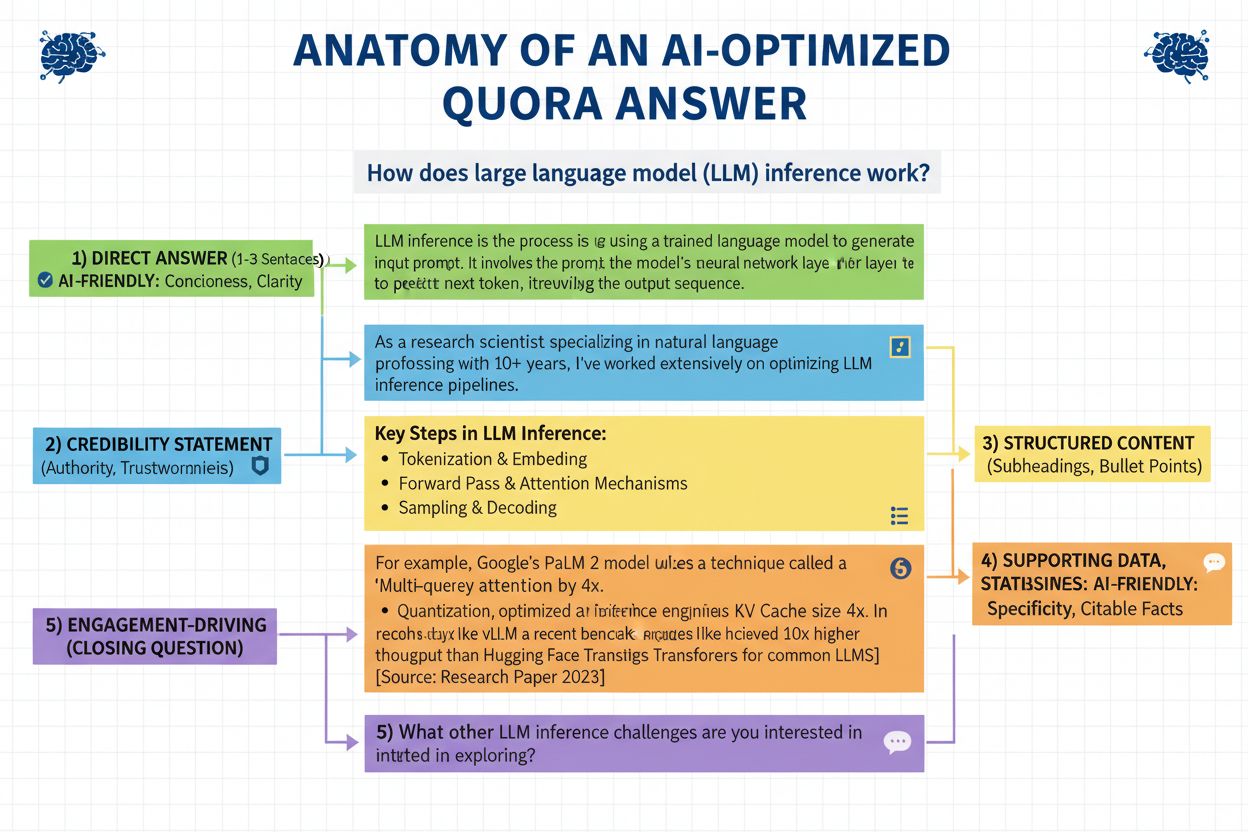
Based on guidance from Quora’s own team and the patterns in cited content, here are the specific practices that maximize your chances of being cited by AI:
Answer directly in the first 1-3 sentences. Don’t bury your main point in a lengthy introduction. AI systems (and human readers) need to immediately understand your core answer. Start with a clear, direct response, then expand with reasoning, examples, and nuance. For instance, if someone asks “What’s the best project management tool for remote teams?” begin with “Asana is the best choice for most remote teams because of its flexibility and collaboration features,” then explain why.
Demonstrate real credibility. Share your background, experience, and why you’re qualified to answer. If you’re a software engineer answering a technical question, mention your years of experience. If you’re a business owner answering about scaling, reference your company. This builds trust with both human readers and AI systems, which prioritize answers from people with demonstrable expertise.
Follow the 80/20 rule. Make 80% of your answer genuinely useful and only 20% promotional. If you mention your product or company, do so naturally and only when it directly addresses the question. Quora’s algorithm (and AI systems) penalize overtly promotional content, so focus on being helpful first.
Format for scannability. Use bold text for key points, break content into short paragraphs, and use bullet points to organize information. AI systems parse structured content more effectively than dense paragraphs, and human readers appreciate the clarity.
Use AI thoughtfully, but maintain your voice. You can use AI tools to help draft or refine your answer, but ensure the final version reflects your genuine expertise and perspective. Readers and AI systems can detect generic, AI-generated content that lacks authentic insight.
One of the most effective strategies for amplifying your Quora visibility is what experts call the “link echo” strategy: taking your best Quora answers and repurposing them across multiple platforms to create multiple citation sources. Here’s how it works: You write a comprehensive answer on Quora, then transform that same content into a Reddit post, a LinkedIn article, a Medium blog, or a section of your website. Each platform becomes a potential citation source for AI systems. When an AI system is synthesizing an answer, it’s more likely to cite your perspective if it appears in multiple trusted locations. Additionally, link back from these repurposed pieces to your original Quora answer, creating what’s called a “link echo”—multiple platforms pointing to the same authoritative source. This signals to both Google and AI systems that your Quora content is important and widely recognized. You can also use services like HARO (Help A Reporter Out) or Terkel to get featured in articles and roundups that cite your Quora answers, further amplifying your visibility. The key is consistency: the more places your perspective appears, the higher the likelihood it will be included in AI-generated responses.
You can’t improve what you don’t measure. The good news is that tracking your Quora citations in AI responses is becoming increasingly straightforward. Start by manually testing your visibility: Ask ChatGPT, Perplexity, Claude, and Google’s AI Overviews questions related to your expertise and note whether your Quora answers are cited. For example, if you’re a marketing expert, ask “What’s the best way to structure a content marketing strategy?” and see if your Quora answers appear in the response.
For more systematic tracking, use AmICited.com to monitor how AI systems cite your brand across all platforms, including Quora. This tool provides real-time visibility into which of your Quora answers are being cited, how frequently, and in response to which queries. You can also use tools like Semrush’s AI Visibility Toolkit to track your brand’s appearance in Google AI Overviews specifically.
Key metrics to track:
By monitoring these metrics over time, you can identify which topics resonate with AI systems, which answer formats get cited most frequently, and where to focus your Quora efforts for maximum impact.
As you build your Quora strategy for AI visibility, be aware of these common mistakes that can undermine your efforts:
Over-promotion and platform etiquette violations. Quora’s community is quick to downvote and report answers that feel like advertisements. Focus on being genuinely helpful, and only mention your product or company when it directly solves the problem being discussed. Violating community norms can result in your answers being hidden or your account being restricted.
Outdated content and relevance decay. AI systems prioritize recent, up-to-date information. If you wrote a great answer two years ago but haven’t updated it with current data, statistics, or examples, it becomes less likely to be cited. Set a calendar reminder to review and refresh your top-performing answers quarterly.
Misinformation and negative sentiment. If your answer contains inaccurate information or if commenters point out errors, address them immediately and transparently. AI systems and human readers both value accuracy and intellectual honesty. If negative sentiment builds around your answer, engage professionally to clarify misunderstandings.
Ignoring AI content guidelines. Google and other AI platforms have specific guidelines about what content they will and won’t cite. Ensure your answers are factual, well-sourced, and free from misleading claims. Avoid making unsubstantiated health claims, financial advice without proper disclaimers, or other content that violates platform policies.
While answering individual questions is valuable, building a Quora Space—a dedicated community around a specific topic—can become a long-term asset for AI visibility. A Quora Space allows you to curate questions, invite contributors, and establish yourself as a thought leader in your niche. When you create a well-maintained Space with high-quality discussions, AI systems may begin to recognize it as a trusted source worth citing directly. For example, a fintech expert might create a “Startup Finance” Space that becomes the go-to resource for questions about fundraising, financial planning, and scaling. Over time, as the Space accumulates quality content and engagement, it becomes a hub that AI systems reference when answering related questions. Beyond AI visibility, Spaces also build community, establish your authority, and create a direct channel to your audience. The investment in building and maintaining a Space pays dividends not just in AI citations but in brand authority, community trust, and long-term visibility. If you’re serious about dominating your niche in the AI-powered search era, creating and nurturing a Quora Space should be part of your strategy.
There's no magic frequency, but consistency matters more than volume. Aim to answer 5-10 high-quality questions per week in your niche. Quality and relevance are far more important than quantity. Focus on answering questions that align with your expertise and have potential for engagement.
Traditional SEO focuses on ranking your website for specific keywords in Google search results. Quora AI visibility focuses on getting your answers cited by AI systems like ChatGPT and Perplexity. With AI visibility, you don't need clicks—you need your ideas to be extracted and cited in AI-generated responses.
You can use AI tools to help draft or refine your answers, but the final version must reflect your genuine expertise and perspective. AI-generated content that lacks authentic insight performs poorly on Quora and is less likely to be cited by AI systems. Use AI as a writing assistant, not a replacement for your knowledge.
Most brands see initial traction within 4-6 weeks of consistent, high-quality participation. However, building significant AI visibility typically takes 3-6 months. The key is consistency—regular participation in relevant discussions compounds over time.
Yes, but use them sparingly and strategically. One or two well-placed links that add genuine value are fine. A long list of links feels spammy and reduces trustworthiness. Only link when the link directly supports your answer and provides additional value to the reader.
You can manually test by asking ChatGPT, Perplexity, Claude, and Google AI questions related to your expertise and checking if your answers appear. For systematic tracking, use AmICited.com to monitor how AI systems cite your brand across all platforms, including Quora.
Focus on topics where you have genuine expertise and where your audience is actively seeking answers. Look for questions with 10+ existing answers and ongoing engagement—these are signals that the topic is important. Use Quora's search and trending sections to identify high-opportunity questions in your niche.
Quora's algorithm identifies high-quality answers and marks them as 'Most Relevant.' Research shows that 89.7% of answers cited by AI systems were also marked as 'Most Relevant' by Quora. By following Quora's best practices, you're simultaneously optimizing for AI visibility.
Track how AI systems cite your brand on Quora, Reddit, and beyond. Get real-time insights into your AI visibility and stay ahead of competitors.
Learn how Quora impacts AI citations in ChatGPT, Perplexity, and Google AI Mode. Discover why Quora is one of the top sources cited by AI systems and how to opt...
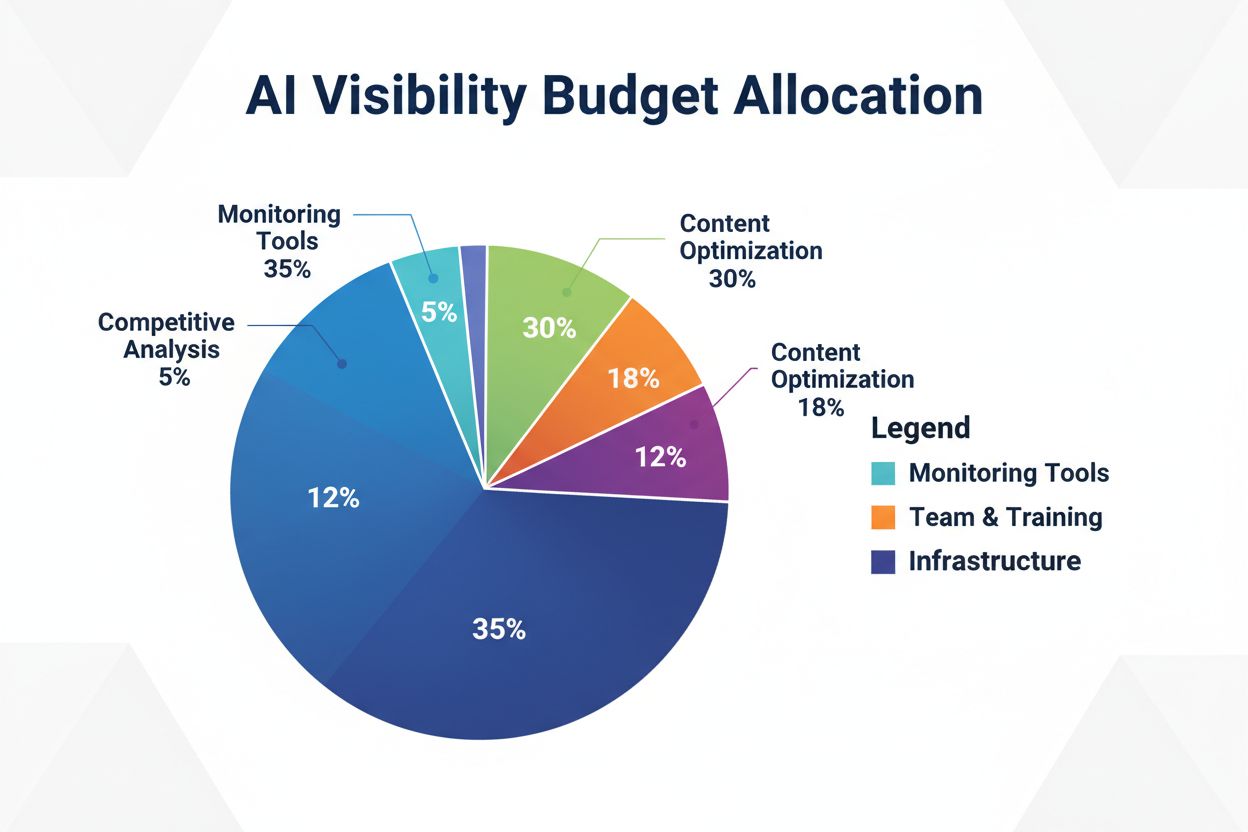
Learn how to strategically allocate your AI visibility budget across monitoring tools, content optimization, team resources, and competitive analysis to maximiz...
Learn proven strategies to maintain and improve your content's visibility in AI-generated answers across ChatGPT, Perplexity, and Google AI Overviews. Discover ...