
Branded Search Volume and AI Visibility: The Connection Explained
Discover how branded search volume directly correlates with AI visibility. Learn to measure brand signals in LLMs and optimize for AI-driven discovery with acti...
8 min read
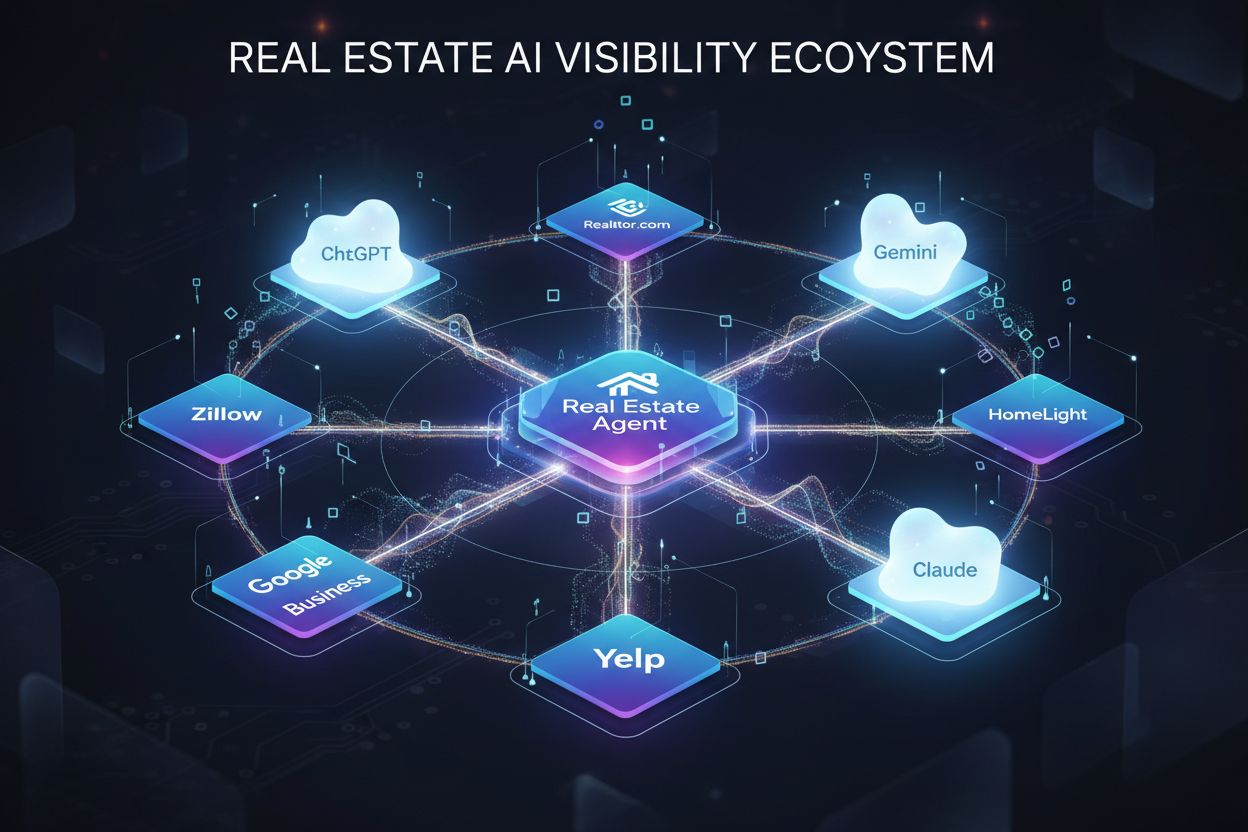
Learn how real estate agents and brokers can optimize for AI visibility in ChatGPT, Perplexity, and Google AI Overviews. Discover strategies for property discovery through LLMs and improve realtor AI visibility.
The way property buyers and agents discover real estate information has fundamentally transformed with the rise of AI-powered search tools. Rather than clicking through multiple search results on Google, users increasingly ask ChatGPT, Google AI Overviews, Perplexity, and Claude direct questions about neighborhoods, agents, and properties—expecting comprehensive answers in seconds. With 18% of Google searches now displaying AI Overviews and ChatGPT commanding over 800 million weekly active users, the shift from traditional Search Engine Results Pages (SERPs) to AI-generated answers represents a seismic change in how real estate professionals are discovered. Traditional SERP results prioritize individual web pages ranked by relevance and authority, while AI-generated answers synthesize information from multiple sources into a single, authoritative response—often without linking to the original sources. This distinction matters enormously for real estate professionals because being ranked #1 on Google no longer guarantees visibility; instead, agents must ensure their information is cited and featured within AI-generated answers. The opportunity cost of ignoring AI visibility is substantial: agents who optimize for AI discovery gain credibility through citations and direct recommendations, while those who don’t risk becoming invisible to an increasingly large segment of property seekers and buyers.

AI models source real estate information from a diverse ecosystem of platforms, each contributing different data types and authority signals. ChatGPT draws from its training data (with a knowledge cutoff) and can access real-time information through plugins, Google Gemini prioritizes Google Business Profiles and Google-owned properties, Claude emphasizes accuracy and source transparency, and Perplexity specializes in real-time web search integration with cited sources. The primary platforms AI systems pull real estate data from include Zillow, Realtor.com, FastExpert, HomeLight, Google Business Profiles, MLS databases, Yelp, Reddit, and specialized real estate directories. Different AI models have distinct preferences: some prioritize structured data and schema markup (like Schema.org’s LocalBusiness and RealEstateAgent formats), while others weight review volume and recency, media mentions, and cross-platform consistency. The critical insight is that AI systems recognize authority through multiple signals simultaneously—consistent Name, Address, and Phone (NAP) information across platforms, high review ratings with detailed testimonials, mentions in reputable publications, and specialization signals that demonstrate expertise in specific neighborhoods or property types. Agents who maintain identical, up-to-date information across all platforms and build authority through reviews, media coverage, and specialization are significantly more likely to be cited and recommended by AI systems. This multi-platform consistency is non-negotiable because AI models cross-reference information to verify credibility, and discrepancies between platforms can actually reduce visibility rather than increase it.
| AI Platform | Primary Data Sources | Key Authority Signals | Real-Time Capability |
|---|---|---|---|
| ChatGPT | Training data + plugins | Backlinks, domain authority, citations | Limited (plugin-dependent) |
| Google Gemini | Google Business, Search, Maps | Google Business Profile quality, reviews, local signals | Yes (real-time) |
| Claude | Web search integration | Source transparency, accuracy, recency | Yes (with web access) |
| Perplexity | Real-time web search | Citation frequency, source authority, freshness | Yes (real-time) |
Real estate agents face a critical visibility challenge that traditional website optimization cannot solve: being invisible in AI-generated answers despite ranking well on Google. An agent might have a beautifully optimized website that ranks on page one for “real estate agents in [neighborhood],” yet never appear in ChatGPT’s response to the same query because AI systems source information from different platforms and apply different ranking criteria. Research shows that the average click-through rate (CTR) drops 34% when an AI Overview appears on Google, meaning that even top-ranking traditional results lose visibility when AI answers are present. This problem compounds because agents who haven’t optimized for AI visibility are essentially competing for the remaining traffic below the AI answer, while agents who do appear in AI responses gain credibility through direct recommendation and citation. The opportunity cost is substantial: agents who don’t optimize for AI visibility are losing potential clients to competitors who do, particularly among younger, tech-savvy buyers who prefer asking AI tools rather than browsing traditional search results. Furthermore, as AI adoption accelerates, the percentage of real estate searches conducted through AI tools will only increase, making current invisibility a long-term business risk. The agents and brokerages that recognize this shift now and optimize for AI discovery will establish competitive advantages that become increasingly difficult for late adopters to overcome.
Optimizing property profiles for AI discovery requires a fundamentally different approach than traditional real estate marketing, focusing on structured data, comprehensive information, and AI-friendly formatting. AI systems extract and synthesize property information from listings, so every detail must be complete, accurate, and properly formatted using schema markup (Schema.org’s RealEstateProperty format) that search engines and AI models can parse automatically. The key data points AI systems prioritize include:
Rather than writing vague descriptions like “charming home in desirable neighborhood,” AI-friendly descriptions should be specific and data-rich: “3-bedroom, 2-bath home built in 2015 with 2,100 sq ft, located in the Riverside school district (rated 8/10), walking distance to downtown shops (0.3 miles), and featuring a recently renovated kitchen with stainless steel appliances.” This level of detail allows AI systems to extract precise information and cite your listing when answering buyer questions. Implementing proper schema markup on property pages signals to AI systems that your information is structured and reliable, increasing the likelihood of citation. Additionally, maintaining consistent property information across Zillow, Realtor.com, MLS, and your brokerage website ensures that AI systems see corroborating data, which strengthens credibility and citation likelihood.
AI systems evaluate agent credibility through multiple authority signals, with local authority and specialization being among the most important factors in determining whether an agent appears in AI-generated recommendations. The foundation of local authority is consistent Name, Address, and Phone (NAP) information across every platform—Google Business Profile, Zillow, Realtor.com, FastExpert, local directories, and your website must all display identical contact information, as discrepancies signal unreliability to AI systems. Beyond NAP consistency, reviews and testimonials are critical authority signals that AI systems weight heavily; agents with 50+ reviews averaging 4.5+ stars are significantly more likely to be cited than those with fewer reviews, because volume and consistency indicate genuine client satisfaction. Building authority also requires local media mentions and press coverage—being quoted in local real estate publications, featured in neighborhood guides, or mentioned in community news articles signals expertise to AI systems that recognize these sources as authoritative. Specialization signals are equally important: agents who clearly specialize in specific neighborhoods, property types (luxury homes, investment properties, first-time buyer homes), or buyer segments (relocating families, downsizers, investors) are more likely to be recommended by AI when users ask questions related to those specializations. A comprehensive multi-platform presence strategy should include optimized profiles on Google Business, Zillow, Realtor.com, FastExpert, HomeLight, Yelp, and local real estate directories, with each profile emphasizing your specializations and featuring recent client testimonials. The agents who dominate AI visibility are those who have systematically built authority across multiple dimensions—reviews, media mentions, specialization clarity, and platform consistency—rather than relying on any single factor.
Not all real estate platforms carry equal weight with AI systems; certain platforms are prioritized because they contain verified, structured data that AI models trust. The top 9 platforms that AI systems most frequently pull real estate information from are: FastExpert (agent-specific platform with detailed profiles), RealTrends (industry data and rankings), Yelp (reviews and local business information), HomeLight (agent matching and reviews), Zillow (comprehensive property and agent data), Reddit (community discussions and local insights), Realtor.com (NAR-affiliated listings and agent profiles), Expertise.com (expert rankings and reviews), and Homes.com (property listings and agent information). These platforms are prioritized by AI because they contain verified information, user reviews, and structured data that signals reliability and authority. Optimizing profiles on each platform requires platform-specific strategies: on Zillow and Realtor.com, ensure complete agent profiles with professional photos, detailed specialization descriptions, and recent client reviews; on FastExpert, create a comprehensive profile highlighting your expertise, market knowledge, and transaction history; on Yelp, maintain an active business profile with regular updates and prompt review responses; on HomeLight, complete your profile with detailed service descriptions and client testimonials. Keeping information current across all platforms is essential because AI systems detect outdated information and may deprioritize agents with stale profiles, while agents who update their profiles regularly signal active practice and current market knowledge. Review management deserves special emphasis: agents with higher review volume, better ratings, and more recent reviews are significantly more likely to appear in AI recommendations, making review generation and response management a critical component of AI visibility strategy.
| Platform | AI Priority Level | Key Optimization Focus | Update Frequency |
|---|---|---|---|
| Zillow | Very High | Complete profile, recent reviews, specialization clarity | Weekly |
| Realtor.com | Very High | NAR data accuracy, client testimonials, market stats | Weekly |
| FastExpert | High | Detailed expertise, transaction history, specializations | Monthly |
| Google Business | Very High | NAP consistency, reviews, posts, Q&A responses | 2-3x weekly |
| HomeLight | High | Service descriptions, client reviews, response time | Monthly |
| Yelp | Medium-High | Business info, review responses, photos | As needed |
| RealTrends | Medium | Market data, transaction volume, rankings | Quarterly |
| Medium | Community participation, local insights, authenticity | Weekly | |
| Expertise.com | Medium | Expert profile, credentials, client feedback | Quarterly |
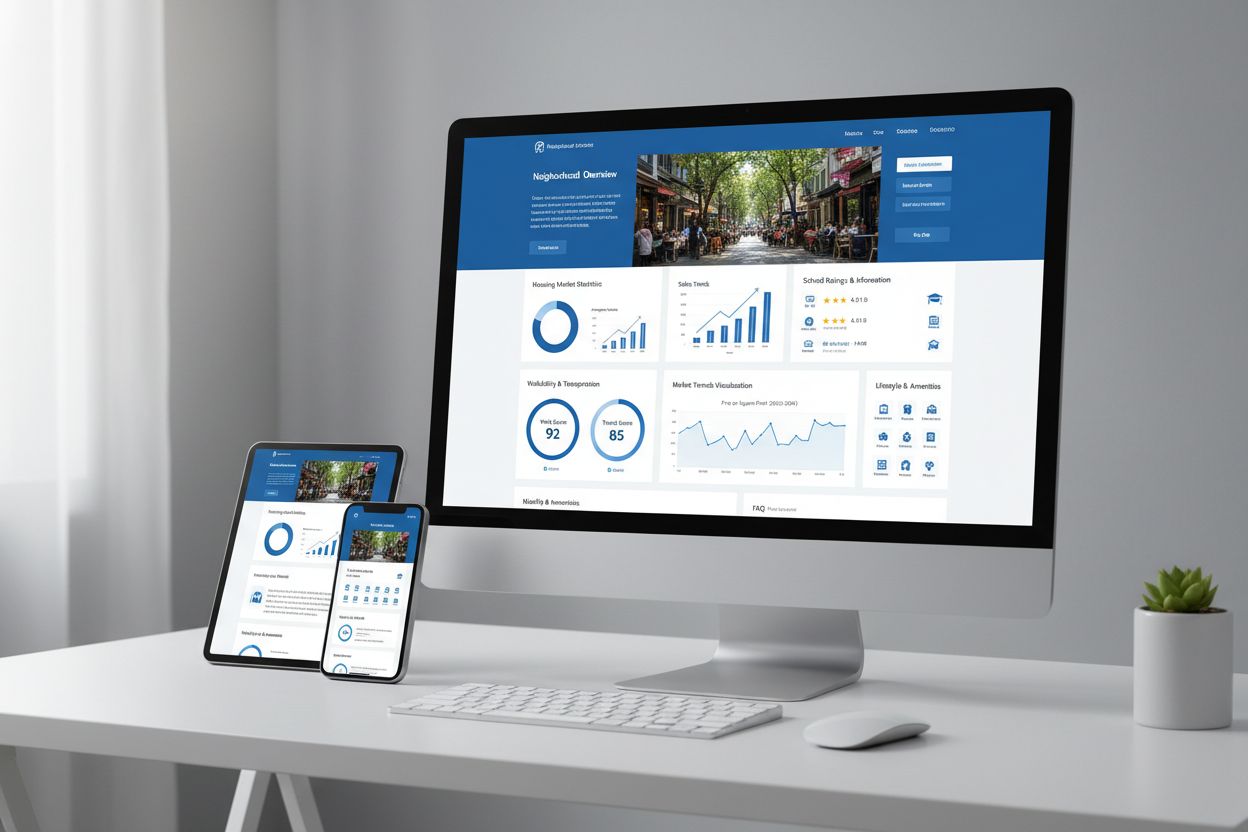
Creating content that AI systems can extract, cite, and recommend requires a fundamentally different approach than traditional real estate marketing, focusing on comprehensive, data-rich neighborhood guides and property-specific content structured for AI consumption. AI systems excel at extracting information from well-organized content that answers specific questions, so agents should create detailed neighborhood guides that address the questions AI systems are asked: “What’s the best neighborhood for families in [city]?”, “What are the top schools in [neighborhood]?”, “Is [neighborhood] walkable?”, “What’s the average home price in [neighborhood]?” Each guide should include specific data points (school ratings, walkability scores, median home prices, demographic information, nearby amenities) rather than subjective descriptions, because AI systems prioritize factual, verifiable information. Using FAQ and Q&A formats is particularly effective for AI visibility because these formats directly match how AI systems structure answers; an agent who creates a page titled “Frequently Asked Questions About [Neighborhood]” with 15-20 detailed Q&A pairs is significantly more likely to be cited when AI systems answer similar questions. Data-rich content that includes statistics, comparisons, and specific examples is more likely to be extracted and cited than generic content; for example, “The Riverside neighborhood has 12 schools within 2 miles, with an average rating of 7.8/10, and median home prices of $485,000” is far more useful to AI systems than “Riverside is a great neighborhood with good schools.” Freshness and recency signals matter significantly: AI systems prioritize recently updated content, so agents should update neighborhood guides quarterly with current market data, new amenities, and recent school information. Additionally, creating property-specific content that goes beyond standard listing descriptions—such as detailed renovation histories, neighborhood context, comparable sales analysis, and buyer testimonial videos—provides AI systems with rich material to cite when answering buyer questions about specific properties or neighborhoods.
Measuring AI visibility requires different tools and methodologies than traditional SEO tracking, because AI citations don’t appear in standard search analytics and require active monitoring across multiple platforms. Agents should regularly test AI queries by asking ChatGPT, Google Gemini, Perplexity, and Claude questions related to their market, neighborhoods, and specializations, then documenting whether they appear in the responses and how they’re cited. AmICited.com provides a specialized solution for monitoring LLM visibility, allowing agents to track mentions and citations across multiple AI platforms, identify which platforms are citing them, and benchmark visibility against competitors. The key metrics to track include: citation frequency (how often you appear in AI responses), citation context (what questions trigger your citations), platform distribution (which AI tools cite you most), review impact (correlation between review volume and AI visibility), and competitive positioning (how often you appear compared to competitors). Effective benchmarking requires establishing baseline measurements by testing 20-30 relevant queries and documenting current visibility, then repeating this process monthly to identify trends and measure the impact of optimization efforts. Agents should also test variations of queries to understand which question formats trigger their citations; for example, testing “best real estate agents in [neighborhood],” “who should I hire to sell my home in [neighborhood],” and “[neighborhood] real estate expert” may yield different results. Iteration is essential: agents who identify which optimization efforts drive AI visibility improvements can double down on those strategies, while those that don’t drive results can be deprioritized. Comparing visibility across different AI platforms reveals important insights—an agent might appear frequently in Perplexity results but rarely in ChatGPT, indicating that different optimization strategies may be needed for different AI systems.
Real estate professionals often make critical mistakes that actively harm their AI visibility, and recognizing these errors is the first step toward optimization. The most common mistakes include:
Outdated or inconsistent information across platforms: Agents with different phone numbers on Zillow versus Google Business, or outdated specializations listed on multiple sites, signal unreliability to AI systems and reduce citation likelihood. Solution: Conduct a platform audit, standardize all information, and implement a quarterly review process.
Vague agent bios and unclear specializations: Bios like “experienced agent serving the community” provide no useful information to AI systems. Solution: Write specific, data-backed bios that clearly state neighborhoods served, property types, buyer segments, and years of experience.
Lack of structured data and schema markup: Agents without proper schema markup on their websites make it harder for AI systems to extract and verify information. Solution: Implement LocalBusiness and RealEstateAgent schema markup on all agent pages.
Ignoring reviews and testimonials: Agents with few reviews or low ratings are deprioritized by AI systems regardless of other optimization efforts. Solution: Implement a systematic review generation process, respond to all reviews promptly, and feature testimonials prominently.
Not optimizing for local authority: Agents who focus only on their website miss the opportunity to build authority through media mentions, community involvement, and local partnerships. Solution: Pursue local media coverage, contribute to neighborhood publications, and build relationships with local organizations.
Focusing exclusively on traditional SEO: Agents who optimize only for Google rankings miss the fact that AI systems use different ranking criteria and data sources. Solution: Develop a parallel AI optimization strategy that complements but differs from traditional SEO efforts.
Neglecting multiple AI platforms: Agents who optimize for ChatGPT but ignore Perplexity, Gemini, and Claude miss significant visibility opportunities. Solution: Test and optimize for all major AI platforms, recognizing that each has different data sources and ranking criteria.
The trajectory of AI-powered real estate discovery is clear: AI will become the primary discovery method for property buyers and agent selection within the next 2-3 years, fundamentally reshaping how real estate professionals compete for visibility. Emerging trends indicate that AI systems will increasingly integrate real-time market data, predictive analytics, and personalized recommendations, moving beyond simple information synthesis toward sophisticated buyer guidance that considers individual preferences, financial situations, and market conditions. As AI models become more sophisticated, they will likely develop specialized real estate-focused versions (similar to how ChatGPT now has industry-specific plugins), which will further prioritize agents and platforms that have optimized for AI discovery. The integration of AI with traditional search will create a hybrid discovery ecosystem where AI answers appear alongside traditional results, but the AI answers will capture an increasing share of user attention and clicks. Early adopters who optimize for AI visibility now will establish competitive advantages that become increasingly difficult for late adopters to overcome, particularly as AI systems develop historical data about which agents consistently appear in recommendations and deliver results. Long-term visibility strategy must treat AI optimization as a core business function, not a supplementary tactic, with dedicated resources for profile management, content creation, review generation, and performance monitoring across multiple platforms. The agents and brokerages that thrive in this AI-driven future will be those who recognize that visibility is no longer determined solely by website rankings or advertising spend, but by systematic optimization across multiple platforms, consistent authority building, and strategic positioning within AI-generated recommendations.
Traditional SEO focuses on ranking individual web pages on Google's search results, while AI visibility is about appearing in AI-generated answers from tools like ChatGPT, Perplexity, and Google AI Overviews. AI systems source information from different platforms (Zillow, Realtor.com, FastExpert, Google Business) and use different ranking criteria, meaning a #1 Google ranking doesn't guarantee AI visibility. AI visibility requires optimization across multiple platforms, consistent information, strong reviews, and specialization signals.
The most important AI platforms for real estate are Google AI Overviews (18% of searches), ChatGPT (800M+ weekly users), Perplexity (15M+ monthly users), and Google Gemini (648M+ monthly visits). However, agents should optimize for all major platforms because only 14% of top sources overlap across these systems. Each platform has different data sources and ranking criteria, so a multi-platform strategy is essential for comprehensive AI visibility.
Update frequency depends on platform importance and market dynamics. High-priority platforms like Zillow, Realtor.com, and Google Business Profile should be updated weekly with new reviews, market data, and recent transactions. Medium-priority platforms like FastExpert and HomeLight should be updated monthly. In fast-moving markets with significant price changes or new developments, more frequent updates (2-3x weekly) can improve AI visibility by signaling active practice and current market knowledge.
Yes, AI optimization and traditional SEO are complementary rather than conflicting. Both benefit from consistent information, quality content, and authority building. However, they require different strategies: traditional SEO focuses on website optimization and backlinks, while AI optimization emphasizes multi-platform presence, structured data, reviews, and specialization signals. A comprehensive strategy addresses both simultaneously, ensuring visibility across traditional search results and AI-generated answers.
Multi-platform consistency is the single most important factor. AI systems cross-reference information across Zillow, Realtor.com, Google Business, FastExpert, and other platforms to verify credibility. Agents with identical, up-to-date information across all platforms are significantly more likely to be cited by AI systems. Beyond consistency, review volume and quality, clear specialization signals, and local authority (media mentions, community involvement) are critical factors that AI systems weight heavily.
Initial improvements can appear within 2-4 weeks if you're optimizing existing profiles and adding reviews. However, significant visibility gains typically require 2-3 months of consistent effort across multiple platforms. Building strong local authority through media mentions and community involvement takes longer (3-6 months). The key is treating AI visibility as an ongoing process rather than a one-time project, with continuous monitoring, updating, and optimization.
For individual agents with limited time, hiring a specialist or using a platform like AmICited.com to monitor visibility can be worthwhile. However, the core optimization work (updating profiles, generating reviews, creating content) can be managed in-house with proper systems and processes. Many brokerages are developing internal AI visibility programs, while others partner with marketing agencies that specialize in GEO (Generative Engine Optimization). The decision depends on your market size, competition level, and available resources.
AmICited.com specializes in monitoring how AI systems like ChatGPT, Perplexity, and Google AI Overviews reference your brand and properties. The platform tracks mentions and citations across multiple AI platforms, identifies which queries trigger your visibility, benchmarks your performance against competitors, and provides insights into optimization opportunities. This data-driven approach helps real estate professionals understand their AI visibility baseline and measure the impact of optimization efforts over time.
Track how AI tools like ChatGPT, Perplexity, and Google AI Overviews reference your properties and agent profiles. Get real-time insights into your AI visibility and stay ahead of the competition.
Discover how branded search volume directly correlates with AI visibility. Learn to measure brand signals in LLMs and optimize for AI-driven discovery with acti...
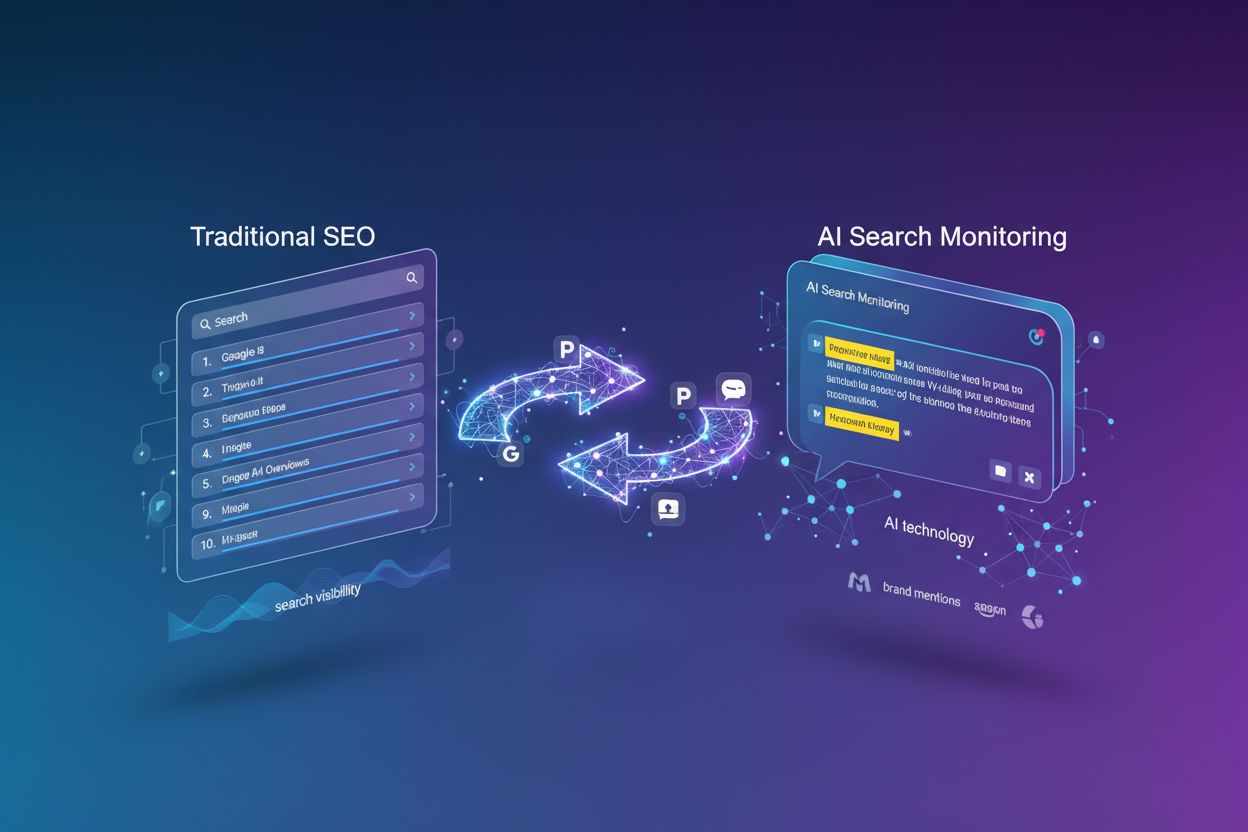
Discover how AI search monitoring is replacing traditional SEO. Learn why AI visitors are 4.4x more valuable and how to optimize for ChatGPT, Perplexity, and Go...

Explore AI Visibility Futures - forward-looking analysis of emerging trends in AI-driven brand discovery. Learn how brands will be discovered by AI systems and ...