

How to Automate AI Search Monitoring for Your Brand
Learn how to automate monitoring of your brand mentions and website citations across ChatGPT, Perplexity, Google AI Overviews, and other AI search engines with ...
9 min read
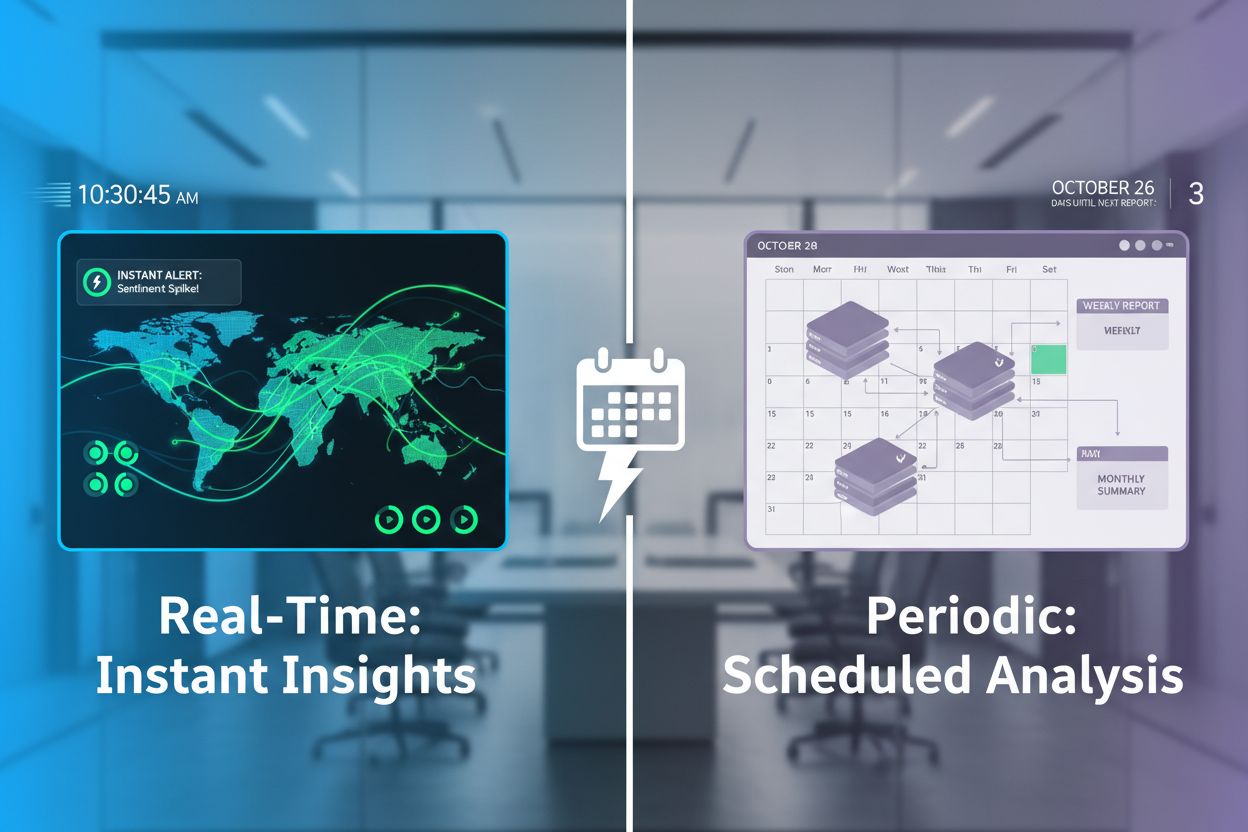
Compare real-time and periodic AI monitoring approaches. Learn which monitoring frequency suits your brand, budget, and competitive landscape for optimal AI citation tracking.
Real-time monitoring and periodic monitoring represent two fundamentally different approaches to tracking AI brand mentions and performance across digital channels. Real-time monitoring continuously scans the internet for mentions, changes, and interactions as they happen, providing immediate alerts and data updates. Periodic monitoring, by contrast, involves scheduled checks at fixed intervals—daily, weekly, or monthly—to assess brand presence and performance metrics. Understanding the distinction between these approaches is crucial for organizations leveraging AI tools like ChatGPT, Perplexity, and Google AI Overviews to maintain brand integrity and competitive positioning.
The speed at which each monitoring approach delivers insights creates significant operational differences that impact decision-making capabilities. Real-time monitoring detects issues within seconds or minutes, enabling immediate response to misinformation, brand hijacking, or competitive threats. Periodic monitoring introduces latency, sometimes measuring hours or days between when an event occurs and when your team becomes aware of it. For AI brand monitoring specifically, this timing difference can be critical—a false attribution to your brand in a ChatGPT response could spread across thousands of user interactions before a periodic check catches it. The following table illustrates key differences in monitoring speed and responsiveness:
| Characteristic | Real-Time Monitoring | Periodic Monitoring |
|---|---|---|
| Detection Speed | Seconds to minutes | Hours to days |
| Alert Frequency | Continuous | Scheduled intervals |
| Response Time | Immediate action possible | Delayed response |
| Data Freshness | Always current | Snapshot-based |
Real-time monitoring delivers substantial benefits for organizations managing AI brand presence in high-velocity environments. Companies using real-time systems can immediately identify when their brand appears in AI-generated content, allowing them to verify accuracy and flag hallucinations before they gain traction. Financial services firms monitoring ChatGPT mentions of their products can catch incorrect financial advice attributed to their brand within minutes, preventing potential regulatory issues and customer confusion. E-commerce brands benefit from real-time alerts when competitors are mentioned alongside their products in AI responses, enabling rapid competitive analysis. Healthcare organizations can monitor AI tools for accurate representation of their services and immediately address any medical misinformation. The ability to respond to crisis situations—such as a major security breach or product recall—becomes exponentially more effective when your team learns about public discussions in real-time rather than during the next scheduled monitoring cycle. Real-time monitoring also enables proactive engagement, allowing brands to participate in conversations and provide corrections while discussions are still active and visible.
Periodic monitoring offers distinct advantages that make it the optimal choice for many organizations and use cases. The reduced computational overhead of periodic checks means lower infrastructure costs and simpler implementation, making this approach accessible to smaller teams and organizations with limited budgets. Periodic monitoring works exceptionally well for tracking long-term trends, brand sentiment evolution, and strategic positioning—metrics that don’t require minute-by-minute updates to provide actionable insights. Marketing teams can use weekly or monthly reports to identify emerging themes in how AI tools discuss their industry, informing content strategy and messaging refinement. Organizations in stable industries with slower-moving competitive landscapes find that periodic monitoring provides sufficient visibility without the operational complexity of real-time systems. Periodic monitoring also reduces alert fatigue, a significant problem in real-time systems where teams can become overwhelmed by constant notifications and lose focus on genuinely important issues. For compliance and archival purposes, periodic monitoring creates cleaner, more manageable datasets that are easier to document and audit.
The financial and resource implications of each approach differ substantially and should heavily influence your decision-making process. Real-time monitoring requires continuous infrastructure investment—dedicated servers, APIs, and monitoring tools that operate 24/7, typically costing $5,000 to $50,000+ monthly depending on scale and sophistication. Periodic monitoring can often be accomplished with basic tools and part-time staff attention, with costs ranging from $500 to $5,000 monthly or even less if using free tools. However, the cost calculation must account for the business impact of delayed detection—a brand crisis that goes unnoticed for 12 hours could cost significantly more than the premium paid for real-time monitoring. Organizations should evaluate their risk profile: high-risk industries like healthcare, finance, and consumer goods typically justify real-time investment, while B2B SaaS companies with longer sales cycles may find periodic monitoring sufficient. Tools like AmICited.com provide cost-effective solutions that bridge this gap, offering real-time AI brand monitoring capabilities at price points that make enterprise-grade monitoring accessible to mid-market organizations without requiring massive infrastructure investments.
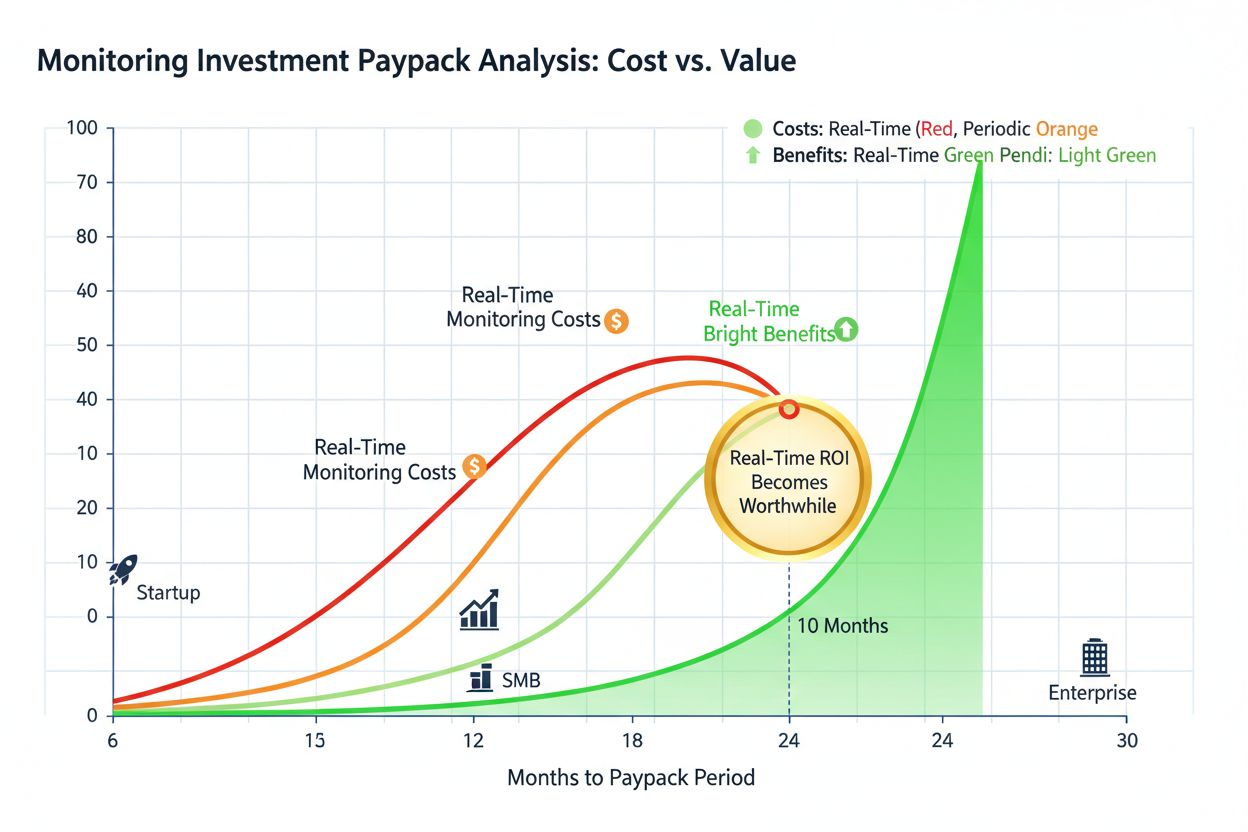
Selecting between real-time and periodic monitoring requires evaluating your specific business context against a structured decision framework. Consider these eight key factors when making your choice:
Many organizations find that hybrid monitoring strategies provide optimal balance between cost, responsiveness, and operational efficiency. A hybrid approach might implement real-time monitoring for critical brand mentions and AI platform discussions while using periodic monitoring for broader trend analysis and competitive intelligence. For example, a pharmaceutical company could set up real-time alerts for any mentions of their drug names in ChatGPT responses (where accuracy is critical) while conducting weekly periodic reviews of how AI tools discuss their therapeutic category overall. This tiered approach allows teams to focus real-time resources on highest-impact monitoring while still maintaining comprehensive visibility. AmICited.com supports hybrid strategies by enabling users to configure different monitoring cadences for different brand elements, allowing granular control over which mentions trigger immediate alerts and which are captured in scheduled reports. The hybrid model also provides flexibility to adjust monitoring intensity based on seasonal factors, product launches, or competitive threats—ramping up to real-time during critical periods and scaling back to periodic monitoring during quieter seasons.
Successful implementation of either monitoring approach requires attention to several technical and organizational considerations. Your team must establish clear protocols for alert response—who receives notifications, what actions they should take, and how quickly they should respond—before deploying real-time monitoring systems. Data integration is critical; monitoring tools must connect seamlessly with your existing analytics platforms, CRM systems, and communication tools to enable efficient workflow. For AI brand monitoring specifically, you need to establish baseline metrics for what constitutes a “mention” across different AI platforms, since ChatGPT, Perplexity, and Google AI Overviews each present information differently. Training your team on the monitoring platform is essential—real-time systems require different skills and workflows than periodic monitoring, and staff must understand how to interpret alerts and take appropriate action. AmICited.com simplifies implementation by providing pre-built integrations with major business tools and offering guided setup processes that help teams establish monitoring protocols quickly. Documentation of your monitoring approach—what you’re tracking, why, and how you’re responding—becomes increasingly important as your organization scales and team members change.
The future of AI brand monitoring will likely see convergence toward intelligent hybrid systems that combine real-time detection with periodic deep analysis. Advances in machine learning will enable more sophisticated filtering of real-time alerts, reducing noise while improving signal quality—allowing teams to focus on genuinely important mentions rather than being overwhelmed by volume. Natural language processing improvements will make it possible to understand context and intent more accurately, distinguishing between positive mentions, critical discussions, and misinformation with greater precision. As AI tools like ChatGPT and Perplexity become more integrated into business workflows and customer decision-making, the stakes for accurate brand representation will increase, likely driving broader adoption of real-time monitoring across industries. AmICited.com and similar platforms are evolving to incorporate predictive analytics that forecast brand reputation trends before they become critical issues, shifting monitoring from reactive to proactive. Organizations that establish monitoring foundations today—whether real-time, periodic, or hybrid—will be best positioned to adapt as AI brand monitoring becomes an essential component of competitive strategy and risk management.
When brand reputation becomes a critical business asset, competitive intensity increases, or you operate in fast-moving industries like SaaS or e-commerce. If you're losing market share due to competitor mentions in AI responses, real-time monitoring becomes essential for maintaining competitive positioning.
Yes, but with delay. Periodic monitoring will eventually show that your AI citations increased or decreased, but you won't know when the change happened or what triggered it. Real-time monitoring provides immediate visibility into these shifts, enabling faster response.
For most brands, daily monitoring provides a good balance between cost and responsiveness. Weekly monitoring works for stable brands in slower industries. Real-time monitoring is essential for competitive, fast-moving markets where brand reputation directly impacts customer acquisition.
Real-time monitoring lets you test content changes and see immediate impact on AI citations, enabling rapid iteration. Periodic monitoring requires longer testing cycles but provides clearer trend analysis for strategic planning and long-term positioning.
No. Brands with stable market positions, longer sales cycles, or limited budgets can succeed with periodic monitoring. Real-time monitoring is most valuable for brands where reputation directly impacts customer acquisition and competitive positioning.
Use automated alerting systems that only notify on significant changes, integrate monitoring into existing workflows, and leverage AI-powered tools that filter noise. Many modern platforms handle the heavy lifting automatically, making real-time monitoring accessible to small teams.
Monitoring frequency doesn't directly affect accuracy—data quality does. Both real-time and periodic systems can be accurate or inaccurate depending on how they collect and process data. Focus on data quality regardless of frequency chosen.
Yes, this is a common approach. Start with periodic monitoring to understand your baseline, then upgrade to real-time as your business grows or competitive pressures increase. Most modern platforms support this scaling path seamlessly.
Discover how AmICited tracks your brand mentions across ChatGPT, Perplexity, and Google AI Overviews. Choose the monitoring frequency that fits your needs and budget.
Learn how to automate monitoring of your brand mentions and website citations across ChatGPT, Perplexity, Google AI Overviews, and other AI search engines with ...

Learn how AI brand monitoring alerts track your visibility and sentiment across ChatGPT, Perplexity, and other AI platforms. Real-time notifications for brand p...
Learn how to compare AI monitoring tools effectively. Discover evaluation criteria, feature comparison frameworks, and selection strategies for brand visibility...