
AI Hallucination About Your Brand: What to Do
Learn how to identify, respond to, and prevent AI hallucinations about your brand. Discover monitoring tools, crisis management strategies, and long-term soluti...
13 min read
Learn how to identify, respond to, and prevent AI hallucinations about your brand. Crisis management strategies for ChatGPT, Google AI, and other platforms.
AI hallucinations occur when generative AI systems confidently produce distorted or incorrect information about your brand, often spreading across multiple platforms simultaneously. Recent research shows that hallucination rates range from 15-52% across leading language models like GPT-4, Gemini, and Claude, meaning your brand could be misrepresented to thousands of users daily. When Google AI Overviews suggest eating glue or ChatGPT lists your company’s wrong founder, that misinformation becomes a user’s first impression of your brand. These errors compound quickly—writers cite them in blogs, bots redistribute them on social platforms, and other AI systems incorporate them into their training data, creating a cascading crisis that erodes trust and authority across both search and generative AI channels.
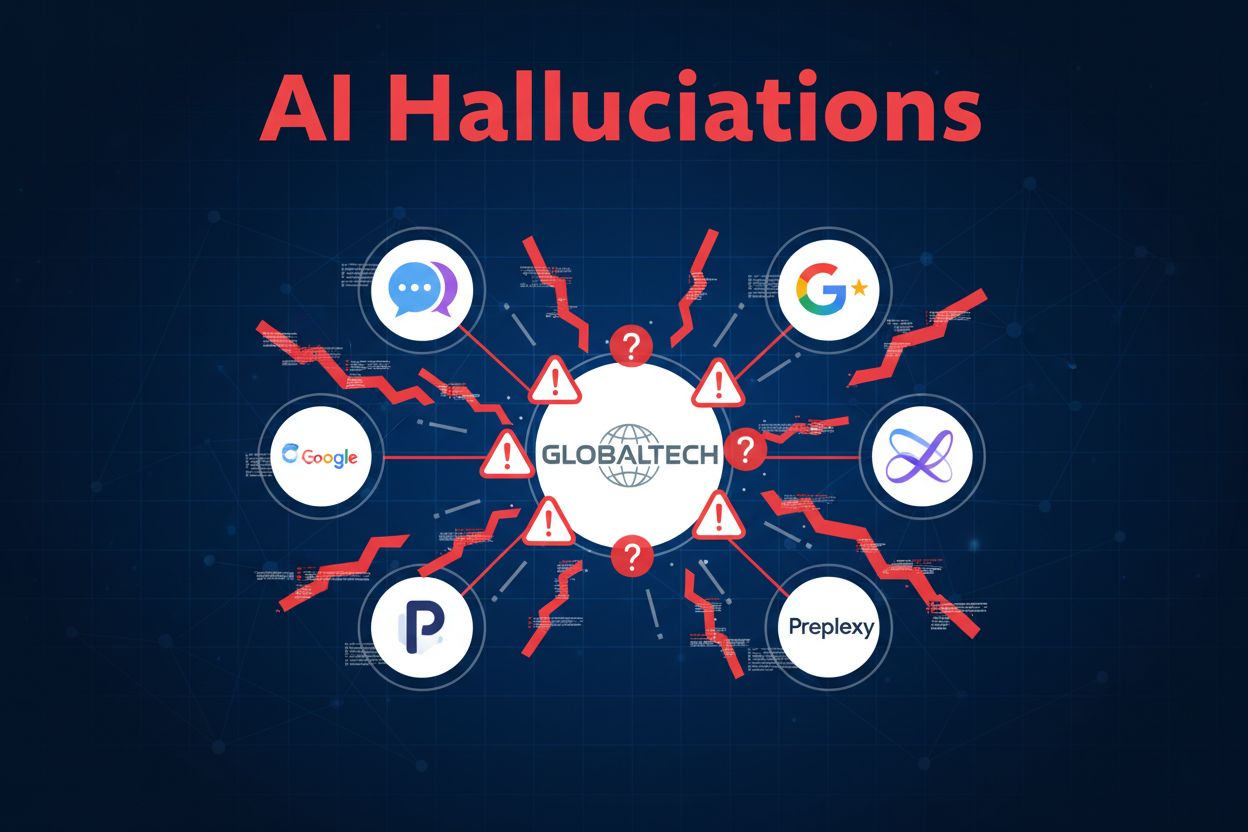
AI models don’t truly “understand” your brand—they approximate it based on patterns extracted from training data and available web sources. These systems build their understanding through entity relationships (connections between your company name, founder, products, and location) and citation weighting (assigning trust scores to different sources based on authority and consistency). When your official website says “Founded in 2018” but Crunchbase lists “Founded in 2020,” the AI model tries to merge these conflicting signals, often producing an incorrect average like “Founded around 2019.” This is data noise—multiple conflicting versions of the same fact. Conversely, data voids occur when key information doesn’t exist anywhere online, forcing the AI to guess or fabricate details that sound plausible but are completely false. The Knowledge Graph, which both search engines and LLMs rely on, acts as the “memory” of the web, and when your brand data is fragmented, outdated, or inconsistent across sources, AI systems have no reliable foundation to build accurate representations.
| Factor | Impact on AI | Example |
|---|---|---|
| Data Void | AI guesses missing information | No founding date on website = AI invents one |
| Data Noise | AI blends conflicting information | Multiple founding dates = AI averages them |
| Weak Entity Links | AI confuses similar brands | Similar names = wrong company referenced |
| Outdated Knowledge Graph | Old information resurfaces | Outdated CEO still listed in Knowledge Graph |
| Low-Quality Sources | Unverified data gets prioritized | Scraped directory outweighs official website |
Start with a simple discovery sweep across the major generative AI platforms—ChatGPT, Gemini, Claude, and Perplexity—by asking straightforward questions that reflect how users might search for your brand. Document the responses and compare them against your official brand information to identify hallucinations. For a more systematic approach, conduct a structured prompt audit by creating a spreadsheet with columns for prompts, model names, and responses, then running the same set of questions across every AI platform you want to monitor. Once you’ve documented the outputs, use entity extraction tools like spaCy or Diffbot to automatically pull out named items (people, products, brands, locations) from the AI responses, making it easy to spot mismatches. Then apply semantic comparison tools like Sentence-BERT (SBERT) or Universal Sentence Encoder (USE) to measure how closely the AI’s description matches your verified brand copy by meaning, not just words—a low similarity score indicates the AI is hallucinating your brand attributes.
Key discovery questions to test across all AI platforms:
When you discover incorrect AI information about your brand, immediate action is critical because misinformation spreads exponentially across AI systems. First, assess the severity of each hallucination using a priority matrix: Critical issues include wrong founder attribution or product misrepresentation that could harm customer decisions; High priority covers location, founding year, or leadership errors; Medium priority includes minor details and outdated information; Low priority covers formatting or non-essential details. For critical and high-priority errors, document them thoroughly and begin correcting your brand data infrastructure immediately (covered in the next section). Simultaneously, use a monitoring tool like AmICited.com to track how these hallucinations spread across ChatGPT, Gemini, Perplexity, and other AI platforms, giving you visibility into the scope of the crisis and helping you measure the impact of your corrections over time. Establish a timeline: critical corrections should be implemented within 48 hours, high-priority fixes within one week, and medium-priority updates within two weeks. Assign clear ownership—typically your SEO or marketing team—to coordinate the response and ensure all corrections are implemented consistently across your web properties.
The most effective way to prevent AI hallucinations is to strengthen your brand’s data foundation so AI systems have no ambiguity to fill. Start by ensuring your core brand facts—name, location, founding date, founder, and key products—are consistent across all web properties: your website, social media profiles, business directories, press releases, and any other platform where your brand appears. Inconsistency signals to AI systems that your brand data is unreliable, encouraging them to guess or blend conflicting information. Create a clear, factual About page that lists essential information without marketing fluff, as this becomes an anchor point for AI crawlers seeking authoritative brand data. Implement schema markup using JSON-LD format to explicitly label each piece of information—Organization schema for your company, Person schema for founders and executives, and Product schema for what you sell. This structured data tells AI systems exactly what each piece of information means, reducing the chance of misattribution.
For advanced implementation, add sameAs links in your Organization schema to connect your website with verified profiles on LinkedIn, Crunchbase, Wikipedia, and Wikidata. These cross-links show AI systems that all those profiles represent the same entity, helping them unify fragmented mentions into one authoritative identity. Here’s an example of proper schema implementation:
{
  "@context": "https://schema.org",
  "@type": "Organization",
  "name": "Your Brand Name",
  "url": "https://yourbrand.com",
  "founder": {
    "@type": "Person",
    "name": "Founder Name"
  },
  "foundingDate": "YYYY-MM-DD",
  "sameAs": [
    "https://www.linkedin.com/company/your-brand/",
    "https://www.crunchbase.com/organization/your-brand",
    "https://en.wikipedia.org/wiki/Your_Brand",
    "https://www.wikidata.org/wiki/Q12345678"
  ]
}
Additionally, create or update your Wikidata entry (one of the largest structured databases used by Google and LLMs), and publish a brand-facts.json dataset on your website that serves as a machine-readable press kit containing verified company details, leadership, products, and official URLs. This gives generative systems a central point of truth to reference directly from your website.
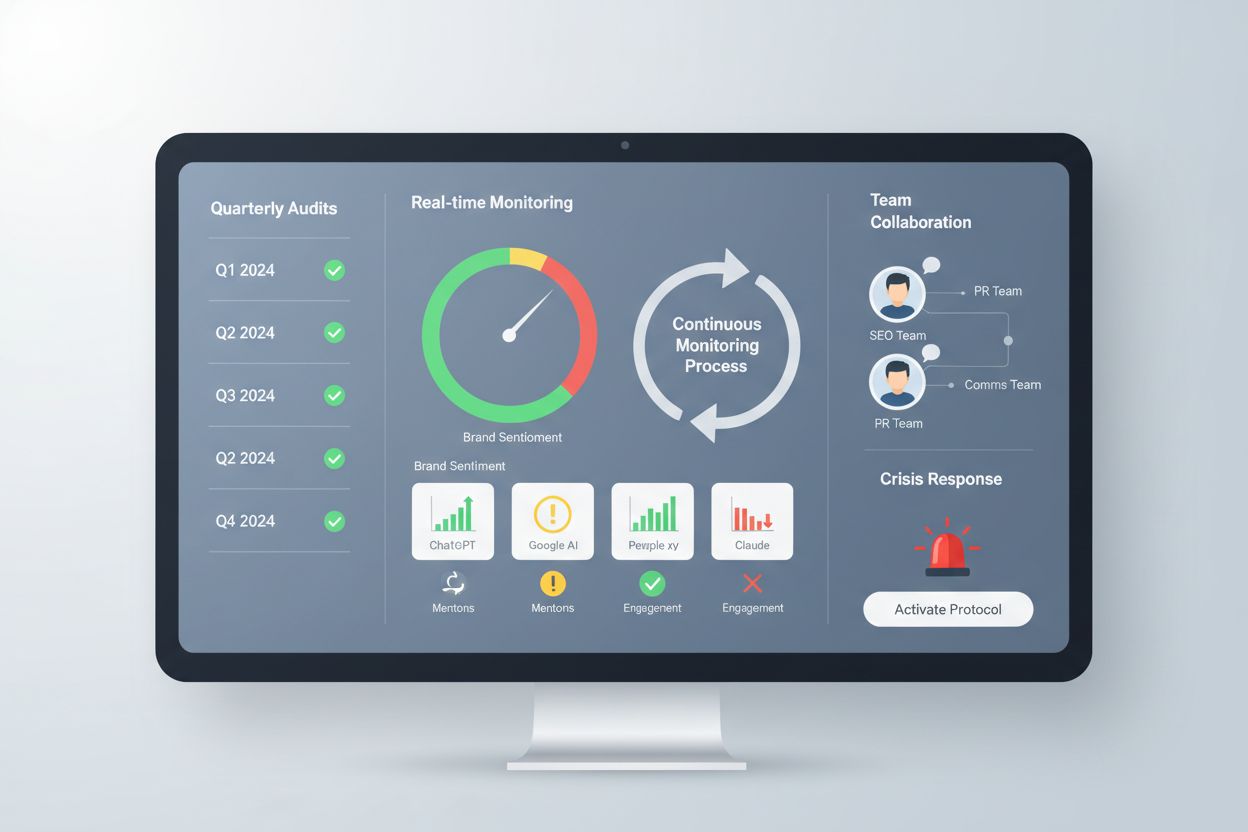
Correcting hallucinations is not a one-time fix—it’s an ongoing process because AI models retrain constantly and can reintroduce outdated information with each update. Establish a quarterly AI brand accuracy audit where you test the same prompts across ChatGPT, Gemini, Claude, and Perplexity, documenting responses and comparing them against your official brand data. After every major AI or search engine update, re-run your top brand prompts within a week to catch any new hallucinations before they spread. Use vector search and embedding comparisons to detect semantic drift—when the way AI systems “understand” your brand gradually shifts due to new, noisy data. For example, if your brand is known for handmade watches but AI increasingly sees mentions of your new smartwatch line, the model’s understanding might drift from “traditional watchmaker” to “tech brand,” even though both products are accurate. Tools like Pinecone or Weaviate can track these shifts by comparing embeddings of your brand descriptions over time.
Most importantly, involve your entire organization in this process. Create a cross-team collaboration between SEO, PR, and Communications teams, establishing monthly sync meetings to align on current brand facts and ensure updates are coordinated. When leadership changes, products launch, or locations shift, all teams should update their respective channels simultaneously—schema on the website, press releases, social bios, and business listings. Use AmICited.com as your primary monitoring solution to track how your brand appears across all major AI platforms in real time, giving you early warning of new hallucinations and measurable proof that your corrections are working.
Building a comprehensive brand protection strategy requires multiple specialized tools working in concert. Use the Google Knowledge Graph Search API to check how Google currently interprets your brand entity—if it shows outdated leadership or missing URLs, that information cascades into AI answers. For detecting fragmentation where your brand appears as multiple separate entities across datasets, entity reconciliation tools like OpenRefine or Diffbot can identify and merge near-duplicates, ensuring knowledge graphs recognize your brand as a single unified entity. Vector search platforms like Pinecone and Weaviate let you store and compare brand text embeddings over time, detecting semantic drift before it becomes a major problem. Embedding tools from OpenAI, Cohere, or Google’s EmbeddingGemma model convert your brand descriptions into numerical vectors that capture meaning, allowing you to measure how closely AI outputs match your verified brand statements.
| Tool Category | Tool Name | Primary Purpose | Best For |
|---|---|---|---|
| Entity Extraction | spaCy | Extract named entities from text | Quick analysis, open-source |
| Entity Extraction | Diffbot | Knowledge graph API | Enterprise-scale analysis |
| Semantic Comparison | Sentence-BERT (SBERT) | Compare text meaning | Drift detection, accuracy audits |
| Semantic Comparison | Universal Sentence Encoder | Capture sentence meaning | Extended summaries comparison |
| Vector Search | Pinecone | Store and search embeddings | Continuous monitoring |
| Vector Search | Weaviate | Open-source vector search | Flexible, self-hosted solutions |
| AI Monitoring | AmICited.com | Track AI mentions across platforms | Real-time brand visibility in ChatGPT, Gemini, Perplexity, Claude |
| Entity Reconciliation | OpenRefine | Merge duplicate entities | Data cleanup, standardization |
When Ahrefs tested how AI systems handle conflicting information about a fictional brand, they discovered something crucial: the most detailed story wins, regardless of truth. The test created a fake luxury paperweight company and seeded conflicting articles across the web, then watched how AI platforms responded. The official website used vague language and declined to provide specifics (“We do not disclose…”), while third-party sources provided detailed, answer-shaped responses to every question. AI systems consistently chose the detailed third-party content over the official denials. This reveals a critical insight: AI doesn’t choose between “truth” and “lies”—it chooses between answer-shaped responses and non-answers. Your official website might be technically correct, but if it doesn’t provide specific, detailed answers to the questions users ask AI systems, those systems will source information elsewhere. The lesson for your brand: when you correct hallucinations, don’t just deny false claims—provide detailed, specific, answer-shaped content that directly addresses what users ask AI systems. Update your About page with concrete facts, create FAQ content that answers specific questions, and ensure your schema markup provides complete, detailed information. This approach gives AI systems no reason to look elsewhere for answers about your brand.
AI hallucinations occur when generative AI systems confidently produce distorted or incorrect information that sounds plausible but is completely false. These happen because AI models approximate information based on patterns in training data rather than truly understanding facts. When your brand data is incomplete, outdated, or inconsistent across sources, AI systems fill the gaps with guesses that can spread rapidly across multiple platforms.
Establish a quarterly AI brand accuracy audit where you test the same prompts across ChatGPT, Gemini, Claude, and Perplexity. Additionally, re-run your top brand prompts within a week after every major AI or search engine update, as these changes can reintroduce outdated information or create new hallucinations. Continuous monitoring with tools like AmICited.com provides real-time visibility between formal audits.
No, you cannot directly edit information in ChatGPT, Google AI Overviews, or other generative AI platforms. Instead, you must correct the underlying data sources that these systems rely on: your website schema markup, Knowledge Graph entries, Wikidata profiles, business listings, and press releases. When you update these authoritative sources consistently, AI systems will gradually incorporate the corrections as they retrain and refresh their data.
Data voids occur when key information about your brand doesn't exist anywhere online, forcing AI to guess or fabricate details. Data noise happens when multiple conflicting versions of the same fact exist online (e.g., different founding dates on different platforms), causing AI to blend them into an incorrect average. Both problems require different solutions: data voids need new information added, while data noise requires standardizing information across all sources.
Timeline varies by platform and data source. Corrections to your website schema can be picked up by some AI systems within days, while Knowledge Graph updates may take weeks or months. Most AI models retrain periodically (ranging from weekly to quarterly), so corrections don't appear instantly. This is why continuous monitoring is essential—you need to track when corrections actually propagate through the AI systems your customers use.
For small brands with limited hallucinations, internal management using the tools and strategies outlined in this guide is feasible. However, for enterprise brands with complex data ecosystems, multiple product lines, or significant misinformation, hiring an agency specializing in AI reputation management can accelerate corrections and ensure comprehensive implementation. Many brands benefit from a hybrid approach: internal monitoring with AmICited.com and external expertise for complex data infrastructure fixes.
The ROI is substantial but often indirect. Preventing misinformation protects customer trust, reduces support inquiries from confused customers, and maintains brand authority in AI search results. Studies show that incorrect information in AI responses can reduce customer confidence and increase product returns. By monitoring and correcting hallucinations early, you prevent cascading damage where misinformation spreads across multiple AI platforms and gets incorporated into training data.
AmICited.com continuously monitors how your brand appears across ChatGPT, Gemini, Perplexity, Claude, and other AI platforms. It tracks mentions, identifies hallucinations, and alerts you to new misinformation in real time. This gives you visibility into the scope of AI-related brand issues and measurable proof that your corrections are working. Rather than manually testing prompts quarterly, AmICited.com provides ongoing surveillance so you can respond to problems before they spread.
Stop guessing about what AI systems say about your brand. Track mentions across ChatGPT, Gemini, Perplexity, and more with AmICited.
Learn how to identify, respond to, and prevent AI hallucinations about your brand. Discover monitoring tools, crisis management strategies, and long-term soluti...

Learn proven strategies to protect your brand from AI hallucinations in ChatGPT, Perplexity, and other AI systems. Discover monitoring, verification, and govern...
Learn what AI hallucination monitoring is, why it's essential for brand safety, and how detection methods like RAG, SelfCheckGPT, and LLM-as-Judge help prevent ...