

Presenting AI Visibility to Leadership: Getting Buy-In
Master the art of securing executive buy-in for AI visibility initiatives. Learn proven strategies to frame AI as a business capability, address leadership conc...
6 min read

Learn how to scale AI visibility monitoring from pilot projects to enterprise-wide implementation. Discover strategies for geographic expansion, governance frameworks, and multi-platform tracking across ChatGPT, Perplexity, and Google AI Overviews.
The journey from a successful pilot program to enterprise-scale AI visibility represents one of the most critical inflection points in modern marketing operations. While pilot projects often demonstrate impressive results—proving that real-time AI monitoring, entity tracking, and citation measurement are achievable—the leap to full implementation across multiple regions, platforms, and teams reveals a fundamentally different challenge. The scaling gap isn’t primarily a technology problem; it’s an organizational one that demands new infrastructure, governance frameworks, and cross-functional alignment. Companies that underestimate this transition risk abandoning their AI visibility initiatives entirely, with Gartner research showing that 30% of AI initiatives are abandoned after proof-of-concept due to scaling failures.
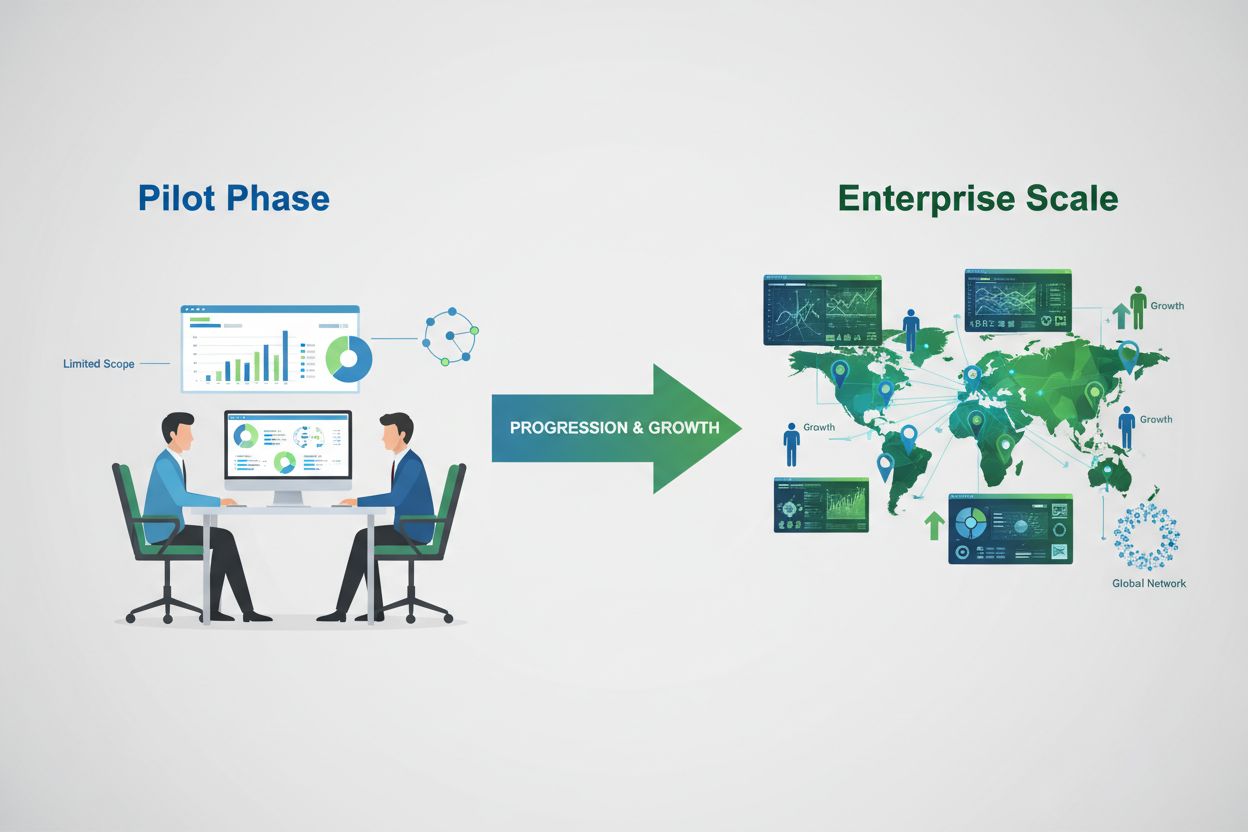
Pilots fail at enterprise scale for reasons that extend far beyond technical limitations, rooted instead in the organizational and structural barriers that emerge when visibility efforts expand. The transition from a small, agile team managing a single platform to a distributed operation monitoring multiple AI systems across regions exposes critical gaps in data consistency, infrastructure capacity, governance protocols, and team coordination. Understanding these barriers requires examining how each dimension transforms during scaling:
| Aspect | Pilot Phase | Enterprise Scale |
|---|---|---|
| Data | Centralized, single platform, manual validation | Distributed across regions, multi-platform, automated quality assurance |
| Infrastructure | Single-region cloud setup, basic APIs | Multi-region deployment, hybrid environments, advanced data pipelines |
| Governance | Informal processes, single team oversight | Formal policies, compliance frameworks, regional regulations |
| Teams | 2-5 dedicated specialists | 20-50+ distributed teams with specialized roles |
These structural differences demand a fundamental reimagining of how organizations approach AI visibility, moving from experimental thinking to operational discipline.
Building scalable infrastructure requires moving beyond the point solutions that work in pilots to embrace modular architectures that can expand without collapsing under their own complexity. Cloud-native solutions provide the foundation, enabling organizations to deploy distributed data pipelines that process AI mentions and citations across multiple platforms simultaneously without bottlenecks. Hybrid environments that combine public cloud infrastructure with on-premise governance systems allow enterprises to maintain security and compliance requirements while scaling globally. The key is designing systems with API-first principles, ensuring that each component—from data ingestion to entity recognition to reporting—can operate independently and scale horizontally. Organizations like Volkswagen and Mercedes-Benz have successfully implemented these architectures, enabling them to monitor their brand presence across ChatGPT, Perplexity, and Google AI Overviews in real-time. The investment in modular infrastructure during the scaling phase pays dividends through reduced technical debt, faster feature deployment, and the ability to integrate new AI platforms as they emerge.
Governance serves as the invisible foundation that enables consistent AI visibility across regions, platforms, and organizational boundaries—yet it’s often the last element companies implement. Effective governance establishes clear data ownership, defining who is responsible for entity consistency, citation accuracy, and regional compliance across the entire monitoring infrastructure. Standardized protocols for data collection, validation, and reporting ensure that a mention tracked in Singapore follows the same rules as one identified in São Paulo, eliminating the regional inconsistencies that plague distributed operations. Compliance layers built into governance frameworks address regional regulations—GDPR in Europe, data residency requirements in Asia-Pacific, and industry-specific standards in regulated sectors—without requiring separate monitoring systems for each region. Escalation procedures embedded in governance structures ensure that critical issues (brand misrepresentation, competitive threats, citation errors) reach decision-makers quickly, regardless of where they’re detected. Companies that prioritize governance during scaling report 40% faster issue resolution and significantly higher confidence in their AI visibility data. Without governance, scaling becomes chaotic; with it, scaling becomes systematic and sustainable.
Geographic expansion transforms AI visibility from a single-market concern into a globally coordinated operation, requiring strategies that balance consistency with local relevance. As organizations expand monitoring across regions, they must address unique challenges that don’t exist in pilot phases:
This geographic expansion strategy transforms AI visibility from a centralized function into a distributed capability that maintains global consistency while respecting local requirements.

Measuring visibility at scale demands metrics that extend far beyond traditional rankings, capturing the multidimensional nature of how AI systems represent your brand and entities. Citation frequency remains important, but it tells only part of the story; organizations must also track mention sentiment, understanding whether AI systems present your brand positively, neutrally, or critically. Entity consistency metrics measure how accurately AI systems recognize and represent your organization across different platforms and regions—a critical indicator of brand trust and data quality. Attribution accuracy quantifies how often AI systems properly credit your content versus paraphrasing without attribution, directly impacting your visibility and authority. Competitive share of voice in AI outputs reveals your positioning relative to competitors within the same AI systems, a metric that traditional search analytics cannot capture. Regional performance variance identifies geographic markets where your AI visibility is strong or weak, guiding resource allocation and regional strategy adjustments. Organizations implementing these comprehensive metrics report 35% better alignment between AI visibility efforts and business outcomes compared to those relying on traditional SEO metrics alone.
AmICited.com addresses the complete spectrum of enterprise AI visibility challenges through a platform purpose-built for scaling from pilot to full implementation. The platform delivers real-time tracking across the major AI systems that matter most—ChatGPT, Perplexity, Google AI Overviews, and Gemini—capturing mentions and citations the moment they appear rather than through delayed batch processing. Multi-platform monitoring eliminates the need for separate tools and manual processes, consolidating visibility data into a single source of truth that teams across your organization can access and act upon. Geographic expansion capabilities enable organizations to scale monitoring across regions while maintaining data consistency through centralized entity management and localized validation workflows. Citation consistency verification automatically detects when AI systems misrepresent your brand, paraphrase without attribution, or provide inaccurate information, triggering alerts that enable rapid response. Competitive benchmarking features position your AI visibility performance against competitors in the same systems, revealing market opportunities and competitive threats. The platform’s governance-first architecture ensures that as your organization scales, visibility efforts remain coordinated, compliant, and strategically aligned—transforming AI visibility from an experimental initiative into a core component of your marketing and brand strategy.
Implementing AI visibility at scale requires a structured roadmap that moves organizations through distinct phases, each building on the previous one while establishing foundations for future growth. Phase 1: Foundation (Months 1-3) focuses on establishing governance frameworks, selecting core platforms to monitor, and building the technical infrastructure for data collection and validation. Phase 2: Pilot Expansion (Months 4-6) extends monitoring to additional platforms and introduces regional tracking in 2-3 key markets, validating that processes scale without degradation. Phase 3: Regional Rollout (Months 7-12) deploys monitoring across all target regions, implements localized governance protocols, and establishes regional teams with clear ownership and accountability. Phase 4: Optimization (Months 13-18) focuses on refining metrics, improving entity recognition accuracy, and integrating AI visibility data into broader marketing and competitive intelligence workflows. Phase 5: Continuous Evolution (Ongoing) maintains the system as new AI platforms emerge, competitive landscapes shift, and organizational priorities evolve. This phased approach prevents the common mistake of attempting full-scale implementation immediately, which typically results in governance failures, data quality issues, and team burnout. Organizations that follow this roadmap report 60% higher success rates in achieving sustainable, enterprise-scale AI visibility.
Scaling AI visibility introduces predictable obstacles that organizations can overcome through proven solutions and proactive planning. Data Quality Degradation occurs when monitoring systems expand faster than validation processes can keep pace; solve this by implementing automated quality assurance workflows that flag inconsistencies before they propagate through your organization. Team Coordination Breakdown emerges when visibility efforts span multiple departments without clear ownership; establish a Center of Excellence model with dedicated leadership, standardized processes, and regular cross-functional synchronization. Platform Integration Complexity multiplies as you monitor more AI systems; address this through API-first architecture and modular platform design that isolates each integration from others. Regional Compliance Conflicts arise when different markets have incompatible data protection requirements; resolve these through governance frameworks that build compliance into data collection rather than treating it as an afterthought. Stakeholder Misalignment occurs when different departments have conflicting priorities for AI visibility; prevent this through executive sponsorship, clear communication of business objectives, and regular reporting that demonstrates value to all stakeholders. Organizations that anticipate these obstacles and implement solutions proactively reduce scaling timelines by 30-40% and achieve higher adoption rates across their teams.
The AI landscape evolves rapidly, with new platforms, capabilities, and competitive threats emerging constantly—requiring organizations to build AI visibility strategies that remain relevant and effective over time. Future-proofing your visibility efforts means designing systems with flexibility built in, enabling rapid integration of emerging AI platforms without requiring complete infrastructure overhauls. Monitor the evolution of AI systems themselves, understanding how platforms like ChatGPT, Perplexity, and Google AI Overviews are expanding their capabilities and how those changes affect your brand visibility and competitive positioning. Invest in governance frameworks that can adapt to new regulatory requirements, ensuring that as governments implement AI-specific regulations, your monitoring practices remain compliant without disruption. Build organizational capabilities around AI visibility as a strategic discipline, not just a tactical tool, ensuring that your team develops expertise that compounds over time. The organizations that will dominate AI visibility in the coming years are those that treat it as a continuous evolution rather than a one-time implementation, maintaining the discipline, governance, and technological investment required to stay ahead of the rapidly changing AI landscape.
Traditional SEO measures rankings and traffic, while AI visibility measures whether a brand is mentioned, cited, or trusted within AI-generated answers. AI systems prioritize entity consistency and contextual validation over keyword placement, making them fundamentally different measurement approaches.
Most organizations follow a 12-18 month roadmap from foundation to continuous evolution. The timeline includes foundation building (months 1-3), pilot expansion (months 4-6), regional rollout (months 7-12), optimization (months 13-18), and ongoing evolution. Your specific timeline depends on organizational complexity and geographic scope.
The primary obstacles are data quality degradation, team coordination breakdown, platform integration complexity, regional compliance conflicts, and stakeholder misalignment. These are organizational challenges rather than technical ones, which is why governance and clear ownership are critical to successful scaling.
Effective multi-region monitoring requires centralized entity databases with regional validation layers, localized monitoring strategies for regional competitors, multi-language entity recognition, competitive landscape tracking by region, and compliance alignment with local data protection laws. This balance maintains global consistency while respecting local requirements.
Key metrics include citation frequency, mention sentiment, entity consistency, attribution accuracy, competitive share of voice in AI outputs, and regional performance variance. These comprehensive metrics provide better alignment between AI visibility efforts and business outcomes compared to traditional SEO metrics alone.
Yes, AmICited.com is specifically designed for geographic expansion. The platform enables organizations to scale monitoring across regions while maintaining data consistency through centralized entity management and localized validation workflows, supporting multi-region deployment without sacrificing governance or compliance.
Governance is the invisible foundation that enables consistent AI visibility across regions and platforms. It establishes clear data ownership, standardized protocols, compliance layers, and escalation procedures that ensure brand representation remains consistent whether a mention is detected in Singapore or São Paulo.
Organizations that scale AI visibility effectively report 35% better alignment between visibility efforts and business outcomes, 40% faster issue resolution, and 60% higher success rates in achieving sustainable enterprise-scale monitoring. The competitive advantage comes from being consistently visible in AI-generated answers where users increasingly seek information.
AmICited.com helps enterprises monitor and optimize AI visibility across ChatGPT, Perplexity, Google AI Overviews, and emerging platforms. Track mentions, citations, and entity recognition at scale.
Master the art of securing executive buy-in for AI visibility initiatives. Learn proven strategies to frame AI as a business capability, address leadership conc...

Discover the 9 critical AI optimization mistakes that cause 95% of projects to fail. Learn how to avoid GEO errors, improve AI visibility, and ensure your AI in...

Learn how to convert AI mentions into actual revenue. Discover strategies for tracking AI visibility impact on conversions, optimizing content for AI platforms,...