
Semantic Completeness
Learn what semantic completeness means for content optimization. Discover how comprehensive topic coverage improves AI citations, visibility in ChatGPT, Google ...
7 min read
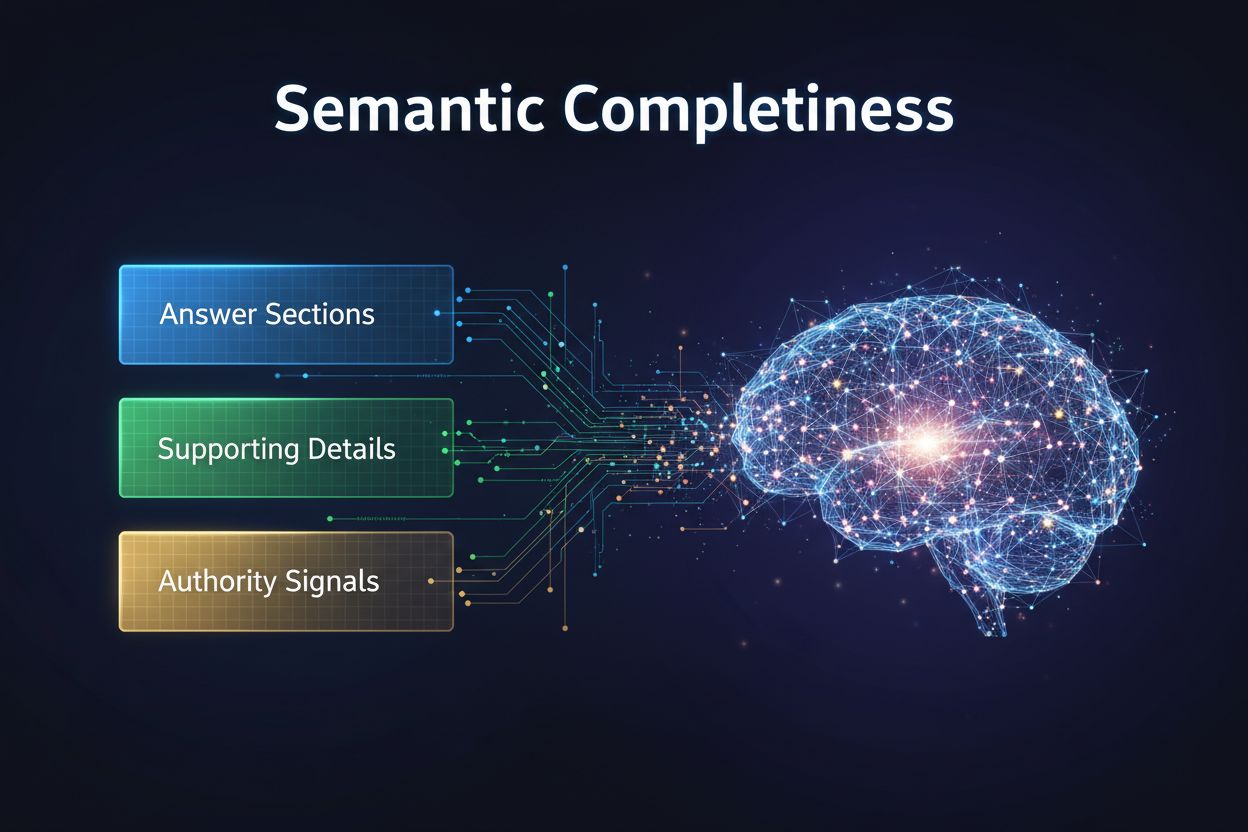
Learn how semantic completeness creates self-contained answers that AI systems cite. Discover the 3 pillars of semantic completeness and implement GEO strategies that boost AI visibility by 40%.
Semantic completeness in AI refers to the degree to which content provides sufficient context and information to be understood independently by language models without requiring external references or additional sources. Unlike traditional SEO, which optimizes for keyword rankings and click-through rates, semantic completeness focuses on ensuring that AI systems can extract, understand, and cite individual sections of content as standalone answers to user queries. When AI platforms like ChatGPT, Perplexity, and Google AI Overviews evaluate content, they assess whether each concept, fact, and claim is explained thoroughly enough to be extracted and presented as a complete response. This distinction matters profoundly because AI systems don’t simply rank pages—they synthesize information from multiple sources and cite the most semantically complete answers. Content that achieves semantic completeness becomes inherently more valuable to AI platforms because it reduces the need for the AI to combine information from multiple sources, making it the preferred citation choice. The shift from keyword-focused optimization to semantic completeness represents a fundamental change in how content creators must approach digital visibility in the age of generative AI.
AI systems employ Retrieval-Augmented Generation (RAG) processes to evaluate content completeness, which involves retrieving relevant information from knowledge bases, ranking that information by relevance and authority, and then generating responses that synthesize the highest-quality sources. During the retrieval phase, AI systems convert user queries into semantic representations and search for documents that match conceptually, not just through keyword matching. The ranking phase is where semantic completeness becomes critical—AI algorithms assess whether retrieved content can stand alone as a complete answer or whether it requires supplementation from other sources. According to research from Princeton University and Georgia Tech analyzing over 1 million AI-generated responses, content that achieves semantic completeness receives 40% more citations than fragmented content requiring synthesis from multiple sources. The evaluation process prioritizes content that is semantically clear, structurally organized with logical headings and lists, factually dense with statistics and data points, and authoritative with proper citations. AI systems recognize that semantically complete content reduces processing overhead and improves answer quality, making such content significantly more likely to be selected for citation.
| Evaluation Factor | Impact on AI Citation | Traditional SEO Relevance |
|---|---|---|
| Semantic Clarity | Critical (40% citation increase) | Moderate |
| Structural Organization | Critical (enables extraction) | High |
| Factual Density | High (verifiability signals) | Moderate |
| Authority Signals | High (credibility assessment) | High |
| Accessibility | High (readability matters) | Moderate |
Semantic completeness rests on three foundational pillars that work together to make content maximally valuable to AI systems:
Authoritative Source Citations: Every claim, statistic, and assertion must link to credible sources (.edu domains, .gov resources, peer-reviewed research, established industry publications). According to research from Stanford and Princeton, content citing authoritative sources receives significantly more AI citations than unsourced content. This pillar signals research rigor and factual grounding, allowing AI systems to verify information independently and cite your content with confidence.
Expert Quotations: Direct quotes from industry experts, practitioners, and thought leaders serve as credibility markers that AI systems recognize and prioritize. When content includes attributed expert perspectives with credentials clearly stated, AI algorithms treat that content as more authoritative and citation-worthy. Research shows that content featuring expert quotations receives substantially higher citation frequency because quotes provide specific, attributable facts that AI engines can extract and present as established knowledge.
Statistical Evidence: Fact-dense content with quantifiable data points, percentages, and numerical evidence receives significantly more AI citations than general content. According to analysis of AI citation patterns, content including one statistic every 150-200 words achieves optimal citation frequency. Statistics serve dual purposes: they answer the specific factual questions users ask AI systems, and they signal expertise and research depth to AI algorithms evaluating content credibility.
Each pillar independently strengthens semantic completeness, but their combined effect is multiplicative—content incorporating all three elements achieves maximum citation potential across all major AI platforms.
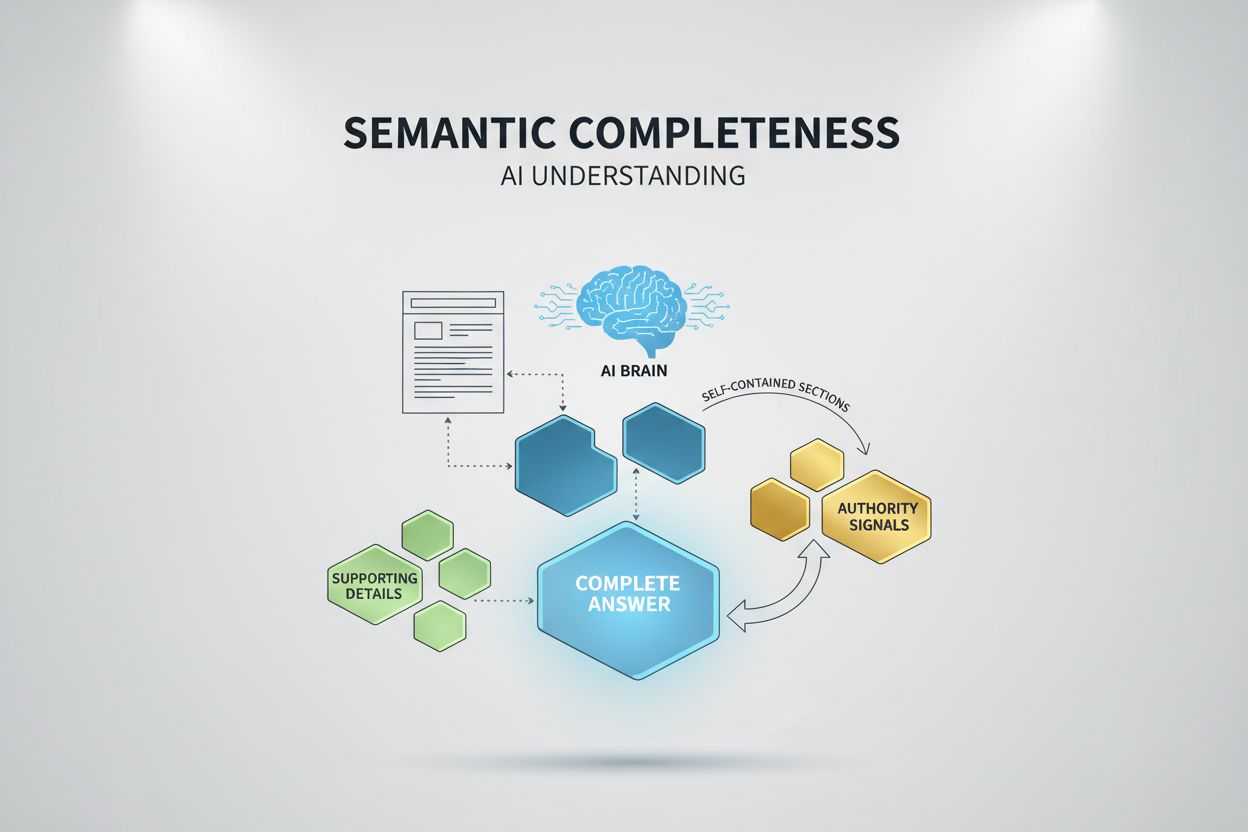
Semantic chunking—organizing content into self-contained sections where each part can stand alone conceptually—is essential for AI citation success. Each H2 section should completely address its heading without requiring readers to reference earlier sections for context, allowing AI systems to extract individual sections as complete answers. Direct answer formats should position the core response in the first 40-60 words, followed by supporting details and examples that expand on the initial concept. For example, when addressing “What is content marketing?”, the opening should immediately state: “Content marketing is a strategic approach focused on creating and distributing valuable, relevant content to attract and retain a clearly defined audience.” This direct answer can be extracted independently, while subsequent paragraphs provide context, statistics, and examples that enhance understanding without being strictly necessary for comprehension. The principle of semantic independence means that an AI system could cite any individual section of your content without confusion, because each section provides sufficient context for standalone understanding. This structural approach simultaneously improves traditional SEO performance because it aligns with Google’s helpful content guidelines emphasizing clear, organized information architecture.
Different AI platforms prioritize different semantic completeness characteristics, requiring nuanced optimization strategies for each system. ChatGPT exhibits strong preference for encyclopedic, authoritative content modeled after Wikipedia’s structure, with research showing that Wikipedia receives 47.9% of ChatGPT’s factual query citations. Perplexity AI strongly favors recent content published within the past 90 days and community-vetted sources, with nearly 46.7% of its top citations coming from Reddit and other community platforms. Google AI Overviews prioritize content that already ranks well organically in the top 10 positions, emphasizing E-E-A-T signals (Expertise, Experience, Authoritativeness, Trustworthiness) and structured data markup implementation.
| Platform | Semantic Completeness Priority | Citation Preference | Content Freshness |
|---|---|---|---|
| ChatGPT | Encyclopedic structure, comprehensive coverage | Wikipedia-style, authoritative sources | 6-12 months acceptable |
| Perplexity | Recent examples, community validation | Reddit, fresh articles, practical cases | 90 days or newer |
| Google AI Overviews | E-E-A-T signals, schema markup | Top 10 organic rankings, featured snippets | Current/updated |
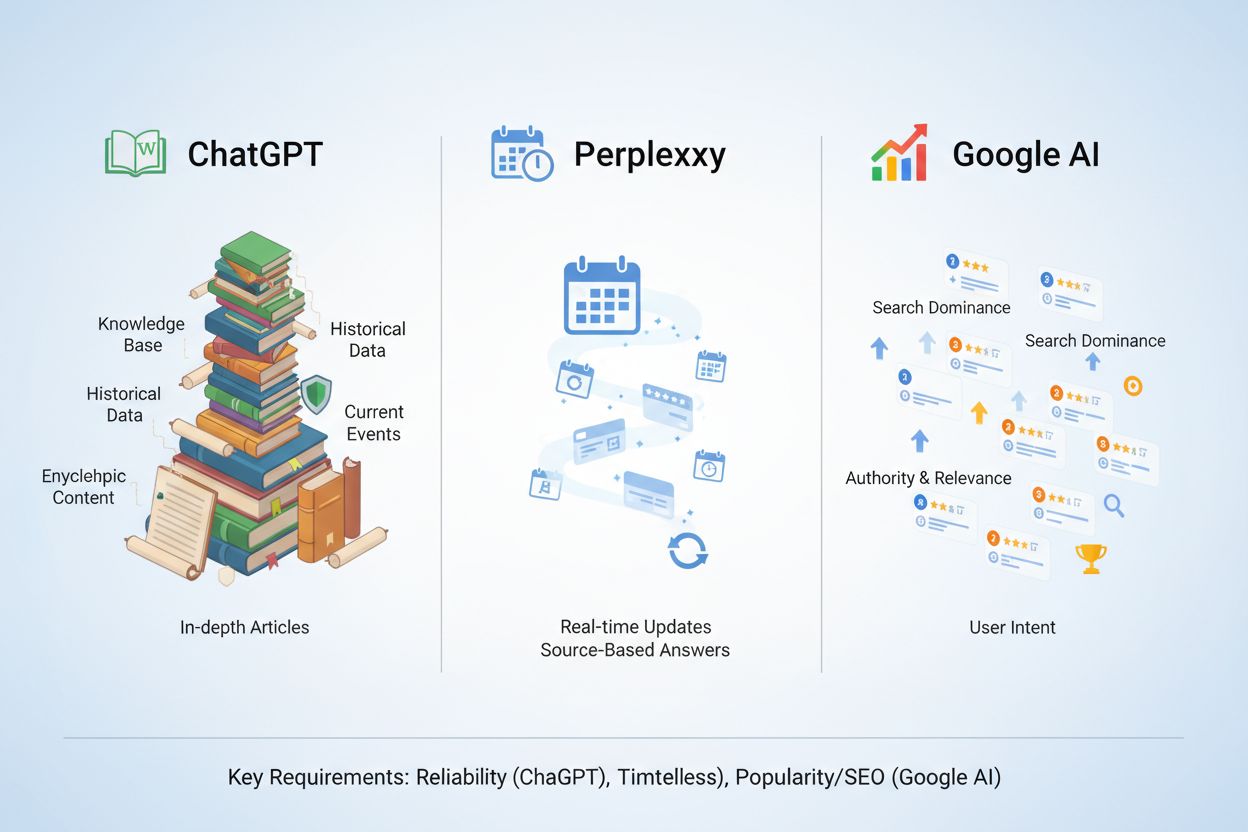
Successful multi-platform optimization requires creating comprehensive base content (2,500-3,000 words) that satisfies all platform requirements simultaneously, incorporating encyclopedic definitions for ChatGPT, practical examples for Perplexity, and strong E-E-A-T signals for Google AI Overviews.
Traditional SEO emphasized keyword density and placement, operating under the assumption that search algorithms matched keywords in queries to keywords in content. Semantic completeness inverts this priority, focusing instead on conceptual clarity and meaning over keyword frequency. A page mentioning “generative engine optimization” dozens of times but lacking conceptual clarity will lose to a page explaining GEO thoroughly with supporting examples and clear structure, because AI systems identify concepts rather than keyword density. According to research from Frase and Single Grain, semantic search identifies concepts and relationships between ideas, making keyword stuffing counterproductive in AI citation algorithms. The shift matters practically: content optimized for semantic completeness naturally incorporates relevant keywords through contextual usage, but forcing keyword density often results in awkward phrasing that AI systems recognize as unnatural and less trustworthy. This semantic approach aligns with Google’s helpful content guidelines, which explicitly penalize keyword-stuffed content while rewarding genuinely useful, well-organized information. For content creators, this means abandoning the keyword density spreadsheets and instead focusing on explaining concepts thoroughly, providing context, and ensuring each section can stand alone as a complete answer.
Self-contained answer formats follow a consistent structure that maximizes AI citation likelihood: direct answer (10-15 words stating the core concept), supporting detail (20-30 words providing context or explanation), and authority indicator (5-10 words referencing expertise or data source). For instance, when answering “How does content marketing generate ROI?”, the structure would be: “Content marketing generates ROI through lead generation, customer retention, and brand authority building (direct answer). Companies implementing content marketing strategies see 3x more leads than those relying solely on paid advertising (supporting detail). According to Content Marketing Institute’s 2024 research (authority indicator).” This 35-55 word format is optimal for AI extraction because it provides complete information without excess context. Each answer should be independently comprehensible—a reader encountering only that paragraph should understand the concept fully. Examples strengthen semantic completeness: “For example, a SaaS company publishing 20 educational blog posts monthly might generate 500 qualified leads annually, compared to 150 leads from paid advertising alone.” This example-based approach helps AI systems understand practical applications while providing concrete evidence that strengthens citation worthiness.
FAQ schema markup, implemented using JSON-LD format, explicitly tells AI systems which content sections answer common questions, dramatically increasing citation likelihood for those queries. According to research from Passionfruit and GetPassionFruit, FAQ schema implementation increases AI citation frequency by enabling AI systems to quickly identify and extract question-answer pairs without parsing surrounding context. The JSON-LD structure for FAQ schema includes a FAQPage entity containing an array of Question items, each with an accepted Answer property containing the complete response. Google explicitly recommends JSON-LD for structured data implementation, citing its ease of maintenance and reduced implementation errors compared to other markup formats. FAQ schema serves dual purposes: it provides semantic signals to AI systems about content organization, and it enables featured snippet eligibility in traditional Google search, creating compounding visibility benefits. When implementing FAQ schema, ensure all marked-up content is user-visible on the page (hidden or dynamically loaded content violates guidelines), each page features unique FAQ content relevant to that specific page’s topic, and answers are self-contained and comprehensible without additional context. The impact on AI citations is substantial—pages with properly implemented FAQ schema receive preferential treatment from AI systems evaluating content for citation-worthiness because the schema explicitly signals semantic completeness.
Measuring semantic completeness success requires tracking both traditional metrics and new AI-specific performance indicators that directly correlate with business outcomes. Citation rate—calculated as (Brand Citations in AI Responses / Total Relevant Queries Tested) × 100—provides the most direct measure of semantic completeness effectiveness, with successful implementations typically achieving 30-50% citation rates for target queries within 6 months. GA4 segmentation enables tracking of AI bot traffic by filtering for user agents like “ChatGPT-User,” “PerplexityBot,” and “Claude-Web,” though this captures only identifiable bot traffic and should be treated as directional rather than comprehensive. Citation context analysis involves manually querying AI platforms monthly with 10-15 core questions your content should answer, documenting which sources get cited and tracking citation frequency trends over time. Expected timelines show initial citation wins within 4-8 weeks after publishing optimized content, with sustained growth building over 6-12 months as content accumulates authority signals and AI platforms recognize your domain as a reliable source for specific topics. Share of AI voice—calculated as (Your Brand Citations / Total Industry Citations) × 100—provides competitive benchmarking, revealing whether you’re gaining or losing citation share relative to competitors. These metrics collectively demonstrate semantic completeness success and justify continued investment in AI optimization strategies.
Seven critical mistakes prevent content from achieving semantic completeness and reduce AI citation likelihood:
Incomplete Answer Coverage - Answering only the primary question without addressing related concerns or follow-up questions that users naturally ask, forcing AI systems to synthesize information from multiple sources rather than citing your complete answer.
Vague Marketing Language - Using abstract descriptions like “exceptional cuisine inspired by bold flavors” instead of specific, factual statements like “authentic street-style tacos and burrito bowls made from scratch,” which prevents AI systems from confidently extracting and citing your content.
Missing Source Attribution - Making claims without citing authoritative sources, which signals to AI algorithms that your content lacks research rigor and reduces citation confidence.
Poor Structural Organization - Presenting information in dense paragraphs without clear headings, bullet points, or logical hierarchy, making it difficult for AI systems to extract self-contained sections.
Outdated Statistics - Citing data points older than 12 months without updating to current information, particularly problematic for Perplexity and Google AI Overviews which strongly favor fresh content.
Lack of Expert Attribution - Publishing content without author credentials or expert perspectives, missing opportunities to strengthen authority signals that AI systems use in citation decisions.
Insufficient Fact Density - Failing to include statistics, percentages, or numerical evidence every 150-200 words, resulting in general content that lacks the specific, verifiable information AI systems prioritize for citations.
Semantic completeness requirements vary across content types, requiring tailored approaches for maximum AI citation effectiveness. Blog posts should open with direct answers in the first 40-60 words, followed by supporting evidence and examples, with FAQ sections addressing common follow-up questions. How-to guides require step-by-step structures where each step is self-contained and includes specific details, measurements, and expected outcomes, enabling AI systems to extract individual steps as complete instructions. FAQ pages should feature 5-10 question-answer pairs formatted with proper FAQ schema markup, with each answer being 40-60 words and independently comprehensible. Product pages benefit from semantic completeness through clear feature descriptions, specific use cases, and direct answers to common purchase questions, though AI systems rarely cite product pages directly—instead citing supporting educational content that influences purchase decisions. Case studies achieve semantic completeness by including specific metrics, timelines, challenges, solutions, and results in clearly labeled sections, allowing AI systems to extract individual case study elements as evidence supporting broader claims. Each content type requires the same foundational principles—direct answers, self-contained sections, factual density, and authority signals—but the structural implementation varies based on content purpose and user intent.
Semantic completeness will become increasingly central to digital visibility as AI search adoption accelerates and AI platforms mature in their citation algorithms. Emerging trends indicate that multimodal AI systems capable of processing text, images, video, and audio simultaneously will require semantic completeness across multiple formats—not just written content. According to Semrush research, AI-referred traffic is projected to surpass traditional Google organic search by early 2028, making semantic completeness optimization a critical long-term investment rather than an experimental tactic. Long-term advantages accrue to early adopters who establish semantic completeness across their content libraries, because AI platforms exhibit “source preference bias”—once a source proves reliable for a topic, the model favors it for related queries, creating compounding citation advantages. As competition for AI citations intensifies, semantic completeness will become the primary differentiator between brands that capture citation share and those that remain invisible in AI-generated responses. Organizations investing in semantic completeness now are building citation moats that competitors will struggle to overcome, establishing authority positions that compound over time. The future of search is conversational, AI-powered, and citation-based, making semantic completeness the foundational skill for content creators seeking visibility in the next decade of digital marketing.
Semantic completeness means your content is self-contained and fully understandable without requiring readers to access external sources or previous sections. For AI systems, it means each section can be extracted and cited independently because it contains all necessary context and information to answer a specific question completely.
Traditional SEO optimizes entire pages for ranking in search results, focusing on keywords and backlinks. Semantic completeness optimizes individual sections and facts for AI extraction and citation. While SEO asks 'Will this page rank?', GEO asks 'Can AI extract and cite this specific section independently?'
AI systems using RAG (Retrieval-Augmented Generation) extract specific sections from multiple sources to synthesize answers. Self-contained sections allow AI to cite your content confidently without needing surrounding context, making your content more likely to be selected for citations.
Research shows optimal self-contained answers follow a 40-60-word opening (direct answer), 20-30 words of supporting detail, and 5-10 words of authority indicator, totaling 35-55 words. However, longer sections (100-200 words) can also be self-contained if they're logically complete and don't require external context.
Read each H2 section in isolation without reading surrounding content. If you can understand the complete concept and answer the section's question without external context, it's semantically complete. You can also ask AI systems directly—if they cite your section without needing surrounding context, you've achieved semantic completeness.
Yes. Content structured for semantic completeness—with clear headings, direct answers, and logical flow—typically performs better in traditional SEO as well. Google's helpful content guidelines reward clear, well-structured content that directly answers user questions, which aligns perfectly with semantic completeness principles.
Update core content every 90-180 days, particularly statistics, examples, and time-specific information. Perplexity and Google AI Overviews strongly favor fresh content. However, the semantic structure itself (how sections are organized) remains stable—focus updates on keeping facts current rather than restructuring.
Yes. Blog posts, how-to guides, FAQs, product pages, case studies, and industry reports can all benefit from semantic completeness. The principle remains the same: each section should be independently understandable. The implementation varies by content type—FAQs naturally align with semantic completeness, while blog posts require deliberate section structuring.
Track how AI systems like ChatGPT, Perplexity, and Google AI cite your brand. Get real-time insights into your semantic completeness performance and competitive citation share.
Learn what semantic completeness means for content optimization. Discover how comprehensive topic coverage improves AI citations, visibility in ChatGPT, Google ...

Learn what content comprehensiveness means for AI systems like ChatGPT, Perplexity, and Google AI Overviews. Discover how to create complete, self-contained ans...
Learn how to create comprehensive content optimized for AI systems, including depth requirements, structure best practices, and formatting guidelines for AI sea...