

What Schema Markup Helps with AI Search? Complete Guide for 2025
Discover which schema markup types boost your visibility in AI search engines like ChatGPT, Perplexity, and Gemini. Learn JSON-LD implementation strategies for ...
9 min read
Learn how semantic HTML improves AI understanding, LLM comprehension, and content attribution. Discover advanced techniques for optimizing markup for AI systems like ChatGPT, Perplexity, and Google Gemini.
Semantic HTML refers to markup that carries meaning beyond mere presentation—using tags like <article>, <section>, <nav>, and <header> instead of generic <div> and <span> elements. While traditional non-semantic markup renders identically in browsers, it provides zero contextual information to AI systems trying to understand page structure and content hierarchy. AI models, particularly large language models (LLMs), rely heavily on HTML structure to extract meaning, identify primary content, and understand relationships between different page elements. When you use semantic HTML, you’re essentially creating a machine-readable blueprint that helps AI systems distinguish between navigation, main content, sidebars, and metadata. This distinction becomes critical as AI systems increasingly crawl, index, and cite web content—they need to know what’s actually important. The difference between semantic and non-semantic markup is the difference between a well-organized document and a pile of unmarked text blocks, and AI systems treat them accordingly.
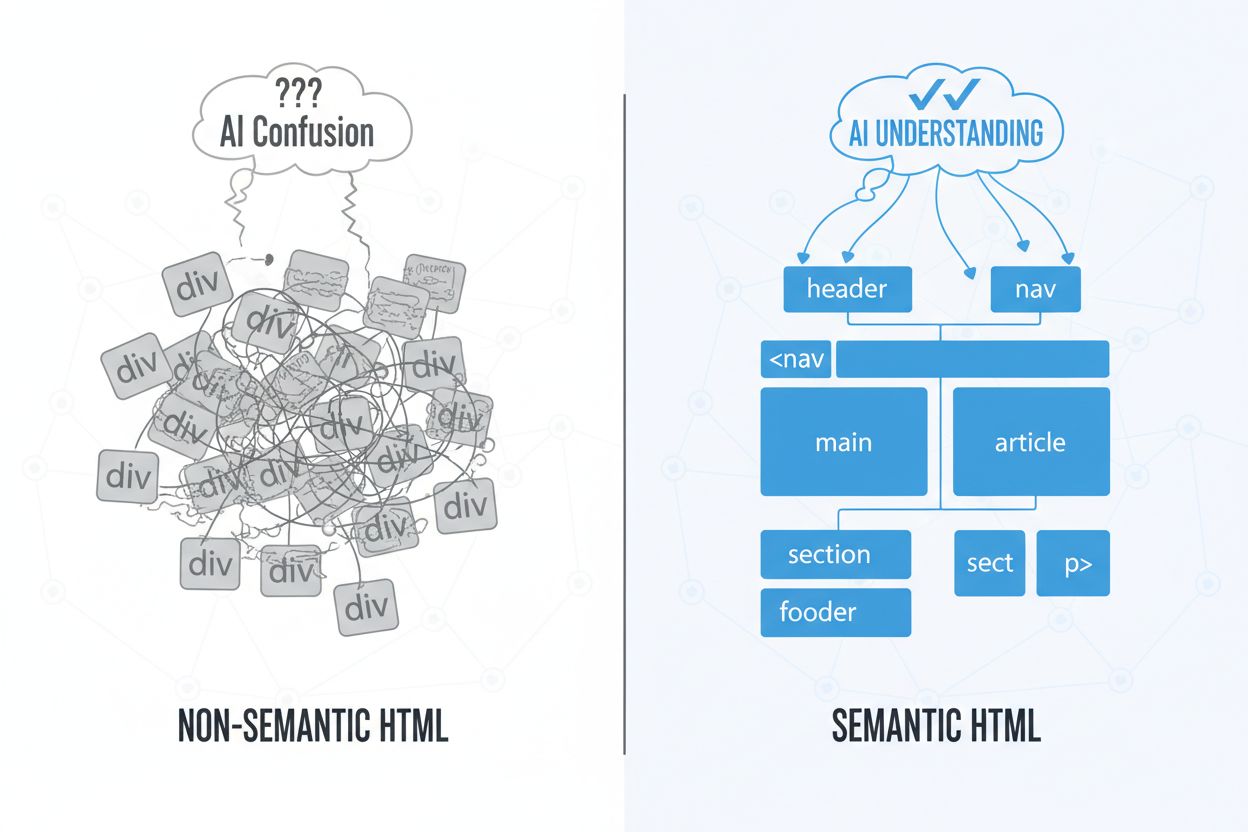
Large language models process raw HTML fundamentally differently than human browsers do. LLMs don’t render JavaScript, apply CSS styling, or execute dynamic interactions—they work exclusively with the raw HTML source code and text content. This means that content hidden behind JavaScript rendering, dynamically loaded elements, or CSS-based visibility tricks are essentially invisible to AI systems. When ChatGPT, Perplexity, or Google Gemini crawl your website, they’re reading pure HTML structure, making semantic markup exponentially more valuable than visual design. The following table illustrates how different AI systems handle HTML processing:
| AI System | HTML Processing | JavaScript Support | Semantic Element Recognition | Citation Accuracy |
|---|---|---|---|---|
| ChatGPT | Raw HTML parsing | Limited/None | High (with proper markup) | Moderate-High |
| Perplexity | Full HTML structure | Partial | High (prioritizes semantic tags) | High |
| Google Gemini | Complete HTML analysis | Limited | High (uses landmark detection) | Moderate |
Understanding these differences helps you optimize content specifically for how each AI system actually processes your pages, rather than assuming they work like traditional search engines.
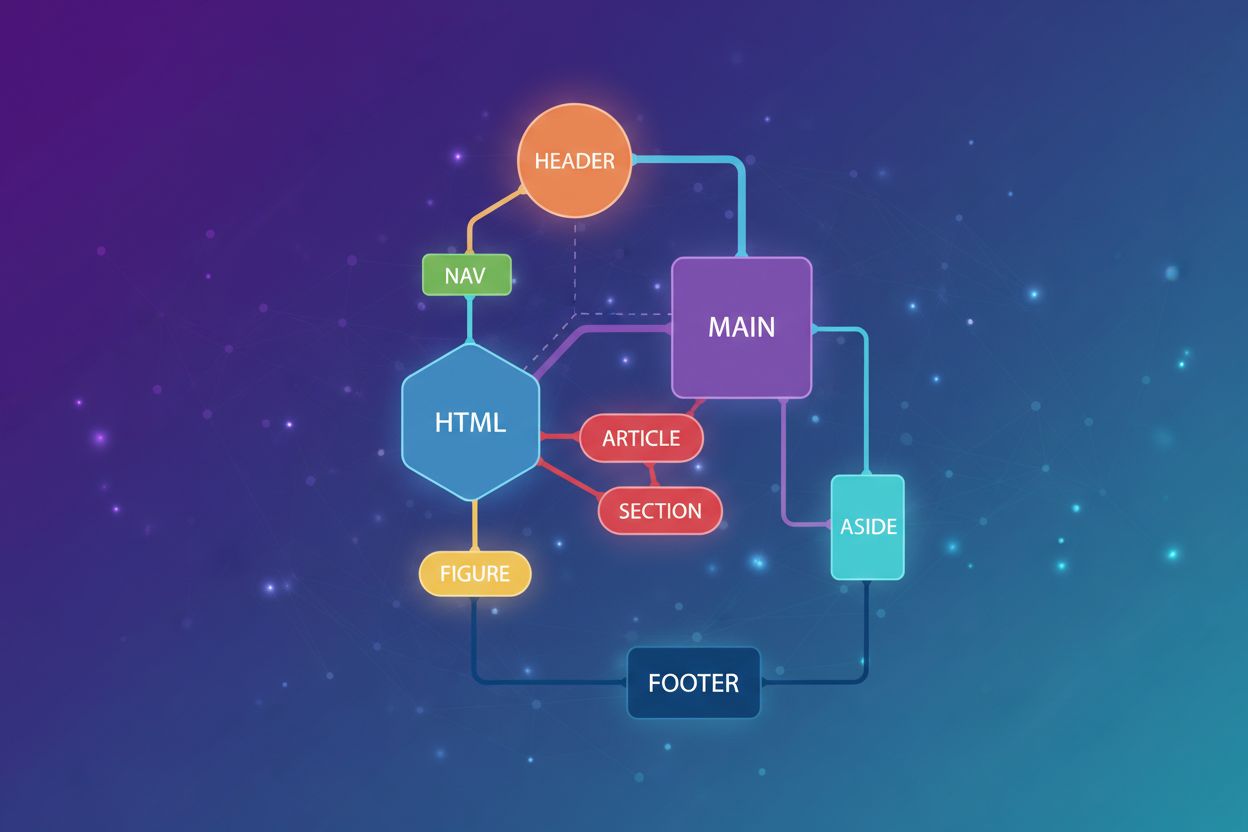
The HTML5 semantic elements form the foundation of AI-readable markup, each serving a specific structural purpose that helps AI systems understand content hierarchy and relationships. The primary semantic landmarks include:
<header> – Identifies introductory content, site branding, and navigation containers; helps AI distinguish page metadata from main content<nav> – Explicitly marks navigation sections; AI systems use this to filter out navigation links when extracting main content<main> – Designates the primary content area; critical for AI systems to identify what’s actually important versus supplementary material<article> – Wraps self-contained content pieces; essential for AI to recognize independent, citable content blocks<section> – Groups thematically related content; helps AI understand content organization and topic boundaries<aside> – Marks tangential or supplementary content; allows AI to deprioritize sidebars and related-content sections<footer> – Contains metadata, copyright, and secondary links; helps AI distinguish footer content from main material<figure> and <figcaption> – Associates images with captions; enables AI to understand visual content context and attributionUsing these elements consistently creates a semantic data layer that AI systems can reliably parse, dramatically improving content extraction accuracy and citation quality.
Semantic HTML and structured data (Schema.org/JSON-LD) serve complementary but distinct purposes in making content AI-accessible. Semantic HTML provides structural context through markup hierarchy—it tells AI systems where important content lives and how it’s organized. Structured data, implemented through JSON-LD or microdata, provides explicit semantic meaning about what the content represents—defining entities, relationships, and properties in machine-readable format. The most effective approach combines both strategies: use semantic HTML for document structure and content hierarchy, while layering Schema.org markup to explicitly define entities, events, products, articles, and their relationships. For example, an <article> tag tells AI “this is an article,” but Schema.org’s Article schema tells it the author, publication date, headline, and word count. Neither approach alone is sufficient for optimal AI understanding—semantic HTML without structured data leaves entity relationships ambiguous, while structured data without semantic HTML provides metadata without context. Forward-thinking websites implement both, creating a rich semantic layer that AI systems can fully leverage for accurate content understanding and citation.
Semantic HTML forms the foundation for AI-driven knowledge graph construction, enabling systems to extract entities, relationships, and hierarchical connections from your content. When you properly structure content with semantic elements, AI systems can reliably identify key entities (people, organizations, concepts) and understand how they relate to each other throughout your document. Entity extraction becomes dramatically more accurate when content is organized semantically—an AI system can distinguish between a person mentioned in the main article versus someone mentioned in a sidebar or footer, allowing for more precise relationship mapping. By combining semantic HTML with Schema.org markup, you create a semantic data layer that explicitly defines these relationships, enabling AI systems to build accurate knowledge graphs that represent your domain expertise. This semantic foundation is particularly valuable for specialized domains like healthcare, finance, or technical documentation, where precise entity relationships and hierarchical understanding directly impact AI system accuracy. Knowledge graphs built from semantically-marked content are more reliable, more complete, and more useful for downstream AI applications—from question-answering systems to recommendation engines.
Proper semantic markup directly improves AI citation accuracy and content attribution, a critical concern as AI systems increasingly generate answers from web content. When AI systems use Retrieval-Augmented Generation (RAG) to cite sources, they rely on content chunking and boundary detection—semantic HTML elements like <article>, <section>, and <figure> provide explicit boundaries that prevent content from being incorrectly attributed or fragmented across sources. Websites with clear semantic structure see significantly higher citation accuracy because AI systems can reliably identify where one piece of content ends and another begins, preventing the misattribution that occurs with generic <div> markup. Tools like AmICited.com help publishers track how often their content is cited by AI systems, and data consistently shows that semantically-marked content receives more accurate attribution. The relationship between semantic markup and citation accuracy creates a direct incentive: better markup leads to better AI understanding, which leads to more accurate citations, which drives more traffic and credibility. As AI-generated content becomes increasingly prevalent, semantic HTML becomes your primary mechanism for ensuring your content is properly attributed and your expertise is correctly credited.
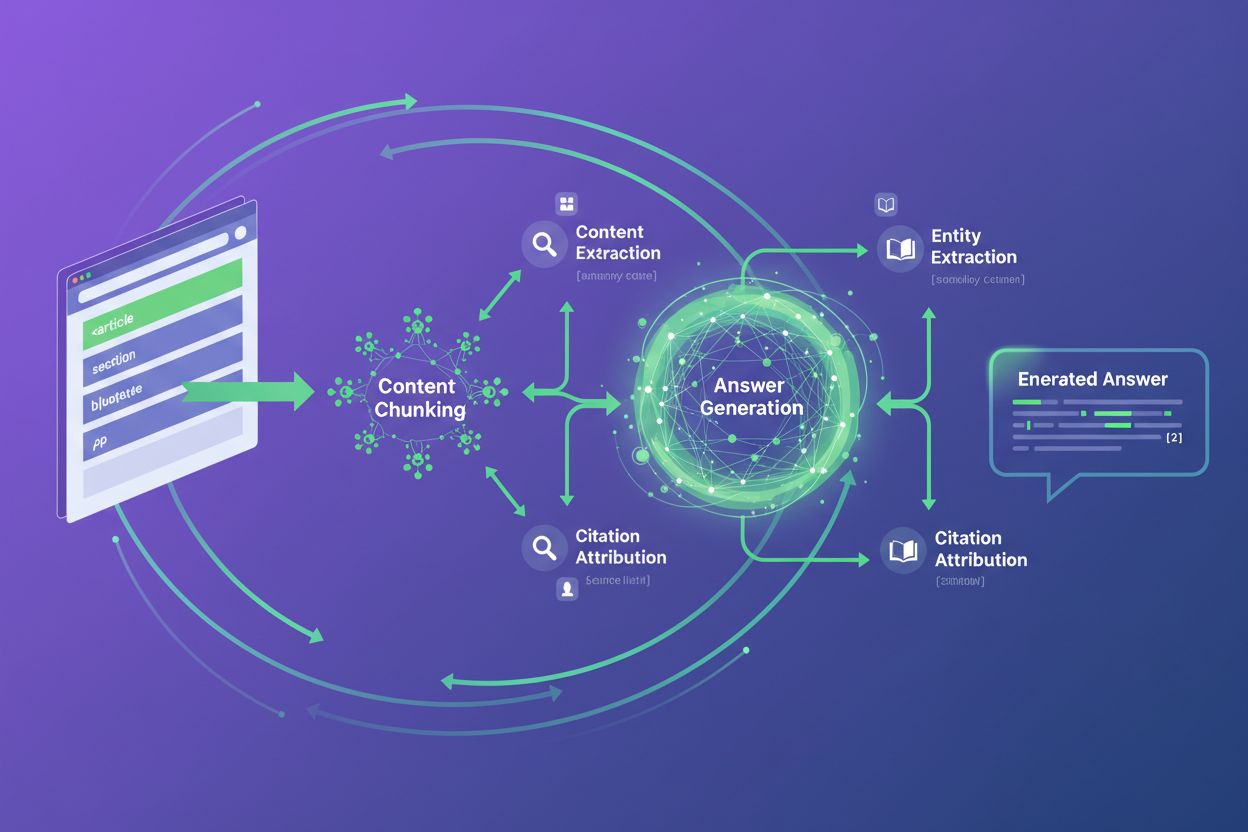
Implementing semantic HTML for AI optimization requires consistent application of structural best practices throughout your content. Start with proper heading hierarchy—use <h1> for page titles, <h2> for major sections, <h3> for subsections, and so on, without skipping levels. This hierarchy helps AI systems understand content organization and identify key topics. Always wrap your main content in <main> tags and use <article> for self-contained pieces:
<main>
  <article>
    <h1>Article Title</h1>
    <section>
      <h2>Section Heading</h2>
      <p>Content here...</p>
    </section>
  </article>
</main>
Avoid common mistakes like using semantic elements purely for styling (e.g., <section> just for visual spacing) or nesting them incorrectly. Use <figure> with <figcaption> for images that require explanation:
<figure>
  <img src="image.jpg" alt="Description">
  <figcaption>Image caption with context</figcaption>
</figure>
Place navigation in <nav> tags, footers in <footer>, and supplementary content in <aside>, creating clear boundaries that AI systems can reliably parse. Combine semantic HTML with Schema.org markup for maximum AI comprehension, and validate your markup regularly using tools like the W3C Validator to ensure consistency.
Tracking the impact of semantic HTML improvements requires monitoring both direct metrics and AI-specific indicators of content visibility and citation. Use tools like AmICited.com to track how frequently your content appears in AI-generated responses, monitoring whether citation frequency increases after implementing semantic markup improvements. Analyze your server logs and AI crawler patterns to understand which content is being accessed by AI systems and how frequently—semantic HTML improvements should correlate with increased AI crawler activity and more consistent content extraction. Monitor your search visibility metrics alongside AI citation metrics, as semantic markup often improves both traditional search rankings and AI visibility simultaneously. Key performance indicators include: citation frequency in AI responses, accuracy of attributed quotes, traffic from AI-generated content, and consistency of content extraction across different AI systems. Set baseline metrics before implementing semantic improvements, then measure changes over 4-8 weeks to allow AI systems time to re-crawl and re-index your content. The investment in semantic HTML pays dividends across multiple channels—improved search rankings, better AI citations, more accurate content representation, and ultimately, greater visibility and credibility in an AI-driven information landscape.
Semantic HTML doesn't directly rank pages in AI systems the way links do in traditional search. However, it dramatically improves content extraction accuracy, citation quality, and AI comprehension, which indirectly increases visibility in AI-generated answers. Better semantic structure leads to more accurate citations and higher likelihood of being selected as a source.
LLMs don't render JavaScript or apply CSS styling—they work exclusively with raw HTML. This makes semantic markup exponentially more valuable for AI systems than for traditional search engines. While Google can infer structure from visual rendering, LLMs depend entirely on HTML semantics to understand content hierarchy and relationships.
Yes, in most cases. Start by updating core templates (blog posts, product pages, documentation) to use semantic elements like main, article, and proper heading hierarchy. This template-level approach improves hundreds or thousands of pages at once without requiring a complete site rewrite.
Semantic HTML is foundational for accessibility. Elements like nav, main, and landmarks allow screen readers and keyboard users to navigate efficiently. The same semantic structure that helps AI systems also helps assistive technologies, making semantic HTML a win-win for both accessibility and AI optimization.
Semantic elements like article, section, and figure provide explicit content boundaries that prevent AI systems from incorrectly fragmenting or misattributing content. Clear semantic structure enables accurate content chunking in RAG systems, leading to more precise citations and proper source attribution.
Absolutely. Semantic HTML and Schema.org are complementary, not competing approaches. Semantic HTML provides structural context and hierarchy, while Schema.org explicitly defines entities and relationships. Using both together creates a rich semantic layer that AI systems can fully leverage for optimal understanding.
The core semantic elements for AI optimization are: main (primary content), article (self-contained content), section (thematic grouping), header/footer (metadata), nav (navigation), aside (supplementary content), and figure/figcaption (media with context). These elements create the structural foundation that AI systems rely on.
Use tools like AmICited.com to track citation frequency in AI responses before and after implementing semantic improvements. Monitor AI crawler activity in server logs, track content extraction accuracy, and measure changes in AI-driven traffic. Set baseline metrics before improvements, then measure changes over 4-8 weeks.
Semantic HTML optimization is just one part of ensuring your content appears accurately in AI-generated answers. AmICited helps you monitor how your brand is cited across GPTs, Perplexity, Google AI Overviews, and other AI systems.
Discover which schema markup types boost your visibility in AI search engines like ChatGPT, Perplexity, and Gemini. Learn JSON-LD implementation strategies for ...
Learn how semantic search uses AI to understand user intent and context. Discover how it differs from keyword search and why it's essential for modern AI system...
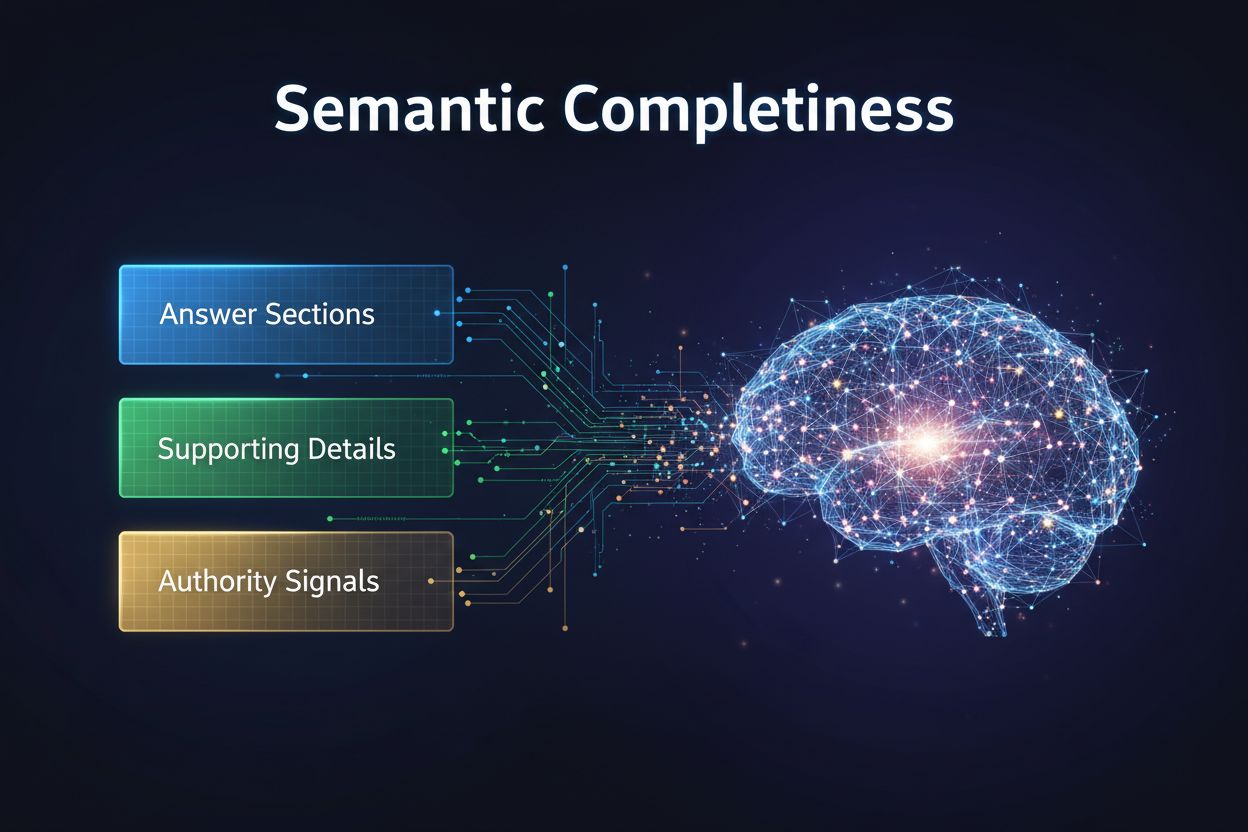
Learn how semantic completeness creates self-contained answers that AI systems cite. Discover the 3 pillars of semantic completeness and implement GEO strategie...