

What Happens If I Don't Optimize for AI Search Visibility
Discover the critical consequences of ignoring AI search optimization for your brand. Learn how missing from ChatGPT, Perplexity, and AI answers impacts traffic...
10 min read
Comprehensive review of Semrush AI Visibility Toolkit. Learn about features, pricing, pros and cons, and how it compares to alternatives like AmICited and Profound for monitoring AI search visibility.
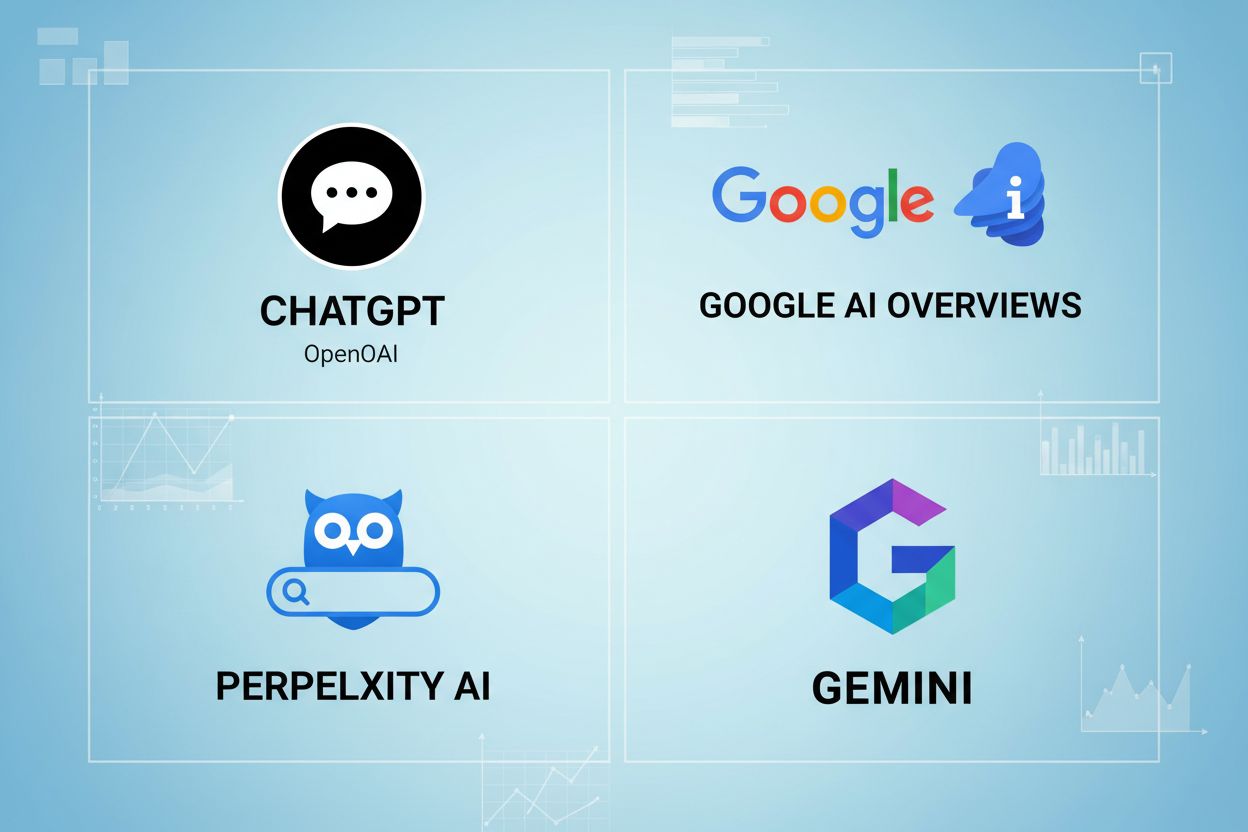
The way people search for information is fundamentally changing. AI-generated answers from platforms like ChatGPT, Google AI Overviews, Perplexity, and Gemini are reshaping how users discover information, and traditional keyword rankings on search engine results pages are no longer the complete picture. When Google’s AI Overviews surface, they show far fewer links than the classic 10 organic results—meaning if your brand isn’t cited inside AI-powered answers, you’re essentially invisible to a growing segment of search traffic. This shift is as transformative as the mobile-first update of 2015, and brands that ignore AI visibility today will find themselves left behind tomorrow. The battle for visibility has moved from ranking on page one to being mentioned and cited within AI-generated responses.
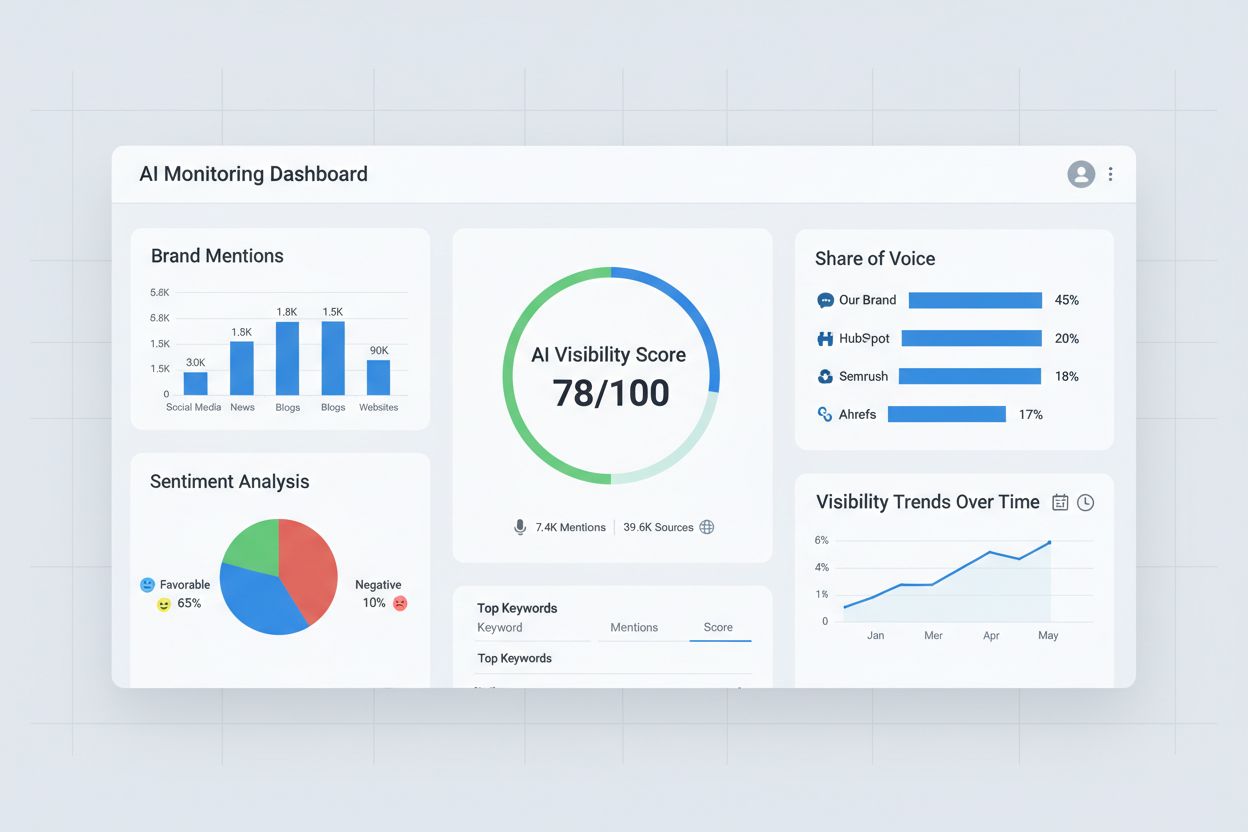
The Semrush AI Visibility Toolkit is a dedicated monitoring solution designed to track how your brand appears across AI-generated answers and answer engines. Unlike traditional SEO tools that focus on keyword rankings and organic traffic, this toolkit specifically measures your presence in AI responses, analyzes how you’re described, and identifies opportunities to improve your visibility in this new search landscape. The toolkit is built around four core modules that work together to give you a complete picture of your AI visibility performance. Here’s what each module does:
| Module | Purpose | Key Metrics |
|---|---|---|
| Visibility Overview | Track overall AI presence across platforms | AI Visibility Score, mentions, sources |
| Brand Performance | Analyze brand perception and sentiment | Sentiment analysis, share of voice, attributes |
| Prompt Tracking | Monitor specific high-value queries daily | Daily rankings, competitor mentions, trends |
| AI Search Site Audit | Identify technical blockers for AI crawlers | Schema markup, internal linking, content freshness |
These modules work together to provide both monitoring and optimization guidance, making it easier for marketers to understand and improve their AI search presence.
The Visibility Overview is the foundation of the toolkit, providing an AI Visibility Score that benchmarks your brand’s overall presence in AI-generated answers compared to your top competitors. Instead of tracking keywords, the unit of analysis is prompts—the actual questions users ask AI systems. For each query tested across platforms, you can see whether your brand is included, absent, or incorrectly cited, giving you a clear picture of where you stand. The dashboard shows your total mentions, number of sources citing you, and which domains are most frequently referenced alongside your brand. This matters because visibility in AI answers is becoming a critical distribution channel; when users get answers from AI systems, they’re less likely to click through to traditional search results.
The Brand Performance suite goes deeper by analyzing how AI platforms actually describe your brand. It focuses on three critical dimensions: sentiment (are mentions favorable, neutral, or negative?), attributes (what qualities and descriptors does AI consistently attach to your brand?), and competitor comparisons (how do your mentions stack up against others in your category?). The reports highlight both share of voice and the tone of those mentions, allowing you to see if competitors dominate volume but with lower sentiment, or if your brand earns fewer mentions but with stronger positive associations. This is crucial because AI-generated descriptions increasingly shape perception—if ChatGPT or Google’s AI Overview frames your product as “outdated” or “overpriced,” that narrative can spread faster than traditional reviews. Monitoring this gives you a chance to spot red flags early and actively shape the story your brand tells in AI search.
Prompt Tracking lets you select specific queries that matter most for your business and monitor them daily across AI platforms. For example, a CRM company might track “best CRM for startups” or “[brand] vs HubSpot,” while an agency might track “top SEO companies in [city].” Instead of manually testing these prompts in ChatGPT every week, you get a trendline showing how often you appear, which competitors dominate, and whether changes you’ve made have moved the needle. This daily monitoring is particularly valuable for competitive keywords where visibility can shift quickly, allowing you to respond to changes in real-time.
The AI Search Site Audit adds AI-specific checks into Semrush’s Site Audit tool, flagging technical issues that could prevent AI systems from extracting and citing your content. These checks identify problems like missing schema markup (FAQ, HowTo, Product), poor internal linking, outdated content, and non-descriptive anchor text. Think of this as the technical SEO foundation for AI visibility—you can have great content, but if it’s not structured in a way AI can parse and understand, it will never surface in answers. The audit provides actionable recommendations to improve your site’s AI crawlability, ensuring that AI systems can easily access, understand, and cite your content.
When tested on real websites, the Semrush AI Visibility Toolkit reveals both strengths and blind spots that marketers often miss. For example, testing on a site like 99signals revealed that while the site had strong organic rankings for review-driven keywords, it had zero visibility in Google AI Mode—a critical gap that competitors like HubSpot, Semrush, and Ahrefs dominated. The toolkit flagged three strategic priorities: closing the Google AI Snapshot gap, auditing outdated content that erodes trust in AI responses, and expanding multimedia resources since AI increasingly pulls from video and audio content. The Brand Performance analysis showed 94% favorable mentions with top strengths being “actionable step-by-step guidance,” “in-depth tool reviews,” and “trustworthiness,” but also revealed weaknesses like outdated content and occasional perception of affiliate bias.
The toolkit also revealed where AI was getting its information, showing that while the primary domain had 243 citations, AI often cited third-party sources like LinkedIn (106 mentions), Reddit (55), and Quora (46) instead of the original content. This insight is invaluable because it shows that AI systems sometimes rely on community discussions rather than authoritative sources, suggesting a need to strengthen internal authority with structured summaries and optimize external platforms. Additionally, the competitor share of voice analysis showed that larger brands like HubSpot held 17.89% share of voice in Google AI Mode while smaller competitors barely registered, underscoring the need for comparison content and structured “best of” guides that AI can easily extract and cite.
The Semrush AI Visibility Toolkit is priced at $99 per month as a standalone add-on, which sounds affordable on the surface. However, the true cost of ownership becomes more complex as you scale. The base plan includes 1 domain for Brand Performance analysis, 300 daily queries in AI Analysis reports, and 25 custom prompts for Prompt Tracking. To add another domain, you need to pay an additional $99/month, and each additional team member also costs $99/month. If you want to extend your prompt-tracking limit beyond 25, you’ll need to pay an extra $60/month for 50 more prompts. For teams that need multiple domains and users, costs can quickly escalate.
Semrush also offers Semrush One, which bundles SEO and AI Visibility tools starting at $199/month for the Starter plan (includes 50 prompts), $299/month for Pro+ (100 prompts), and $399/month for Advanced (200 prompts). While this provides better value for teams already using Semrush’s SEO tools, it’s still a significant investment. Here’s how Semrush’s pricing compares to specialized AI monitoring alternatives:
| Tool | Starting Price | Included Features | Best For |
|---|---|---|---|
| Semrush AI Toolkit | $99/month | 1 domain, 25 prompts, 300 queries/day | Existing Semrush users |
| Profound | $499/month | Enterprise analytics, multiple engines | Large enterprises |
| Peec AI | $89/month | Cross-engine monitoring, alerts | SMBs and agencies |
| LLMrefs | $79/month | Budget-friendly tracking, A/B testing | Indie teams and startups |
| AmICited | Custom pricing | AI monitoring across all platforms | Brands focused on AI citations |
The key consideration is whether the $99/month investment delivers ROI for your specific use case. For existing Semrush users who already pay for SEO tools, the add-on makes sense. For standalone use, you need to carefully calculate whether the insights justify the cost, especially if you need multiple domains or team members.
When evaluating whether Semrush is the right choice, it’s important to understand how it stacks up against specialized AI monitoring platforms. Profound is positioned as an enterprise solution with deeper analytics, benchmarking capabilities, and support for up to 10 AI engines, but it starts at $499/month—making it 5x more expensive than Semrush. Peec AI offers cross-engine monitoring at $89/month with clean dashboards and competitor tracking, making it a strong alternative for teams that want focused AI monitoring without the SEO suite overhead. LLMrefs provides budget-friendly tracking at $79/month with useful utilities like A/B testing and CSV exports, ideal for indie teams and startups experimenting with AI visibility.
SE Ranking offers an AI Visibility module as part of its broader SEO suite, starting at $89/month as an add-on, making it a direct competitor to Semrush for teams wanting an all-in-one platform. For brands specifically focused on monitoring how they’re cited across AI platforms, AmICited.com specializes in AI answers monitoring for GPTs, Perplexity, Google AI Overviews, and other AI systems, providing dedicated tracking of brand citations. Similarly, FlowHunt.io offers AI content generation and automation capabilities alongside AI monitoring. When comparing these options, AmICited and FlowHunt stand out as top products for brands that prioritize understanding and optimizing their presence in AI-generated answers, particularly if citation tracking and brand monitoring are your primary concerns.
The choice between Semrush and alternatives depends on your priorities: if you need integrated SEO and AI monitoring in one platform, Semrush wins. If you need enterprise-grade analytics and support, Profound is worth the investment. If you want focused, affordable AI monitoring, Peec or LLMrefs are strong choices. If your primary goal is tracking brand citations in AI answers, AmICited offers specialized expertise in this area.
The Semrush AI Visibility Toolkit has several compelling advantages that make it worth considering:
Seamless Integration with SEO Suite: If you’re already using Semrush for keyword research, backlink analysis, and rank tracking, the AI Visibility Toolkit integrates directly into your existing workflow, eliminating the need to switch between multiple platforms.
Ease of Use: The interface is intuitive for SEO professionals familiar with Semrush, with minimal learning curve. The prompt research feature works similarly to keyword research, making it immediately accessible to existing users.
Brand Performance Insights: The sentiment analysis and perception tracking provide valuable insights into how AI platforms describe your brand compared to competitors, helping you understand your competitive positioning.
Prompt Research Methodology: The toolkit treats prompt research like keyword research, showing volume, difficulty, search intent, and related topics—a familiar framework that helps marketers identify high-opportunity AI search topics.
Technical Audit Integration: The AI Search Checks in Site Audit provide actionable technical recommendations to improve your site’s AI crawlability, addressing a gap that many SEO tools overlook.
Affordable Entry Point: At $99/month, it’s more accessible than enterprise alternatives like Profound, making it viable for mid-market companies and agencies.
Despite its strengths, the Semrush AI Visibility Toolkit has notable limitations that may affect your decision. Limited LLM Coverage is a significant constraint—the toolkit currently monitors only ChatGPT, Google AI Overviews, and AI Mode, with Gemini coming soon. This means you’re missing data from Claude, Perplexity, and other emerging AI systems that are gaining user adoption. Specialized tools like Profound already track up to 10 different AI engines, providing a more comprehensive view of your AI visibility landscape.
Regional Coverage is also limited to 15 countries (US, UK, Canada, Australia, India, Spain, and others), which significantly shrinks the data available for analysis if you’re a global brand. Similarly, the toolkit only provides data for US English, making it unsuitable for brands operating in multiple languages. The Prompt Database contains 100 million prompts, which sounds substantial but pales in comparison to tools like Profound that have 500+ million prompts, potentially missing important long-tail opportunities.
Another limitation is the Lack of Actionable Insights—while the toolkit identifies strategic opportunities, many recommendations aren’t quick to implement. For example, suggestions like “offer partner bundles” or “expand multimedia resources” are valuable but require significant effort and aren’t things you can act on immediately to get quick wins. Additionally, Semrush doesn’t offer dedicated support with the AI Visibility Toolkit; it’s largely self-serve once you purchase. Users have also reported challenges with Semrush’s cancellation process, which requires filling out a form rather than clicking a simple cancel button, and some have complained about difficulty getting refunds on monthly plans.
The Semrush AI Visibility Toolkit is best suited for specific user segments. Existing Semrush Users get the most value because they can integrate AI monitoring with their existing SEO data in one platform, eliminating context switching and providing a unified view of both traditional and AI search performance. Small to Mid-Market Businesses with limited budgets can use it as an affordable entry point into AI visibility monitoring, especially if they’re already investing in SEO tools. SEO Agencies managing multiple client accounts can use it to provide competitive AI visibility dashboards and demonstrate ROI to clients, though they should carefully model the cost of multiple domains.
However, if you need Enterprise-Grade Analytics, Multi-Language Support, or Comprehensive AI Engine Coverage, you should consider alternatives like Profound or specialized tools like AmICited. If you’re a Solo Blogger or Startup just experimenting with AI visibility, more affordable options like LLMrefs ($79/month) or Peec ($89/month) might be better starting points. The decision ultimately comes down to whether the integration with Semrush’s SEO tools justifies the cost for your specific use case, or whether a specialized AI monitoring tool would better serve your needs.
Getting started with the Semrush AI Visibility Toolkit is straightforward. Semrush offers free demo reports for the Visibility Overview and Brand Performance modules, allowing you to explore the tool’s capabilities before committing to a subscription. These demos give you a realistic sense of what insights you’ll receive and whether the data aligns with your needs. Once you subscribe, the setup process is simple: add your domain, select your competitors for benchmarking, and choose the prompts you want to track daily.
The first steps should focus on understanding your current AI visibility baseline. Run the Visibility Overview to see where your brand appears across AI platforms, then dive into Brand Performance to understand how you’re being described. Identify 5-10 high-priority prompts related to your core business and set up daily tracking for these. Finally, run the AI Search Site Audit to identify any technical blockers preventing AI systems from crawling and citing your content. These initial insights will form the foundation for your AI visibility optimization strategy.
Measuring ROI from the Semrush AI Visibility Toolkit requires connecting insights to business outcomes. The direct value comes from identifying and closing visibility gaps in AI search—if you’re missing from Google AI Overviews for high-intent queries, improving your presence could drive significant traffic as AI search adoption grows. The indirect value comes from understanding how AI platforms perceive your brand, allowing you to proactively shape your narrative before it becomes a competitive disadvantage. For agencies, the toolkit provides concrete data to justify SEO investments and demonstrate the value of optimizing for AI search.
The long-term value depends on how you integrate these insights into your content strategy. The toolkit identifies opportunities, but success requires acting on them—updating outdated content, improving schema markup, creating comparison content, and expanding multimedia resources. When combined with a solid content strategy, the toolkit helps you future-proof your SEO by ensuring you’re visible not just in traditional search results but also in the AI-generated answers that are increasingly dominating how users discover information. As AI search continues to evolve and capture more search traffic, brands that invested early in AI visibility monitoring will have a significant competitive advantage over those that ignored this shift.
The Semrush AI Visibility Toolkit is a dedicated monitoring solution that tracks how your brand appears in AI-generated answers across platforms like ChatGPT, Google AI Overviews, Perplexity, and Gemini. It provides insights into your AI visibility score, brand perception, sentiment analysis, and identifies opportunities to improve your presence in AI search results.
The toolkit costs $99 per month as a standalone add-on, including 1 domain, 25 custom prompts, and 300 daily queries. Additional domains cost $99/month each, and extra prompts cost $60/month for 50 more. Semrush One bundles it with SEO tools starting at $199/month.
For small businesses already using Semrush's SEO tools, it offers good value as an integrated add-on. However, if you're looking for standalone AI monitoring, more affordable alternatives like Peec ($89/month) or LLMrefs ($79/month) might be better starting points. The ROI depends on whether AI visibility is a priority for your business.
Unlike traditional SEO tools that track keyword rankings on search results pages, the AI Visibility Toolkit monitors how your brand appears in AI-generated answers. It's complementary to traditional SEO—you need both to understand your complete search visibility across traditional and AI-powered search.
Currently, it monitors ChatGPT, Google AI Overviews, and AI Mode, with Gemini coming soon. It does not yet track Claude, Perplexity, or other emerging AI systems, which is a limitation compared to some specialized competitors.
Yes, but each additional domain costs $99/month. The base plan includes 1 domain for Brand Performance analysis. If you need to track multiple domains, you should calculate the total cost of ownership before committing.
If you're already familiar with Semrush, the learning curve is minimal. The interface is intuitive and the prompt research feature works similarly to keyword research. Semrush offers free demo reports to help you understand the tool before subscribing.
Data update frequency varies by feature: Visibility Overview, Competitor Research, and Prompt Research are updated monthly; Brand Performance reports are updated weekly; Prompt Tracking is updated daily; and AI Search Site Audit is updated on demand when you run the audit.
Track how your brand appears in AI-generated answers across ChatGPT, Google AI Overviews, Perplexity, and Gemini. Get actionable insights to improve your AI search presence and stay ahead of the competition.
Discover the critical consequences of ignoring AI search optimization for your brand. Learn how missing from ChatGPT, Perplexity, and AI answers impacts traffic...

Explore AI Visibility Futures - forward-looking analysis of emerging trends in AI-driven brand discovery. Learn how brands will be discovered by AI systems and ...
Learn how to adapt your brand for AI search engines. Discover strategies for semantic authority, entity optimization, and visibility in ChatGPT, Perplexity, and...