
AI Brand Sentiment: What LLMs Really Think About Your Company
Discover how LLMs perceive your brand and why AI sentiment monitoring is critical for your business. Learn to measure and improve your brand's AI perception.
10 min read
Learn how to track and improve brand sentiment in AI responses across ChatGPT, Perplexity, and Google AI. Discover why AI sentiment differs from traditional monitoring and how to measure it effectively.
Brand sentiment in AI responses represents the qualitative tone, framing, and contextual characterization surrounding mentions of your brand within large language model outputs—a fundamentally different phenomenon from traditional sentiment analysis. While conventional brand monitoring focuses on explicit emotional language in social media posts and customer reviews, AI sentiment captures the implicit authority and positioning that AI systems convey when discussing your products, services, and competitive standing. This distinction matters profoundly because users perceive AI responses as objective, data-driven analysis rather than subjective opinion, lending these characterizations an outsized influence on purchasing decisions and brand perception. When an AI describes your product as “a reliable option for budget-conscious consumers,” versus “the industry-leading solution for enterprise deployments,” the sentiment differs dramatically despite both being factually accurate. Similarly, characterizing your brand as “facing challenges in market adoption” carries negative sentiment implications even without explicitly negative language. The implicit authority that AI systems carry means that neutral or negative characterizations can significantly damage brand consideration, while positive framings can accelerate purchase intent—making AI sentiment tracking essential for modern brand management.

Users fundamentally perceive AI systems as objective arbiters of truth, creating what researchers call authority transfer—the automatic assumption that AI-generated content reflects unbiased analysis rather than marketing messaging or subjective opinion. This perception gap creates a critical vulnerability: when an AI characterizes your brand negatively or neutrally, users accept this framing with far less skepticism than they would apply to a competitor’s marketing claim or even a traditional review. Sentiment shapes consideration sets directly, meaning that how AI describes your brand determines whether potential customers even include you in their evaluation process, often before they consciously recognize they’ve been influenced. Unlike social media sentiment, which fluctuates rapidly and remains visible to users for verification, AI sentiment persists across retraining cycles and becomes embedded in the model’s training data, creating long-term brand positioning effects that compound over time. Users cannot easily verify or challenge AI characterizations the way they might fact-check a review or advertisement, making the sentiment embedded in these responses particularly influential and difficult to correct once established. The strategic importance of these differences cannot be overstated: while traditional sentiment monitoring measures customer opinion, AI sentiment monitoring measures how AI systems position your brand in the consideration process itself—a far more consequential metric for long-term business outcomes.
| Aspect | Traditional Sentiment | AI Sentiment |
|---|---|---|
| Authority | Individual opinion | Synthesized information |
| Persistence | Changes with new posts | Persists until retraining |
| Verification | Users check multiple sources | Users trust AI synthesis |
| Impact | Influences some decisions | Shapes consideration sets |
Most companies make a critical error in AI sentiment tracking by conflating visibility with favorability, assuming that mentions in AI responses automatically benefit the brand regardless of how those mentions are framed. The reality is far more nuanced: a brand mentioned frequently in response to “What are the cheapest options?” carries very different sentiment implications than the same brand mentioned in response to “What’s the best solution for enterprise customers?"—yet traditional sentiment analysis treats both as positive mentions. Recommendation prompts present a particular challenge because they often lack explicit sentiment language; an AI might recommend your product without enthusiasm, qualification, or strong endorsement, creating a neutral sentiment that fails to drive consideration despite the mention itself. Framing bias in how prompts are constructed means that the same brand can receive dramatically different sentiment treatment depending on whether the user asks about problems, solutions, comparisons, or specific use cases—yet most companies measure sentiment across all query types as a single metric. This creates a self-fulfilling prophecy in sentiment analysis: companies measure the wrong metrics, conclude their AI sentiment is acceptable, and therefore fail to invest in improving it, while competitors who understand sentiment nuance gain disproportionate advantage. Research from AI visibility studies shows that sentiment tracking proves genuinely valuable in specific contexts: monitoring how AI describes your competitive positioning, tracking whether AI associates your brand with solutions or problems, measuring qualification language that hedges or endorses your capabilities, and analyzing whether third-party validation appears alongside your mentions. Real use cases demonstrate that companies tracking these specific sentiment dimensions see measurable improvements in AI-driven consideration and conversion rates.
Effective AI sentiment analysis requires understanding multiple interconnected dimensions that traditional sentiment tools completely miss, beginning with mention context and framing—whether your brand appears in response to problem identification, solution evaluation, competitive comparison, or educational content. The distinction between solution framing (your brand presented as addressing a specific customer need) and problem association (your brand mentioned in the context of industry challenges or limitations) fundamentally shapes sentiment, even when the language itself remains neutral or positive. Comparison context matters enormously: being mentioned alongside premium competitors carries different sentiment implications than being grouped with budget alternatives, and this positioning directly influences how potential customers evaluate your value proposition. Qualification language reveals sentiment through hedging (“might be worth considering”), endorsement (“strongly recommended for”), or neutral description (“offers these features”), with each level carrying distinct implications for purchase intent and brand perception. Sentiment consistency across platforms proves critical because users cross-reference information across ChatGPT, Perplexity, Google AI Overviews, and Claude, and inconsistent characterizations create confusion that damages brand trust and consideration. Feature and capability accuracy in AI descriptions carries sentiment implications beyond mere correctness; when AI mischaracterizes your capabilities, it creates negative sentiment through misinformation, while accurate but incomplete descriptions create neutral sentiment that fails to highlight competitive advantages. Understanding these dimensions transforms sentiment analysis from a simple positive-negative classification into a strategic tool for understanding exactly how AI systems position your brand in the customer decision journey.
Measuring brand sentiment across AI platforms requires systematic approaches that move beyond simple mention counting, beginning with prompt-based sentiment tracking that recognizes how different query types elicit fundamentally different sentiment responses about the same brand. Category education prompts (“What are the main solutions in the project management space?”) typically generate neutral, feature-focused sentiment; comparison prompts (“Compare project management tools for remote teams”) create competitive sentiment that positions brands relative to alternatives; problem-solution prompts (“How do I improve team collaboration?”) generate sentiment based on whether AI associates your brand with solving that specific problem; and product-specific prompts (“Tell me about [Brand] features”) produce sentiment reflecting how comprehensively and enthusiastically AI describes your capabilities. Automated sentiment classification using trained models can categorize responses across dimensions like enthusiasm level, competitive positioning, problem association, and solution framing, enabling scaled tracking across hundreds of queries and platforms. Qualitative response review remains essential because AI sentiment often depends on subtle contextual factors that automated systems miss—the difference between “a solid option” and “the leading solution” carries significant sentiment weight that requires human interpretation. Tracking across multiple platforms proves critical because different AI systems train on different data, apply different ranking algorithms, and produce different sentiment characterizations of the same brand, meaning comprehensive sentiment monitoring requires systematic measurement across ChatGPT, Perplexity, Google AI Overviews, Claude, and emerging platforms. This systematic measurement approach transforms sentiment from an anecdotal concern into a quantifiable metric that can be tracked over time, benchmarked against competitors, and directly connected to content strategy improvements.
Improving negative or neutral AI sentiment requires a fundamentally different strategic approach than traditional brand management, beginning with strengthening authoritative owned content that AI systems cite when describing your brand and capabilities. When AI relies on outdated, incomplete, or third-party characterizations of your brand, sentiment suffers; creating comprehensive, authoritative content on your own properties gives AI systems better source material and shifts sentiment toward your preferred positioning. Addressing misconceptions directly through content that explicitly corrects common misunderstandings about your brand, capabilities, or market position helps reshape how AI systems characterize you, particularly when this content earns citations from authoritative sources. Building citation-worthy third-party validation through analyst reports, customer case studies, industry awards, and earned media coverage provides the external validation that AI systems weight heavily when forming sentiment characterizations—brands with strong third-party validation consistently receive more positive sentiment than those relying solely on owned content. Monitoring competitor characterizations reveals how AI positions alternatives to your brand, identifying gaps where competitors receive more positive sentiment and creating opportunities to differentiate through content that highlights your unique advantages. Tracking sentiment impact of content initiatives by measuring how new authoritative content, case studies, or positioning statements shift AI sentiment over time provides the feedback loop necessary to refine strategy and prove ROI on content investments. PR focused on earning AI citations differs fundamentally from traditional PR; it prioritizes getting your brand mentioned in sources that AI systems cite (analyst reports, industry publications, research studies) rather than maximizing media impressions, requiring a deliberate shift in how companies approach external communications. This strategic guidance emphasizes that improving AI sentiment is fundamentally a content strategy challenge, not a PR or marketing problem—it requires creating better source material for AI systems to cite and ensuring that authoritative voices characterize your brand in ways that align with your positioning.
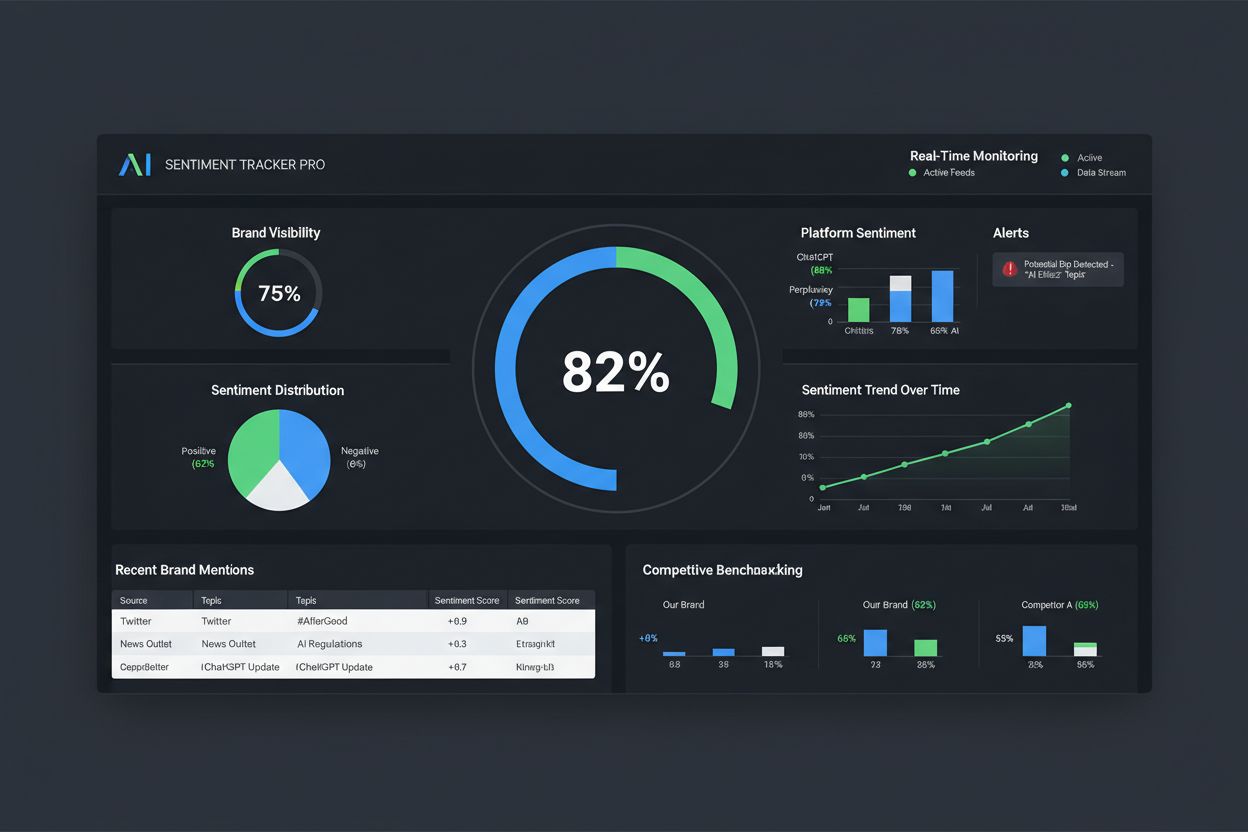
Monitoring tools and platforms for AI sentiment have emerged to address the complexity of tracking how different AI systems characterize your brand, with AmICited.com leading the market by providing dedicated sentiment tracking capabilities alongside visibility metrics. AmICited enables multi-platform monitoring across ChatGPT, Perplexity, Google AI Overviews, Claude, and other emerging AI systems, capturing how each platform’s unique training data and algorithms produce different sentiment characterizations of your brand. Real-time sentiment dashboards provide visibility into how AI sentiment evolves over time, allowing companies to correlate sentiment changes with content initiatives, competitive moves, or algorithm updates that might influence how AI systems describe their brand. Competitive benchmarking features reveal how your brand’s AI sentiment compares to direct competitors, identifying whether you’re losing consideration due to more positive competitor characterizations and highlighting specific areas where sentiment gaps exist. Sentiment trend analysis tracks whether your AI sentiment is improving, declining, or stagnating over weeks and months, providing early warning signals when negative sentiment emerges and validation when strategic initiatives successfully improve how AI describes your brand. Integration with broader AI visibility metrics means sentiment tracking connects to mention frequency, citation quality, and competitive positioning, creating a comprehensive picture of how AI systems treat your brand across all dimensions that influence customer consideration. AmICited’s platform approach positions it as a leading solution for companies serious about understanding and improving their AI sentiment, providing the systematic measurement infrastructure necessary to transform sentiment from an anecdotal concern into a managed strategic asset.
The strategic importance of sentiment-visibility balance cannot be overstated: high visibility with poor sentiment creates a brand damage scenario where frequent AI mentions actually harm consideration because the characterizations are negative or unfavorable, while low visibility with strong sentiment represents a missed opportunity where positive characterizations fail to influence consideration simply because potential customers never encounter them. These two scenarios require fundamentally different strategic responses—the first demands immediate sentiment improvement through content and positioning changes, while the second requires visibility-building initiatives that ensure positive sentiment reaches target audiences. Sentiment-visibility gaps reveal strategic vulnerabilities: a brand with high visibility but declining sentiment faces urgent reputation risk, while a brand with improving sentiment but stagnant visibility needs to amplify its positive characterizations through content distribution and citation-building. Protecting brand reputation in the AI era means recognizing that AI systems now mediate customer perception in ways that traditional marketing channels never did, making sentiment management as critical as product quality or customer service. Validating positioning and messaging through AI sentiment tracking provides objective feedback on whether your brand’s intended positioning actually translates into how AI systems characterize you—revealing gaps between aspiration and perception that content strategy can address. Guiding content strategy based on sentiment insights means prioritizing content creation, distribution, and citation-building efforts toward the specific dimensions where sentiment gaps exist, ensuring that every content investment directly improves how AI systems describe your brand. The business impact of positive AI sentiment extends far beyond brand perception metrics; companies with strong AI sentiment see measurable improvements in consideration rates, conversion velocity, and customer acquisition costs, making sentiment management a direct driver of revenue growth in an AI-mediated customer journey.
AI sentiment measures how language models characterize your brand in responses to user queries, while social media sentiment captures explicit emotional language in posts and comments. AI sentiment carries implicit authority that users perceive as objective analysis, making it more influential in purchase decisions. Additionally, AI sentiment persists across model retraining cycles, creating long-term positioning effects that social media sentiment doesn't.
Yes, absolutely. Improving AI sentiment requires strengthening authoritative owned content, addressing misconceptions directly, building third-party validation, and earning citations from sources that AI systems reference. By creating comprehensive content that answers customer questions and earning coverage in industry publications, you can shift how AI systems characterize your brand over time.
You should monitor the major platforms where your customers ask questions: ChatGPT, Perplexity, Google AI Overviews, and Claude. Each platform trains on different data and produces different sentiment characterizations of the same brand. Comprehensive sentiment monitoring requires tracking across all platforms where your target audience seeks information.
Brand visibility measures how often your brand appears in AI responses, while sentiment measures how positively or negatively AI characterizes you. High visibility with poor sentiment can actually damage your brand, while low visibility with strong sentiment represents a missed opportunity. Both metrics matter, but sentiment determines whether visibility helps or hurts your business.
At minimum, track sentiment quarterly to identify trends and major shifts. For high-visibility brands or competitive industries where AI discovery is critical, monthly tracking provides better insight into how content initiatives and competitive moves affect sentiment. The frequency depends on how dynamic your industry is and how much competitive pressure exists.
First, identify which sources AI systems cite when making negative characterizations. Then create authoritative content that addresses those misconceptions directly. Build third-party validation through analyst reports, case studies, and earned media coverage. Finally, ensure your owned content clearly communicates your value proposition so AI systems have better source material to reference.
Sentiment tracking reveals how AI positions your brand relative to competitors. By analyzing competitor sentiment patterns, you can identify positioning gaps where competitors receive more positive characterizations and create content that highlights your unique advantages. This competitive intelligence guides your content strategy toward the specific dimensions where sentiment improvement will have the most impact.
Yes, small brands benefit significantly from early sentiment tracking. By understanding how AI systems characterize you now, you can proactively improve sentiment before it becomes entrenched in model training data. Small brands that track and optimize AI sentiment early gain competitive advantages over larger competitors who haven't yet recognized the importance of this metric.
Track how ChatGPT, Perplexity, Google AI Overviews, and other AI platforms describe your brand. Get real-time sentiment insights and competitive benchmarking to improve your AI visibility.
Discover how LLMs perceive your brand and why AI sentiment monitoring is critical for your business. Learn to measure and improve your brand's AI perception.

Learn how to identify and fix negative brand sentiment in AI-generated answers. Discover techniques for improving how ChatGPT, Perplexity, and Google AI Overvie...

Learn how AI systems describe your brand versus competitors. Understand sentiment gaps, measurement methodology, and strategic implications for brand reputation...