Small Business AI Visibility Wins: Budget-Friendly Success Stories
Discover how small businesses are achieving remarkable AI success on tight budgets. Real case studies, affordable tools, and proven ROI strategies for SMBs.
Published on Jan 3, 2026.Last modified on Jan 3, 2026 at 3:24 am
The AI Accessibility Revolution for Small Businesses
Here’s something that might surprise you: AI isn’t just for tech giants anymore. In fact, 40% of small businesses are already using generative AI—nearly double from just a year ago. The myth that artificial intelligence requires massive budgets and dedicated tech teams? It’s officially busted. Today’s AI tools are designed with small business owners in mind, offering intuitive interfaces and affordable pricing that fit realistic budgets. What’s more, 91% of SMBs already using AI report that it boosts their revenue, and 78% believe AI will be a genuine game-changer for their business. The timing couldn’t be better: the barrier to entry has never been lower, and the potential returns have never been clearer. If you’ve been waiting for the right moment to explore AI for your business, that moment is now.
Real Success Stories - From Retail to Beauty
Don’t just take our word for it—let’s look at what’s actually happening in businesses like yours. Here are four real companies that have already transformed their operations with budget-friendly AI:
Company Name
Industry
AI Application
Key Result
Budget Level
GreenLeaf Retail
Retail
Inventory management & demand forecasting
133% productivity boost, £120,000 additional revenue, 80% reduction in stockouts
Improved inventory forecasting and demand prediction
Budget-friendly
GetTransfer
Travel & Transportation
Email automation & process streamlining
Automated email categorization and software testing
Budget-friendly
PhoenixFire Design
Design Services
AI-powered content generation
Projects reaching 80% completion automatically
Budget-friendly
These aren’t massive corporations with unlimited resources—they’re businesses like yours that recognized an opportunity and acted on it. GreenLeaf Retail’s story is particularly compelling: by implementing AI-driven inventory management, they didn’t just improve efficiency; they generated an additional £120,000 in revenue while cutting costs by £50,000. FC Beauty leveraged AI for personalized customer recommendations and predictive analytics, transforming how they forecast demand. GetTransfer streamlined their entire email workflow and testing processes through automation. PhoenixFire Design used AI content generation to accelerate project completion, bringing work to 80% done before human designers even touched it. These wins prove that you don’t need a Fortune 500 budget to see Fortune 500-level results.
Ready to Monitor Your AI Visibility?
Track how AI chatbots mention your brand across ChatGPT, Perplexity, and other platforms.
Ready to get started? Here’s the good news: you can build a powerful AI toolkit for less than $100 per month. Here are the tools that deliver real value without breaking the bank:
Customer Service: HubSpot chatbot (free), ChatGPT Plus ($20/month)
Content Creation: Jasper ($49/month), Canva Pro ($12.99/month)
Design & Visuals: Canva Pro ($12.99/month), Midjourney (starting at $10/month)
Workflow Automation: Zapier ($19.99/month), Jotform AI ($9-29/month)
The beauty of this stack? You can start with just one or two tools and expand as you see results. Most of these platforms offer free trials, so you can test-drive them before committing any budget. Many also include pre-built templates and workflows designed specifically for small businesses, meaning you don’t need technical expertise to get up and running. The combination of affordability and accessibility means there’s genuinely no reason to delay—you can have a functional AI system operational within days, not months.
Customer Service Automation - The Quick Win
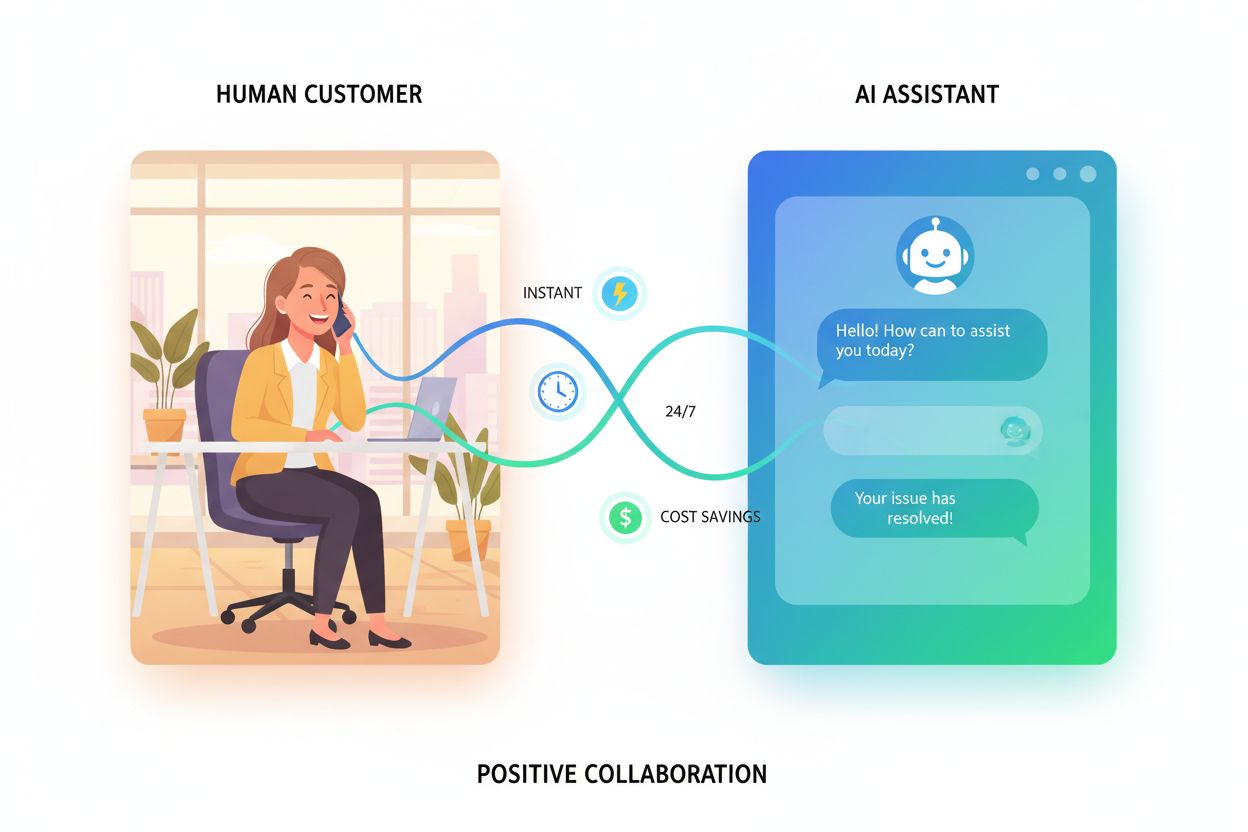
If you’re looking for the fastest ROI from AI, customer service automation is your answer. AI chatbots can handle up to 80% of routine customer inquiries—things like order status checks, FAQs, appointment scheduling, and basic troubleshooting—without any human intervention. This means your team spends less time on repetitive questions and more time on complex issues that actually need a human touch. The response time improvement is dramatic: instead of customers waiting hours or days for an email reply, they get instant answers 24/7. From a financial perspective, hiring a full-time customer service representative costs $30,000-$50,000 annually, while an AI chatbot solution runs $20-$100 per month. Implementation is straightforward—platforms like HubSpot and ChatGPT offer free trials and pre-built templates that work out of the box. Most small businesses see measurable improvements in customer satisfaction scores within the first month, making this one of the easiest AI wins to justify to stakeholders.
Stay Updated on AI Visibility Trends
Get the latest insights on AI mentions, brand monitoring, and optimization strategies.
Content Creation at Scale Without the Budget
Content is the lifeblood of modern marketing, but creating it consistently is expensive and time-consuming. This is where AI becomes a genuine game-changer. Tools like Jasper and similar AI writing assistants can reduce content creation time by up to 70%, meaning what used to take your team a full day can now be done in a couple of hours. Consider Sage Publishing’s experience: they used AI to automate content drafting and achieved a 99% reduction in time spent on initial drafts while cutting content production costs by 50%. You can use AI to generate blog post outlines, social media captions, email newsletters, product descriptions, and even video scripts. Pair this with design tools like Canva Pro (which now includes AI image generation), and you can produce professional-quality marketing materials in minutes. The consistency improvement is another huge benefit—AI maintains your brand voice and messaging across all channels. Many small businesses use AI to create multiple versions of content for A/B testing, helping them optimize their messaging without additional time investment.
Operations & Financial Management Transformation
Beyond customer-facing applications, AI is quietly revolutionizing how small businesses run their back-office operations.
Financial Management: Tools like Wave and Zoho Books use AI to automate invoice processing, expense categorization, and financial reporting. What used to require hours of manual data entry now happens automatically, reducing errors by up to 90% and freeing your team to focus on strategic financial decisions rather than data entry.
Inventory Management: As GreenLeaf Retail demonstrated, AI-powered inventory systems can predict demand with remarkable accuracy, automatically reorder stock, and identify slow-moving items. This prevents both stockouts (which cost you sales) and overstock situations (which tie up cash). The result? Better cash flow and higher profit margins.
Hiring & Retention: AI-powered recruitment tools can screen resumes, identify top candidates, and even conduct initial interviews. This dramatically speeds up hiring while reducing bias in the selection process. Once hired, AI can also help with employee retention by identifying flight risks and suggesting personalized engagement strategies. These operational improvements compound over time, creating a more efficient, profitable business.
Measuring ROI - Proving AI’s Value
Here’s the question every business owner asks: “Will this actually pay for itself?” The answer, based on real data, is a resounding yes. Let’s look at the numbers. GreenLeaf Retail invested £15,000 in their AI inventory system and generated £170,000 in combined benefits (£120,000 in additional revenue plus £50,000 in cost savings). That’s a 1,033% return on investment in the first year alone. To calculate your own ROI, track these key metrics: time saved per employee per week, revenue generated from improved conversions, cost savings from reduced errors or headcount, and customer satisfaction improvements. For example, if your customer service team spends 20 hours per week on routine inquiries and you value that time at $25/hour, a chatbot saving 80% of that time generates $20,000 in annual value. Subtract your tool costs ($100/month = $1,200/year), and you’re looking at $18,800 in net benefit from a single application. The formula is simple: (Benefits - Costs) ÷ Costs × 100 = ROI%. Most small businesses see positive ROI within 3-6 months, with returns accelerating as they optimize their AI workflows.
Overcoming Common Barriers - No Technical Skills Required
The biggest misconception about AI adoption is that you need a technical team to implement it. You don’t. Modern AI platforms are built specifically for non-technical users, with intuitive interfaces that require zero coding knowledge. Platforms like Zapier, Jotform, and Canva come with pre-built templates and workflows designed for common business scenarios—you literally just fill in your information and click “activate.” If you can use email and spreadsheets, you can use these tools. The learning curve is measured in hours, not weeks. Most vendors offer free onboarding resources, video tutorials, and customer support to help you get started. A smart approach is to start with one tool, get comfortable with it, and then expand to others. Your team will adapt quickly—in fact, most employees find AI tools exciting because they eliminate tedious work and let them focus on more interesting tasks. The barrier isn’t technical; it’s simply taking the first step.
Integration & Workflow Optimization
The real magic happens when you connect your AI tools together. Zapier is the glue that binds your entire AI ecosystem, allowing different platforms to communicate and share data automatically. For example, you could set up a workflow where a customer inquiry comes into your chatbot, gets logged in your CRM, triggers an automated email response, and creates a task in your project management tool—all without anyone touching a keyboard. This kind of integration multiplies the value of each individual tool. Instead of data living in silos where it’s only useful to one department, information flows seamlessly across your entire business. A lead captured by your chatbot automatically becomes a contact in your email marketing platform. An invoice processed by your accounting software automatically updates your financial dashboard. These connected workflows save time, reduce errors, and give you better visibility into your business. The investment in setting up these integrations (usually just a few hours) pays dividends every single day.
The Competitive Advantage - Why Early Adopters Win
Here’s what the data shows: 75% of small businesses are experimenting with AI right now, but 83% of the fastest-growing businesses are leading in adoption. That’s not a coincidence. The businesses that are winning are the ones moving fastest. Additionally, 78% of growing SMBs plan to increase their AI investment over the next year, meaning the gap between early adopters and laggards will only widen. If you wait another year to implement AI, you won’t just be behind—you’ll be significantly behind. Your competitors who move now will have optimized their processes, trained their teams, and built competitive advantages that are hard to replicate. They’ll be faster, more efficient, and more profitable. The cost of waiting isn’t zero; it’s the opportunity cost of all the revenue you didn’t generate and all the time your team wasted on tasks that could have been automated. This is why now is the moment to act. Tools like AmICited.com help you monitor how AI is being used across your industry and by your competitors, giving you visibility into where the market is heading. The businesses that thrive in the next five years won’t be the ones that eventually adopt AI—they’ll be the ones that adopted it first and optimized it relentlessly.
Frequently asked questions
Can small businesses really afford AI tools?
Yes, many AI tools cost under $100/month total. Start with free trials and freemium options like HubSpot's chatbot or ChatGPT's free tier. Most SMBs see ROI within 3-6 months through time savings and efficiency gains.
Do I need technical expertise to implement AI?
No, modern AI tools are designed for non-technical users. Most offer pre-built templates, step-by-step onboarding, and extensive documentation. Start with one tool in your biggest pain point area and expand from there.
What's the fastest ROI for small businesses?
Customer service automation and content generation typically show fastest ROI. These can reduce operational costs by 30-50% within the first month of implementation, making them ideal starting points.
How do I measure if AI is actually helping my business?
Track specific metrics: time saved on tasks, cost reductions, lead conversion rates, customer satisfaction scores, and revenue growth. Compare these metrics before and after AI implementation to calculate your ROI.
What if my team resists using AI tools?
Start with early adopters to demonstrate benefits, provide hands-on training, and clearly communicate how AI will make their jobs easier, not replace them. Most resistance fades once people see real results.
Can I start small and scale AI gradually?
Absolutely. Start with one tool addressing your biggest pain point, master it, then expand to other areas. This approach reduces risk and allows you to learn as you grow without overwhelming your team.
How does AI help with visibility and brand monitoring?
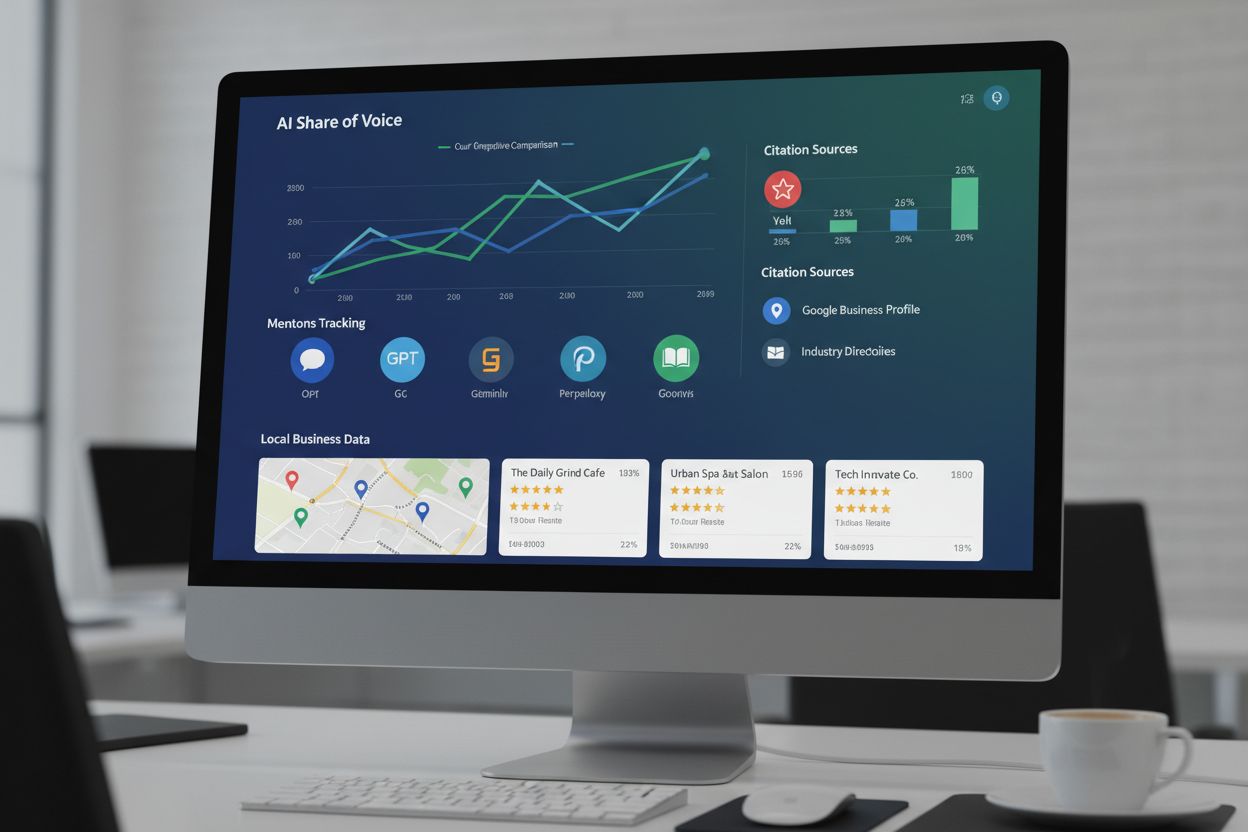
AI tools can monitor how your brand appears in customer conversations, reviews, and AI-generated content. Tools like AmICited track how AI systems reference your business across platforms like GPTs and Perplexity.
What's the biggest mistake small businesses make with AI?
Trying to implement too many tools at once without clear strategy. Focus on one specific problem, measure results, then expand. Quality implementation beats quantity of tools every time.
Monitor Your AI Visibility Today
Track how AI systems reference your brand across GPTs, Perplexity, and Google AI Overviews. Get insights into your AI visibility and competitive positioning.
Small business owners: Is AI search optimization even worth it for us? Feel like it's only for big brands
Community discussion on AI search optimization for small businesses. Owners share budget-friendly strategies for appearing in ChatGPT, Perplexity, and Google AI...
Local SEO Meets AI: How Small Businesses Can Appear in AI Recommendations
Learn how small businesses can optimize for AI visibility in ChatGPT, Gemini, and Google AI Overviews. Discover strategies for local AI recommendations and LLM ...
Real before and after case study showing how strategic website optimizations increased AI citations by 47+ monthly mentions. Learn the exact changes that improv...
7 min read
Cookie Consent We use cookies to enhance your browsing experience and analyze our traffic. See our privacy policy.